
- Collection type
- Object
- Description
- Rectangular stringwork bag [.1], edged with Pteropus hair, with two netted tubes as handles, also edged with Pteropus hair. [El.B 12/2/2007]
- Long description
- Rectangular stringwork bag [.1], edged with Pteropus hair, with two netted tubes as handles, also edged with Pteropus hair. With seven sling-stones [ see 1884.29.2-.8]. [El.B 12/2/2007]
- Geographical reference
- Unknown
- Person
- Maker Unknown Maker
- Field collector Unknown Collector
- PRM source Augustus Henry Lane Fox Pitt Rivers founding collection
- Date / Period
- Date made: Possibly before 1874
- Date collected
- ?By 1874
- Acquisition information
- Donated: 1884
- Materials and processes
- Material String, Material Net Textile, Material Pteropus Hair Animal, Process Netted, Process Grooved
- Dimensions
- Length: max 530 mm
- Object numbers
- Accession number: 1884.29.5.1 PR Cat other PR nos: 1027
- Research and responses
There seems to be some confusion as to how these bags were worn and used. In various Accession Book/Card catalogue entries/labels they have been described as bag with head fillet attached, bag with waistband and cap with pendant net bags. George Forster in 'A Voyage Round The World' (vol.2) writes: 'The stones which they [the New Caledonians] used were oblong and pointed at each end, being made of a soft and unctuous soaprock (simectites) , which could easily be rubbed into that shape. These exactly fitted the loop in the middle of the sling, and were kept in a wallet or pocket of coarse cloth, strongly woven of a kind of grass, which was tied on about the middle.' Dr Fritz Sarasin in 'Ethnologie der Neu-Kaledonier und Loyalty-Insulaner' (Munich 1929) also describes these bags and states that they were filled with the sling-stones, extra stones were put into the netted tubes and the tubes were then tied round the waist. [El.B 13/2/2007]
A sample of the hair from the cord at the top of the pouch was given to Caroline Cartwright of the Department of Conservation and Scientific Research at the British Museum for identification.[JU 13/12/2012] It was identified as flying fox fur (Pteropus sp.) - both guard hairs and underfur. [JU 13/12/2013]
Search terms: Weapon, Transport and Travel, Bag, Cordage, Clothing Headgear, Carrying Device, Headgear
Further items to explore
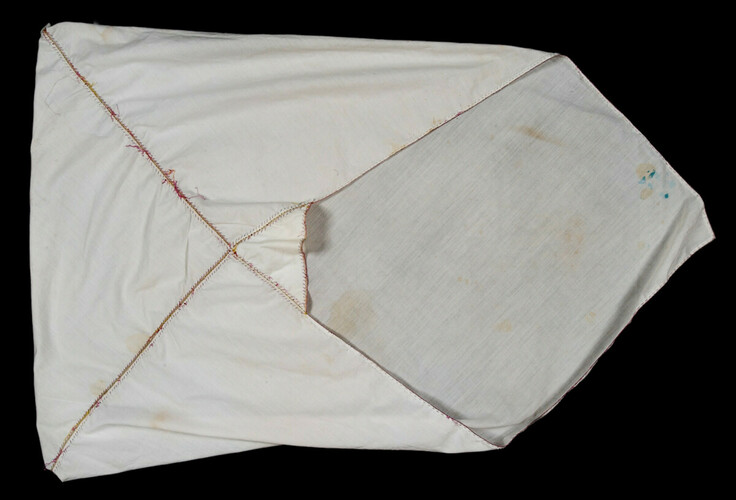 2003.9.286.2Dishdasha cover/holder2003.9.286.2
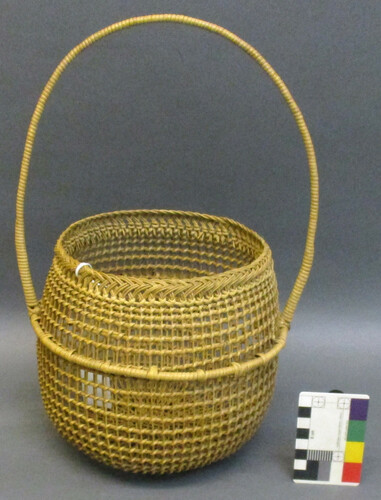 2011.109.2.1Multi purpose woven basket. The lid for this basket is 2011.109.2 .2. [MOBB [OPS move] 16/11/2016]2011.109.2.1
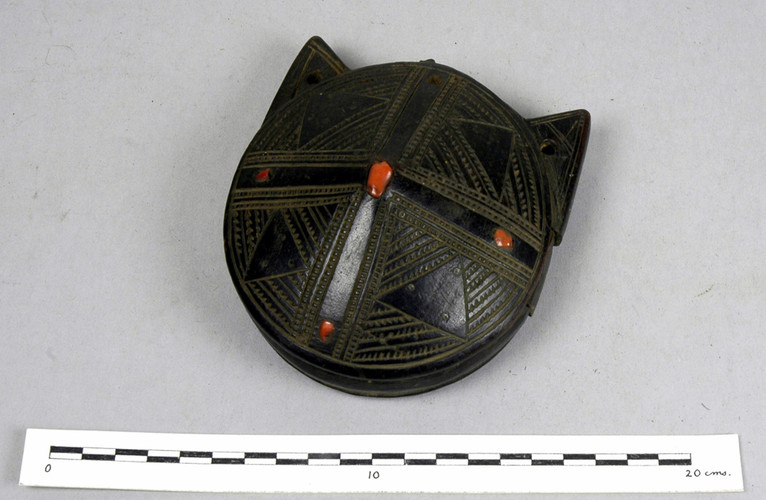 1900.15.34Flask for gunpowder. Of dark wood. Neck missing. [MdeA 20/11/2008]1900.15.34
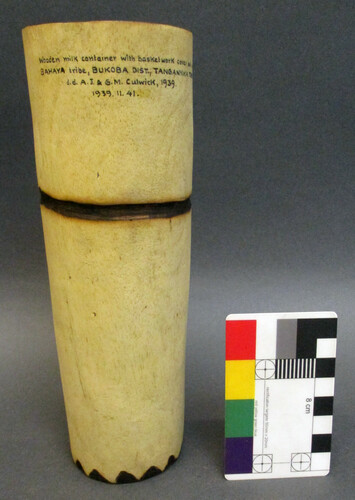 1939.11.41.1Tall wooden milk bottle with burnt decorative triangles around base and a horizontal line near the centre. For basketwork cover see [1939.11.41 .2] and net sling see[1939.11.41 .3] [RM [OPS move] 20/9/2016]1939.11.41.1
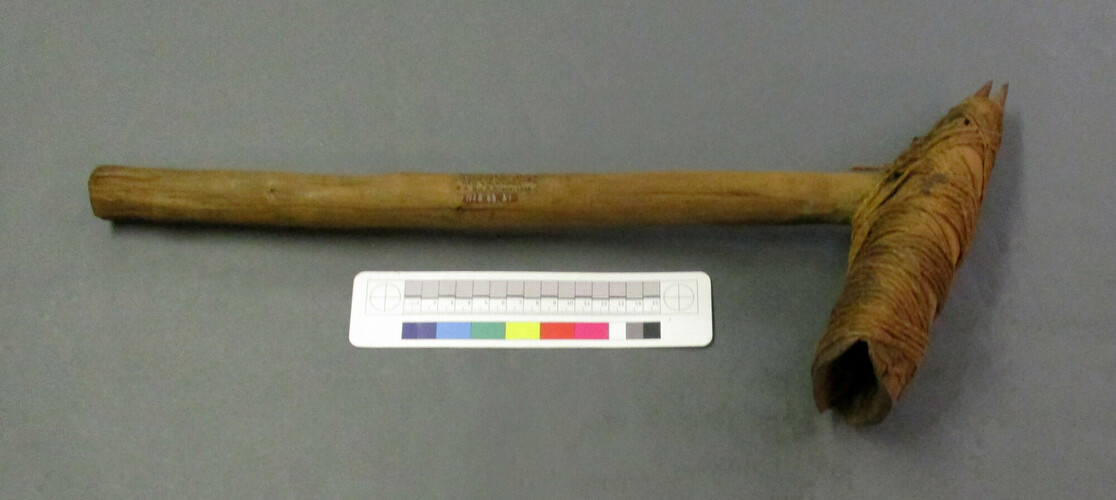 1928.68.8Carved wooden haft of axe with blade missing. The head is bound with plaited plant fibre. [FB 03/04/2014]1928.68.8
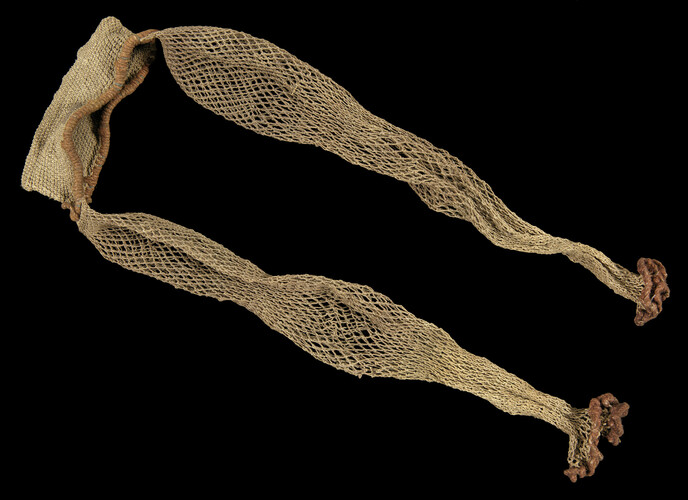 1928.68.9.1String-work pouch edged with Pteropus hair, with two netted tubes also edged with Pteropus hair. [El.B 12/2/2007]1928.68.9.1
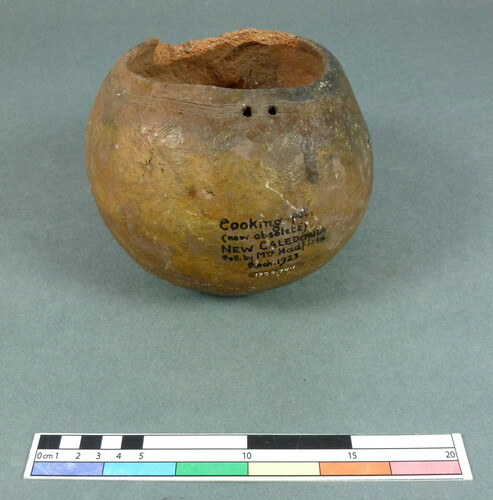 1923.74.1Cooking vessel: globular pot with incised decoration around rom and two perforations.1923.74.1
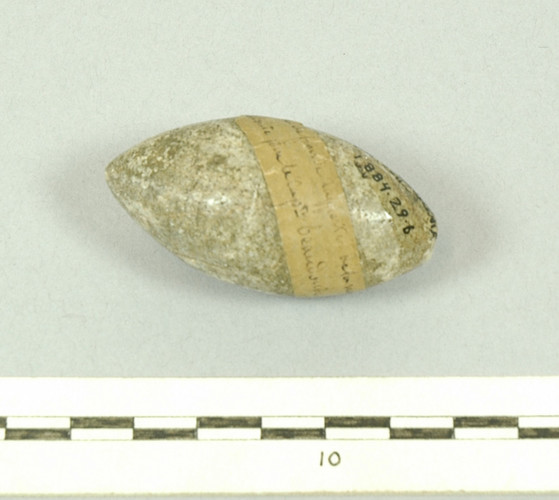 1884.29.6Ground stone ball in the shape of a prolate spheroid, recorded as a sling-stone. [Dan Hicks 13/06/2012]1884.29.6