
- Collection type
- Object
- Description
- Axe with expanded blade and convex edge, asymmetrically set with wooden haft made of ash. [SM 04/04/2007]
- Long description
- Axe with expanded blade and convex edge, asymmetrically set with wooden haft made of ash. The haft is decorated with incised patterns on both sides. The haft butt is made of bone and also has incised decoration. [SM 04/04/2007]
- Person
- Maker Unknown Maker
- Field collector Unknown Collector
- PRM source Augustus Henry Lane Fox Pitt Rivers founding collection
- Date / Period
- Date made: Possibly before 1874
- Date collected
- ?By 1874
- Acquisition information
- Donated: 1884
- Materials and processes
- Material Iron Metal, Material Ash Wood Plant, Material Animal Bone, Process Carved, Process Incised, Process Decorated, Process Forged (Metal), Process Socketed
- Dimensions
- Length: max 1086 mm, Width: max 180 mm
- Object numbers
- Accession number: 1884.26.10 PR Cat other PR nos: 962 PR Cat other PR nos: 800A
- Research and responses
* Gustav Klemm (1802-1867) author and collector [see Chapman, 1981]. Wrote 'Die Werkzuge und Waffen, ihre Entstehung und Ausbildung', Sondershausen G Neuse 1858. [AP Leverhulme project on founding collection 1995-1998]
The following notes are drawn from research compiled by Andy Mills as part of the DCF Cutting Edge Project in 2006-2007. This is a distinctively Scandinavian axe, as is made clear by the curved shaft. This feature is described as emerging from the wearing of the axe over the shoulder at the back, although that hardly seems reason enough, unless there was an ergonomic benefit also. I would argue that this back-curved head served the purpose of increasing the size of the point of percussion, much as we also see in the curved swords of South Asia. Curved axes such as this are known from excavations in Denmark, dating to as early as the 10th Century AD. Thus, it can be called a ‘Viking’ style of axe, although it is undoubtedly several centuries later.
The axe is of great symbolic worth in Scandinavia, and appears on the royal crest of Norway as a symbol of Saint Olav, the country’s patron saint. .
This particular axe is embellished with incised surface decoration on the haft, and a bone shoe at the butt, similarly incised, albeit it with quite different decoration. The decoration of cartouches, scrolls and bands is reminiscent of a surface decoration style current in Norway, Denmark and Germany during the late 17th century, and applied to both wood and metalwork, such as silver (see Miller’s Antiques Encyclopaedia, by J. Miller. 1998. p. 247). The haft is ash, as can be seen from its distinctive warm honey colour. The rich embellishment may preclude this being a ‘peasant’s axe’, as asserted on Objects PRM.
This piece has been attributed a date of the early 17th century, on the basis of a loose attribution to the battlefield of Kringelen in Norway. In this battle of 1612, 900 Scottish mercenaries were slaughtered, defeated, taken prisoner and then executed by local Norwegian villagers, in a narrow mountain pass. From accounts, it seems that the Norwegians themselves rained musket shot on the Scots from hiding, and rolled enormous boulders down on them. Consequently, it seems unlikely that this axe truly came from the field of Kringelen, as it is unlikely that many Norwegian weapons were left on the field. As with a number of other attributions, one can’t help suspecting that the vendor may have embellished the weapon’s biography with a link to the bloodiest battle possibly known to Britons, in which a Norwegian axe may have served (see Wikipedia – Battle of Kringen, http://en.wikipedia.org/wiki/Battle_of_Kringen). [SM 17/03/2008]
- Associated publications
- This object features in the Museum's audio guide produced during the DCF-funded 'Cutting Edge’ project, 2007-2009. [HH 20/06/2010]
Search terms: Weapon, Ritual and Ceremonial, Tool, Axe, Ceremonial Object
Further items to explore
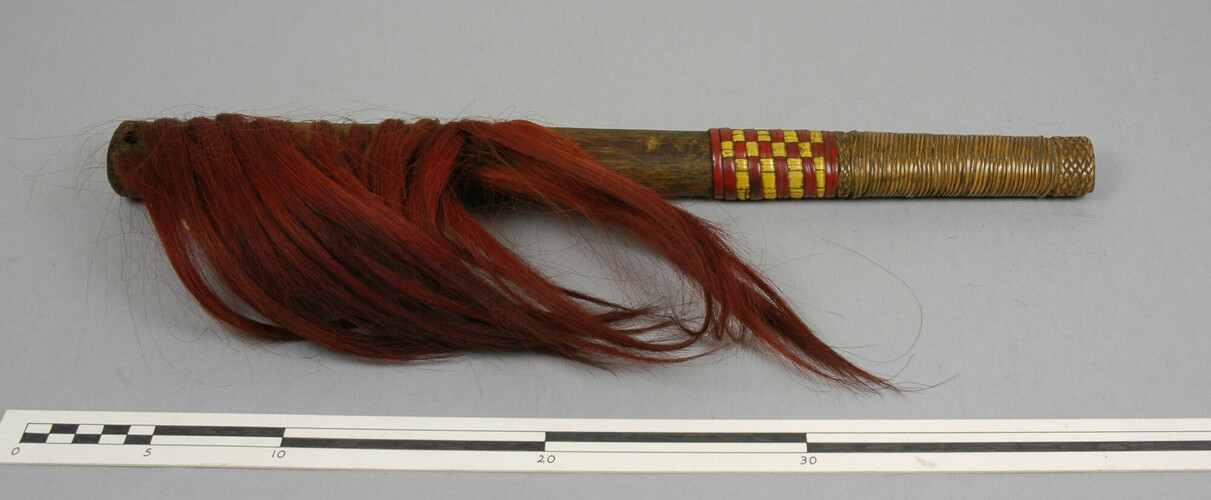 1909.21.22Axe or Dao handle made from bamboo with bound and plaited cane and red goat hair fringe. [SM 05/07/2007]1909.21.22
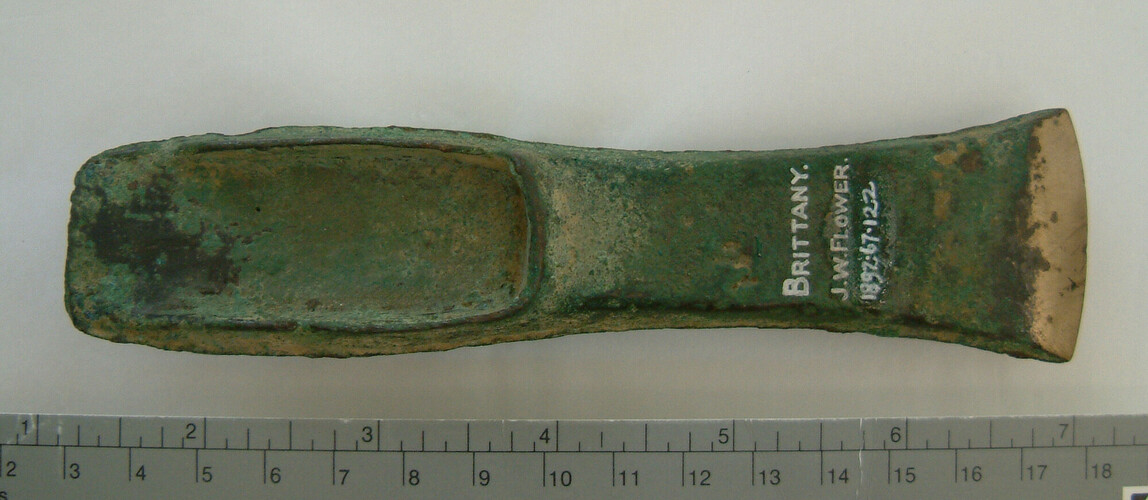 1892.67.122Axe, with narrow blade.1892.67.122
 1947.2.182Stone tool: axe1947.2.182
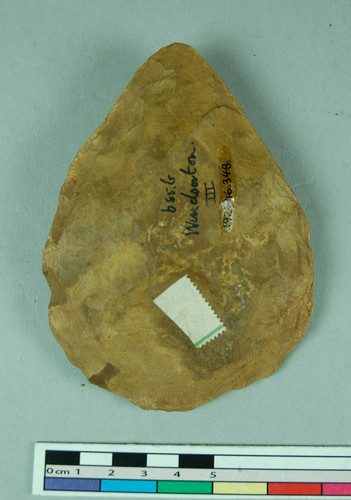 1925.46.348Stone hand-axe, orange in colour and teardrop shaped. [MJD 08/03/2010]1925.46.348
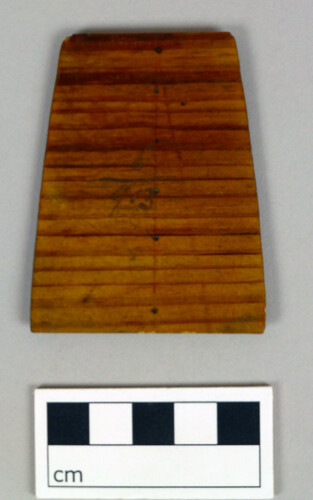 1884.54.31.4Varnished hatch to cover part of the floor of a row boat providing storage underneath, part of boat model 1884.54.31 [ZM 9/3/2016]1884.54.31.4
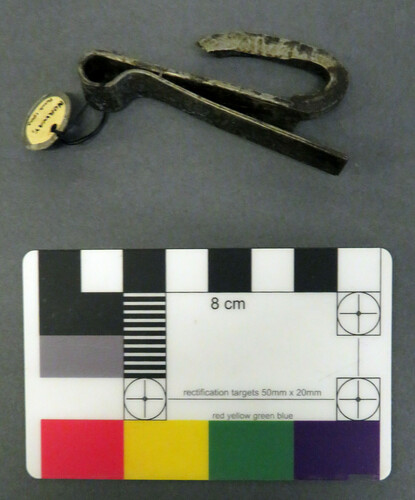 1938.35.624Fire steel. Flat length of metal bent into an acute angle with circular bend. At one end of the lengths there is a narrowed, curved hook. [BS [OPS move] 4/9/2017]1938.35.624
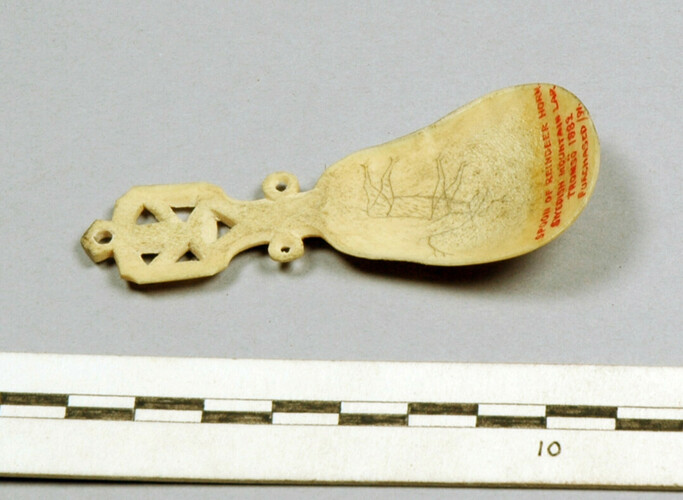 1891.56.3Spoon of reindeer antler with protruding ring on the handle and triangular perforations. Bowl incised with figure of a reindeer. [El.B 'DCF 2004-2006 What's Upstairs?' 8/3/2006]1891.56.3
 1884.1.3.24Wooden pole for tent support tapered at both ends. (see 1884.1.3)1884.1.3.24