
- Collection type
- Object
- Description
- Katar with long triangular blade and gilt handle decorated with a flower design. [SM 27/04/2007]
- Long description
- Katar with long triangular blade and gilt handle decorated with a flower design. The blade has deep grooves running down its length. The katar has long side guards and there are two cross bars which are expanded in the centre. [SM 27/04/2007]
- Geographical reference
- Person
- Maker Unknown Maker
- Field collector Unknown Collector
- PRM source Augustus Henry Lane Fox Pitt Rivers founding collection
- Date / Period
- Date made: Possibly before 1874
- Date collected
- ?By 1874
- Acquisition information
- Donated: 1884
- Materials and processes
- Material Steel Metal, Material Gilt Metal, Process Forged (Metal), Process Gilded, Process Decorated
- Dimensions
- Length: max 443 mm, Width: max 84 mm
- Object numbers
- Accession number: 1884.24.147 PR Cat other PR nos: 1214
- Research and responses
The following notes are drawn from research compiled by Andy Mills as part of the DCF Cutting Edge Project 2006-2007. The katar is a very particular weapon, quite unique to India. They are transverse-handled stabbing knives, with aesthetically refined arch-profiled blades, which are often etched with deep fullers, decoratively incised with relief designs, and occasionally pierced. There is often the rich use of mixed metals – the arm-guards being composed of cast relief-work gilded brass, as in our examples. Katars bearing high-relief sculptural decoration are characteristically associated with the northern Maratha (Mahratta) states of the 17th and 18th centuries, spanning the entire width of the subcontinent (see Indian & Oriental Armour. by Lord Egerton of Tatton, published in 1896 by Arms and Armour Press. p.65). The Mina tribe of Rajputana were among the Maratha army’s most accomplished users of the katar (Egerton 1896. p.114). The secular nature of the decoration to be seen on these knives is another Maratha characteristic, although Egerton figures a number of Punjabi katar which bear much the same decoration (Egerton 1896. p.131). Their diversity, extremely wide distribution and lack of academic attention makes any truly meaningful attribution almost impossible. The transverse grip is particularly interesting, as it reflects a more ergonomically-informed approach to a stabbing weapon than most other knives.
This katar is much larger than either 1902.87.15 or 1884.24.152, although it is stylistically much closer in form to 1902.87.15. It has the same straight-sided forearm-guards, although this weapon is decorated with a niello technique. Niello is a widely-practiced technique very similar to koftgari, whereby a gold (or, as here, gilt-brass) ground is incised with a design and infilled with niello (a black alloy of sulphur, copper, silver and often lead) (Wikipedia). Insofar as the Indians derived niello technology from the Persians (Egerton, 1896. p.70), it is likely that this piece is Mogul in origin, or at least from Northwestern India. The blade is very nice, wrought with a relief panel containing a conventionalised floral motif. However, it is highly abstracted and refined. [SM 16/06/2008]
Further items to explore
 1928.37.1.21 of 16 metal currency rods tied together in a bundle. [LKG 05/01/2010]1928.37.1.2
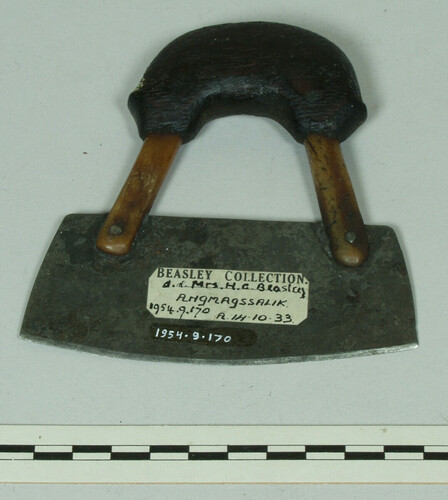 1954.9.170Knife with wooden handle, two ivory arms and iron blade with convex edge.1954.9.170
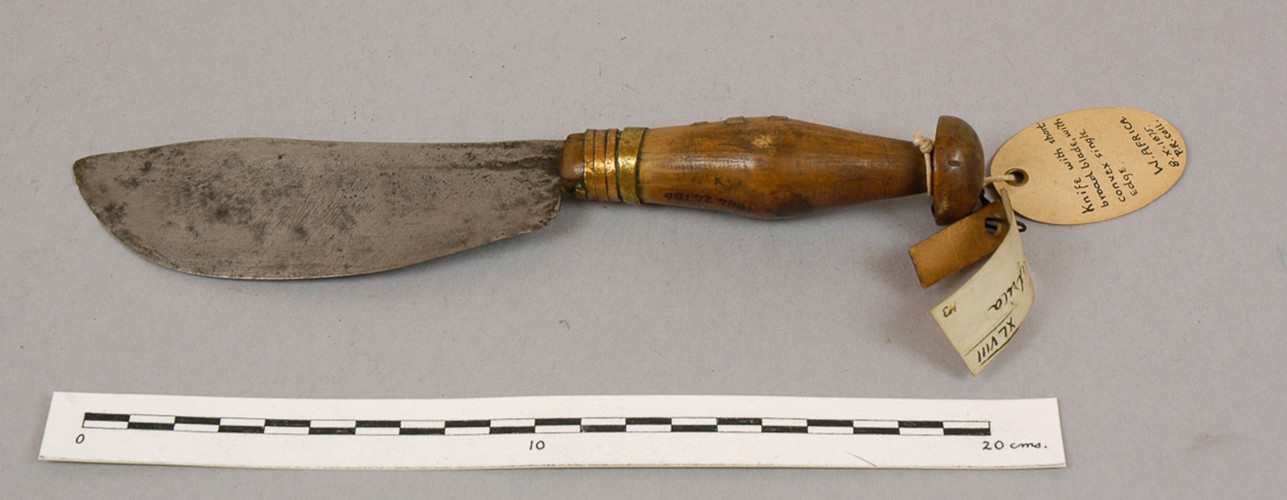 1884.24.186Knife with single-edged iron chopper blade in wooden handle with mushroom pommel. Handle is bound with brass and copper strips and ornamented with brass squares. [LM 03/07/2007]1884.24.186
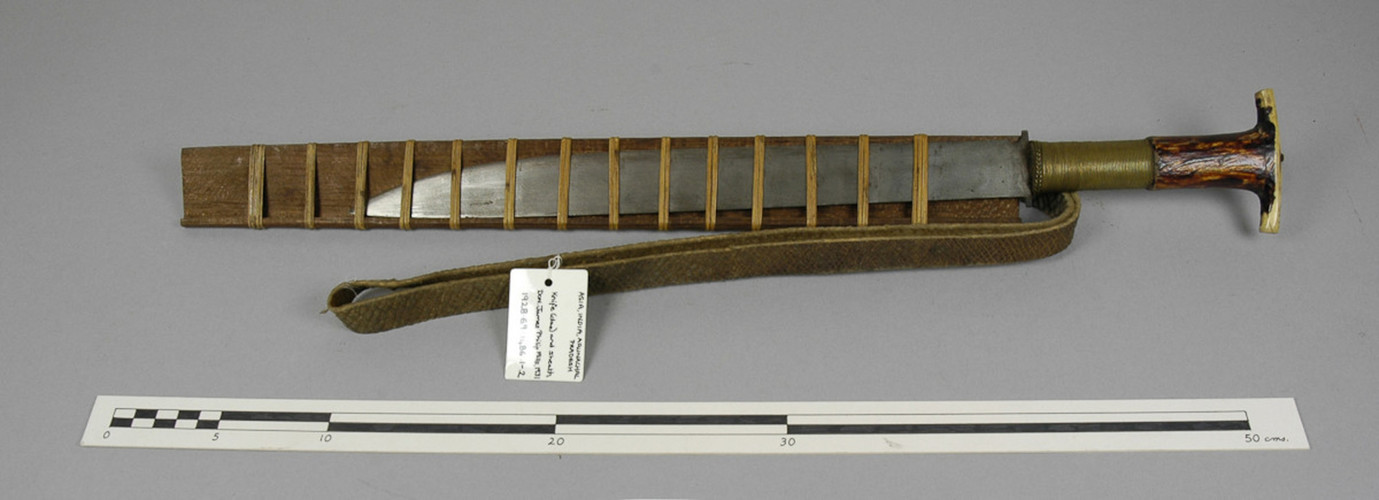 1928.69.1486.1Dao [.1] with single edge blade and grip bound with brass wire. With wooden sheath [.2] bound with cane and with a leather strap.[SM 18/05/2007]1928.69.1486.1
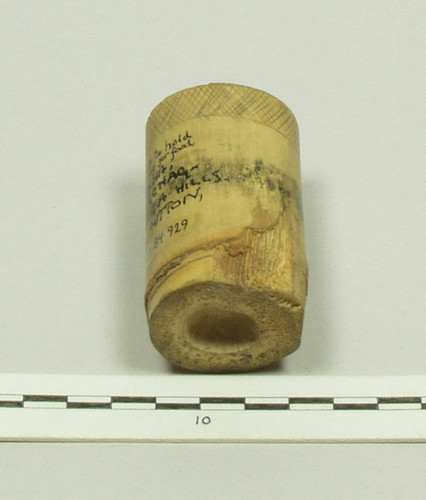 1923.84.929Length of bamboo stem, decorated with incisions, with an opening at one side, used as a cap for a leaf food container. [N.B. 'DCF 2004-2006 What's Upstairs?' 8/4/2005]1923.84.929
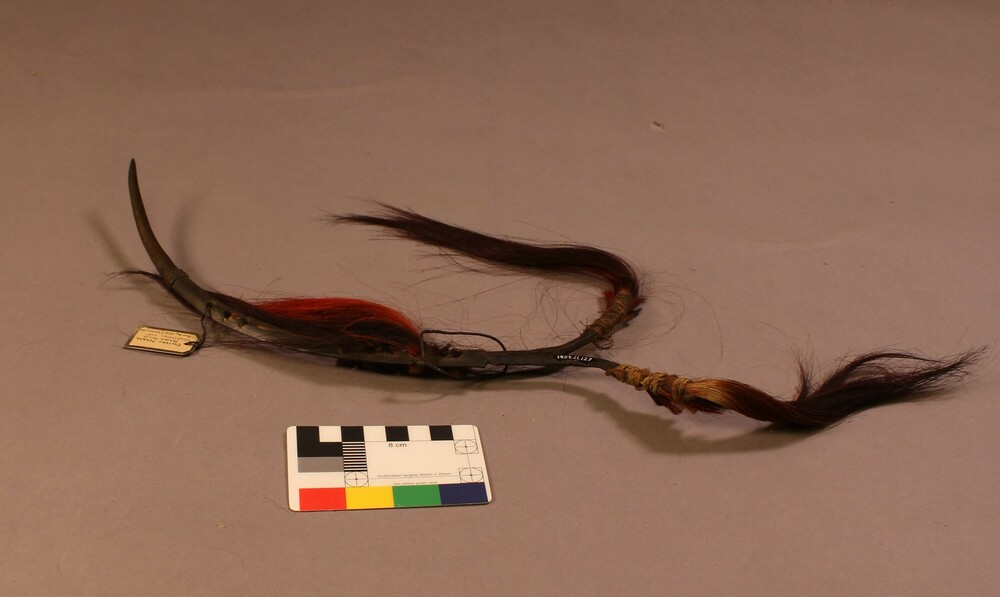 1909.21.127Horn which is worn on side of a helmet1909.21.127
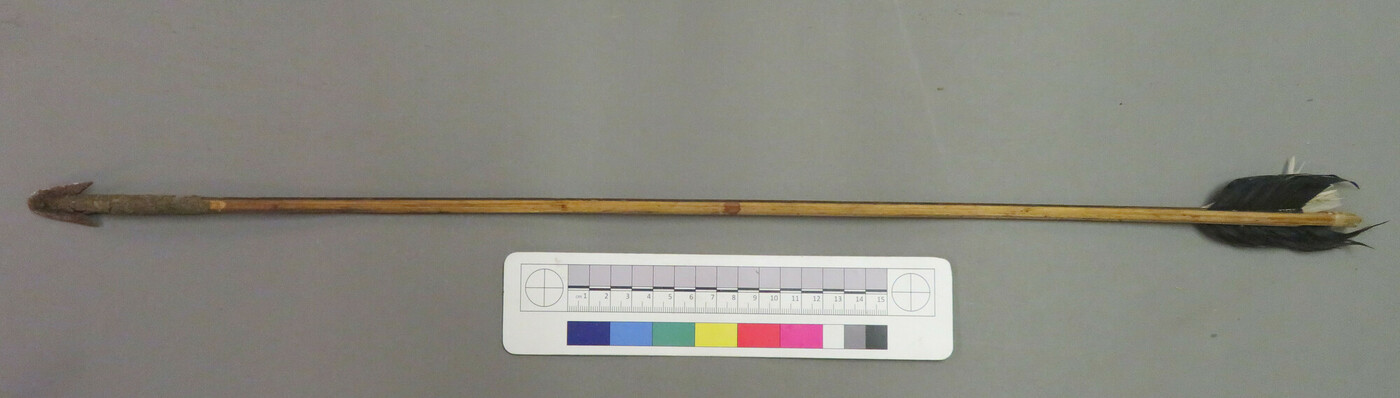 1928.69.1481.6Arrow. See [1928.69.1481 .1 - .3] for associated quiver, and [1928.69.1481 .4 - .12] for arrows. [EH [OPS move] 13/9/2017]1928.69.1481.6
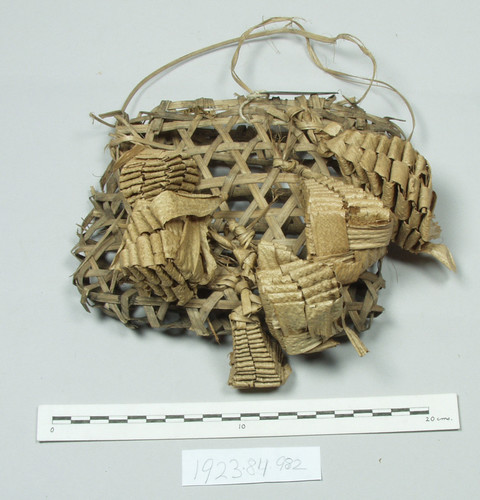 1923.84.982Small basket of cane strips with pyramid-shaped tassels of leaf strips. [El.B 'DCF 2004-2006 What's Upstairs?' 1/2/2005]1923.84.982