
- Collection type
- Object
- Description
- Early Iron Age falcata with curved, grooved blade.
- Long description
- Early Iron Age sword with curved, grooved blade. The tang is perforated for attachment to a horse-head hilt. A triangular fitting is riveted to the top of the blade. [LM 18/04/2007]
- Geographical reference
- Person
- Maker Unknown Maker
- Field collector Unknown Collector
- PRM source Augustus Henry Lane Fox Pitt Rivers founding collection
- Date / Period
- Archaeological period: Early Iron Age
- Date collected
- By 1874
- Acquisition information
- Donated: 1884
- Materials and processes
- Material Iron Metal, Process Grooved, Process Perforated, Process Riveted
- Dimensions
- Length: max 563 mm
- Object numbers
- Accession number: 1884.24.124
- Research and responses
See El armamento ibérico: Estudio tipológico, geográfico, funcional, social y simbólico de las armas en la Cultura Ibérica (siglos VI-I a.C.) (Monographies Instrumentum, 3), by Fernando Quesada Sanz, Montagnac: Monique Mergoil (1997). [MdeA 19/2/1999; JC 21 7 2011]
An entry in the manuscript catalogue of Pitt-Rivers's second collection held by Cambridge University Library suggests that the four items from this site in the founding collection [1884.24.124, 1884.120.35, 1884.121.22, 1884.121.23] were obtained from Rollin and Feuardent. The entry for two iron spear-heads Pitt-Rivers acquired from Rollin & Feaurdent on 19 March 1891 is annotated 'Bought of Rollin & Feuardent (Mr Whelan) Bloomsbury Street W ... [1 of] Two iron spear-heads from Spain. They were found with the well known hoard of iron swords of early form and of which you possess an example acquired from us many years since' (see CUL MS Add.9455, Vol. 2, p. 672). [AP 18/1/2010; JC 21 7 2011]
The kopis is a weapon typically associated with Iron Age Greece, whereas the falcata is associated with the Iberian Peninsula (what is now Spain and Portugal). Although there were Greek colonies in Spain and the two weapons are likely strongly related, it is more accurate to refer to this example as a falcata. Greek hoplites (heavily armed foot soldiers) sometimes carried these instead of the xiphos, a double-edged, straight shortsword. This falcata is extremely well made and would have been a high status item. Comments provided by ancient weapons expert Matt Easton during a research visit in March 2025.
- Associated publications
- For an illustrated, descriptive account, supported by metallurgical analyses, of 1884.24.124 [i.e. this object] and 1884.121.22, see 'Etruscan and Spanish Swords of Iron', Sibrium, Vol. 3 (1956-7), pp. 167-74. [JC 21 7 2011] For an illustrated account of the collection history of the four items from this site in the founding collection [1884.24.124, 1884.120.35, 1884.121.22, 1884.121.23], see 'Armes Ibériques entre Almedinilla et Oxford, en passant par Paris: les dessins de Jean-Charles Geslin en 1870', by Fernando Quesada and Pierre Rouillard, Gladius, Vol. 22 (2000), pp. 119-129. All four pieces are illustrated in black and white in Figure 6 on page 128. (Copy in RDF for 1884.24.124.) [MdeA 20/2/2001; JC 21 7 2011]
Search terms: Weapon, Death, Religion, Sword, Grave Good
Further items to explore
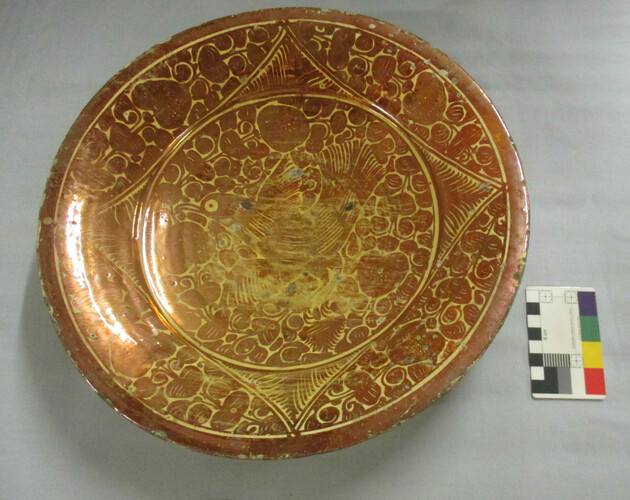 1947.1.61Buff or cream ware dish, glazed, and the interior painted with lustrous bronze paint.1947.1.61
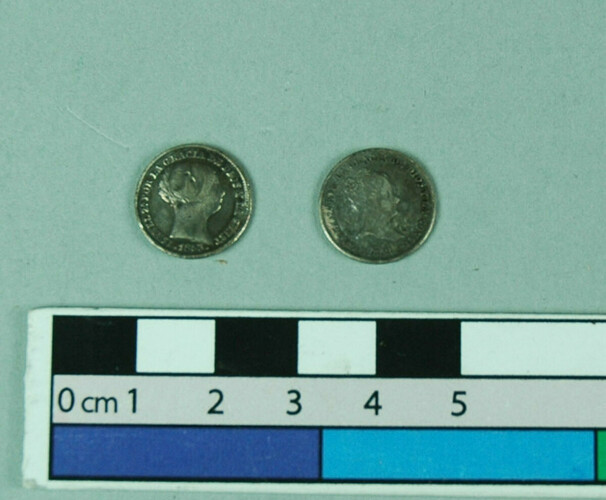 1935.29.20Silver coin (one real). [LKG 20/01/2010]1935.29.20
 2017.291.1.3Section of wood. [MOBB [OPS move] 20/11/2017]2017.291.1.3
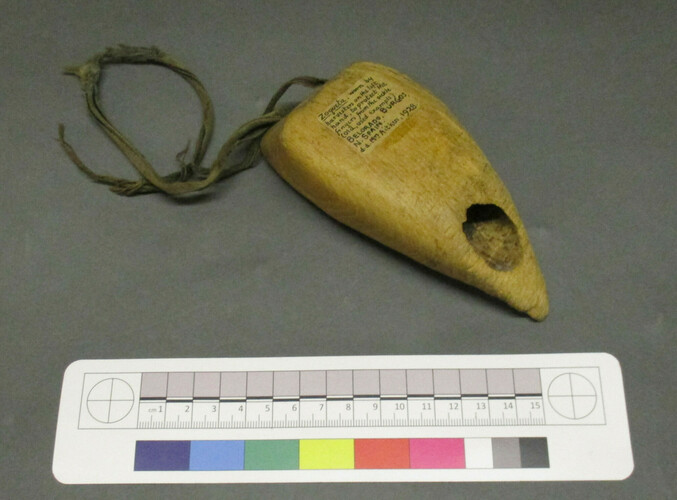 1928.32.1Wooden hand-protector. Carved from wood. Triangular and hollowed, the tip curves downwards. Above the tip there is a oval shaped hole. The underside has rectangular opening. There are two perforations on the back with a green/brown textile loop passing through. [AB [OPS Move] 8/12/2016]1928.32.1