
- Collection type
- Object
- Description
- Dress rapier with two edged, grooved blade.
- Long description
- Dress rapier with two edged, grooved blade, stamped in the groove on one side 'IOHANS' and on the other 'TESCHE'. Perforated, decorated, bilobed shield guard; decorated knucklebow, quillon bar and pas d'ane; elongated pommel with indented dots; grip bound with twisted wire.
- Geographical reference
- Cultural groups
- European
- Person
- Maker Johans (Juan) Tesche
- Field collector Unknown Collector
- PRM source Augustus Henry Lane Fox Pitt Rivers founding collection
- Date / Period
- Date made: 1700-1800
- Date collected
- By 1862
- Acquisition information
- Donated: 1884
- Materials and processes
- Material Metal, Material Steel Metal, Material Wood Plant, Material Metal Wire, Process Inscribed, Process Stamped, Process Bound, Process Perforated, Process Carved
- Dimensions
- Length: max 915 mm
- Object numbers
- Accession number: 1884.24.100 PR Cat other PR nos: 1044
- Research and responses
C ffoulkes. 1912. 'European Arms and Armour in the University of Oxford' Clarendon Press, Oxford. p37 '39. Dress sword of the XVIII cent. The pommel is of steel pear-shaped with small indented marks. The grip is of wood, wire bound. The knuckle-guard and pas d'ânes are of chiselled steel. The shell guard is of flat steel perforated. The workmanship is rough. The blade is 30 in x 3/4 in of diamond section grooved for six inches. On the blade is engraved 'Johans Tesche'. Juan Tesche was a Solingen swordsmith who worked in the latter half of the seventeenth century. The family were at work in the same town as early as 1518 and in 1618 Peter Tesche was mayor of Solingen Pitt Rivers coll 1044' [illustration] . [AP Leverhulme project on founding collection 1995-1998]
The rapier is the quintessential Early Modern civilian sidearm of Europe. It was a functional development of the broadsword, which was forged thinner and longer over time. This formal change emerged from the Renaissance development of lunging thrusts in European fencing. The development of the thrust in European fencing was itself a bi-product of the widespread abandonment of armour around the time of the Renaissance, due to the increased use of firearms (Castle, 1885). In this way, we ought to recognise the completely integrated nature of all military technologies, and the manner in which changes in one aspect of technology generate repercussions in the wider material culture complex. The advantage acquired by the adoption of the lunging thrust, particularly in the range from which an attack might be rapidly mounted, is enormous – transforming one’s effective reach from a little over 1m to 3m or more. Its development in Italy – by far the most advanced European culture throughout the medieval and early modern periods, in terms of fighting techniques, metallurgy and military technology – rapidly spread throughout the continent. The rapier is a dual-use weapon, adapted to both ‘Cut and Thrust’, with a two-edged blade for cutting and a lean pointed profile for thrusting with the maximum application of force (Burton, 1884; Castle, 1885). 17th century rapiers were longer and heavier than many others from the 18th and 19th centuries. The rapier also marked a secondary revolution in European swordplay, whereby parrying was developed. This functional revolution had two formal manifestations in weapons: Firstly, it caused the experimental development of increasingly more complex and elaborate guards for the sword-hand, now brought into ever-closer proximity to the opponent’s weapon; the result of this was the basket-hilted swords of later centuries. Secondly, it brought about the almost universal abandonment of the shield in Europe, which in turn allowed for a less encumbered and more agile style of fighting to develop. In addition to these two formal results, the development of parrying with rapier encouraged the development of fencing as an art. Rapiers often have a pronounced fuller (central groove in blade), which serves to give the blade rigidity along its length, through the introduction of two structural arches within the sectional shape of the blade. This engineering solution permitted greater lengthening and thinning of the blade. Research Conducted for DCF Cutting Edge 2006/2007 [AM].
Search terms: Weapon, Writing, Sword, Inscription
Further items to explore
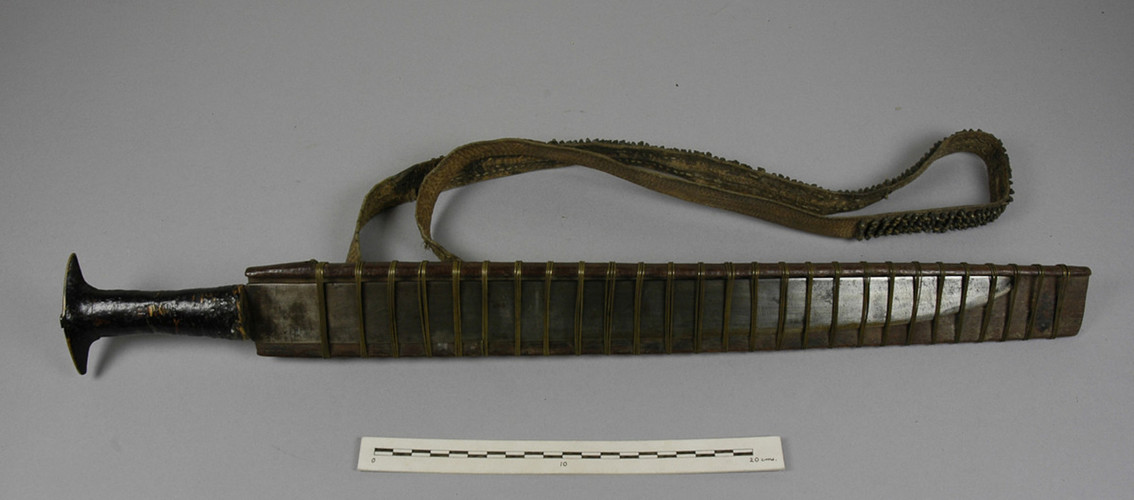 1930.17.4.1Short sword dao [.1] with single edged blade and open wooden sheath [.2], with a leather carrying strap/belt. [SM 16/05/2007]1930.17.4.1
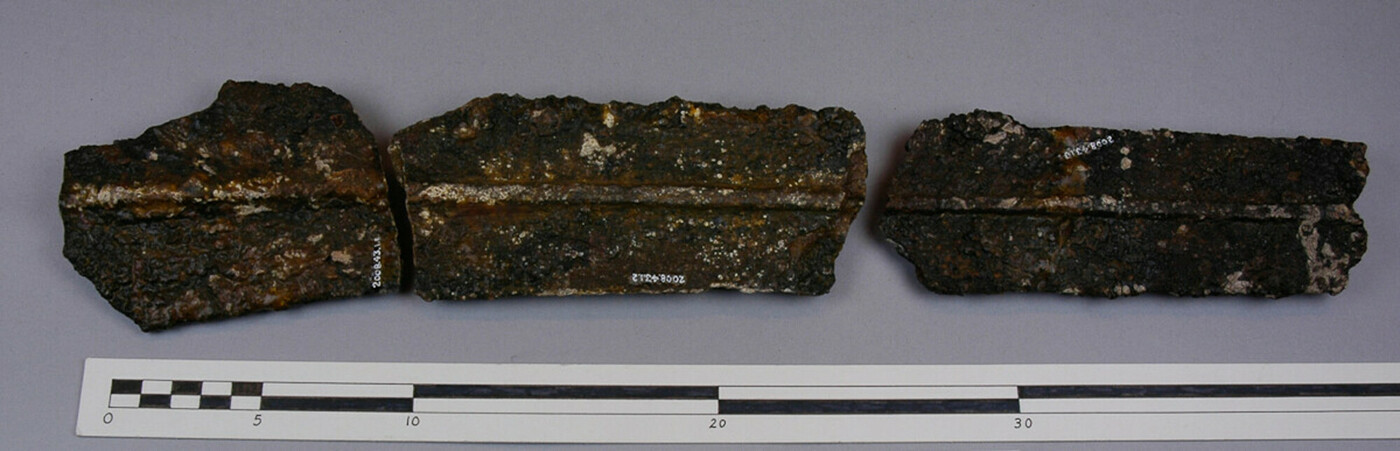 2008.43.1.1Fragments of an iron sword, in three pieces [.1 - .3], with a central rib. Very badly corroded. [SM 21/02/2008]2008.43.1.1
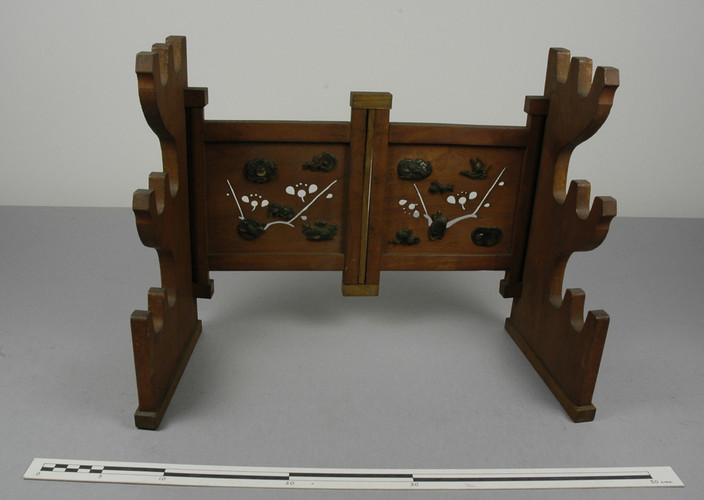 1911.1.60Collapsible sword-rack, of four hinged wooden plates, two forming the back when unfolded and two side pieces with six cradles. The back pieces are perforated with a floral pattern and decorated with small metal plaques. [El.B 07/09/2007]1911.1.60
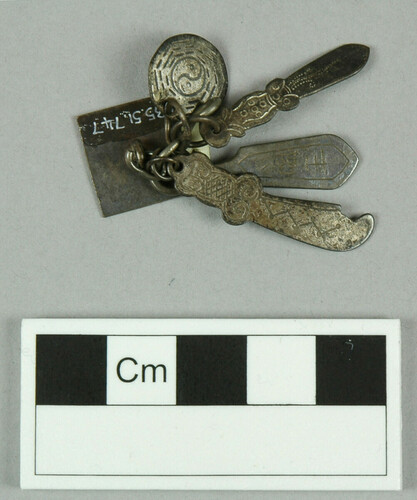 1985.51.747Amulet consisting of a miniature sword, ?knife, fan and ying-yang symbol. All attached to a metal square with a ?Chinese character in the centre. [SM 04/05/2011]1985.51.747
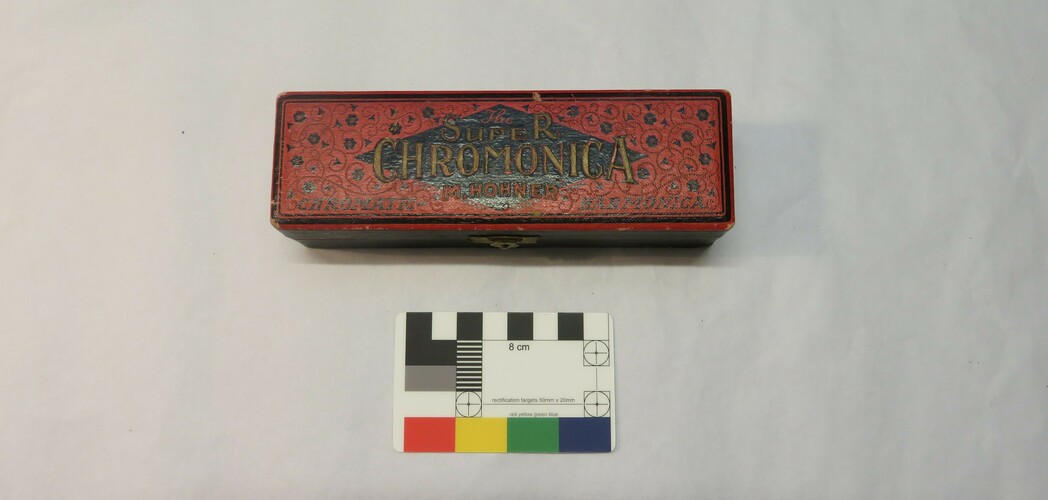 1985.19.1.1Harmonica box.1985.19.1.1
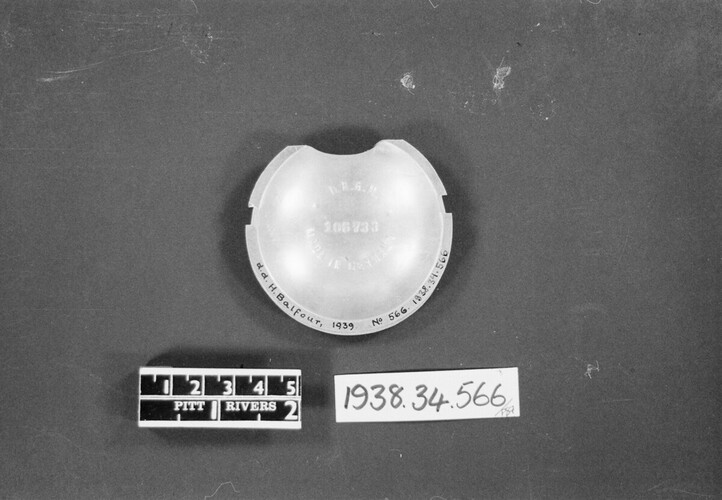 1938.34.566Mirliton voice disguiser.1938.34.566
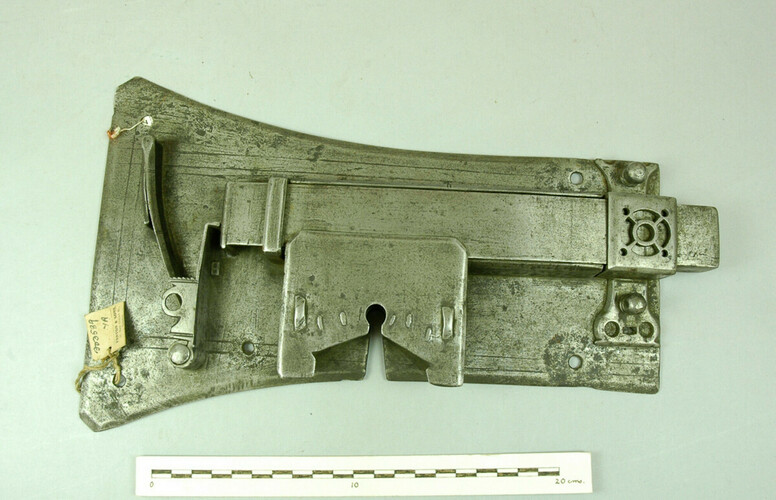 1951.13.792Iron cabinet lock with single bolt.1951.13.792
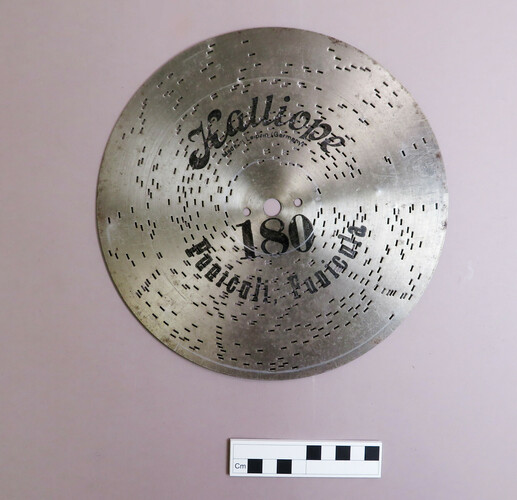 1982.5.1.9Metal music disc to be played on musical box 1982.5.1.11982.5.1.9