
- Collection type
- Object
- Description
- Two-edged sword or knife, expanding blade with convex, wide-angled top. Wooden handle bound with reptile skin. [El.B 06/11/2007]
- Cultural groups
- Fang
- Person
- Maker Unknown Maker
- Field collector Unknown Collector
- PRM source Augustus Henry Lane Fox Pitt Rivers founding collection
- Date / Period
- Date made: Possibly before 1867
- Date collected
- ?By 1867 [judging by mention in 'Primitive Warfare]
- Acquisition information
- Donated: 1884
- Materials and processes
- Material Metal, Material Wood Plant, Material Reptile Skin, Process Forged (Metal), Process Carved, Process Bound
- Dimensions
- Length: max 520 mm
- Object numbers
- Accession number: 1884.24.22 PR Cat other PR nos: 1098
- Research and responses
The provenance suggests this might be a RBN Walker object. In 'Primitive Warfare' [lecture given to Royal United Services Institution] there is mention of a Fan war axe, used as Plate 1 fig 5 'Sword of native manufacture, minus the wooden handle, and War Axe both constructed by the Fans of the Gaboon country, West Africa. From Col. Lane Fox's collection. A nearly similar axe is the collection of the Royal United Services Institution. The patterns of ornamentation are taken, partly from the Fan War Axe and partly from some knives of iron brought from Central Africa by Mr. Petherick and now in Col. Lane Fox's collection'. [p31] [AP Leverhulme project on founding collection 1995-1998]'... while the Institute has a most valuable collection of skulls and skeletons, it has on the other hand never succeeded in collecting an ethnographical museum of any educational value. A few articles, not unfamiliar to the visitors of any large ethnographical museum, such as weapons, dresses, models &c., have been presented to the Society at various times, but while they have occupied much wall space in the rooms of the Institute, and thus cramped the library, they are neither sufficient in number nor capable of arrangement in any order complete enough to serve the purpose intended. Upon a careful review of the whole of the circumstances, therefore, the Council have resolved that it would be the wisest course for the Institute to devote all spare funds to the enlargement of the Library, and to maintain the collection of skulls and skeletons, but to give up the attempt, which they are convinced would be a hopeless one, to establish any sufficiently large and comprehensive ethnographical museum. Their view was confirmed by the independent professional opinion of a valuer nominated by an eminent firm, who estimated the value of all the ethnographical specimens referred to at only £45. ... The Council resolved, therefore, subject to the approval of this meeting, to accept two offers, amounting together to £54, or £9 more than the valuer's estimate, viz: one of £14 from Mr Franks, curator of the Christy Collection, for the Burmese gong, and one of £40 from Major-General Pitt Rivers for the other objects, with the view of their being ultimately deposited at South Kensington. ...' [Report of the Council of the Anthropological Institute ...' [JAI, vol 10 (1881) 438-9] [AP 6/12/2005]
Further items to explore
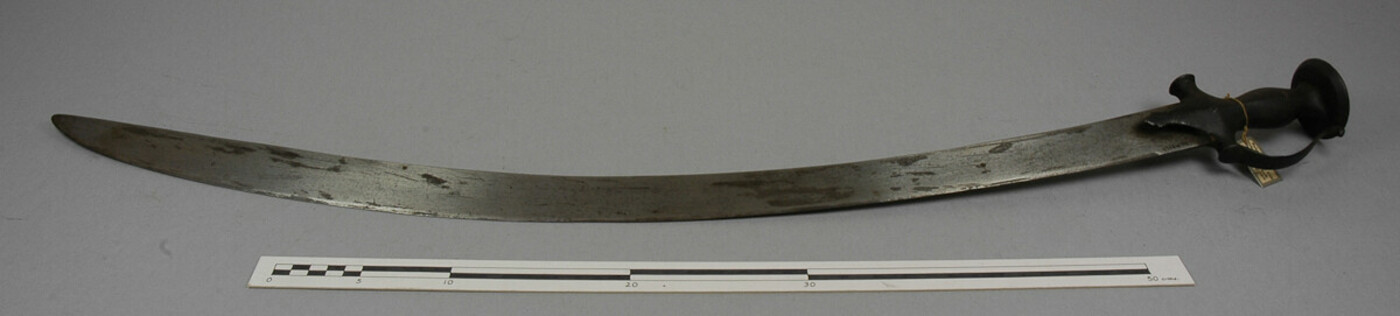 1943.6.73Sword, tegha, with curved steel blade and steel hilt with short quillons, langets, knucklebow and disc pommel. [SM 05/09/2007]1943.6.73
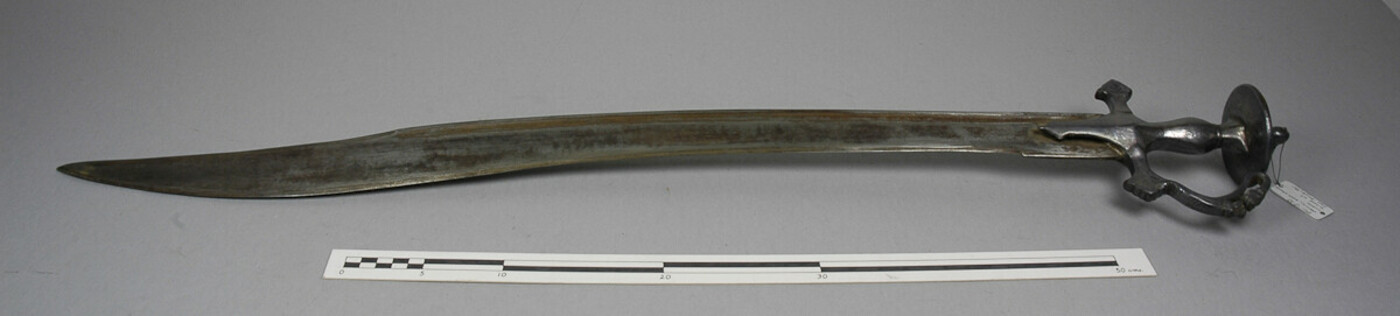 1969.29.37Sword with steel blade and highly decorated silver ?plated hilt with, quillons, langets, disc pommel and knucklebow. [SM 04/09/2007]1969.29.37
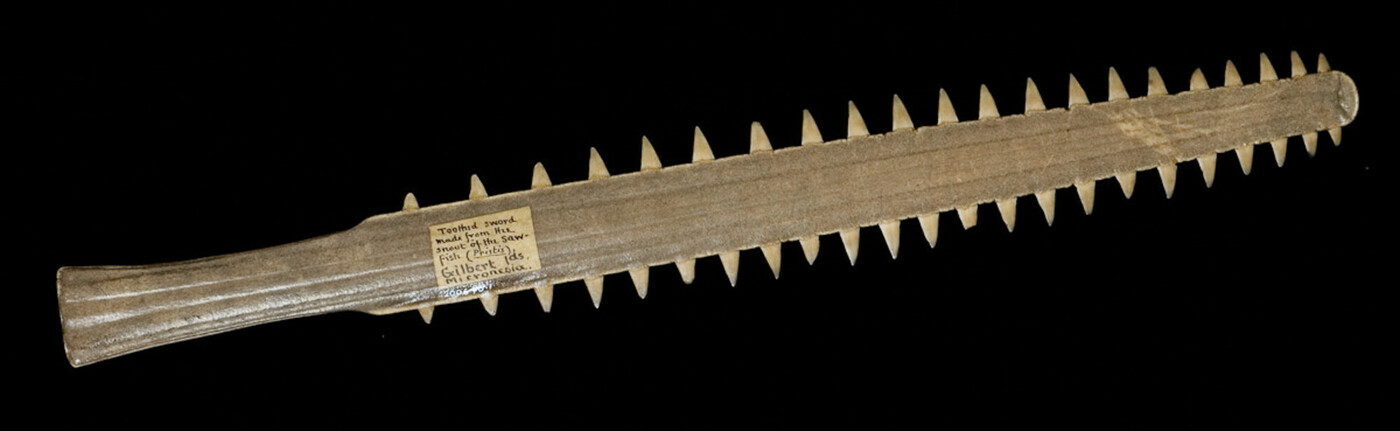 2006.70.1Sword made from the snout of a sawfish. [AB [OPS Move] 23/5/2017]2006.70.1
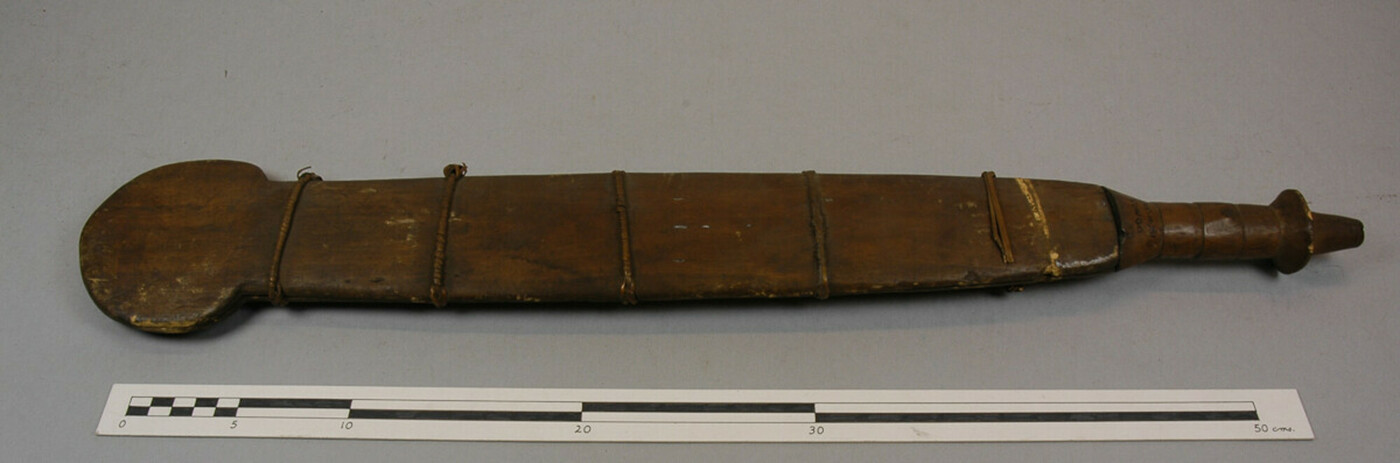 1945.11.74.1Sword [.1] with leaf shaped two edged blade decorated with herringbone pattern, with wooden sheath [.2] bound with cane strips. [SM 25/10/2007]1945.11.74.1
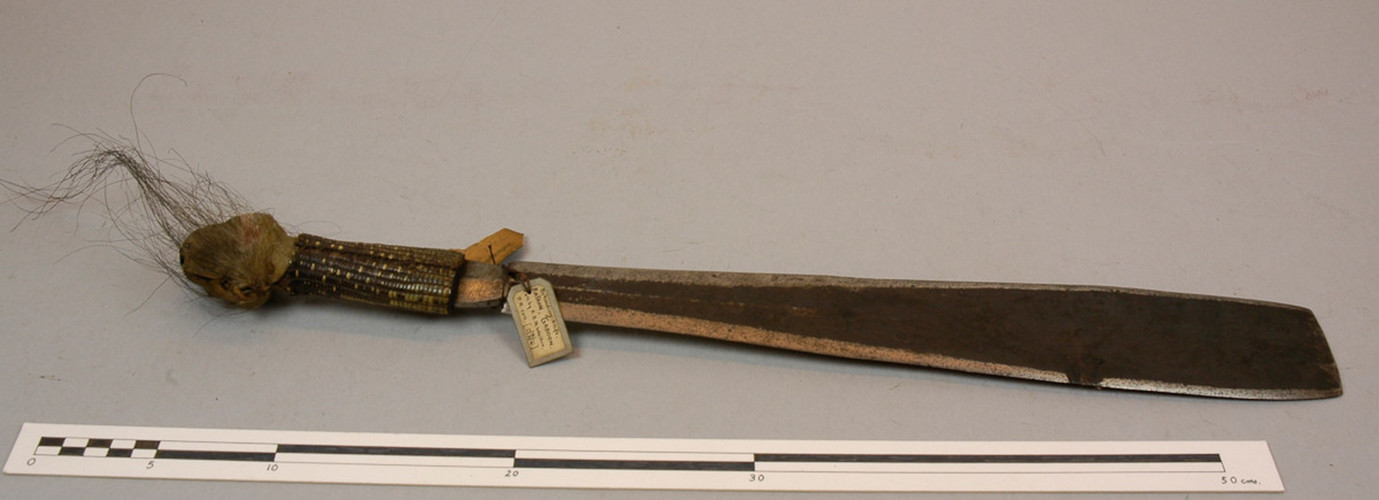 1884.24.21Two-edged sword or knife with expanding blade, wooden handle bound with animal hide with some hair still attached and with reptile skin over that. [El.B 06/11/2007]1884.24.21
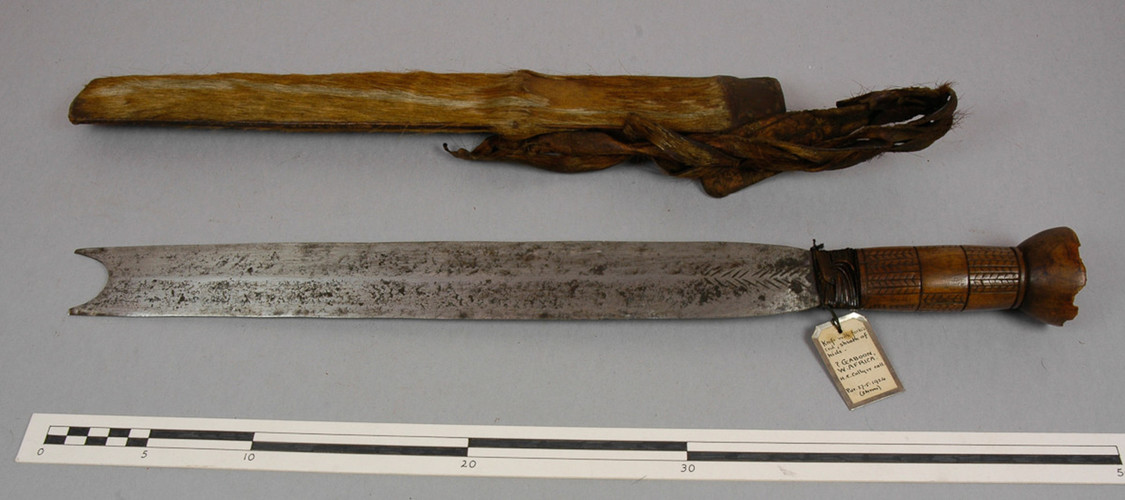 1924.62.34.1Sword or knife [.1] with two-edged, bifurcated iron blade with incised chevrons; plant-fibre binding near the hilt; wooden grip with incised chevrons and expanded pommel. Stitched hide sheath [.2] with plaited carrying strap. [LM 03/07/2007]1924.62.34.1
 1900.39.33.5Iron rod shaped like a long-handled axe, a form of currency. [El.B 20/04/2011]1900.39.33.5
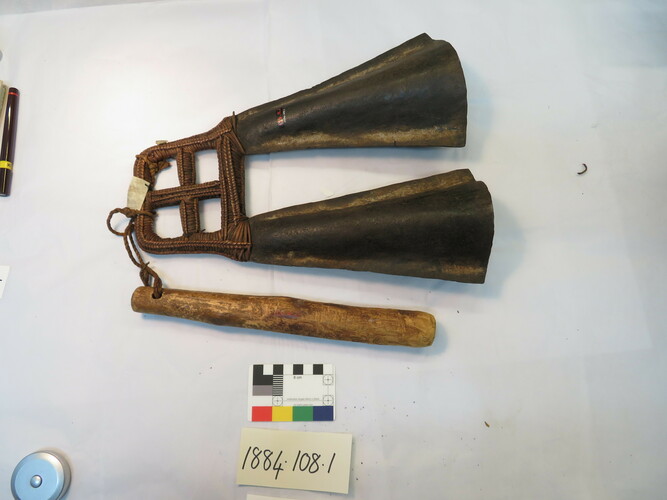 1884.108.1Double iron gong, okenge, each gong shaped like a bell in two pieces with flanges welded together; each has tang fitted into elaborate wickerwork handle that unites the two; the notes are different; a plain wooden striker attached with a cord. [HLR]1884.108.1