
- Collection type
- Object
- Description
- Finely cut harpoon line of walrus hide with ivory toggle and fasteners.
- Long description
- Finely cut harpoon line of walrus hide with ivory toggle and fasteners. The harpoon line is coiled and tied. The toggle has been carved and incised to represent a bear and a seal. [FB 11/8/2016; JC 24 8 2016]
- Geographical reference
- Alaska
- Cultural groups
- Western Inuit
- Person
- Maker Unknown Maker
- Field collector Unknown Collector
- PRM source Augustus Henry Lane Fox Pitt Rivers founding collection
- Date / Period
- Date made: Before 1874
- Date collected
- By 1874
- Acquisition information
- Donated: 1884
- Materials and processes
- Material Walrus Skin Animal, Material Animal Ivory Tooth, Material Animal Hide Skin, Process Carved, Process Tied, Process Twisted, Process Knotted, Process Incised
- Dimensions
- Diameter: max 300 mm, Length: max 45 mm bear/seal toggle, Depth: max 54 mm
- Object numbers
- Accession number: 1884.20.11
- Research and responses
In response to an emailed enquiry from Philippe Descola, in August 2016 I had occasion to investigate the history of this object. At first it was not clear whether it was part of the founding collection or of the collection that was transferred from the Ashmolean in 1886. Of the two surviving labels, the first would appear to be the parchment-like one. This was presumably produced by the PRM's first curator Henry Balfour (the Roman numerals will have referred to a listing or catalogue prepared by Balfour that does not appear to survive). It is clear from the query and the reference to both 'PR' and 'Ashm' that Balfour was not sure of its provenance. The metal-edged label was presumably added at the time that the accession book entry was composed (that is, in the 1920s), but on what evidence is not clear. At the time of my investigation, there was nothing in the database entry to suggest that the object had been listed in any of the documentation pertaining to the founding collection. However, a search on the 'PRM possible objects' database retrieved a record based on an entry in the Black Book: '1702 Case 42 Line of leather with ivory buttons carved in the form of animal's [sic] heads Esquimaux'. It seems extremely likely if not certain that this entry relates to this object. I have therefore copied across the Black Book entry into this record and arranged for the entry on the 'PRM possible objects' database to be deleted. I am now confident that this object may be assigned to the founding collection and may be assumed to have been acquired by Augustus Henry Lane Fox (later Pitt-Rivers) by 1874. [JC 24 8 2016]
- Associated publications
- A toggle on this line was illustrated in a line drawing (two views) by Henry Balfour as Figure 37 on page 97 of The Evolution of Decorative Art: An Essay upon its Origin and Development as Illustrated by the Art of Modern Races of Mankind, by Henry Balfour (London: Rivington, Percival & Co., 1893). Caption (same page): 'Fig. 37. - Esquimaux ivory toggle on harpoon line. (Pitt Rivers Collection.)' Balfour writes (pages 95-7): 'DELINEATION OF GRAPHIC ART. Let us now turn to the consideration of the application of the art of design to flat surfaces, Graphic Art, as opposed to sculpture and modelling or Plastic Art. Mr. John Collier (Primer of Art) has pointed out that it is very possible, in fact probable, that the idea of representing objects by means of lines upon a flat surface, was in the first instance suggested by the supplementary slight touches, scratched lines, added to figures carved or modelled in complete relief, in order to express certain details which would not otherwise appear in [95/96] the process of giving the shape. The use of such lines to express certain of the less prominent features is extremely common, and, the greater the use of this method of giving expression, the less the need of representation in the solid or complete relief. Thus it may gradually have been suggested that the whole object could be by means of lines represented upon the flat. [new paragraph] The following example will serve to illustrate this point, although it in no way professes to be a strictly primitive example showing the actual transition, as the Esqimaux are well acquainted with the use of lines as a sole medium of expression. The ivory button or 'toggle' (Fig. 37) has been ornamentally carved into the shape of a polar bear's head, of which the general outline is indicated by the shape produced. In order to express details which do not appear in the general conformation, incised lines have been used; the ear, eye, nostril, and mouth are thus represented, or, so to speak, sketched in on one side. The mouth might certainly have been carved out, but this would have involved far greater labour and skill. On the reverse a design representing a seal has been produced; the shape of the button, which is that of the bear's head, has been partly used to express the outline of the seal, the back and head being thus conveniently formed; but [96/97] it has been necessary to express the outline of the lower part of the body and the flippers by means of lines, as the shape of the piece does not suggest these. Were the shape still less adapted to this design, the whole seal would have to be represented by lines alone. Once the idea of graphic representation was acquired, the art could maintain an independent position, and continue to develop upon lines of its own, as new possibilities suggested themselves in rapid succession, keeping pace with the increasing scientific knowledge, and foreshadowing the perfection to which it was to attain.' [JC 11 8 2016] The drawing by Henry Balfour of a toggle on this line (see above) was published as Figure 32 on page 15 of Studier i Amerikansk Ornamentik: Ett Bidrag till Ornaments Biologi, by Hjalmar Stolpe (Stockholm, 1896). Caption (same page): '32. Remknapp af hvalrosstand 1/1. Pitt Rivers Museum, Oxford. (Efter Balfour [Balfour. The Evolution of decorative Art. London 1893.]).’ Stolpe writes (page 14): ‘En egendomlig sådan knapp i Pitt Rivers’ museum i Oxford (fig. 32) visar den ovanliga anordningen, att den å ena sidan föreställer ett isbjörnshufvud och å den andra bär teckningen af en fullständig säl. Här har snidaren midt under arbetet, på grund af konturens tillfälliga likhet med en sälkropp, fallit på idén att frångå den ursprungliga planen och ytterligare förstärka denna likhet genom den ingraverade teckningen.’ [JC 11 8 2016, 24 8 2016] The drawing by Henry Balfour of a toggle on this line (see above) was published as Figure 32 on page 82 of Collected Essays in Ornamental Art, by Hjalmar Stolpe (transl. Mrs H. C. March) (Stockholm: Aftonbaldets, 1927). Caption: ‘Fig. 32. Toggle of walrus ivory (1/1). Pitt-Rivers Museum. Oxford (after BALFOUR [BALFOUR. The Evolution of decorative Art. London, 1893]). Stolpe writes (page 82): ‘A very characteristic button or “toggle” in the Pitt-Rivers Museum at Oxford (Fig. 32), shows an unusual design. On one side, the head of a white bear is represented and on the other an entire seal. Here the artist, after finishing one side of the work, has evidently changed his plan and strengthened an accidental likeness in the contour to a seal by carving the outlines of limbs, etc.’ [JC 11 8 2016]
Search terms: Weapon, Hunting, Fishing, Harpoon Line, Fishing Accessory, Hunting accessory
Further items to explore
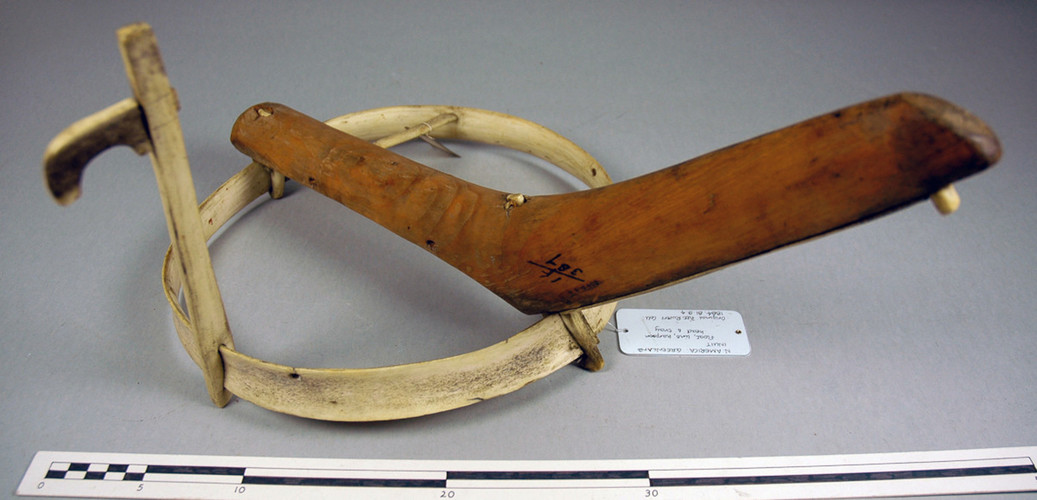 1884.81.9.4.1Canoe accessory, skin float [.1] and skin line with harpoon head and 2 small 'acorn' ivory caps with pins for ends of canoe. Also with this object is a tray [.2] for the holding the harpoon line. [MdeA 20/11/2001]1884.81.9.4.1
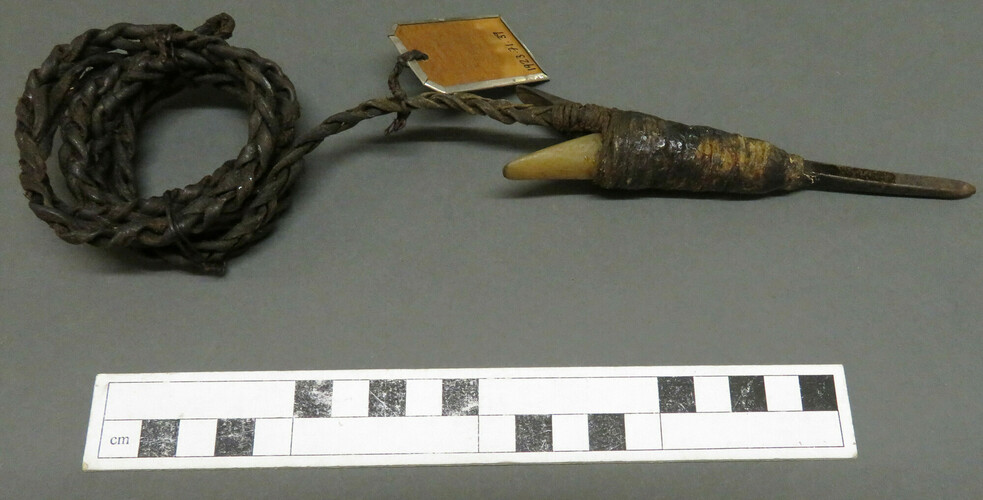 1923.71.39Head of fishing-harpoon with an iron point and horn barb forming socket for shaft. Line of plaited hide attached. [ASh [OPS move] 20/6/2017]1923.71.39
 1884.20.36.2Bamboo shaft for turtle harpoon. One end is bound with string and cane strips. There are crosshatch notches at each node.1884.20.36.2
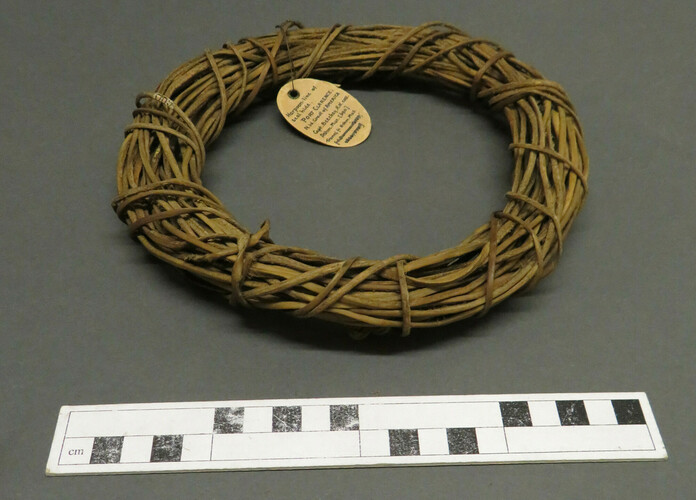 1886.1.690Harpoon line. [ASh [OPS move] 27/6/2017]1886.1.690
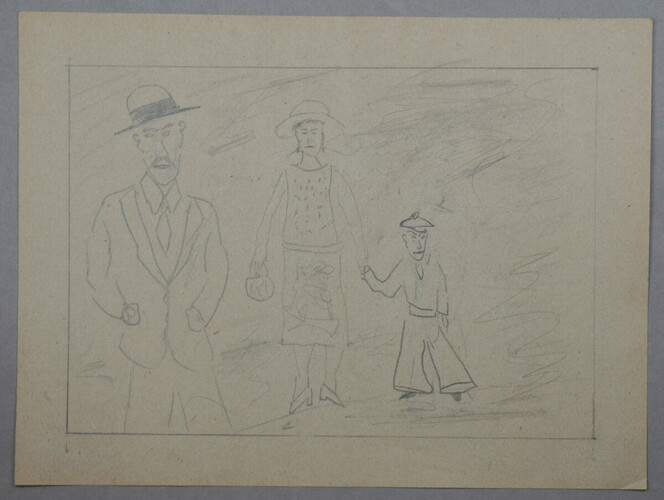 1994.15.2451Pencil drawing of a man, a woman and a boy. [El.B 20/05/2008]1994.15.2451
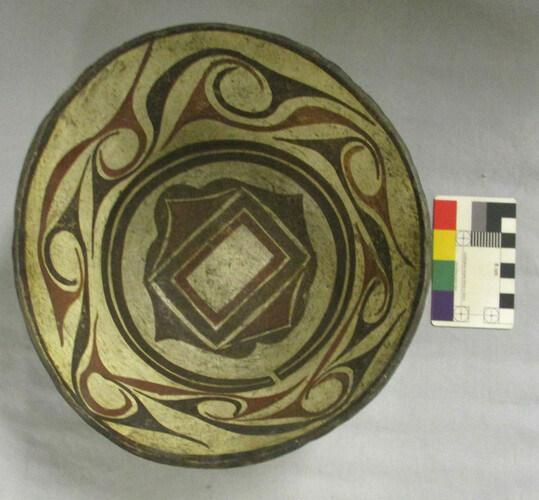 1938.35.1547Buff ware bowl with a flat base and flared sides with an uneven undulating rim. [ASh [OPS move] 06/04/2016]1938.35.1547
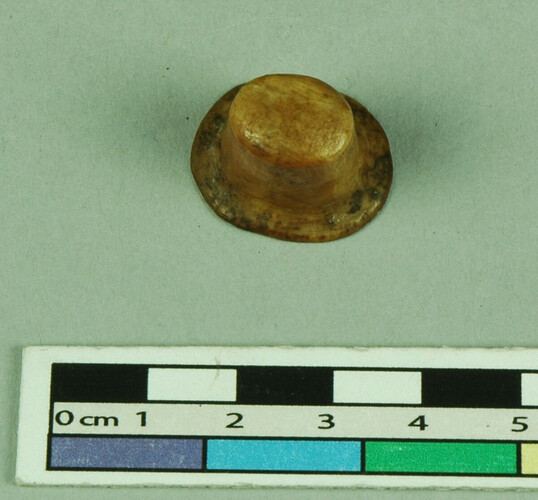 1954.9.149Ivory labret - possibly a distender for the lip-hole. [JP 1/9/2001]1954.9.149
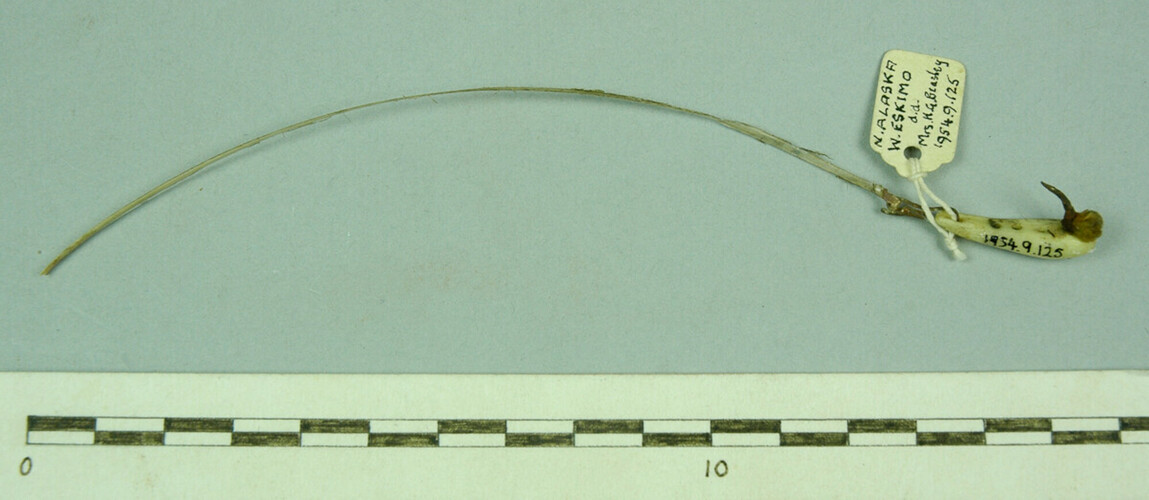 1954.9.125Fish hook lure, of iron wire barb in ivory shank, with 3 copper rivets and a strip of baleen line attached.1954.9.125