
- Collection type
- Object
- Description
- Spearthrower, carved from a flat piece of wood, with a groove and ivory peg (broken) at the narrower distal end to engage the spear butt. [LM 16/10/2007]
- Long description
- Spearthrower, carved from a flat piece of wood, with a groove and ivory peg (broken) at the narrower distal end to engage the spear butt. At the wider proximal end the implement is carved to fit the hand, with an angle for the thumb, a hole for the index finger, grooves for the other fingers and an ivory peg to fit between the second and third fingers. On the other side, an incised line connects the finger hole with the tip of the implement. [LM 16/10/2007]
- Geographical reference
- Western USA Alaska Icy Cape Point Barrow
- Person
- Maker Unknown Maker
- Field collector Robert Dunn
- Field collector HMS Assistance
- PRM source Augustus Henry Lane Fox Pitt Rivers founding collection
- Date / Period
- Date made: Possibly before 1852
- Date collected
- 1852 - 1854
- Acquisition information
- Donated: 1884
- Materials and processes
- Material Wood Plant, Material Animal Ivory Tooth, Process Carved, Process Perforated, Process Incised, Process Grooved
- Dimensions
- Length: max 453 mm, Width: max 77 mm
- Object numbers
- Accession number: 1884.19.352 PR Cat other PR nos: 213
- Research and responses
In Primitive Warfare II (read Friday June 5th 1868) Pitt-Rivers describes 2 hafted projectile points collected 'from the Esquimaux, between Icy Cape and Point Barrow' which he purchased from someone who had 'bought them himself from that locality'. He illustrated these 2 objects on Plate XVIII (numbers 163 and 164), to show 'the mode of fixing [arrow-heads and spear-heads] in their shafts' (p. 419). It is possible that this object is part of the material obtained from Alaska in this purchase. [Dan Hicks 20/09/2012]
Spear throwers were used by the Inuit in North America to help harpoons and spears travel further and with greater speed. Inuit spears had bone or ivory pegs which fitted perforations in the spear-throwers. Handgrips were important in the intense cold of northernmost N America and these spear-throwers often have grips designed to fit a particular hunter's hand. The length of an Inuit spearthrower is usually equal to the distance between the tip of the elbow and the extended index finger of the hunter. [AP Leverhulme project on founding collection 1995-1998]
- Associated publications
- Lane Fox. A.H. 1868. Primitive Warfare II. Journal of the Royal United Services Institution 12 (1868): 399-439. [Dan Hicks 20/09/2012]
Search terms: Weapon, Hunting, Spear-thrower
Further items to explore
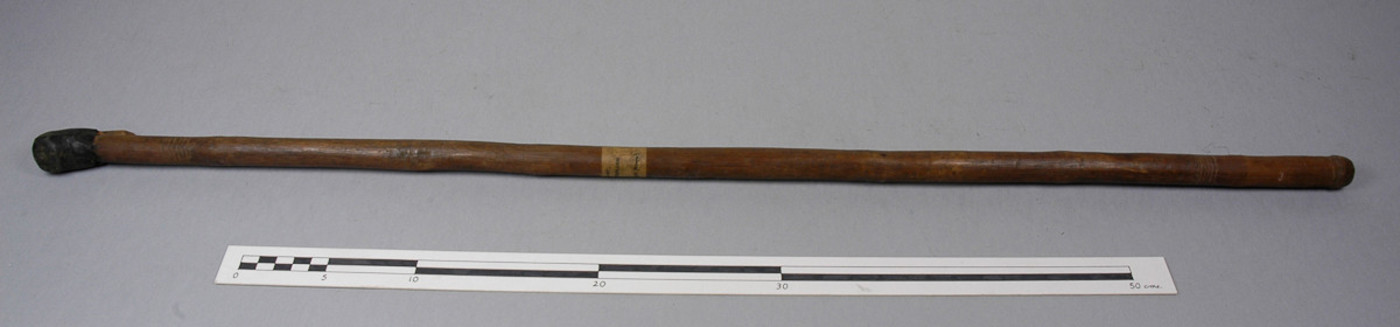 1931.78.30Straight rod spear-thrower with wooden peg fixed in resin. Six deeply incised bands around each end. [El.B 21/08/2007]1931.78.30
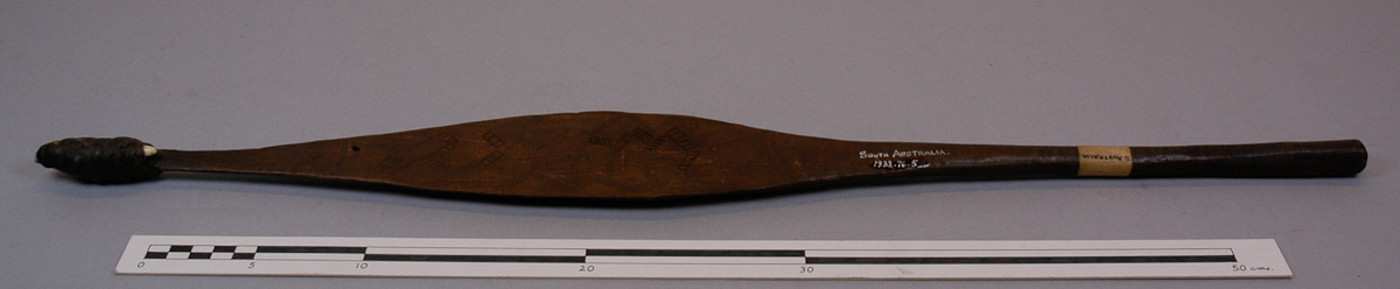 1932.76.5Small spear-thrower, tapered at both ends with wide blade and tapering cylindrical handle. [SM 01/02/2008]1932.76.5
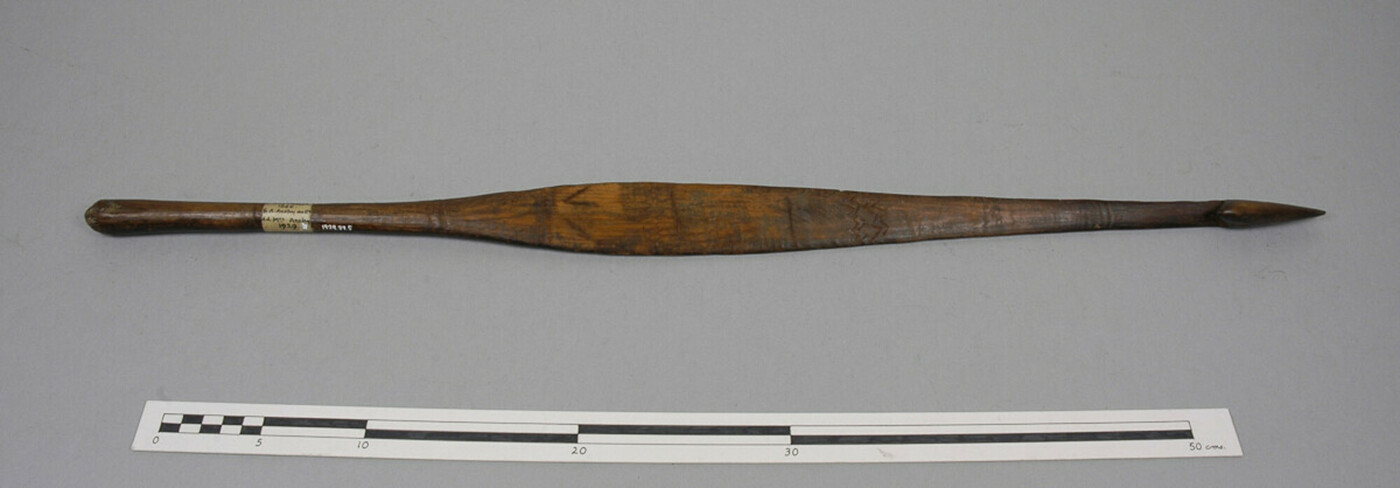 1929.39.5Spear-thrower carved from one piece of wood, with handle of round section flattening out into a narrow leaf shape with a hook at the end. Both sides carved with zigzags and other linear designs. [LM 28/08/2007]1929.39.5
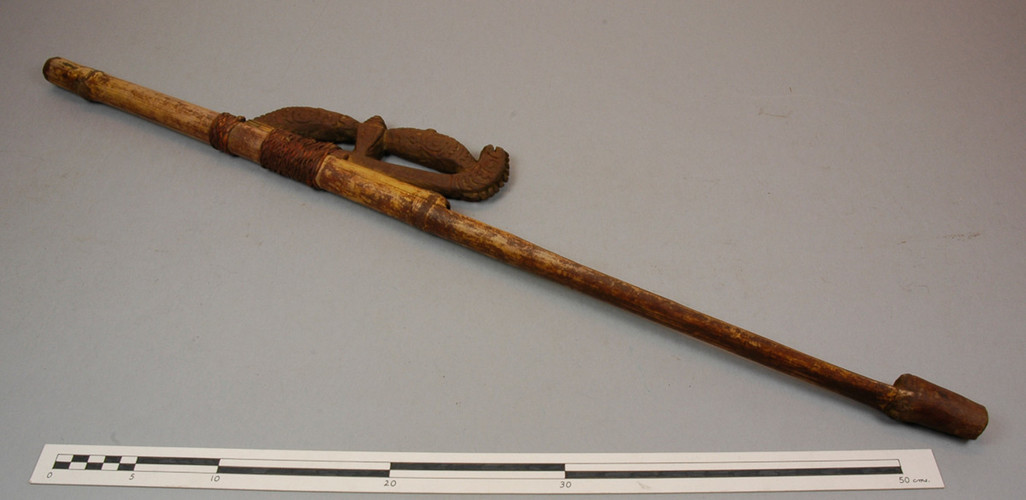 1914.70.1Spearthrower made of a length of bamboo, partly cut away to leave a node to engage the spear butt. A carved wooden animal figure, acting as a spear support, fits into a slot in the bamboo shaft, bound in place with two rings of twill-plaited rattan. The object has been partly covered in red pigment. [LM 15/10/2007]1914.70.1