
- Collection type
- Object
- Description
- Spear with spruce shaft and chert point. [LM 23/1/2007]
- Geographical reference
- Alaska Icy Cape
- Person
- Maker Unknown Maker
- Field collector Edward Belcher
- PRM source Augustus Henry Lane Fox Pitt Rivers founding collection
- Date / Period
- Date made: Before 1884
- Date collected
- ?1826 1827
- Acquisition information
- Donated: 1884 Found unentered: Unknown date, uncertain
- Materials and processes
- Material Wood Plant, Material Chert Stone, Material Spruce Wood Plant, Material Chert Stone, Process Flaked, Process Carved
- Dimensions
- Length: max 2042 mm
- Object numbers
- Accession number: 1884.19.349 PR no.: 26/ 11547
- Research and responses
?Intended to be used from a kayak to spear swimming caribou. [AP Leverhulme project on founding collection 1995-1998]
- Associated publications
- Bockstoce, 1977: no 44 - 'Lances ... Belcher collection, part of the Pitt Rivers collection, unnumbered. Length 204.2cm, weight 367.4 gm. According to the PRM Catalogue, collected at Icy Cape (fig 23 a-c). This lance has a spruce shaft, 2.5cm in maximum diameter. Its grey chert point, which has become detached from the shaft is 11.8cm long and 3.3cm maximum in width. The point is very skilfully flaked. There are three similar lance points in the British Museum's Belcher collection (BM nos 8247 - 8249). Two of them came from Cape Lisburne. A similar point was purchased by Nordenskiöld (1882: 271) at Port Clarence and one was excavated from a recent burial at Point Hope (Larsen and Rainey, 1948: plate 94, 6). The fore end of the shaft was split to receive the point's base. It was then wrapped in depilated caribou skin and lashed with three-strand caribou sinew twine. Belcher gave a clear translation of the flaking process used in the manufacture of the points "Selecting a log of wood, in which a spoon-shaped cavity was cut, they placed the splinter to be worked over it, and by pressing gently along the margin vertically, first on one side, then the other, as one would set a saw, they splintered off alternate fragments until the object, thus properly outlined, presented the spear or arrowhead form, with two cutting serrated sides" (Belcher 1861: 138-9) ....'. [AP Leverhulme project on founding collection 1995-1998]
Further items to explore
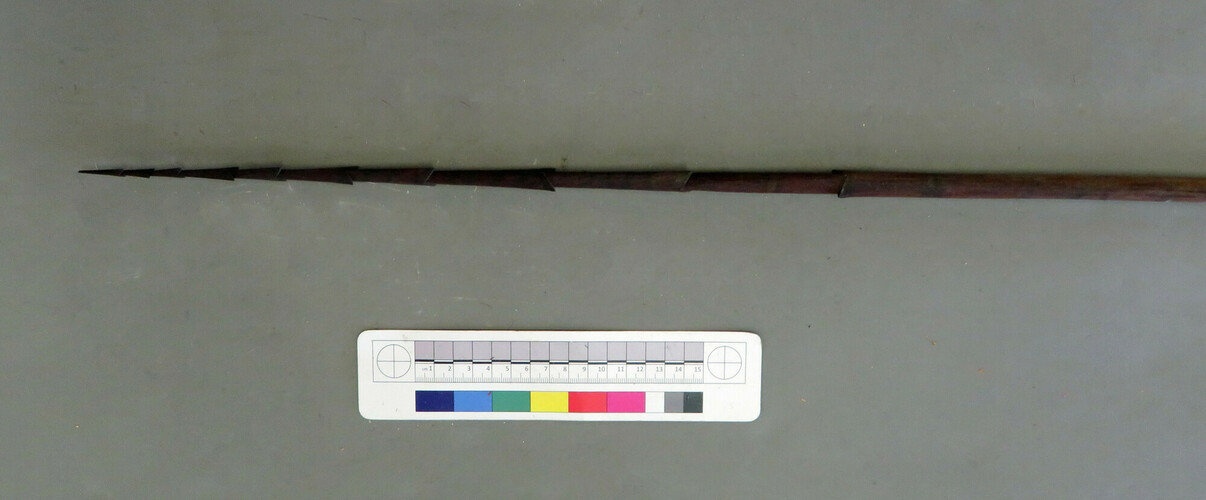 1924.51.39Spear with elaborately barbed head. [JMC [OPS move] 27/7/2018]1924.51.39
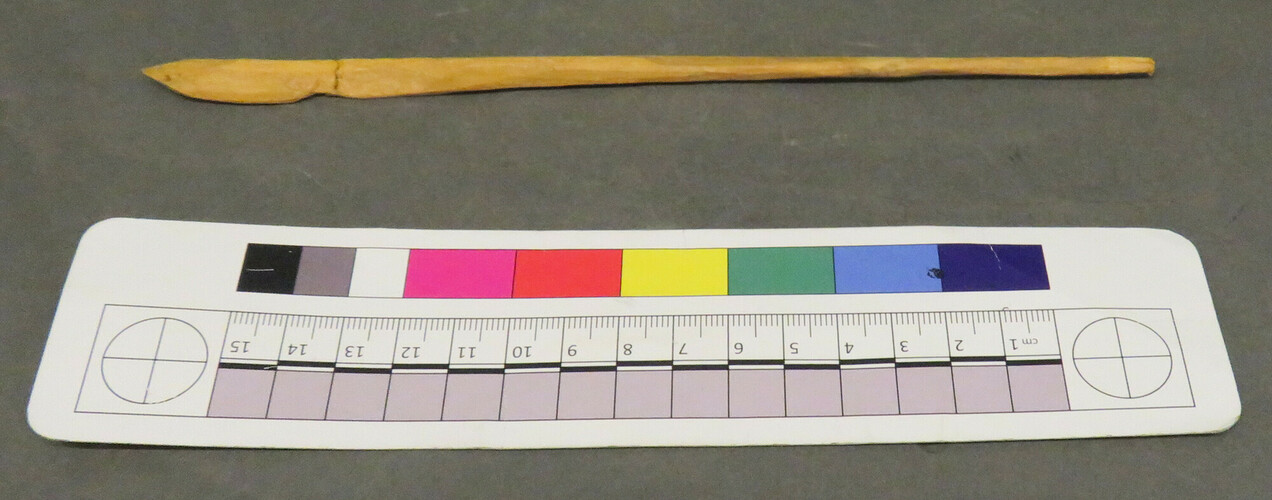 2009.5.1.3Spear for figure [2009.5.1 .1]. It consists of a narrow wooden stick, widening towards one end where it is carved to a point. For shield see [2009.5.1 .2]. [JC [OPS Move] 13/6/2017]2009.5.1.3
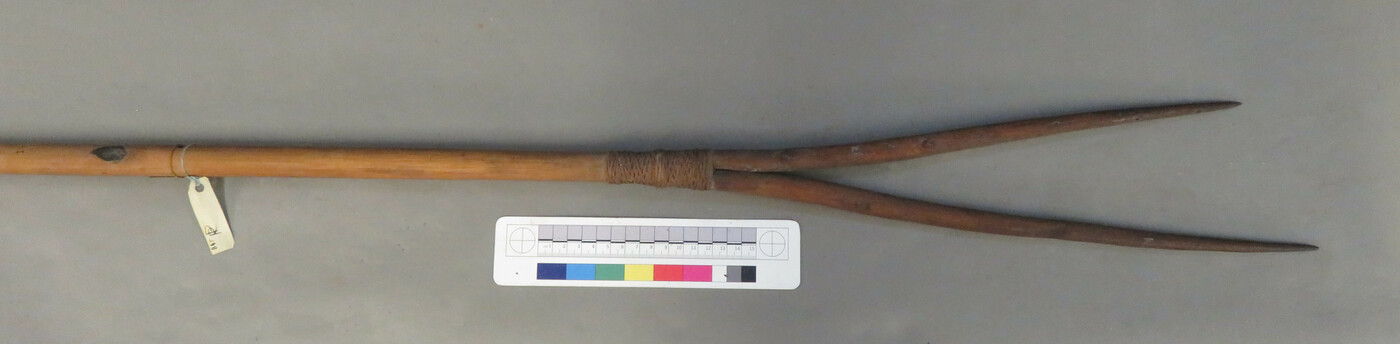 1884.19.285Spear with long tapering wooden shaft and two slightly curved harwood points bound to the shaft with plaited plant fibre. [RH [OPS move] 16/7/2018]1884.19.285
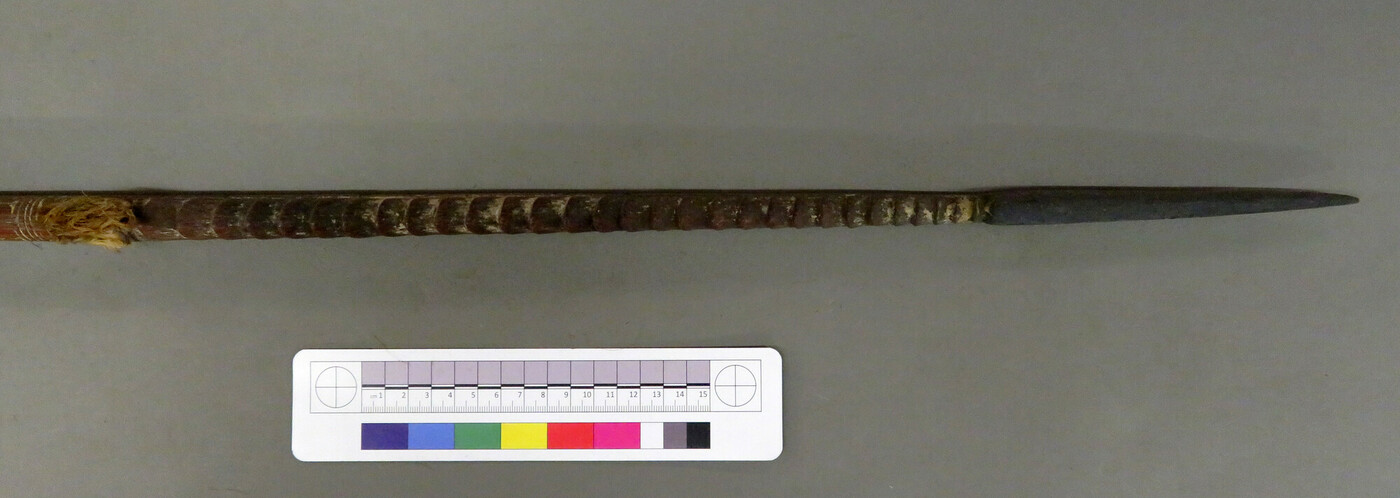 1911.64.8Carved and painted spear. [PH [OPS move] 22/6/2018]1911.64.8
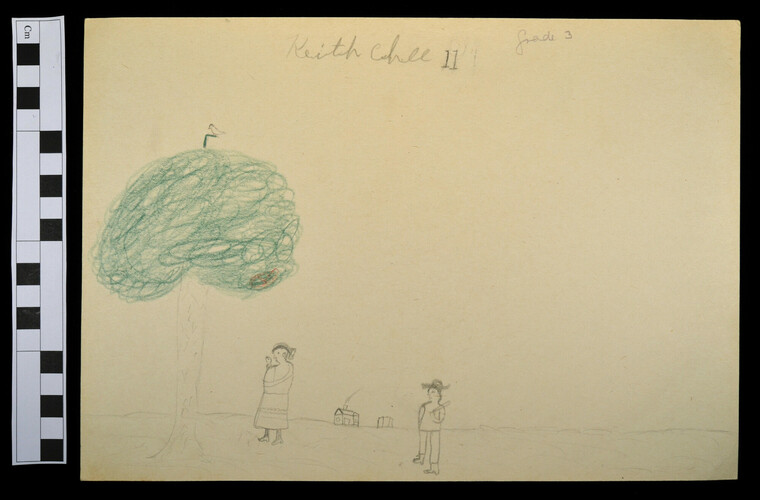 1994.15.109Drawing by schoolchild of two figures, a tree and two buildings. [MJD 22/12/2014]1994.15.109
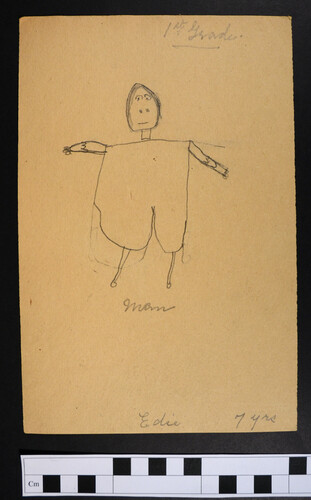 1994.15.190Drawing by child in pencil of three figures. [MJD 24/03/2015]1994.15.190
 1994.15.470Drawing by child in pencil of three figures. [MJD 22/01/2015]1994.15.470
 1947.4.124BOld button, shallow fluted, thick large fluting, plain centre.1947.4.124B