
- Collection type
- Object
- Description
- Skin vase with irregular globular body and short neck, decorated with a geometric pattern in paper. [ZM 10/8/2005]
- Geographical reference
- Punjab
- Person
- Maker Unknown Maker
- Field collector Unknown Collector
- PRM source Augustus Henry Lane Fox Pitt Rivers founding collection
- Date / Period
- Date made: Possibly before 1874
- Date collected
- By 1874
- Acquisition information
- Donated: 1884
- Materials and processes
- Material Animal Sinew, Material Paper Plant, Material Blood, Material Animal Membrane, Process Moulded, Process Decorated
- Dimensions
- Height: max 221 mm, Length: max 191 mm, Width: max 157 mm
- Object numbers
- Accession number: 1884.7.24 Other numbers: 16/ 83 PR Cat other PR nos: 3083
- Associated publications
- Illustrated in black and white photograph as figure 50 on plate IV of ''The Tandu Industry in Northern Nigeria and its Affinities Elsewhere', by H. Balfour, in Essays Presented to C.G. Seligman, (1934), pp. 5-18. Caption (page 18) reads: 'Plate IV. 45 = A small oil-flask, made by layering membranous material over a clay core, Patna, Bengal, from Sir R. C. Temple’s collection; 46 to 48 = two similar oil-flasks, of which number 46 is in the finished state, while 47 shows the exterior and 48 the interior of a specimen which I bisected in order to reveal the hollow clay core in situ, collected by H. E. Drake-Brockman in Mirzapur, N.-W. Provinces, in 1893; 49 = oil-vessel, sireshom, made by coating a clay core with skin-scrapings, Afghanistan, from Mrs. Courtney Bell’s collection; 50 = a thick-walled oil-jar, kupa, decorated with cut-out paper patterns appliques to the surface, Punjab, from General Pitt Rivers’ collection; 51 = an ornamentally shaped jar with cover, similarly ornamented, Multan, Punjab, collected by A. Brown, c. 1895; 52 = an ornamental flask with body of which is pierced by five “tunnels”, covered with paper patterns, Multan; 53 = a drinking-mug with similar decorative surface, Multan. The two last were formally in the Plymouth Museum. 54 = an oil-jar with gadrooned surface, N. India, from General Pitt Rivers’ collection; 55 = an oil-jar, tel kuppa, of moulded membrane, with flanges to which are attached loop-handles of cane, fitted with a duct of wood and tin for pouring the oil, Bikanir State, Rajputana, from Sir R. C. Temple’s collection, 1892; 56 = a very finely made kupa, stoutly built and very strong, decorated with a small panel of cut-out paper, the whole surface being varnished over, collected by Mrs. Leslie Saunders in Beawar, Ajmere-Mewara Province, Rajpuntana; 57 = a smaller similar flask, kupi, painted and varnished same data as the last.' [MJD 01/11/2011]
Search terms: Vessel
Further items to explore
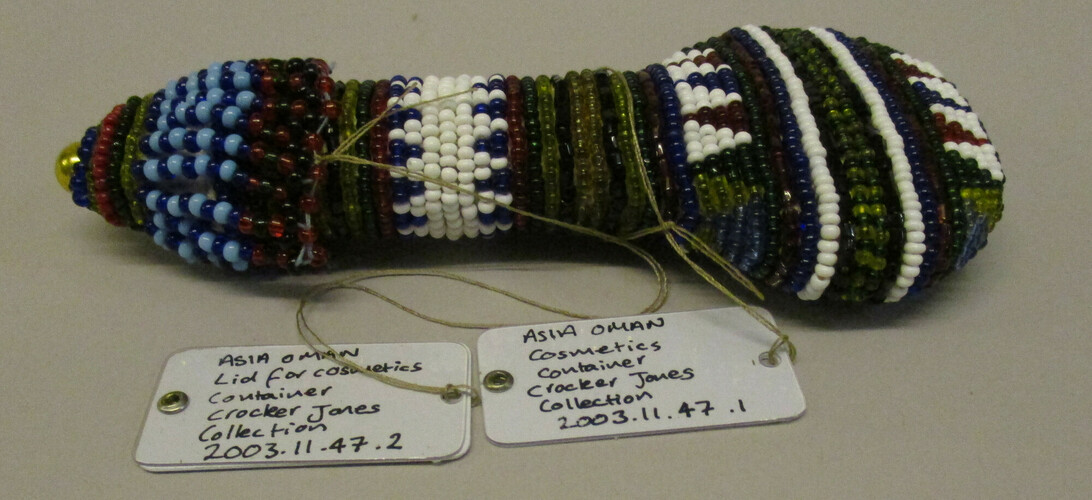 2003.11.47.1Cosmetic container of beadwork. Lid for vessel [2003.11.47 .2] [RM [OPS move] 17/8/2016]2003.11.47.1
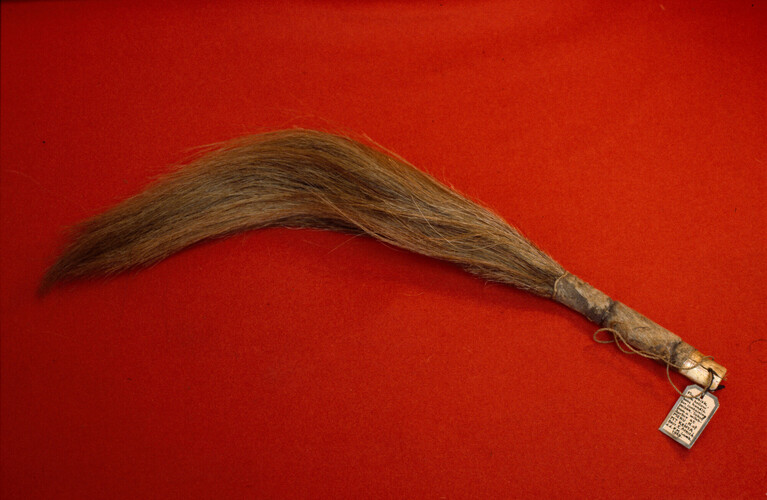 1929.57.1Flywhisk of animal tail bound with animal skin to a bone handle. [MJD 03/08/2009]1929.57.1
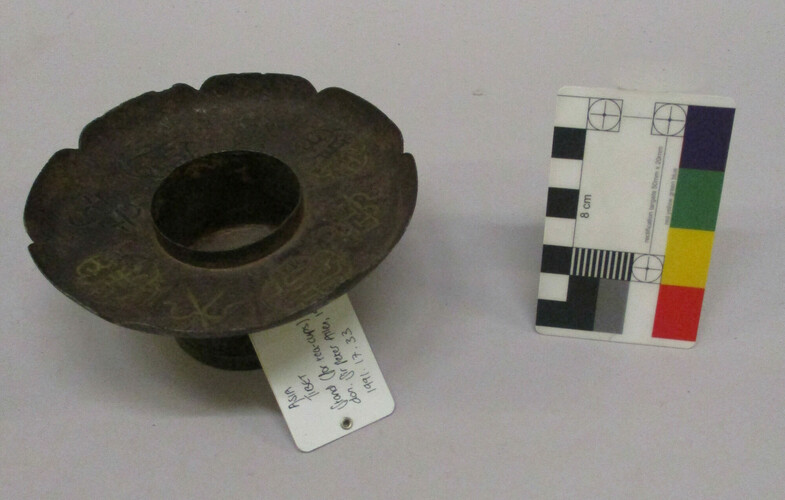 1991.17.33Rusted iron teacup stand in the form of a flower, with eight sets of inlaid characters and band of yellow metal around the base. [JC [OPS move] 14/7/2016]1991.17.33
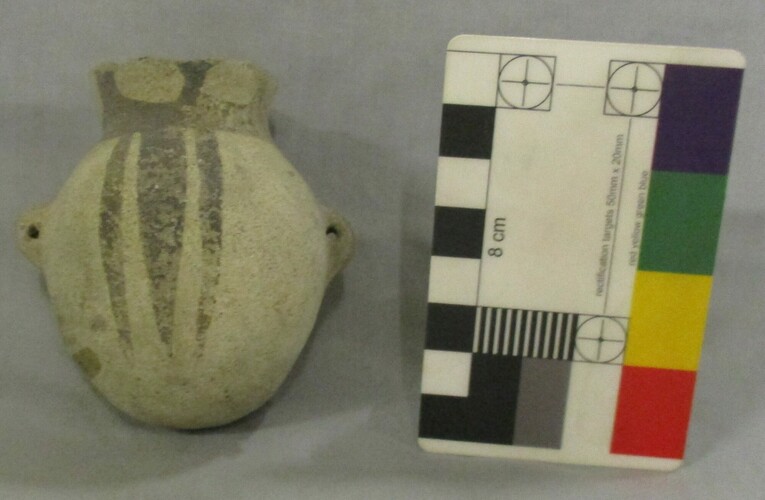 1921.92.71Pottery vessel of ovoid shape body and fully rounded base. [MOBB [OPS move] 16/03/2016]1921.92.71
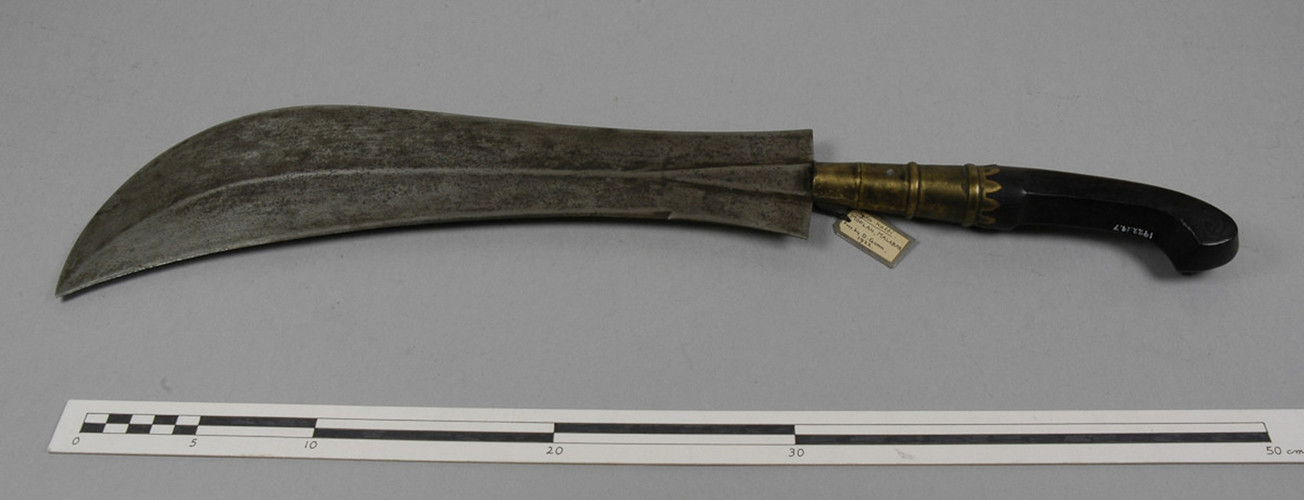 1922.19.7Sword with broad, single-edged, curved blade with central rib; brass-mounted ebony grip with curved pommel. [LM 03/10/2007]1922.19.7
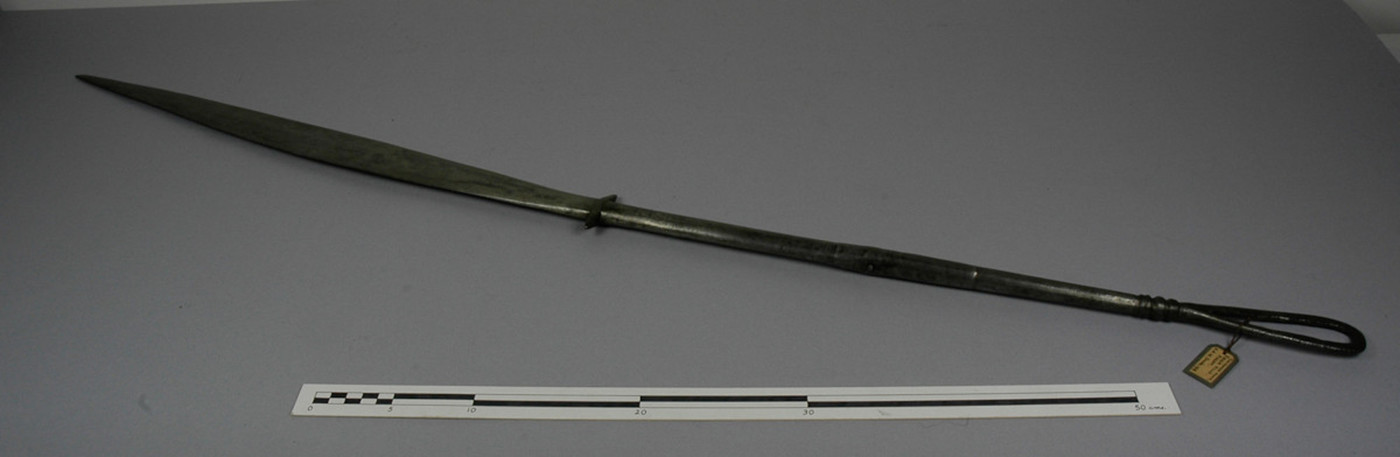 1918.19.13Iron sword, with narrow leaf-shaped blade in one piece with the handle, separated by a short crosspiece. The handle is the same length as the blade, with a perforation through which an iron pin has been stuck. The handle ends in a loop. [El.B 19/11/2007]1918.19.13
 1884.15.93Bow, made from wood. Semi-circular in section with tapering ends. The cane string mentioned in the accession book is missing. [SB [OPS move] 1/8/2017]1884.15.93
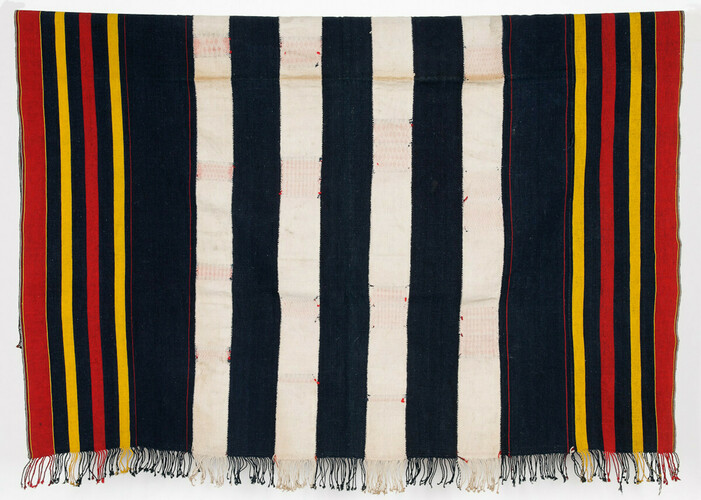 2008.70.36Man's cloth or wrap.2008.70.36