
- Collection type
- Object
- Description
- Ceramic "moon-horn" idol or fire dog [Dan Hicks 1/3/2017]
- Long description
- Clay crescent-shaped object, cracked and heavily repaired. One surface shows traces of vertical grooves. [SM (Verve) 11/02/2014]
- Geographical reference
- Bern Berne Nidau Mörigen [Lake Biel, Bielersee, Lac de Bienne]
- Person
- Maker Unknown Maker
- Field collector Unknown Collector
- PRM source Augustus Henry Lane Fox Pitt Rivers founding collection
- Date / Period
- Date made: Circa 1800-700 BC Archaeological period: Bronze Age
- Date collected
- ?By 1875
- Acquisition information
- Donated: 1884
- Materials and processes
- Material Clay, Process Repaired (local), Process Fire-Hardened, Process Grooved
- Dimensions
- Length: max 323 mm, Height: max 154 mm
- Object numbers
- Accession number: 1884.3.21
- Research and responses
Objects like this found in Swiss Lakes Bronze Age contexts are variously known as "moon horns" (Mondhörner), "moon idols" (Mondidole) or ceramic fire-dogs (Feuerböcke). [Dan Hicks 1/3/2017]
Unprovenanced single find [PW]
Please note that this object is not 'Unprovenanced' as stated above, but was recovered from the lake village of Mörigen, as is stated in the Accession Book and written on the object (please note the accession book misspells the name as Möringen). [MN 18/02/2010]
According to Francesco Menotti in his 2002 article 'The Pfahlbauproblem and the history of lake dwelling research in the Alps' (Oxford Journal Of Archaeology 20(4): 319–328, doi:10.1111/1468-0092.00139) the lake village at Mörigen was first reported by Albert Jahn in the mid 19th Century (p 320). Jahn published his investigations at the site in an 1865 article in the newspaper Der Bund (16: 342–3) titled 'Zur Geschichte der Entdeckung der keltischen Pfahlbauten'. It is unknown if this object was retrieved from a specific excavation at the site. [MN 18/02/2010]
Ian Shaw's "Timeline of the Ancient World 3000 BC - AD 500" gives dates for the Bronze Age as c.1800-700 BC. Therefore I have added these dates to the database fields. [SM (Verve) 13/10/2016]
Email (15.1.2016) from Zdenek Mazac, who wrote a thesis on "moon-shaped idols": "I dont know, how much do you know about problematic of "Moon-shaped objects".
It is quite wide topic with variable kind of founds. In the middle Europe we know some thousands of founds from Final Bronze Age (NE France, Switzerland, SW Germany, Bohemia, Moravia, Lower Austria, Slovakia and Hungary – Transdanubia) and Early Iron Age (SW Germany, Central Germany, German – Saxony, Poland – Silesia, Bohemia, Moravia, Lower Austria, Slovakia, Hungary – Transdanubia, Slovenia, France, N Italy, N Spain). From Bohemia belongs 80 pieces sure to Final Bronze Age – of wich is almost complete only one specimen from Zdiby- Přemýšlení. All of them are from settlements or from situations, which can be considered as demonstration of cult behaviour. From Early Iron Age comes 123 pieces – from which 99 comes from graves and 24 from settlements (only in fractions). Mörigen is well known archeological Final Bronze Age locality. In 1876 were published some "Moon-shaped objects" by F. Keller (see attachment XX: 2–8, 10, 12–13, 15–18, 21) and some in 1987 by Bernatzky-Goetze (see attachment). Best regards, Zdeněk" [Dan Hicks 1/3/2017]
Email from Francesco Menotti (12.1.2016): "Moon-shaped idols are pretty common with within the lake-dwelling phenomenon of the Circum-Alpine region, from Lake Zurich/Constance to Lake Neuchatel; though, I must say, I have rarely seen them so 'simply' shaped as in your pictures...usually there are more 'sophisticated'. [Dan Hicks 1/3/2017]
Search terms: Furniture Dwelling, Religion, Fire, Unidentified Object, Religious Object, Fire Accessory
Further items to explore
 1906.16.186Unidentified iron object. Some sort of blade? [JC 8 7 1999]1906.16.186
 1887.1.424Bronze stud. [El.B 18/10/2007]1887.1.424
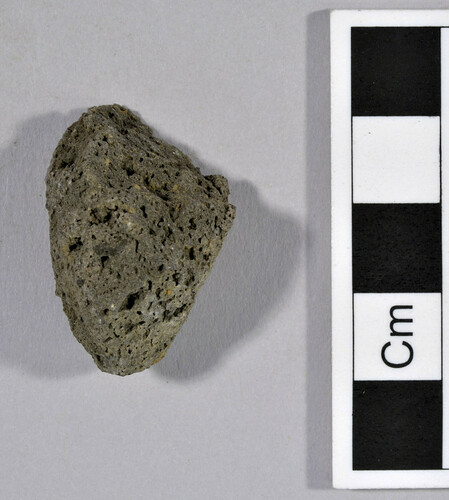 1884.140.1323.19Ceramic pellet1884.140.1323.19
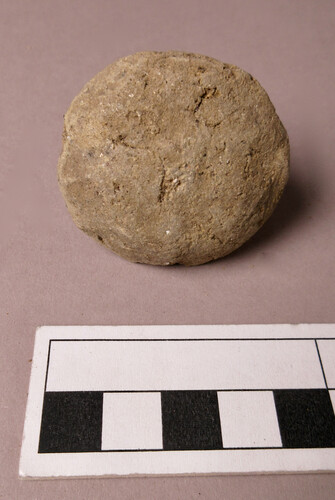 1886.1.7.33One of thirty-six clay models of 'chatyas'.1886.1.7.33
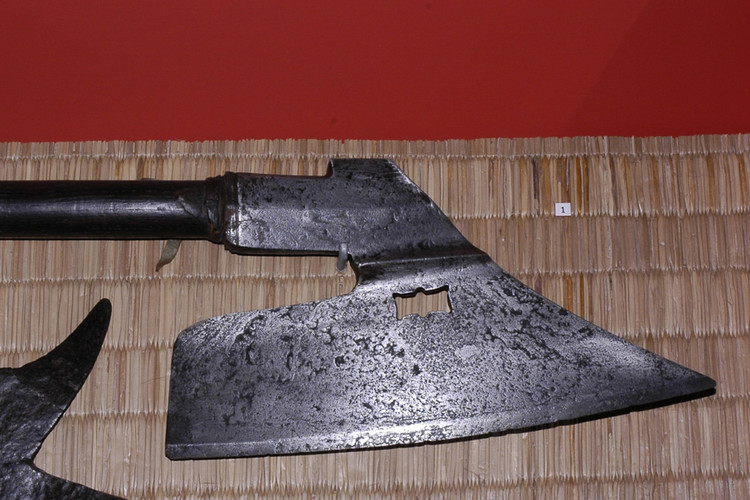 1884.21.52Pole-axe with out-sloping quadrangular blade, with long point at the top of the bevelled cutting edge curving away downwards to the top of the heavy short socket [El.B 18/10/2007]1884.21.52
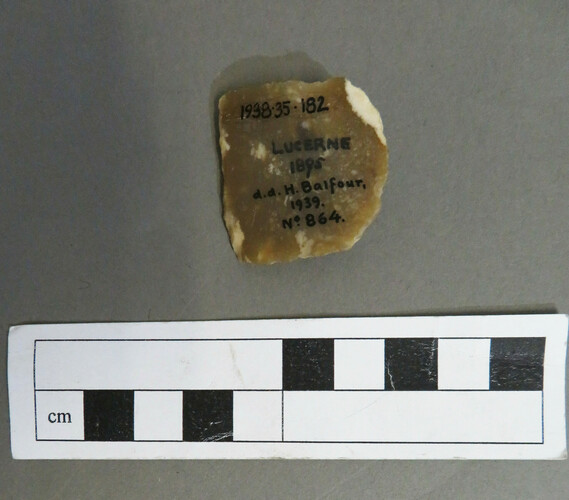 1938.35.182Gun flint. Smooth yellow-brown stone with lighter patches. It is in the shape of a triangular prism, with two flat sides tapering to a sharp edge. [ILL [OPS move] 7/9/2017]1938.35.182
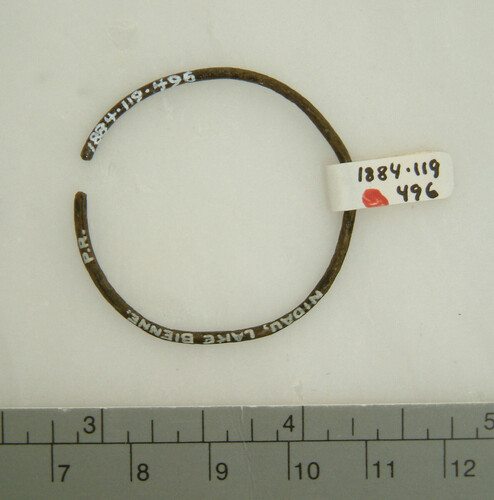 1884.119.496Unidentified object - piece of slender bent wire.1884.119.496
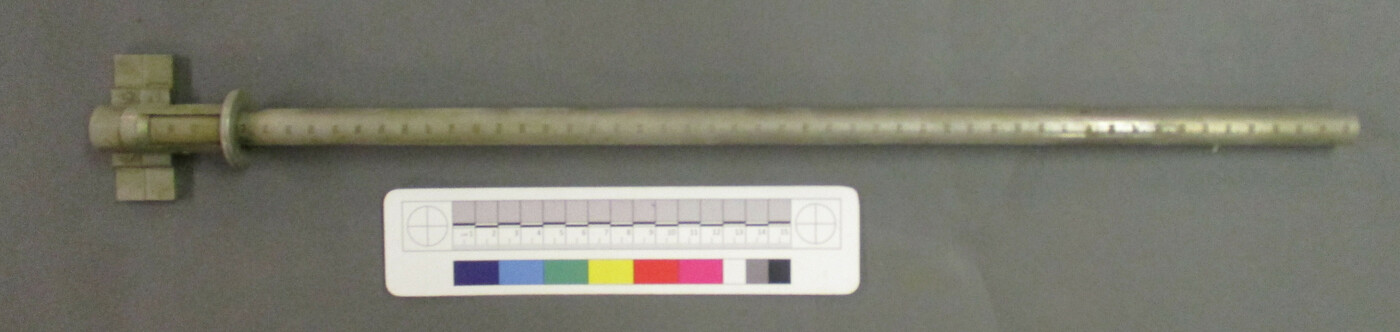 1997.10.2.5Hollow cylindrical pole with one flat side and T-shaped bracket at one end. Part of Beatrice Blackwood's fieldwork equipment. Engraved with measuring lines and the numbers 148 - 199 cm. Engraved 'P. HERMANN ZURICH'. Can be joined to [1997.10.2 .2 - .4] & [1997.10.2 .6 - .7] to form a measuring device. Stored inside canvas [1997.10.2 .1]. [EH [OPS Move] 5/7/2017]1997.10.2.5