
- Collection type
- Object
- Description
- Wooden stool with oval seat, four splaying feet, and a long necked handle and tail at either end [RTS 26/8/2004].
- Long description
- Stool carved from a single piece of wood and probably intended to be zoomorphic in form, perhaps imitating a turtle. This consists of an oval seat with flat sides and underside, and with an upper surface that is convex across its width and concave along its length. This has had notches have been cut into the centre of either end, with a carved flat-sided lug projecting and hanging down from the back notch - probably representing an animal's tail - and a more substantial handle projecting from the front one, perhaps a stylised animal's neck and head. Both are somewhat angular; the handle has a flat sided lug at its base, then a round-sectioned arm with a ridge running along the top projecting from this at right angles before splaying out to form the 'head', which has a flat, square end. The remnants of two plant fibre cords have been tied around the handle. Both are made of two strands of gathered plant fibres twisted together; the smaller cord is an orange brown colour (Pantone 7511C) with a diameter of 3.3 mm, while the thicker cord is a reddish brown colour (Pantone 7516C) and has a diameter of 4.5 mm. The stool has four legs that extend from the underside of the stool. These are carved as two pairs, joined along their tops by a semicircular strut. Each leg splays outwards, with a convex outer face and concave inner face, ending in short 'feet' made of convex flat-sided lugs with flat, teardrop shaped undersides. The stool is nearly complete, with some damage to the head, tail and one foot; it is currently a dark brown colour on the surface (Pantone 7533C), and a lighter yellow colour underneath on some of the damaged areas (Pantone 7509C). The stool is 137 mm tall and has a weight of 544.4 grams. The seat is 210 mm long, 146 mm wide and 5 mm thick; the base of each foot is 60 mm long and 26 mm wide [RTS 26/8/2004].
- Geographical reference
- Cultural groups
- Bongo
- Person
- Maker Unknown Maker
- Field collector John Petherick
- PRM source Augustus Henry Lane Fox Pitt Rivers founding collection
- Date / Period
- Date made: On or before 1858
- Date collected
- 1858
- Acquisition information
- Donated: 1884
- Materials and processes
- Material Wood Plant, Material Plant Fibre, Process Carved, Process Polished, Process Twisted, Process Tied, Process Stained
- Dimensions
- Height 137 mm, Length 210 mm seat, Width 146 mm seat, Depth: max 5 mm seat, Weight 544.4 g
- Object numbers
- Accession number: 1884.3.16 PR Cat other PR nos: 2917
- Research and responses
This object is said to have been collected in 1858; in that year Petherick led a trading expedition through Bongo territory, an account of which is given in his 1861 volume, Egypt, The Sudan and Central Africa; he refers to this group as the Dor. The expedition entered Bongo territory on January 25, 1858, visiting villages called Djau, Kurkur, Maeha, Mura, Umbura, Modocunga, Miha, Nearhe, Gutu, Mungela, Ombelambe and Lungo. Later in February they passed back through the Bongo villages of Djamaga and Lungo again. This material was shipped back to England in 1859. It was subsequently acquired by Pitt Rivers, probably at auction, and displayed in the Bethnal Green and South Kensington Museum (now the Victoria and Albert Museum).
For stools of similar design, with splaying feet and projections at either end, see Schweinfurth 1875, Artes Africanae pl. IV nos 1 and 4, also attributed to the Bongo. He says that the Bongo usually make these 'of the beautiful chestnut-brown wood of the 'Göl' tree ... which is susceptible of a splendid polish'. He gives the latin name of this tree as Prosopis oblonga according to his 1875 publication, but Prosopis lanceolata, in his 1873 book. These stools are said to have been found in every household, but were used only by women; they were called hegba (G. Schweinfurth, 1873, The Heart of Africa Vol. I, p. 283). Evans-Pritchard added that the Bongo had ceased making these stools when he encountered them, in the 1920's, but that Rumbek Jurs of both sexes were still using them, usually as neck rests (E.E. Evans-Pritchard, 1929, "The Bongo", Sudan Notes and Records XII no. I, p. 58) [RTS 26/8/2004].
Search terms: Furniture Dwelling, Figure, Cordage, Stool, Animal Figure, Furniture, Headrest
Further items to explore
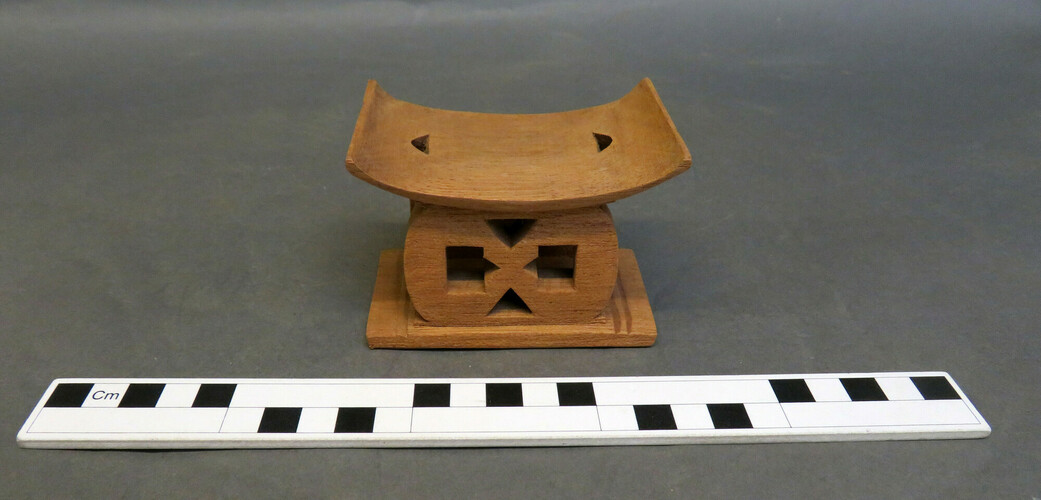 1945.12.19BModel wooden stool. [PR [OPS move] 17/5/2017]1945.12.19B
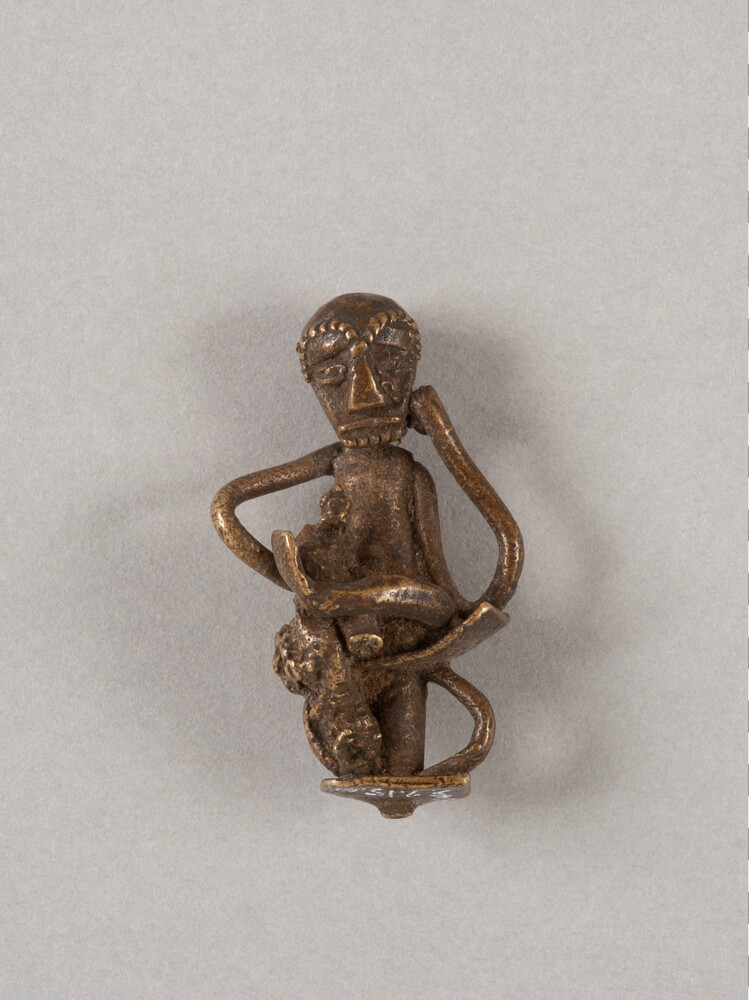 1949.7.15.61Copper alloy weight for weighing gold, in the form of a figure seating on a stool. [MJD 27/06/2011]1949.7.15.61
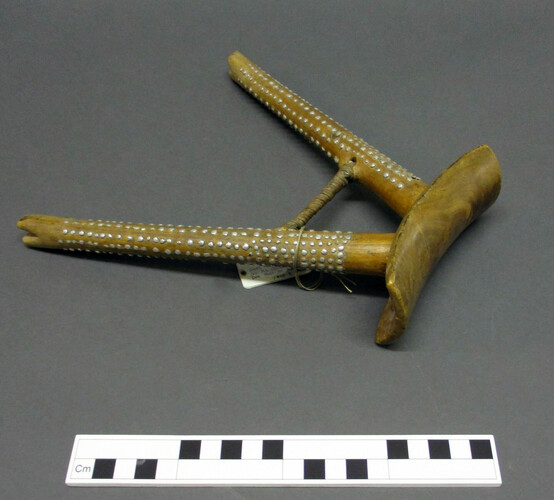 1978.9.2Headrest or stool, carved from a single piece of wood. Curved rectangular seat and two legs, decorated with solder. [EH [OPS Move] 17/3/2017]1978.9.2
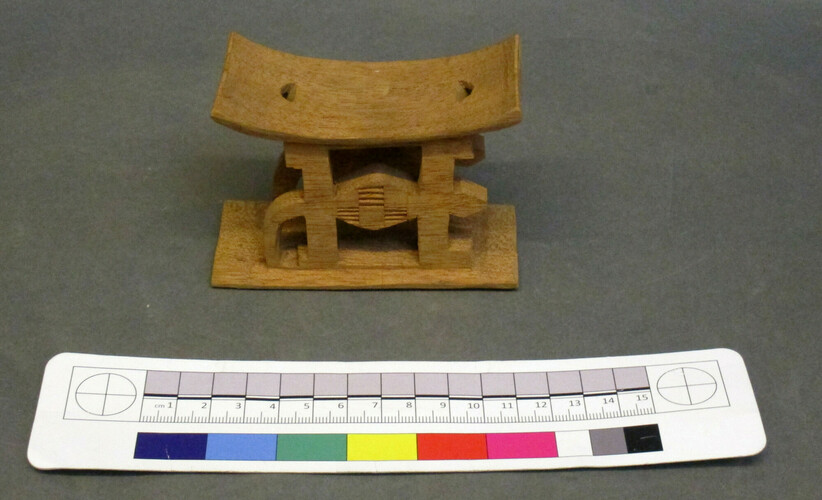 1945.12.2BModel stool, made of wood. It has a concave, rectangular seat and rectangular base with two ornamental supports in the shape of crocodiles. Each support has two pillars, creating four legs, with a rounded body, projecting head and long curving tail. The body is decorated with three squares of transverse grooves. [JC [OPS move] 16/5/2017]1945.12.2B