
- Collection type
- Object
- Description
- Small rectangular dance and fighting shield, made from giraffe hide [RTS 16/9/2005].
- Long description
- Small shield formed from a thick rectangular piece of reddish brown giraffe skin (Pantone 732C), with long, straight sides and a slightly concave upper and lower edge that flares out to form projecting horns at each corner, with a short triangular tab of hide bent inwards from the centre of the base. A deep line has been cut just inside the edges, as a decorative frame. The fornt of the shield is irregularly concave across its width, and convex along its length. It has a raised, rounded rib running down the centre, where the hide has been pushed up from its underside. This is flanked by large stitches on either side, made from narrow hide thongs, doubled up, and arranged as single pairs of stitches at top and bottom, with 2 double pairs at the centre. The lowest pair of stitches has been made from a twisted yellow grass cord, rather than hide, and is probably a repair (Pantone 7508C). These hold a wooden strut running down the back of the shield in place. This has been carved from a single piece of yellowish brown wood (Pantone 7508C), and has a lentoid-shaped section for most of its length, becoming more oval at its base. It extends just above the top of the shield body, and further beyond its base. Towards the centre, it has been bent outwards to form a hand grip, with a thick, lentoid-shaped piece of dark brown hide fitted beneath this section to protect the knuckles (Pantone Black 7C). It rests on two short pieces of similar hide, and has a narrow strap extending out from one side. Originally both ends of this would have fitted beneath the lentoid piece, but one looks to have been broken in the past, then mended by piercing the broken end and tying it to a thong that passed around the strut. The grip protector and hide handle are otherwise held in place by the same hide thongs that are visible as stitches on the front of the shield. The wooden strut has been bound round with narrow hide strips, in addition to the thongs that hold it in place; these have been plaited together to form a raised ridge that runs along the wood in 3 separate sections; this binding does not cover the actual handle area or those parts of the wood that extend beyond the shield body. There is a small loop at the ends of two of the plaited ridges, perhaps intended to fasten some kind of suspension loop, now missing. The shield is nearly complete, but damaged. There are some cut marks on the front of the body, and a tear in the lower corner; the hide has become stressed and the surface is beginning to flake in some areas. The handle has cracked across its centre, and some of the hide binding strips are missing just below. It has a weight in excess of 1000 grams. The body is 500 mm long, 220 mm wide and 6.6 mm thick; the wooden strut is 595 mm long, 18.8 mm wide and 5 mm thick; the handle guard plate is 70 mm wide, and the side handle is 130 mm long, 18 mm wide and 5 mm thick. The thong stitching has a width of 6 mm [RTS 16/9/2005].
- Cultural groups
- Southern Laarim
- Date / Period
- Date made: Before 03/1979
- Date collected
- 20 - 25 March 1979
- Acquisition information
- Purchased: 1979
- Materials and processes
- Material Giraffe Skin Animal, Material Wood Plant, Material Plant Fibre, Process Carved, Process Incised, Process Plaited, Process Bound, Process Stitched, Process Repaired (local), Process Twisted
- Dimensions
- Length: max 595 mm, Length 500 mm hide body, Width: max 277 mm, Depth: max 105 mm, Weight 1000 g
- Object numbers
- Accession number: 1979.20.180 Other numbers: ∆32
- Research and responses
This shield was used for fighting or dancing; attaching a ball of feathers such as ostrich would turn it into the latter. For a similar Southern Larim shield collected in the same period, and costing £1.50, see 1979.20.146; that example is made of buffalo skin and was used for fighting; it is called kilip chidoro in Larim. This style of rectangular hide shield is also found amongst other cultural groups in southern Sudan and northern Uganda, including the Toposa (1939.7.120), Turkana, Suk, Didinga, Lango and Acholi (1952.5.10); see M. Trowell & K.P. Wachsmann, 1953, Tribal Crafts of Uganda, pp 229-230 and pl. 58.A1-2 and B1-2, and J.H. Driberg, 1923, The Lango, pp 81-82, both of whom describe how these shields were made. Amongst both the Acholi and the Lango, both authors suggest that balls of feathers would be added to the base of the shield prior to battle. Driberg tells us that Lango men usually made their own shields (op. cit., 82). The Acholi and Lango versions tend to be larger than those used by the Toposa, Didinga, Turkana and Larim, who tend to use them as parry shields in close combat (C. Spring, 1993, African Arms and Armour, p. 121; J. Mack, 1982, "Material Culture and Ethnic Identity in Southeastern Sudan, in J. Mack & P. Robertshaw (eds), Culture History in the Southern Sudan, p. 116 and fig. 2). [RTS 16/9/2005].
Search terms: Weapon, Dance, Shield, Dance Accessory
Further items to explore
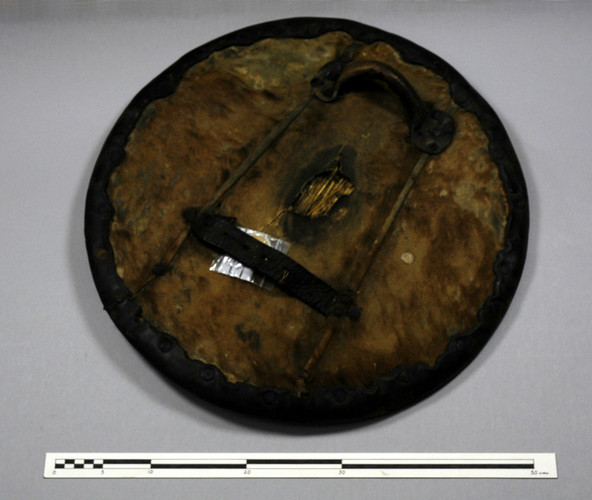 1888.46.1Round shield of wood, covered with leather with tooled curvilinear patterns. Central brass boss and pattern of brass and copper studs. [LM 03/04/2007]1888.46.1
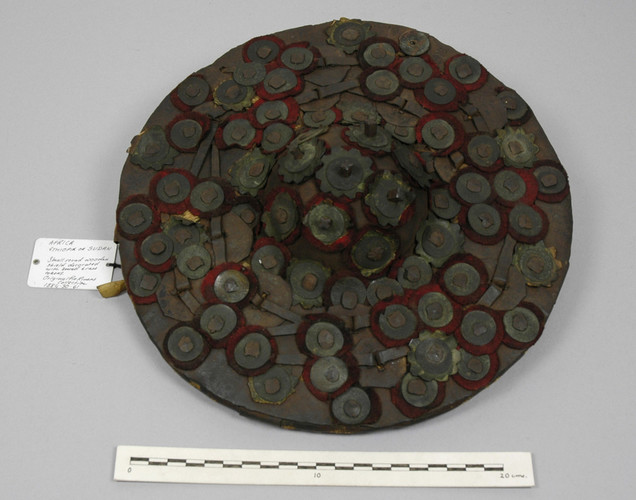 1884.30.61Small round wooden shield, with false boss covered with small brass tokens or coins [SM 14/03/2007]1884.30.61
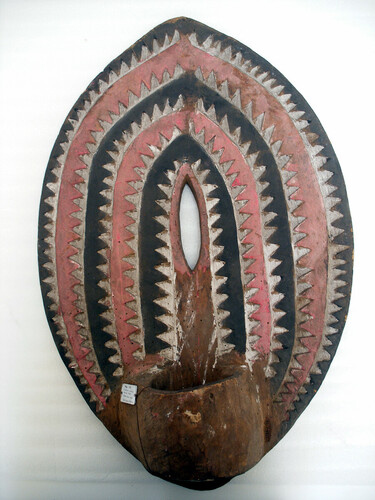 1966.1.33Wooden dance shield with simple front carved design1966.1.33
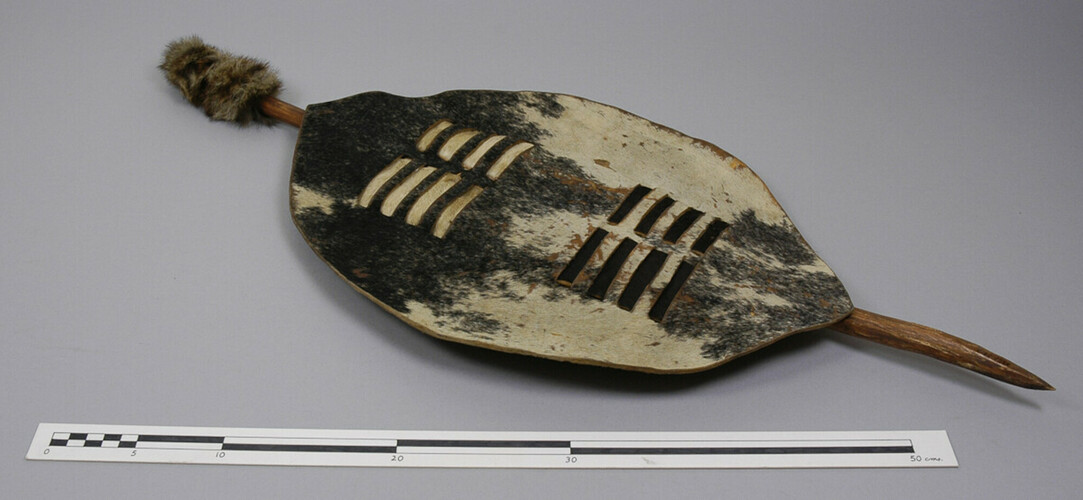 1937.38.1Black and white cow hide shield used at weddings. [SM 14/03/2007]1937.38.1