
- Collection type
- Object
- Description
- Waist ornament made from elephant ear hide, with glass beading at front, worn by men [RTS 16/6/2004].
- Long description
- Waist ornament consisting of a rectangular strip of elephant hide, taken from the ear of the animal, and bent into an oval loop to fit around the waist. This strip has been doubled over to present a convex outer face and flat inside edge where the two sides of the strip are pressed together, leaving a groove running around the circumference between. It tapers to either end, with the ends tied together and wound several times around the join. The hide is a dark brown colour, with some small reddish brown hairs visible in places (Pantone black 7C). At the centre of the object is a small section of beadwork, 24 to 26 mm in width, strung on short vertical lengths of plant fibre to wrap around the curved outer face of the hide strip, with each length then knotted off at either end on the inside face of the object. This section consists of 10 vertical rows of 18 beads each (except one of the edge rows, which has only 16 beads), arranged in a repeating design of 4 green beads (Pantone 359C), a group of red-black-red beads (Pantone 1797C and black 6C), 4 green beads, another red-black-red group, then a final 4 green beads. This makes a total of 178 beads. The beads appear to be made of opaque glass, whose surfaces are partially discoloured by dirt; these are all of the same shape - a small ring or 'seed' bead with convex sides. In additional to the vertical threads that run through each column, there are two horizontal bands of twisted plant fibre stitching to hold the beads in place as a group; these are positioned just below and above the top and bottom bands of green beads. On either side of this beadwork, the outer surface of the object has been decorated with a series of shallow incised grooves that run parallel to the edges. On one half of the object there are three grooves - placed with one groove around the edge of the upper face, a second groove around the outside edge, and the third groove on the ornament underside. The areas between grooves have been decorated with two bands of incised oblique hatching; just before the central beaded section, there is a small gap, then the hatching changes direction. The decoration of the other half of the object is not symmetrical to the first half. There are four roughly parallel grooves around the surface. In addition, between these, the underside is decorated with a horizontal band of oblique hatching, all running in one direction, a short section where a fifth groove is added to the underside, then a continuation of the hatching band. The upper surface has no further decoration until it approaches the knotted end of the waist band, where there is similar oblique hatching. The object appears to be complete and intact. It has a length of 327 and a width of 260 mm (across the outside edges), and 305 by 231 (across the inside edges). The hide strip is 12.5 mm high, and 13.5 mm thick, in its current doubled over form. The binding strips around the tied off area, which are assumed to be a continuation of the ends of the waist band strip, are 5 mm wide. The beads are all of very similar dimensions, with a typical example being 2 mm in diameter and 1 mm thick. It weighs 120.3 grams [RTS 16/6/2004].
- Geographical reference
- Eastern Equatoria Lomachada Kapoeta
- Cultural groups
- Northern Laarim
- Date / Period
- Date made: Before 1979
- Date collected
- 21 March 1979
- Acquisition information
- Purchased: 1979
- Materials and processes
- Material Animal Hide Skin, Material Glass, Material Plant Fibre, Process Beadwork, Process Incised, Process Tied, Process Stitched
- Dimensions
- Length 327 mm, Width 260 mm, Length 305 mm internal, Width 231 mm internal, Depth 12.5 mm, Weight 120.3 g
- Object numbers
- Accession number: 1979.20.143 Other numbers: Langton Collection PL 9
- Research and responses
The green, black and red beads on this object are the same type and colours as seen on the goat hide belt, 1979.20.179, which is attributed to the Southern Larim. For this object, we are told that the beads came from Kapoeta [RTS 16/6/2004].
Search terms: Ornament, Dance, Status, Bead, Clothing, Waist Ornament, Dance Accessory, Belt
Further items to explore
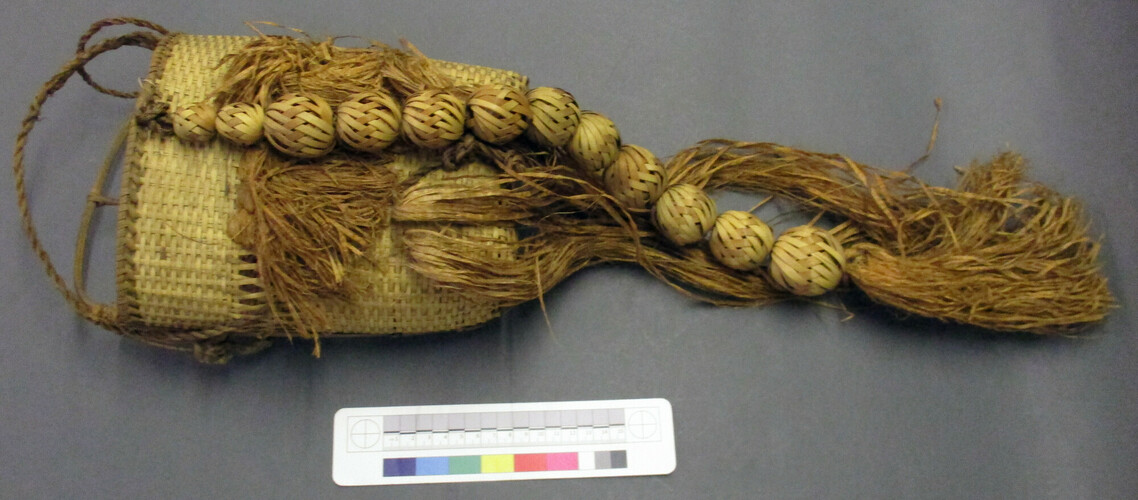 1928.69.324Basket with plant fibre streamers and string of twelve cane woven balls. [MJD 13/5/2010]1928.69.324
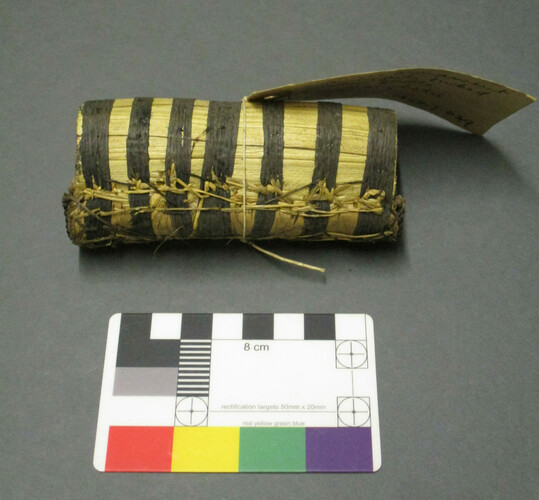 1940.7.029Waist ornament. Made from strips of plant leaf, bound into a cylindrical shape by black strips of plant fibre. In total there are seven strips of plant fibre down the whole piece. There is a flap at one end of the cylinder. [ASh [OPS move] 30/11/2016]1940.7.029
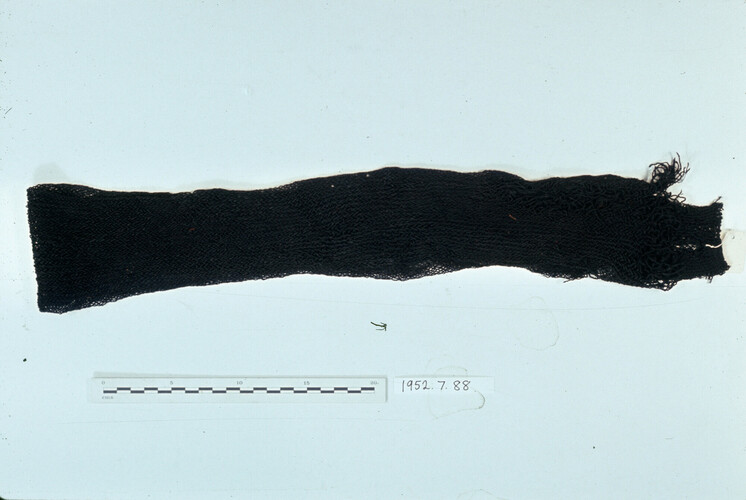 1952.7.88Portion of belt, very loosely woven with coarse cotton thread, dyed indigo. No decoration.1952.7.88
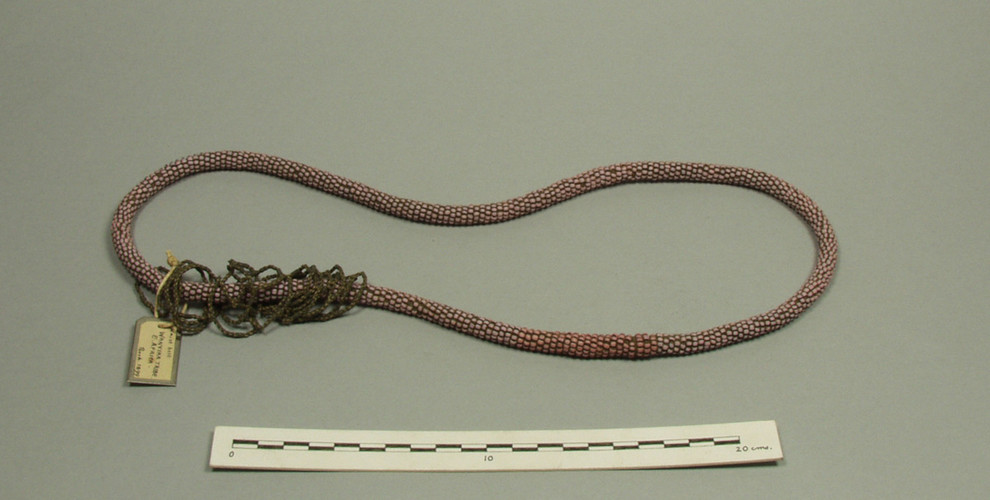 1899.83.13Waist belt of pink beads, with chain circles strung on [L.Ph 'DCF 2004-2006 What's Upstairs?' 29/4/2005]1899.83.13
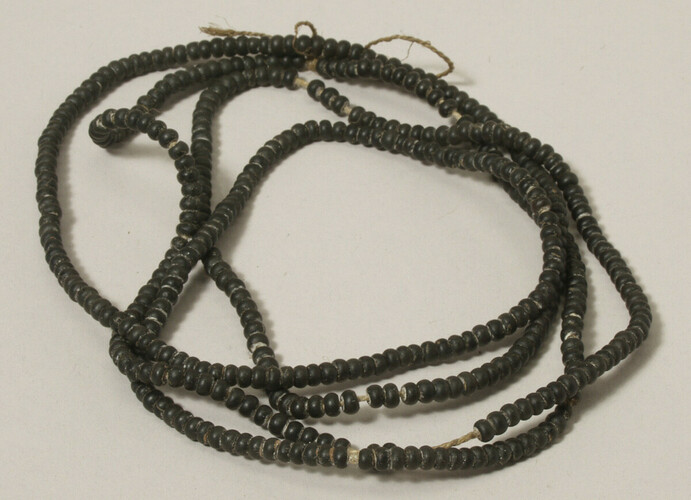 1979.20.189Small black ring shaped seeds strung onto a length of twisted plant fibre, worn as a necklace [RTS 14/5/2004].1979.20.189
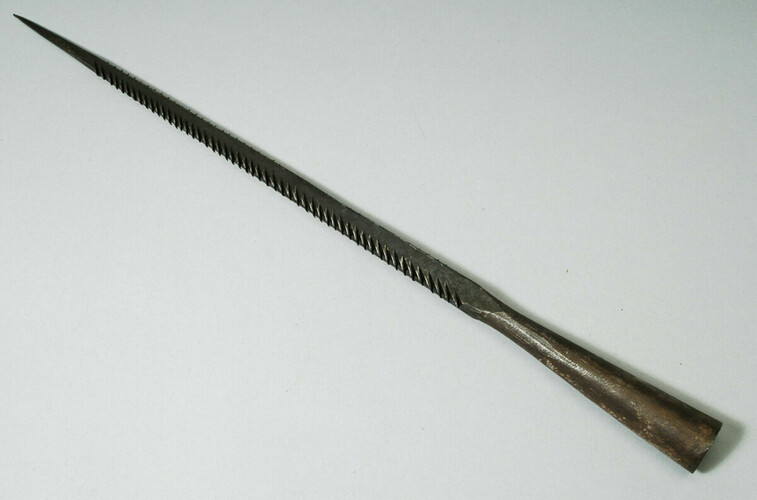 1936.10.7Iron spear-head with narrow barbed body and a socketed base, used for fishing and of European manufacture [RTS 27/6/2005].1936.10.7
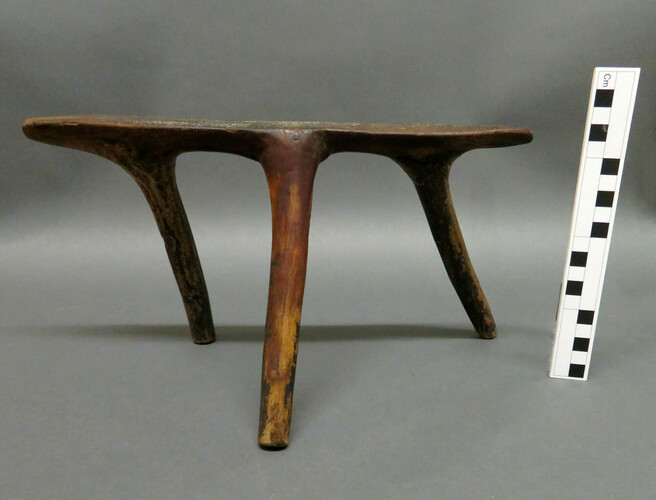 1936.10.55Headrest carved from a tree branch, with narrow seat, pointed at either end, and 3 angled legs [RTS 2/6/2005].1936.10.55
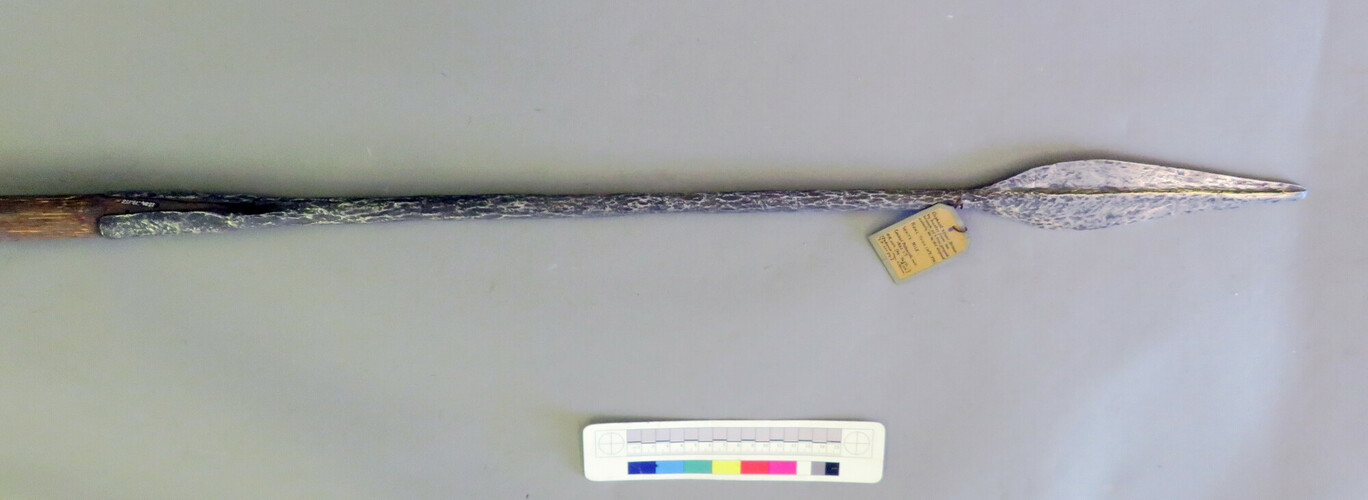 1884.19.158Elephant spear with bamboo shaft and socketed leaf-shaped ogee iron blade with long shank. At the end of the shaft is a large wooden butt with a flat bottom. [RH [OPS move] 5/9/2018]1884.19.158