
- Collection type
- Object
- Description
- Basketry fighting helmet made from tightly woven palm fibre, with flat everted brim and a twisted hide chin loop [RTS 17/11/2004].
- Long description
- Hat or helmet with an oval plan view, made from several strands of plant fibre, bundled together, and then bound round with narrow palm strips, creating a continuous circular coil that is bent round in a spiral, with each loop being woven into neighbouring loops by the binding strips. This has a flat circular top, with a small circular hole at the centre, where the spiral begins. The sides then curve out and down to a slightly bulging middle before turning concavely into the base of the crown, where a narrow brim projects out at right angles for around 30 mm. The lip of the brim curls up slightly. This has been carefully finished, with the overlapping starting edge of the coil woven tightly into the adjacent loop. A series of narrow gaps have been left in the body, where the adjacent coils have not been woven into each other. This creates a narrow 'buttonhole'-like slot, around 12 to 14 mm long, that could have been used to seat various attachments, such as a feather plume. There are 2 such slots on opposite sides of the brim, 3 slots in an oblique line rising up one side of the crown, and an additional slot near the top edge. 3 hide cords have also been sewn into the top of the crown, leaving a single stitch across the upper surface in each case and their ends dangling down inside the hat. These loose ends are very short, and may have been broken or cut away; this may have been to secure further ornaments. Finally, a short length of cord made from two narrow hide strips twisted together has been threaded through holes on either side of the brim, where it joins the crown, and knotted on the outside to hold it in place. This was presumably added as a chin or neck strap to keep the hat in place; it has begun fraying near its ends, where the cord has rubbed against the edges of the holes. The original colour of the palm strips appears to be a light yellowish brown (Pantone 7508C), now a darker brown over most of the surface (Pantone 462C); the hide cord is a similar colour. The hat is complete, apart from the apparently broken hide ties at the top of the crown, but there is some damage to the inside edge of the brim wher the hat would have been in contact with the head. This consists of sections where the fibre binding has been worn away, exposing the fibrous core beneath. The hat has a brim length of 257 mm, brim width of 215 mm, and height of 115 mm; the crown itself is 105.4 mm deep. The chin cord has a diameter of 4 mm, while the hide stitches are 4 mm wide [RTS 17/11/2004].
- Geographical reference
- Northern Bahr el Ghazal Dhangrial Wun Rog Mayen
- Cultural groups
- Dinka Tuich
- Date / Period
- Date made: Before 1979
- Date collected
- 22 February 1979
- Acquisition information
- Purchased: 1979
- Materials and processes
- Material Palm Fibre Plant, Material Animal Hide Skin, Process Basketry, Process Woven, Process Coiled, Process Twisted, Process Tied, Process Knotted, Process Stitched
- Dimensions
- Height 115 mm, Length: max 257 mm, Width: max 215 mm, Height 105.4 mm internal, Weight 193 g
- Object numbers
- Accession number: 1979.20.100 Other numbers: Langton Collection 247
- Research and responses
At the time this object was collected, the Bahr el Ghazal province was bordered by the Upper Nile Province to the east and Western Equatoria to the south; this area is now divided into the districts of Western Bahr el Ghazal, Northern Bahr el Ghazal, and parts of Warab and El Buheyrat. Dhangrial, Wun Rog and Mayen lie within Northern Bahr el Ghazal. For a map showing the distribution of Dinka Tuich groups, see J. Ryle, 1982, Warriors of the White Nile: The Dinka, p. 25.
Nebel gives the definition of Athugo as 'Helmet of a recently initiated youth, to cover his wounds’; presumably athugo nhoon must be a related term (Nebel 1979, Dinka-English Dictionary, p. 13) [RTS 17/11/2004].
Search terms: Clothing Headgear, Armour Weapon, Helmet, Armour, Headgear, Hat
Further items to explore
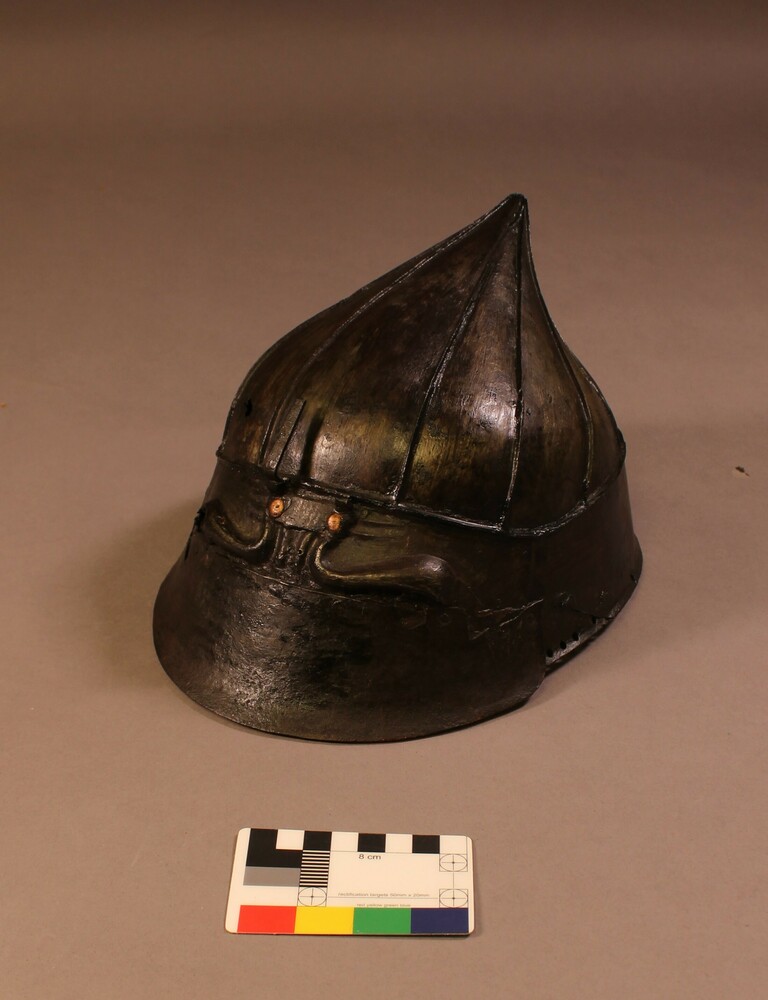 1884.32.9Helmet with backward-pointing projection on crown with peak and hooks for face, mask crest1884.32.9
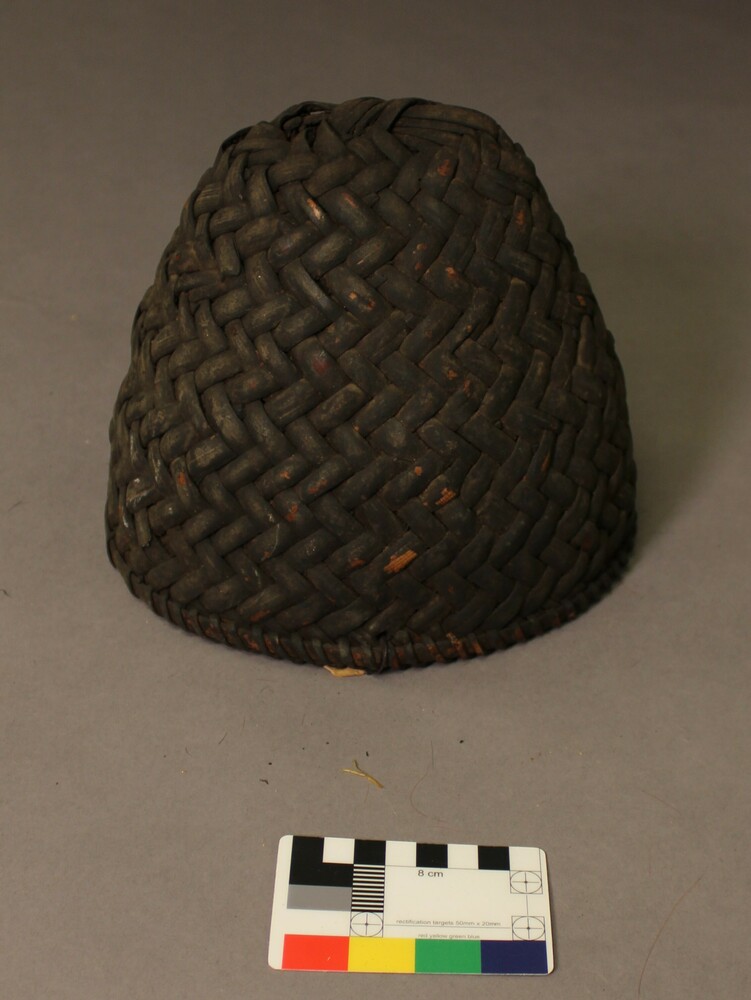 1923.84.569Helmet of cane, used in war and hunting.1923.84.569
 1901.46.1.23Horn [.23] mounted on the helmet, part of complete suit of Japanese armour.1901.46.1.23
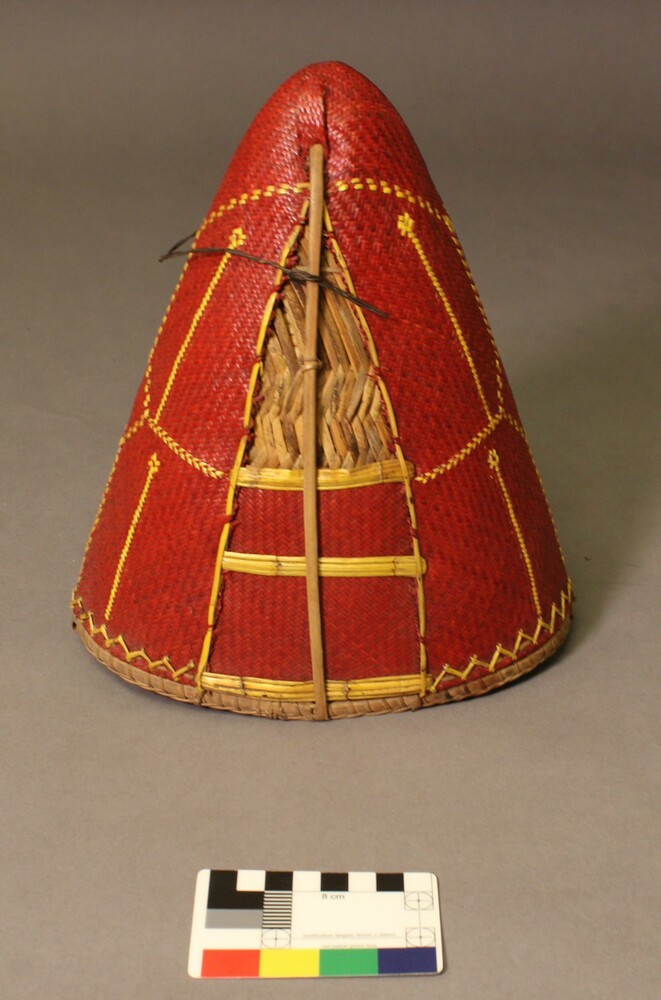 1946.7.86Cane helmet1946.7.86
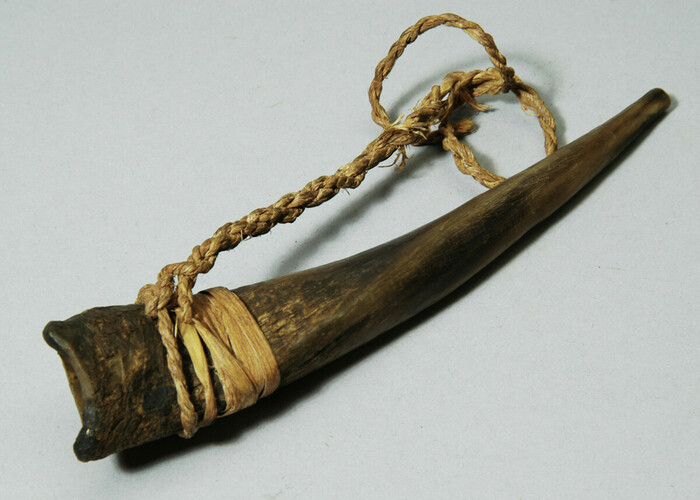 1934.8.96Notched end-blown flute carved from twisted antelope horn, with added resin narrowing the embouchure; wound round with fibre strips tied to a twisted grass cord [RTS 6/12/2004].1934.8.96
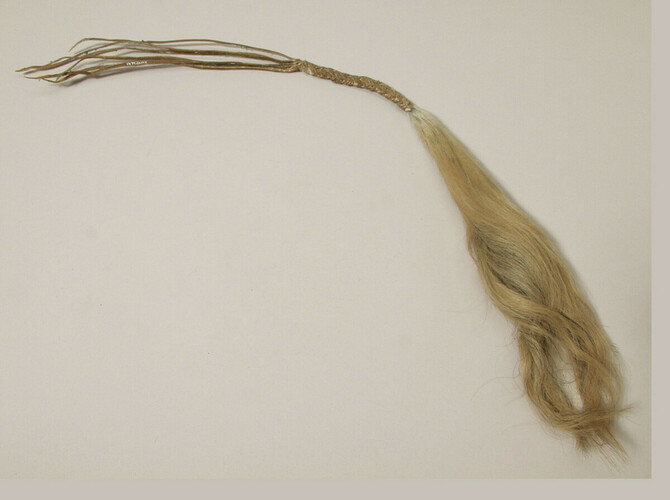 1979.20.145Unfinished upper arm ornament, with plaited hide arm band and tassel made from a cow's tail, worn by men [RTS 13/4/2004].1979.20.145
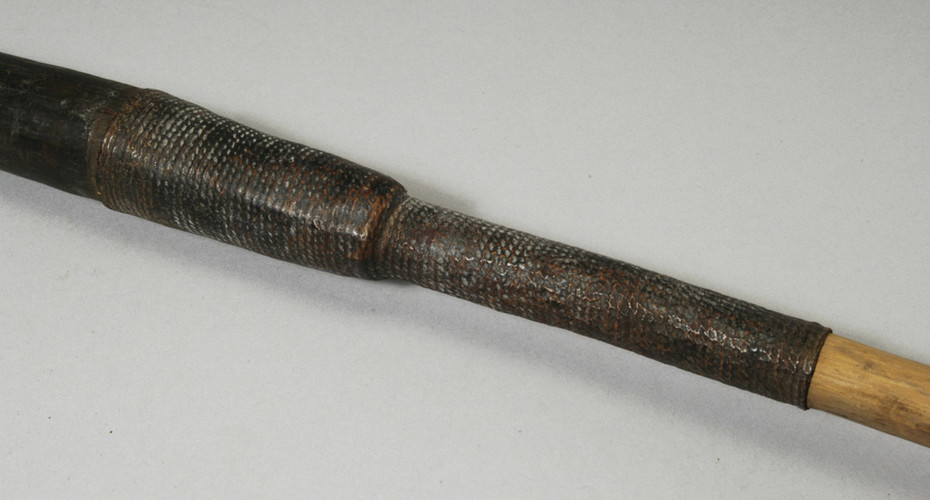 1919.13.18Spear with antelope horn point set into a long wooden shaft, with a tooled hide sheath covering the junction [RTS 5/8/2005].1919.13.18
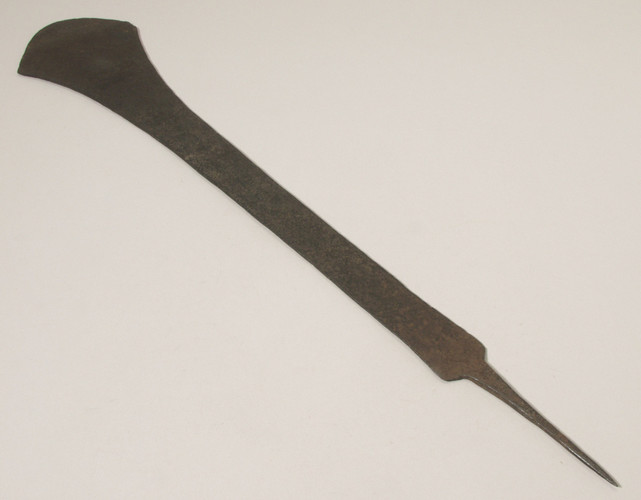 1934.8.131Long iron blade with splayed end and short tang, used as bride money [RTS 16/6/2004].1934.8.131