
- Collection type
- Object
- Description
- Shallow, circular winnowing tray made from grass covered in strips of dyed palm, arranged in concentric patterns [RTS 16/11/2004].
- Long description
- Circular winnowing tray with rounded rim and everted sides that flare down and in to form a shallow interior with flat base. It has been made from bundles of riath grass, bound round with narrow strips of palm, creating a continuous circular coil that is wound round in a spiral, with each loop woven into neighbouring loops by the binding material. The centre of the base is crossed by a number of palm strip stitches, covering the area where the coil begins, while the rim edge has been neatly finished with a herringbone style plaiting. Some of the palm strips have been left a natural yellow colour (Pantone 7508C), but others have been dyed pink (Pantone 190C), a greenish gray colour (Pantone 446C) and purple (Pantone 5265C). These colours look faded, particularly on the inside, and the originals may have been much brighter. These strips create a pattern around the object, made up of alternating blocks of colour. The rim is decorated with alternating pink and greenish gray blocks, with an undyed yellow band below, then a further row of pink and greenish gray. The walls below this are decorated with alternating rows of yellow and either greenish gray, or purple, then the central part of the tray is predominantly yellow, broken by rectangular blocks of greenish gray alternating with purple around the outside edge, a purple circle, a smaller greenish gray circle within this, then the central stitching, which has been dyed greenish gray. A short length of plant fibre cord has been threaded through the top rim edge of the tray, where a gap has been purposely left just before the end of the coil, then stitched back into the tray body on the other side. This cord has been made from a single strand, folded in half and then the two loose ends twisted together and knotted at the base. This was probably intended to be tied in a loop for suspension; it has been dyed pink, to match the rim colour. This would seem to have been done by dipping, and the colour has flaked off in places. The object is complete, but has some surface staining on the inside. It has a weight of 438.9 grams, a rim diameter of 425 mm and a height of 46 mm. Each coil is 5 mm wide, while a typical palm binding strip has a width of 2 mm [RTS 16/11/2004].
- Cultural groups
- Dinka Tuich
- Date / Period
- Date made: Before 1979
- Date collected
- 21 February 1979
- Acquisition information
- Purchased: 1979
- Materials and processes
- Material Grass Fibre Plant, Material Palm Fibre Plant, Process Basketry, Process Dyed, Process Bound, Process Plaited, Process Twisted, Process Knotted
- Dimensions
- Diameter: max 425 mm, Depth 46 mm, Weight 438.9 g
- Object numbers
- Accession number: 1979.20.81 Other numbers: Langton Collection 189
- Research and responses
At the time this object was collected, the Bahr el Ghazal province was bordered by the Upper Nile Province to the east and Western Equatoria to the south; this area is now divided into the districts of Western Bahr el Ghazal, Northern Bahr el Ghazal, and parts of Warab and El Buheyrat. Mayen is located within Northern Bahr el Ghazal . For a map showing the distribution of Dinka Tuich groups, see J. Ryle, 1982, Warriors of the White Nile: The Dinka, p. 25.
Colour readings were taken from the underside of the vessel, where the dyed strips were brighter and less faded.
This tray was made of riath, or riet, a type of swamp grass (Nebel 1979, Dinka-English Dictionary, p. 77 and p. 109 under 'basket'), covered in palm strips, known as nyeth. This type of tray is known as ateng. For a similar Dinka winnowing tray, see 1979.20.43, collected at Wun Rog. This style of work is typical of further North, in the Darfur region, particularly in the use of colour dyes (Jeremy Coote pers. comm. 25/11/2004). For a more local style of winnowing tray, see 1979.20.71-72 [RTS 20/9/2005].
This object was chosen to feature in a trail around the Pitt Rivers Museum in association with the Museum of English Rural Life on Farming The First 12,000 years (https://merl.reading.ac.uk/explore/online-exhibitions/farming12k/). It featured in a pamphlet with the caption "Winnowing baskets. After threshing, crops are winnowed to further separate to further separate grain from chaff. This involves throwing the mixture into the air so that the lighter unwanted chaff blows away. Crops can be winnowed by hand, using tools such as these baskets from Picardie, Seine-Maritime, France and Northern Bahr el Ghazal, Mayen, South Sudan. In Europe, the nineteenth-century drive for efficiency led to the invention of mechanised solutions to this job. Today, harvesting, threshing, and winnowing can be all carried out by a single machine - the combine harvester."[FB 5/1/2021]
- Associated publications
- Illustrated with a line drawing in the leaflet 'Basketry in The Pitt Rivers Museum', devised by Felicity Wood with the Oxfordshire Basketmakers, 2001. It is also featured on the website http://basket.prm.ox.ac.uk/ [JN 14/11/2001].
Search terms: Tool, Food and Fuel Gathering, Basketry, Agriculture and Horticulture, Tray, Basket, Agricultural Tool, Food Accessory
Further items to explore
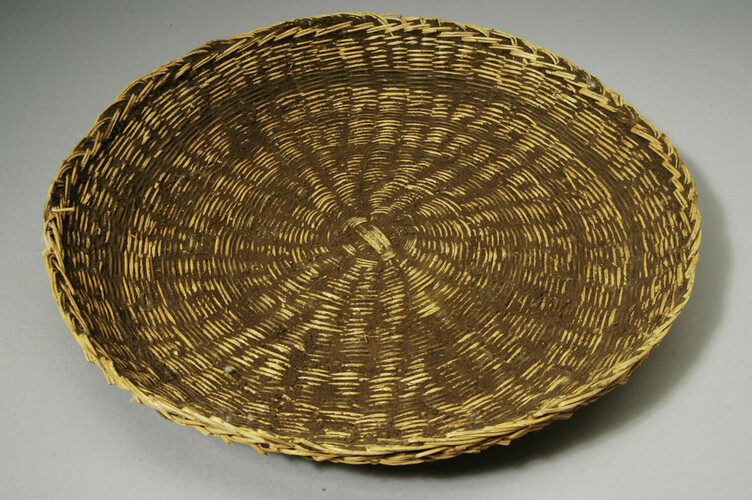 1979.20.71Shallow basketry lid, also used as a winnowing tray; decorated with 3 brown bands [RTS 2/8/2005].1979.20.71
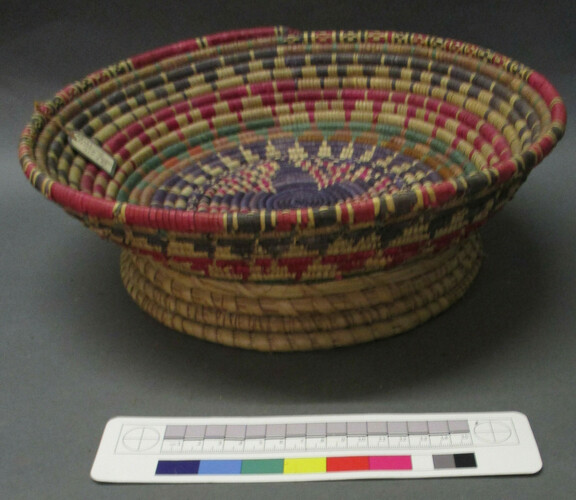 1945.9.67Circular coiled basketry tray, with plain coiled basketry pedestal. The tray is patterned with a central star design, with concentric bands and triangles, made from strands dyed purple, pink and green on a natural ground. [CW [OPS Move] 15/12/2016]1945.9.67
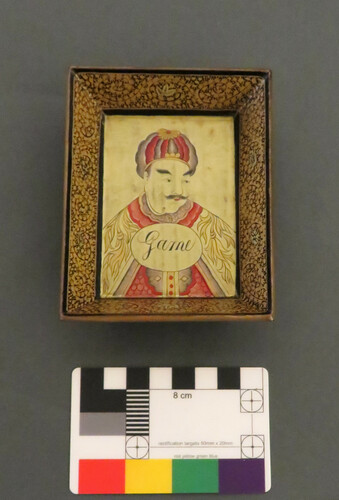 1992.8.3.17Rectangular lacquered gaming tray with sloping sides, part of a lacquered gaming box set. The base is plain black lacquer-ware on the inside, with a gold rim. The insides is decorated with a gold scroll border and a central figure with a curled moustache, wearing a turban. The word 'Game' is encircled. For the other decorated trays see [1992.8.3 .18 - 28]. [CW [OPS Move] 22/3/2017]1992.8.3.17
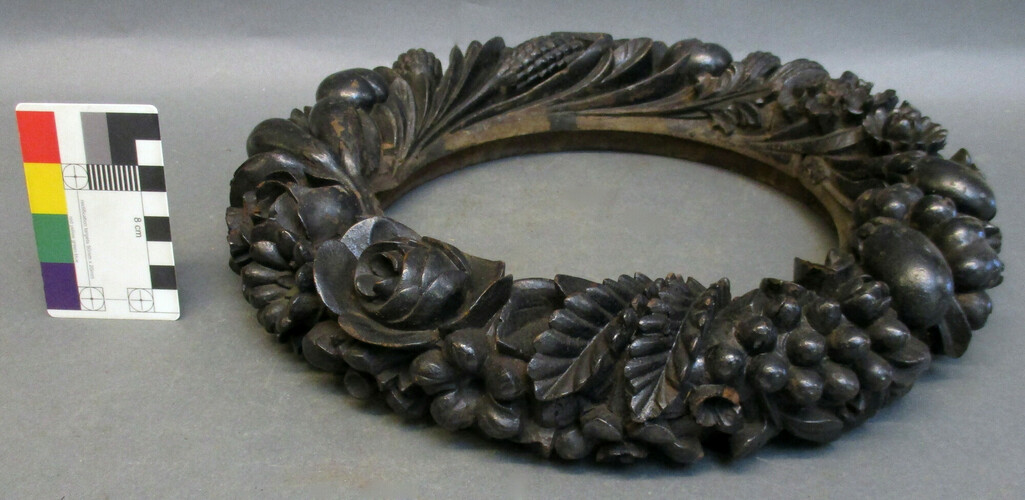 1969.16.1.4A circular wooden wreath that acts as a top section for a plant pot. For all four parts of the plant pot see 1969.16.1 .1 - .4 [RM [OPS move] 26/10/2016]1969.16.1.4
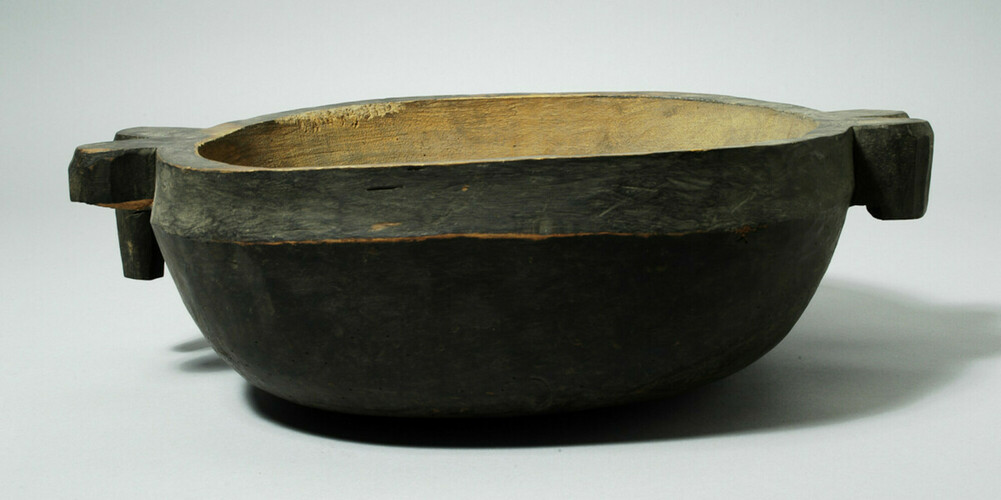 1970.38.8Oval wooden food bowl with carinated body, flat base, and 2 pairs of pendant lug handles on either side of the rim [RTS 17/5/2005].1970.38.8
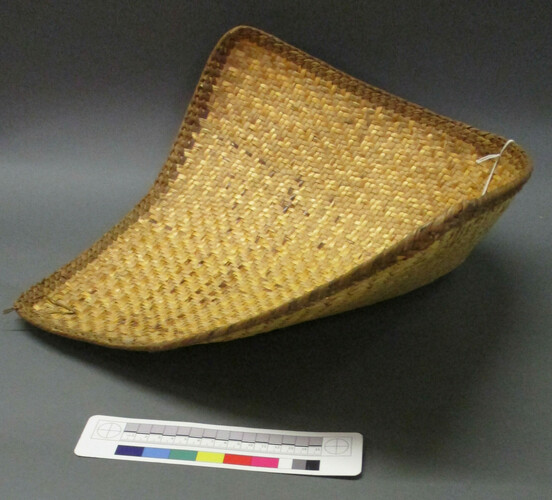 1979.20.26Basketry winnowing tray made of yellow checkerwoven fibre strips with a brown border [RTS 20/9/2005].1979.20.26
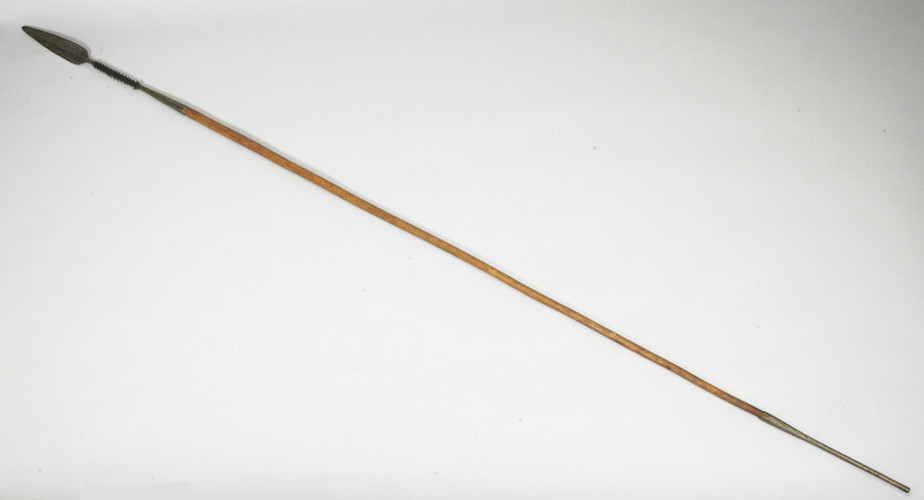 1934.8.1Spear with iron leaf-shaped spearhead, square barbed shank and socketed base on a long wooden shaft with a socketed iron butt [RTS 11/7/2005].1934.8.1
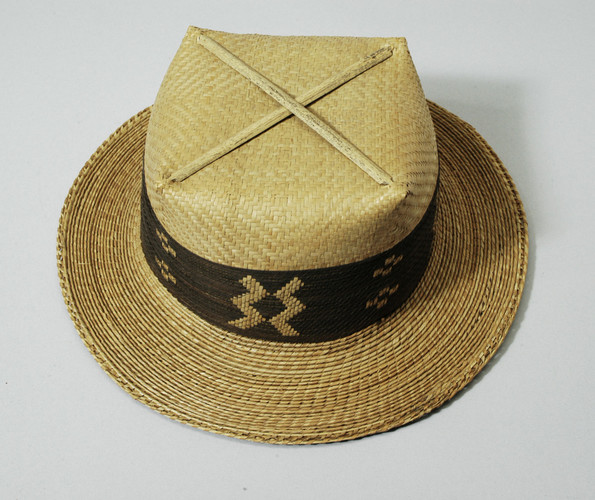 1930.86.34Basketry hat with square crown strengthened with cane cross-pieces, brown band with vertical zigzag motifs around body and a broad flat brim, worn by men [RTS 7/2/2005].1930.86.34