
- Collection type
- Object
- Description
- Deep hemispherical pottery bowl with inturned, flat-topped rim, for cooking sorghum porridge [RTS 3/6/2005].
- Long description
- Pottery bowl made from a coarsely levigated fabric with mica and some large stone inclusions, fired at a low temperature to create a mottled reddish brown (Pantone 479C) to black surface inside and out. The vessel has an inturned rim with narrow flat top, on a deep hemispherical body with convex base. Apart from a narrow reserved band that was wiped immediately below the rim, the entire exterior surface has been covered with impressed decoration, consisting of a series of closely spaced oval depressions, probably made using a roulette tool. In a few areas the decoration has been distorted or smoothed, probably as the pot was being hand turned while applying the design. The vessel is nearly complete, but has a small section of the rim missing. There are also several small cracks around the rim. It has a weight in excess of 1000 grams, and is 200 mm high, with a rim diameter of 240 by 247 mm and rim thickness of 4 mm; the maximum diameter across the shoulders of the vessel is 270 mm [RTS 3/6/2005]
- Cultural groups
- Moru Misa
- Date / Period
- Date made: Before 1979
- Date collected
- 5 February 1979
- Acquisition information
- Purchased: 1979
- Materials and processes
- Material Pottery, Process Handbuilt, Process Decorated, Process Impressed, Process Incised, Process Fire-Hardened
- Dimensions
- Height: max 200 mm, Diameter: max 270 mm, Diameter: max 247 mm rim, Weight 1000 g
- Object numbers
- Accession number: 1979.20.13 Other numbers: Langton Collection 36
- Research and responses
This type of pot was called wese and is used for cooking durka, a type of sorghum porridge. For a similar vessel Moru Misa vessel made from the same fabric and with comparable decoration, see 1979.20.33.
For a photograph showing a female Moru potter using a roulette to apply decoration to a pottery vessel, see Barley, N., 1994, Smashing Pots, p. 36 top (photograph by John Mack; this similarly covers large parts of the vessel surface). Different styles of grass roulette may be found in the Pitt Rivers Museum collection; plaited grass strings (1979.20.28, Moru Misa; 1979.20.125-6, from the Dinka Tuich), and string wrapped around sticks (1949.20.27, Moru Misa). A number of South Sudanese clays seem to contain particles of mica, including those used by the Zande and Bongo (P.M. Larken, 1926, "An Account of the Zande", Sudan Notes and Records IX no. 1, p. 4; G. Schweinfurth, 1873, In the Heart of Africa Volume I, p. 292; Volume II, p. 25). [RTS 12/1/2004].
Search terms: Vessel, Food and Drink, Pottery, Cooking Vessel, Bowl, Food Accessory
Further items to explore
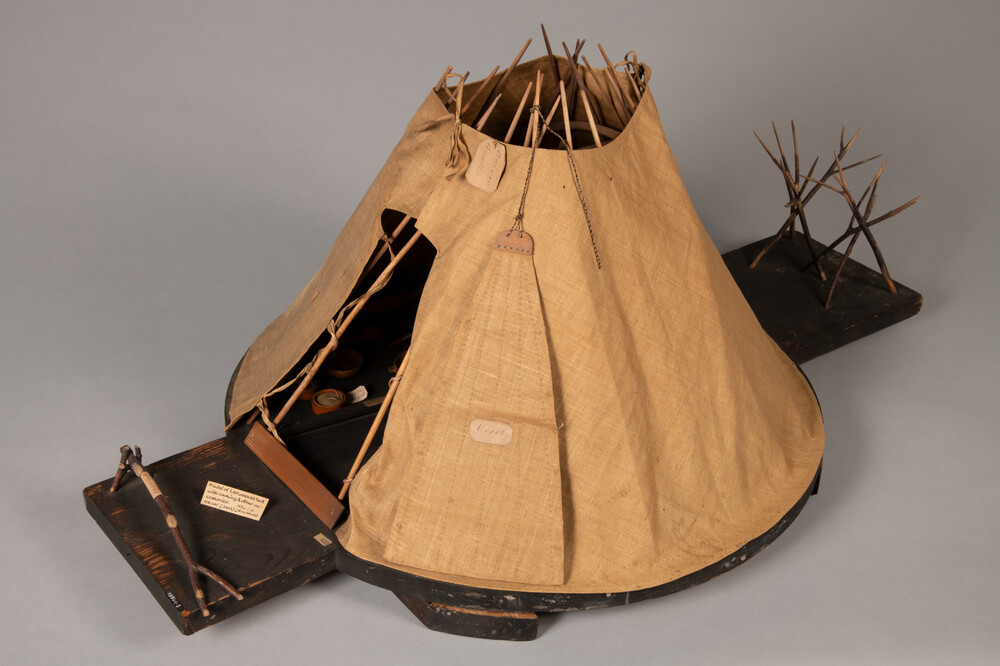 1884.1.3Model tent with cooking and other accessories and drying erection and log outside.1884.1.3
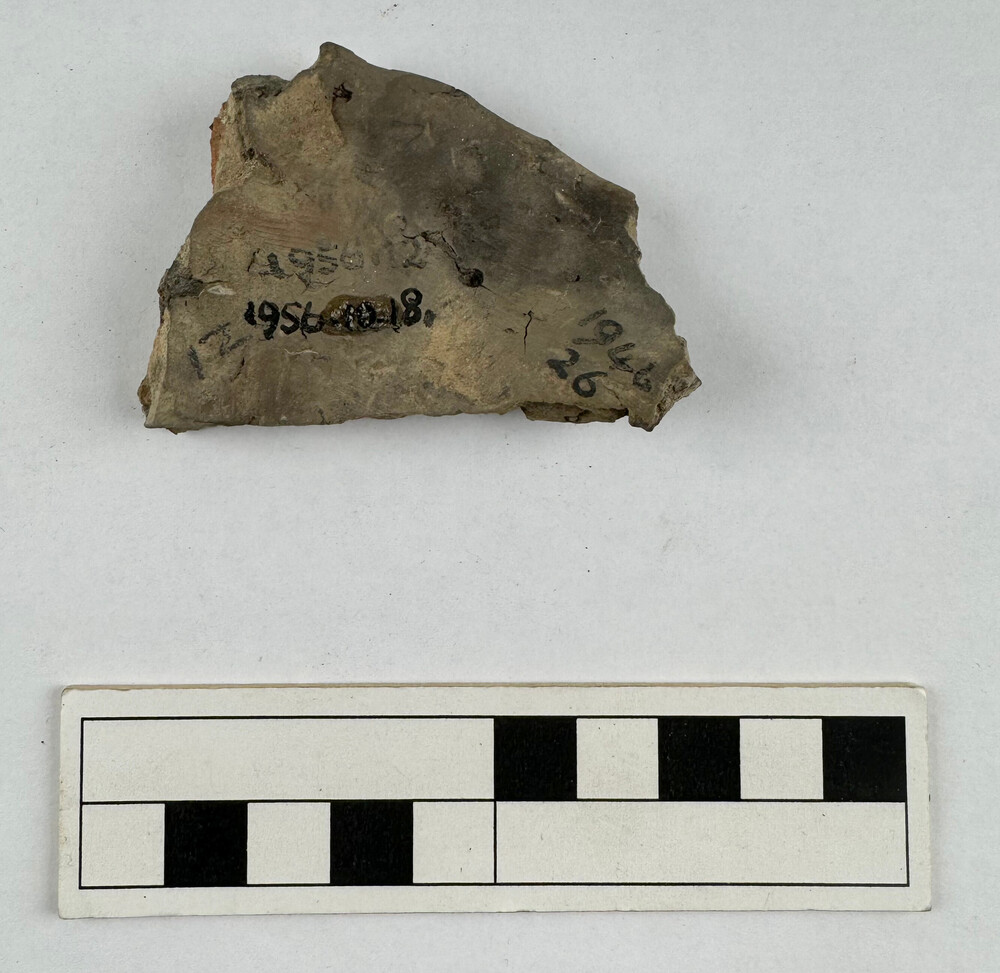 1956.10.18Pottery sherd from the shoulder of a cooking pot, with impressed linear decoration.1956.10.18
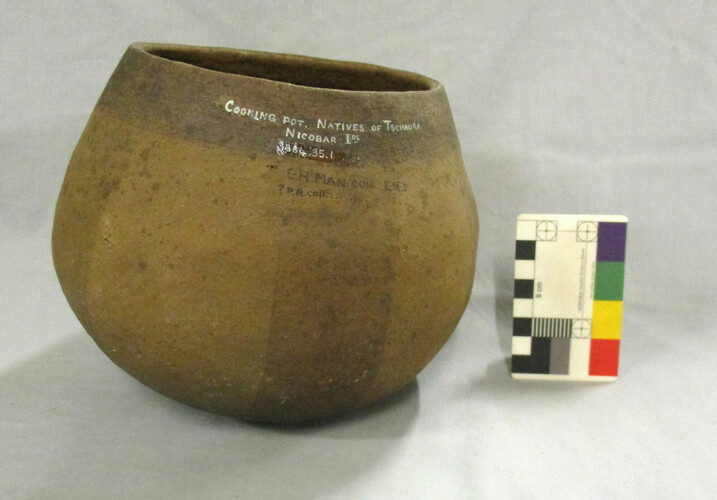 1884.35.1Black-topped, red ware, globular cooking pot with in-sloping surface. [ASh [OPS move] 13/04/2016]1884.35.1
 1884.1.3.50.2Wooden cooking accessory, lid for cooking pot. Accessory for model tent (see 1884.1.3).1884.1.3.50.2
 1934.8.32Wooden bow with tapering, perforated ends and sinew bow string [RTS 27/9/2005].1934.8.32
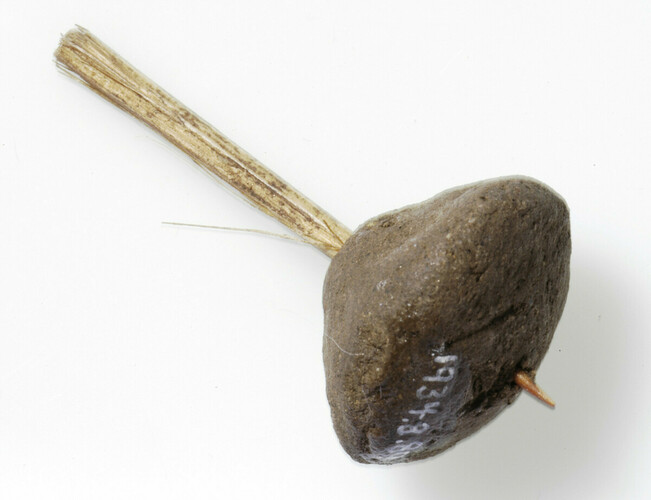 1934.8.80Spinning top made from a hand made clay whorl threaded onto a plant thorn [RTS 21/7/2004].1934.8.80
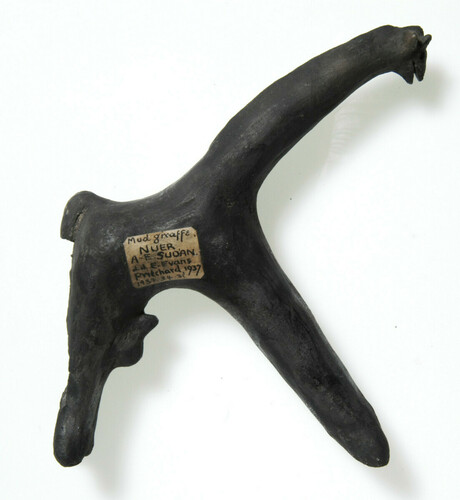 1937.34.71Hand modelled clay figure of a male giraffe, used as a toy.1937.34.71
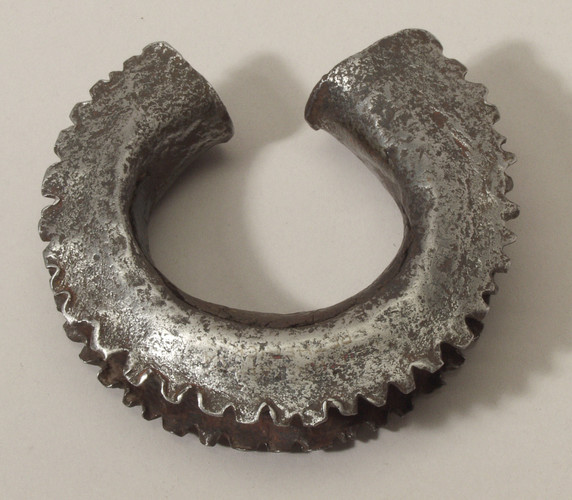 1884.82.23Heavy iron warrior's armlet with denticulated edges, decorated with abrus seeds, cowrie shells and glass beads [RTS 5/3/2004].1884.82.23