
- Collection type
- Object
- Description
- Dao with large single edged blade with curved cutting edge and long visible tang, with a small bamboo haft bound with cane. [SM 06/07/2007]
- Long description
- The spine is roughly straight, the cutting edge is convex with a small hooked tip. The tang forms a long spike at the end of the dao. [SM 06/07/2007]
- Cultural groups
- Zeme Naga
- Date / Period
- Date made: Before 1946
- Date collected
- 1938 - 1946
- Acquisition information
- Donated: 08/07/1983
- Materials and processes
- Material Iron Metal, Material Bamboo Plant, Material Reed Plant, Material Plant Fibre, Material String Plant, Process Forged (Metal), Process Carved, Process Bound, Process Recycled, Process Tied, Process Twisted
- Dimensions
- Length: max 1090 mm, Width: max 102 mm
- Object numbers
- Accession number: 1983.13.1
- Research and responses
In a letter to Bryan Cranstone dated 21st February 1983, Ursula Betts (Graham Bower), describe this dao and its acquisition:
"Its history is this. I was told of this type of dao by some of the old men; it is now completely obsolete, and was 40 years ago. I was told of a smith who remembered the pattern, and commissioned one. (It came, I think, from Khangnam, a very remote area where much tradition remained which had been lost elsewhere). When it arrived it was an object of great interest and almost reverence to the Laisong villagers, who had heard of the type, but never seen one, and I received numerous requests to buy it from old men who wished to include it in their grave-goods. Since I had been for some time then in the Nzemi area and my interest in Naga tradition and custom was known, the smith did his best for me. The dao started out as 18" of rail acquired by night from an Assam Railway scrap-dump - railway metal was apparently workable in the fairly primitive Naga forge; this, I think, accounts for its unusual size and weight. As it stands, it is a purely ceremonial dao, far too heavy for any practical use - but possibly conferring considerable prestige on the owner. I have no idea at all when daos of this type when out of use. I was told that the spike protruding beyond the grip was used to stick the dao upright in the soil, as is necessary with Naga spears. When required for use, the spike was clenched back parallel with the handle. As for Naga spears, these should always be thrust upright into the ground; if propped in a corner the shaft warps and will not throw true...
...2) A large, heavy Zemi Naga dao of a long-obsolete pattern. It was made for me by an elderly smith who remembered the ancient way; and, may I say, I had to fight a running battle for some time against aged gentlemen who desired it for their grave-goods, because it would make them suitably equipped to meet their ancestors. Incidentally, it started life as a piece of discarded railway-line; iron is in short supply in the Zemi country, and odd bits of rail from the Assam-Bengal Railway are of a sufficiently malleable consistency to be dealt with by native smiths."
Search terms: Tool, Weapon, Ritual and Ceremonial, Knife
Further items to explore
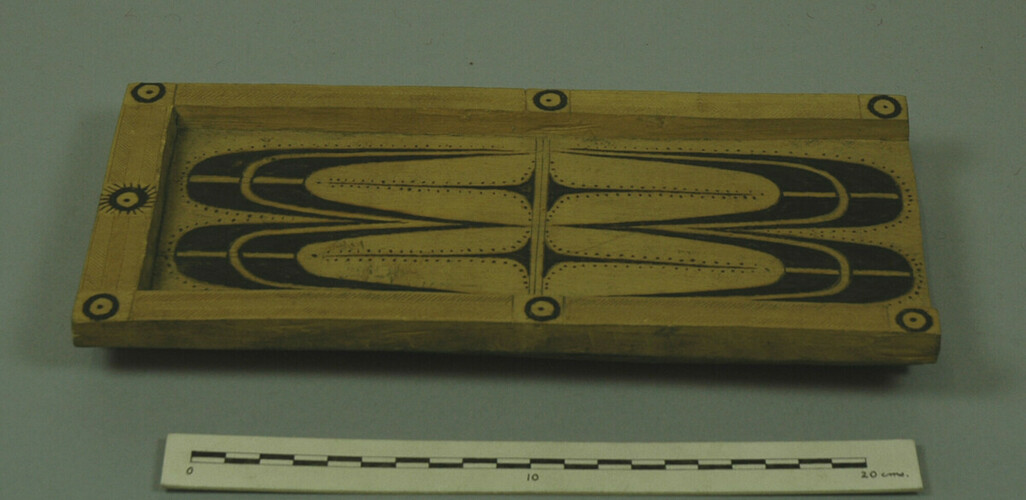 1953.10.135Wooden dao carrier, flat, with burnt and incised decoration. [El.B 28/2/2007]1953.10.135
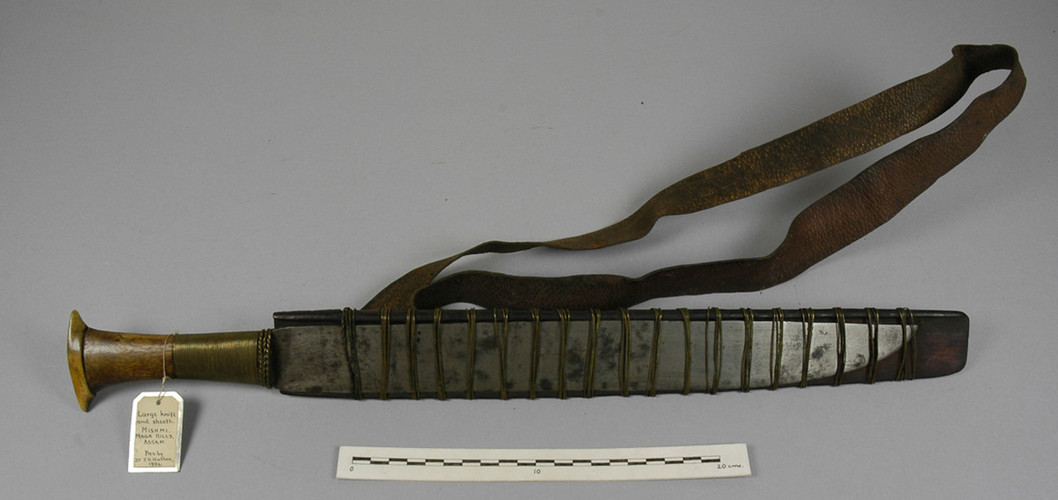 1923.85.49.1Knife [.1] with bone hilt and open sheath [.2] bound with brass wire. [SM 16/05/2007]1923.85.49.1
 2024.22.68.1Knife with wooden hilt.2024.22.68.1
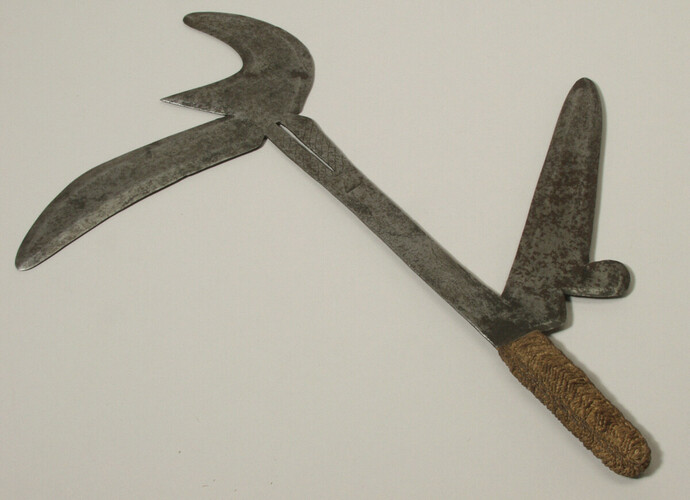 1940.12.609Iron throwing knife with plant fibre bound handle [RTS 14/4/2004].1940.12.609
 1994.32.3Imitation dZi bead, strung with others [1994.32.1 - .5] [L.Ph 'DCF 2004-2006 What's Upstairs?' 9/6/2005]1994.32.3
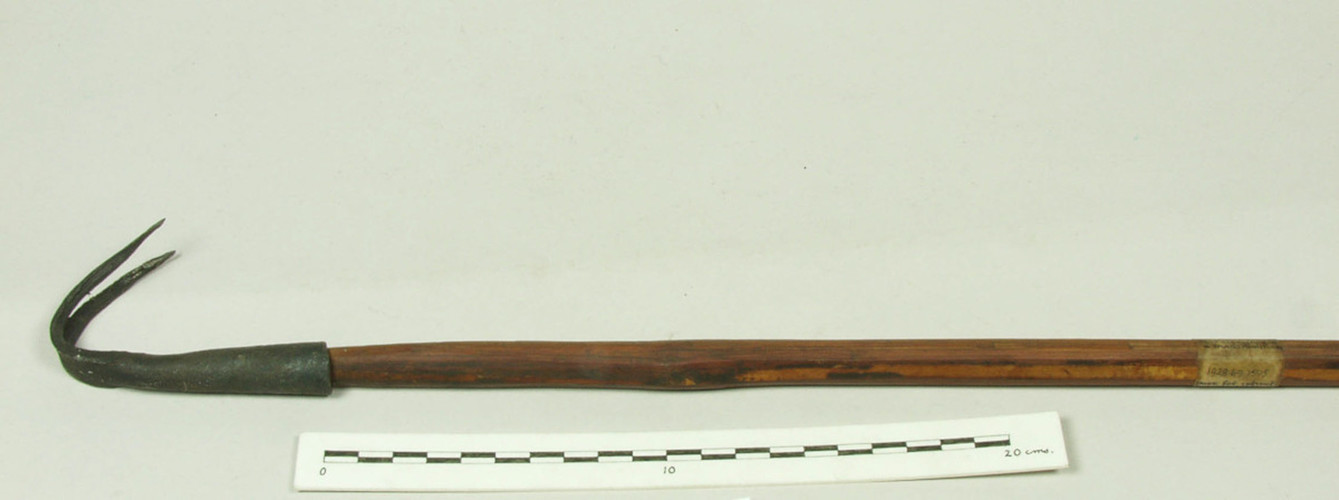 1928.69.1595Hook for extracting meat from the cooking pot, the handle of a thin length of red palm wood, the hook of 2 bent prongs of iron socketed on the handle1928.69.1595
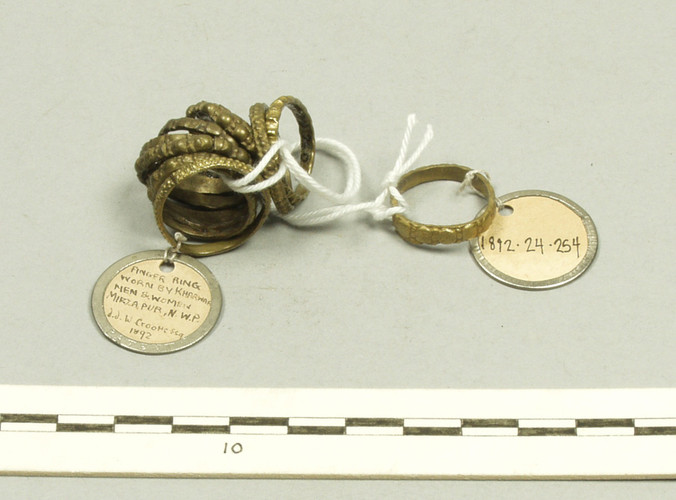 1892.24.253Metal finger ring [L.Ph 'DCF 2004-2006 What's Upstairs?' 22/6/2005]1892.24.253
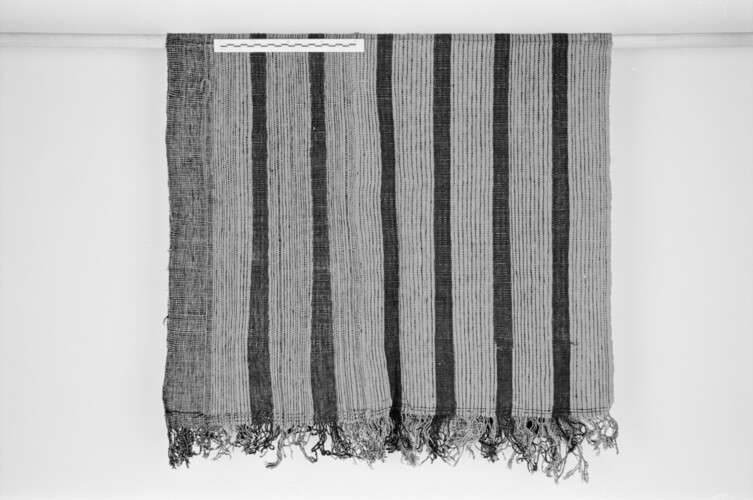 1994.45.20Rectangular red cloth with six blue stripes embroidered with diamond motifs. [ZM 12/5/2005]1994.45.20