
- Collection type
- Object
- Description
- Goatskin garment dyed with red ochre with a glass beaded edging, probably a back apron, worn by women [RTS 9/3/2005].
- Long description
- Goatskin garment, probably worn as a back apron, consisting of a single piece of supple hide cut to form a broad body with convex sides that curve down and into a convex lower edge. The upper edge is irregular, with a narrow tongue of skin at the centre representing part of the goat's tail, with some orange hair left on the surface (Pantone 7510C), flanked by 2 triangular flaps of skin on either side. However this whole edge has been doubled over and creased, so that the flaps and tail hang down the front of the apron. It is not entirely clear which way round this garment was worn, as the folded area would work on both faces. However, assuming that the tail hair was meant to be visible, the outer surface would be the brown face (Pantone 469C), while the inner surface is the one given a regular coating of red ochre (Pantone 477C). This coating is thickly applied and unlikely to be an accidental result of contact with body paint. The upper corners of the apron extend to form 2 narrow rectangular strips of skin that could be used to fasten it in place around the waist. All the edges of the apron have been decorated with bands of beadwork, arranged in a rather symmetrical fashion with the occasional odd placement of colour. The upper, folded edge has 3 horizontal rows of beads. These consist of blocks of opaque white, opaque and occasionally translucent red (Pantone 1979C and 1807C) and black glass ring-shaped beads (Pantone black 6C) - mostly with groups of 3 to 11 white or red beads alternating with one another. Most are the same colour throughout their bodies, but some of the red beads are of the type that have an opaque white core. There are also 4 translucent purplish blue beads mixed in amongst the white at one point (Pantone 2707C). A typical bead in this group has a diameter of 2 mm and is 1.5 mm long. The only part of this upper edge that is not beaded is the tip of the central tail section; this part is framed by only white beads on its two side edges. The sides of the apron have been decorated with larger opaque and slightly glossy cylindrical glass beads in white, green (Pantone 346C), dark blue (Pantone 2757C), black (Pantone black 6C) and a light red colour (Pantone 173C). These are arranged in 4 rows around the edge, also in alternating blocks of colour - primarily white with green, then white and black down one side of the apron, and white, red and black up the other side. Towards the top of the other side the pattern varies slightly, with an outside row of white beads forming a continuous line framing the alternating blocks. The actual number of beads in each coloured block varies, and there are some substitute beads introduced - dark blue for black, translucent for opaque white and so on. These beads are of similar sizes; a typical example is 4 mm long and 3.8 mm in diameter. All the beads have been sewn in place using some kind of string, possibly hide, although the surface is heavily accreted making the material difficult to identify. This has been used to string columns of beads together - 4 at a time on the side borders, 3 at a time along the top edge - which were then stitched to the edge of the skin, the string passed back through the column and then across to the adjacent set, creating a continuous thread that weaves its way in and out of the groups. This method creates a neat row of twisted stitches that runs along the outer edge of the beading. The apron is complete, but has creases across the body where it has been folded; the only other damage is a row of four holes that runs below the upper edge on one side; these may have been originally used to attach further decorative elements, as seen on 1940.7.013 that are now missing. The apron has a weight of 365 grams, and measures 923 across the top, including the length of the ties, and is 540 mm long (with the upper edging folded over). The ties are 15 mm wide near their ends and the hide is less than 1 mm thick. The bead edging along the upper edge is 7 mm wide, while the edging along the sides is 15 mm wide [RTS 9/3/2005].
- Cultural groups
- Bari (Nilotic)
- Date / Period
- Date made: Before 1940
- Date collected
- By 1940
- Acquisition information
- Loaned: 1940
- Materials and processes
- Material Goat Skin Animal, Material Goat Hair Animal, Material Animal Hide Skin, Material Glass, Material Bead, Material Ochre, Material Pigment, Process Beadwork, Process Twisted, Process Strung, Process Knotted, Process Stitched
- Dimensions
- Length 540 mm, Width: max 923 mm including ties, Weight 365 g
- Object numbers
- Accession number: 1940.7.012
- Research and responses
A province known as 'Equatoria' or 'Al Istiwa'iyah' was in existance from some time in the 1940's to 1981, after which point it was divided into the districts of Eastern and Western Equatoria; in the 1990's these were subdivided further into the modern administrative districts of Western Equatoria, Bahr el Jebel, and Eastern Equatoria [; Times Comprehensive Atlas, 1999, plate 86]. The Bari seem to be located within Bahr el Jebel, suggesting a provenance within this area.
Note that Samuel Powell attributes the term 'bongor' to several different groups; the 'Banana tribe' (1940.7.0222), the Bari (1940.7.012-013) and the Acholi (1940.7.096). It needs to be established which group the term actually belongs to.
Although this object is called a shirt, it looks more like a typical apron; a similarly shaped object collected by Powell-Cotton, for example, was said to be a back apron (1934.8.44, also from the Bari, with a similar method of attaching the beaded edging). See also 1940.7.013 (which uses some of the same types of beads and has a very similar form). Is it possible that the term 'shirt' used on the typed list was a typing error for 'skirt'?
The ochre coating is very regularly applied across the surface and may be in this case deliberate. The beads were not counted, but there must be well over 1000 involved in the construction of this object [RTS 9/3/2005].
Further items to explore
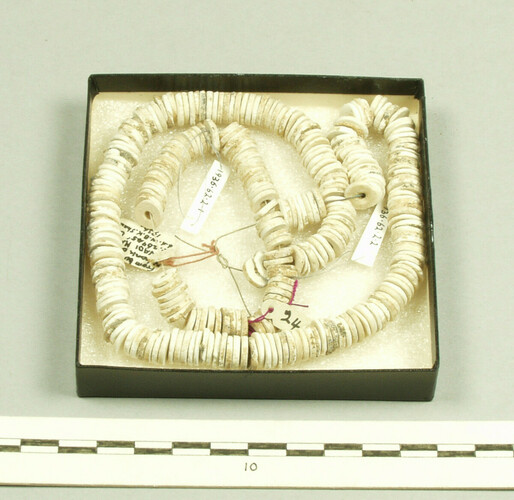 1936.62.2.1String of ostrich eggshell disc beads. [El.B 'DCF 2004-2006 What's Upstairs?' 18/7/2005]1936.62.2.1
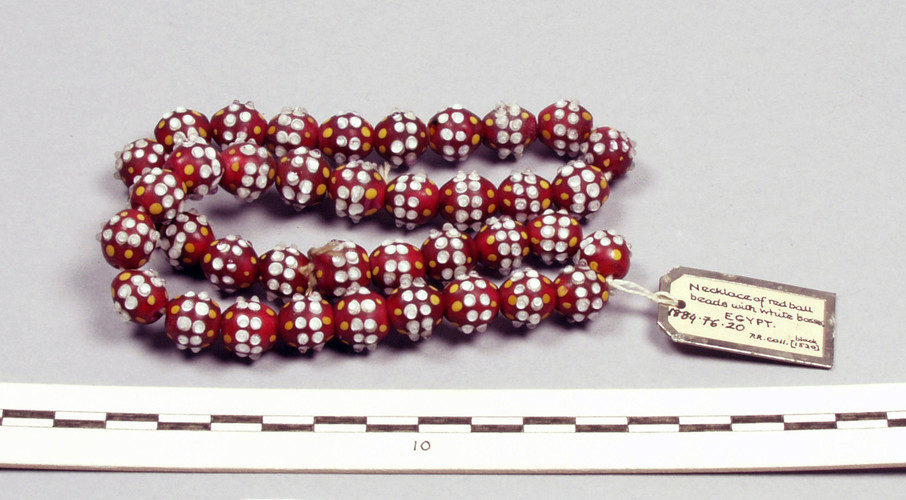 1884.76.20Necklet of round red beads with a decoration of yellow dots and white-transparent bosses. [N.B. 'DCF 2004-2006 What's Upstairs?' 28/6/2005]1884.76.20
 1942.13.1088.8Agate bead. Pearshaped with irregular hand bored holes. Strung onto the same cord with identical beads numbered 1942.13.1088 .1 - .8. [ASh [OPS move] 23/11/2016]1942.13.1088.8
 1985.50.1374.3Amulet made from a cylindrical metal bead. It is decorated with palm frond motifs and lines. [BA [OPS move] 22/11/2017]1985.50.1374.3
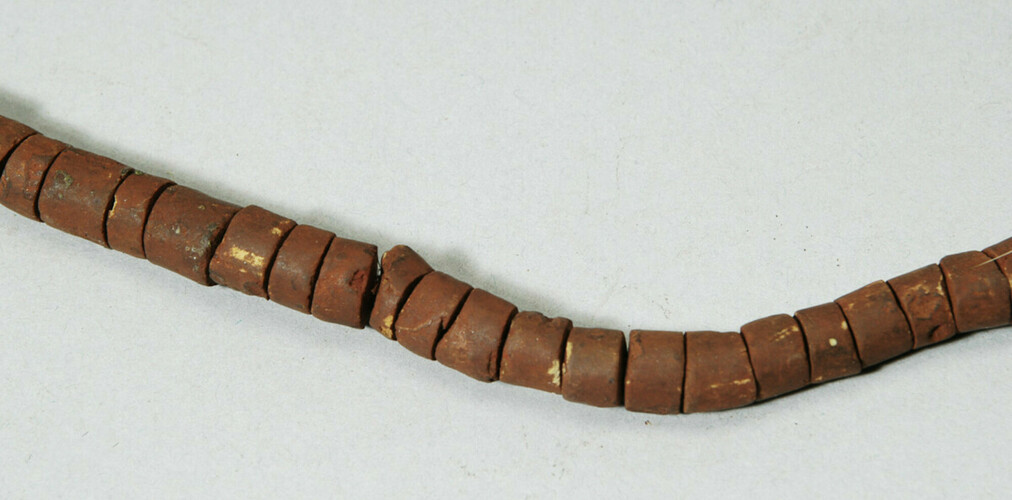 1940.7.082Neck ornament made from scented wooded cylindrical beads coated in red ochre on a plant fibre cord, worn by a girl [RTS 8/6/2004].1940.7.082
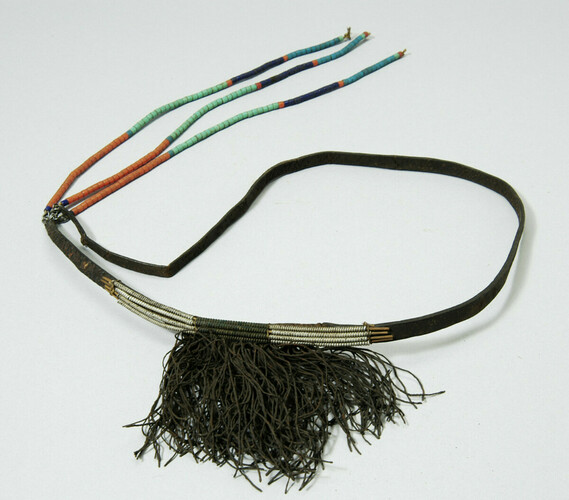 1942.1.446Leather belt with stringwork apron and twisted metal beads at front, and 3 strings of coloured glass beads hanging from the side [RTS 14/12/2004].1942.1.446
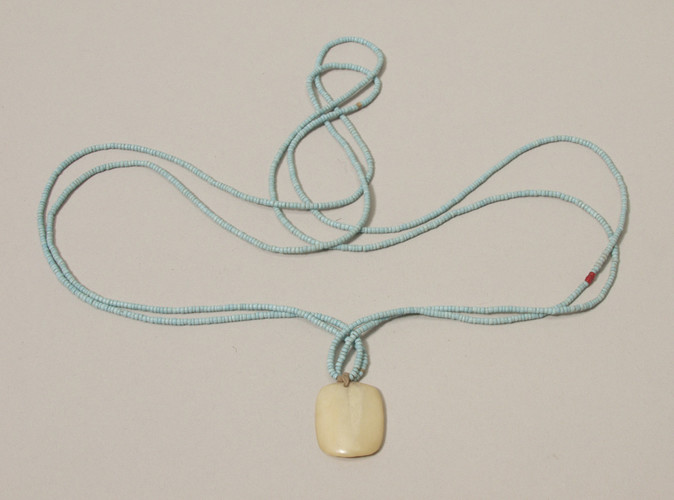 1934.8.25Necklet of blue and red glass trade beads with subrectangular ivory pendant [RTS 29/6/2004].1934.8.25
 1930.86.63Carved wooden knife handle in the shape of a human figure with elongated, twisted neck; the shoulders form the handle guard [RTS 8/9/2004].1930.86.63