
- Collection type
- Object
- Description
- Circular wooden food bowl with 2 ledge handles and a flat base, decorated on the rim and with a black-stained exterior [RTS 22/3/2005].
- Long description
- Deep food bowl carved from a single piece of wood, and consisting of a narrow flat topped rim that widens on either side of the mouth to form 2 rectangular ledge handles, similarly flattened. The outer edge of both handles and rim have been cut flat, forming an upright collar around the outside face, below which the walls flare in convexely to a narrow flat base, slightly oval in plan view. With these handles, the bowl has an almost oval plan view; the interior however is circular and nearly hemispherical, flattening off slightly at the centre of its base. Incised decoration has been added to the flat upper surface of either handle, with similar designs on either side consisting of a central motif of 2 hatched 'wings', next to 2 parallel lines that run parallel to the outside edge; these are flanked by 2 arcs, made of double lines filled with opposing groups of hatching. Although there is a symmetry to the designs, there are some minor variations - one arc band is filled with simple hatching only, while the central motifs have been executed in quite different ways, one formed by long intersecting lines and arcs, the other formed by much shorter, jagged straight lines only. The wood used is a orangey brown colour (Pantone 720C) that is still visible on the bowl interior; however the upper rim surface and bowl exterior have all been coloured a darker brown (Pantone black 7C) and polished; we are told this staining done by the owner, not the actual bowl maker. The bowl is complete, except for some minor chipping along the rim interior; a couple of bore holes in the rim may be the result of old insect activity. Tool marks are visible across the surface, particularly the outer walls, while the dark staining has worn off areas of the rim. The inside of the bowl has been stained with several splashes of some brown liquid material, as well as a patch of blackish sooting. The bowl has a weight of 677.3 grams and is 137 mm high (the height is not regular from one side of the rim to the other, as the bowl sits at a slight angle). The rim has a length of 320 mm and a width of 297 mm across, while the handles are 158 mm long and 57 mm wide; the rim is narrower, with a width of 16 mm. The base has a diameter of 113 by 110 mm [RTS 22/3/2005].
- Cultural groups
- Zande
- Date / Period
- Date made: Before 1930
- Date collected
- 1927 - 1930
- Acquisition information
- Purchased: 1970
- Materials and processes
- Material Wood Plant, Material Pigment, Process Carved, Process Hollowed, Process Incised, Process Stained, Process Polished, Process Decorated
- Dimensions
- Height 137 mm, Width: max 297 mm, Diameter: max 113 mm base, Length: max 320 mm, Length 158 mm handles, Weight 677.3 g
- Object numbers
- Accession number: 1970.38.9
- Research and responses
The catalogue card states that this material was collected by Evans Pritchard in the 1920's; this presumably means between 1926 and 1930 when he conducted fieldwork amongst the Zande. The Related Documents File suggests these types of objects were 'stained'; groups such as the Zaghawa, further north, do this by mixing oil and soot, which also helps give the surface a glossy appearance (G.S. Reed, pers. comm. 23/3/2005). Another possibility that would be in keeping with Zande woodworking methods was that the exterior was scorched black, but the colour lacks the slight bleeding that is often seen on this method. Is the coloration meant to make the object appear glossy, or was it intended to imitate another wood, such as ebony?
This may be the type of bowl that Larken describes as follows: "Shallow wooden bowls, kurungbu, usually oval, though sometimes circular, from six inches to two feet in length and half an inch thick, are universal. They may be smoothed on both sides, or the outside may be so trimmed that it presents a series of flat, narrow surfaces, running longitudinally, parallel with the grain of the wood. A small protuberance at either end is left as a handle, and the outside is wholly or partly blackened with a hot iron. These are used as platters" (P.M. Larken, 1927, "Impressions of the Azande", Sudan Notes and Records X, pp 131-132). [RTS 22/3/2005].
Search terms: Food and Drink, Vessel, Bowl, Food Accessory
Further items to explore
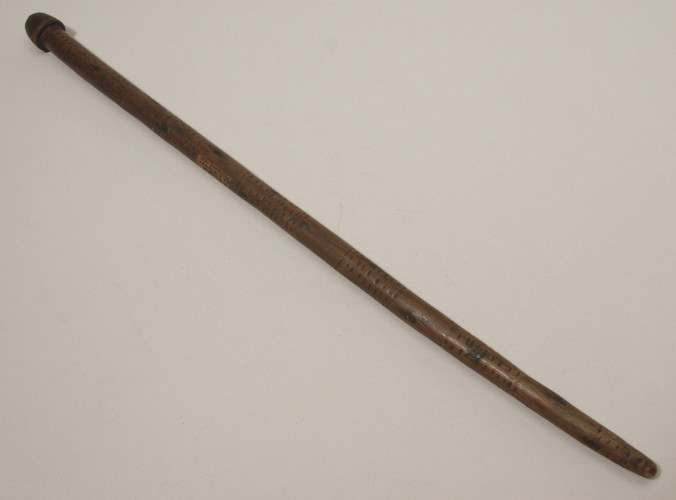 1931.66.14Wooden dance stick with carved knob at top and pyroengraved decoration on the shaft, used by girls [RTS 12/8/2004].1931.66.14
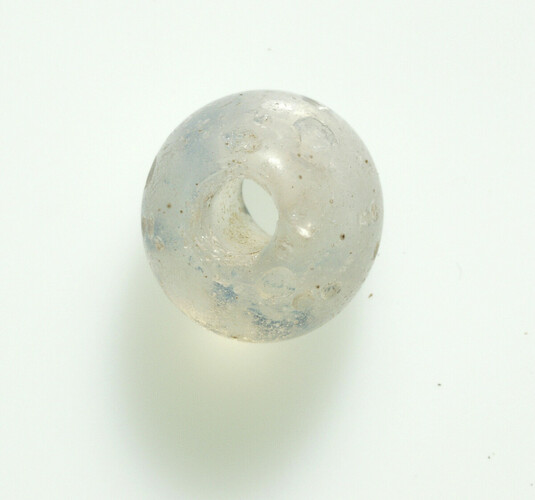 1946.8.105Spherical bead of translucent slightly bluish white glass with medium thread hole [RTS 19/4/2004].1946.8.105
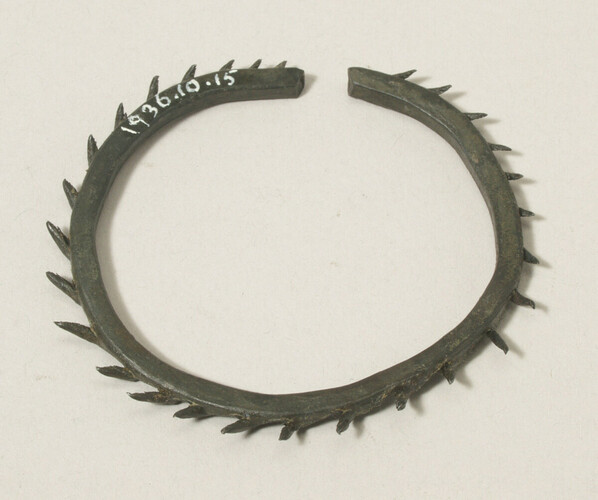 1936.10.15Iron armlet with sharp spikes around the edge, used for wrestling fights [RTS 23/3/2004].1936.10.15
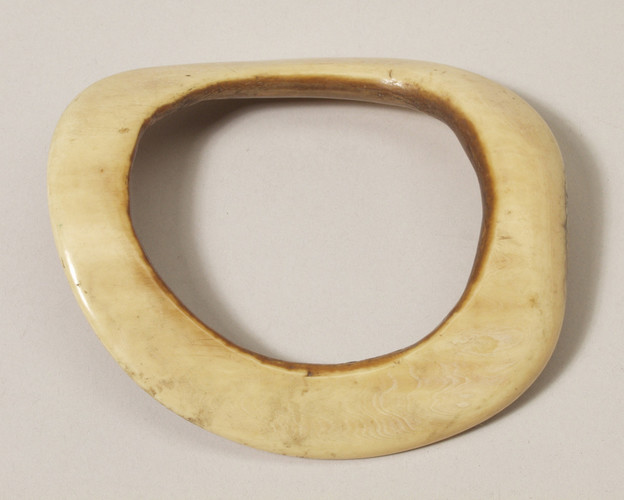 1917.25.82Annular ivory arm ornament with convex upper surface [RTS 25/3/2004].1917.25.82