
- Collection type
- Object
- Description
- Shield of hide. Elliptical in shape with a supporting stick woven through the underside of the hide, the stick also acts as a handle. [AB [OPS Move] 17/8/2016]
- Long description
- Shield of hide. Elliptical in shape with a supporting stick woven through the underside of the hide, the stick also acts as a handle. The front of the hide is white and brown and incised with rectangular shapes with hide woven through. [AB [OPS Move] 17/8/2016]
- Geographical reference
- Cultural groups
- Zulu
- Date / Period
- Date made: Before 1969
- Date collected
- By 1969
- Acquisition information
- Transferred: 1969
- Materials and processes
- Material Animal Hide Skin, Material Wood Plant, Process Incised, Process Woven, Process Cutwork
- Dimensions
- Length: max 766 mm, Height: max 53 mm, Width: max 492 mm
- Object numbers
- Accession number: 1969.29.3
- Research and responses
Zulu shields were made by a specialist shield-maker. The first stage in its manufacture was skinning a cow (only two shields could be made from one skin – making them very expensive) and pegging the skin out in the sun to dry. Then the skin was buried in acidic kraal manure for two days, pounded with stones, and washed it in the soapy lather of the Incukudwane lily. Then it was cut to shape, mounted on the long vertical supporting pole behind, and finally greased with cattle fat or brains. Two distinctive columns of horizontal slashes appear on Zulu shields, which allow two long strips of leather to be woven in and out – giving the central part of the shield a double thickness. In traditional Zulu thinking, the skin and hair of an animal are traditionally understood to ‘remember’ something of the animal’s power and life-essence (uloya). Animal furs, hairs and skins are consequently very important in formal Zulu dress – unlike woven cloth, which is viewed as lifeless. Like many southern and eastern African peoples, the Zulu were traditionally cattle pastoralists. Relevant Reading: Morris, D.R. (1965) The Washing of the Spears. London: Sphere Books Ltd. Spring, C. (1993) African Arms & Armour. London: British Museum Press. Papini, R. (1996) Some Zulu Uses for the Animal Domains. In: Zulu Treasures: Of Kings & Commoners. Natal: KwaZulu Cultural Museum. Knight, I. (1999) Great Zulu Commanders. London: Arms & Armour Press. Research Conducted for DCF Cutting Edge 2006/2007 [AM].
Further items to explore
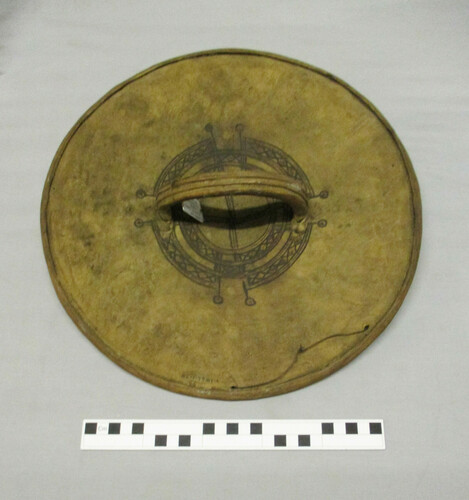 1966.1.38Shield of ?hippopotamus hide, with domed central boss and inclined rim. [CW [OPS move] 10/8/2016]1966.1.38
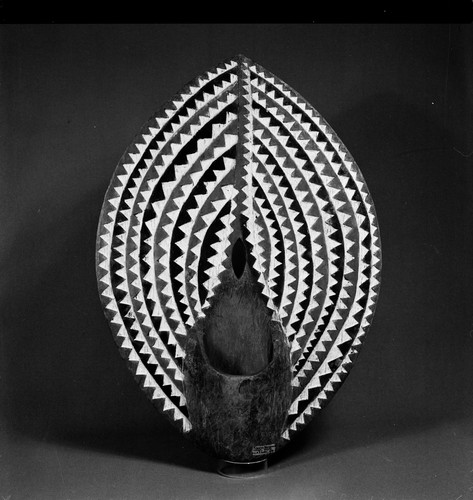 1910.28.1Shield worn on the arms by boys at initiation ceremony1910.28.1
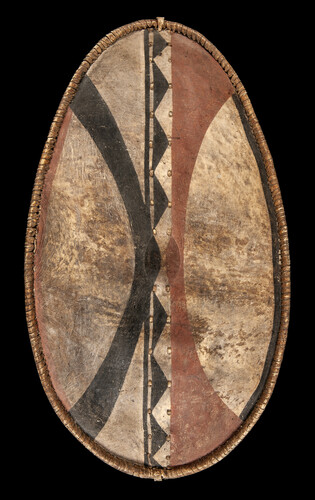 1966.1.8Hide shield with slightly raised central boss and bound around the edge with hide strip. [MJD 05/08/2010]1966.1.8
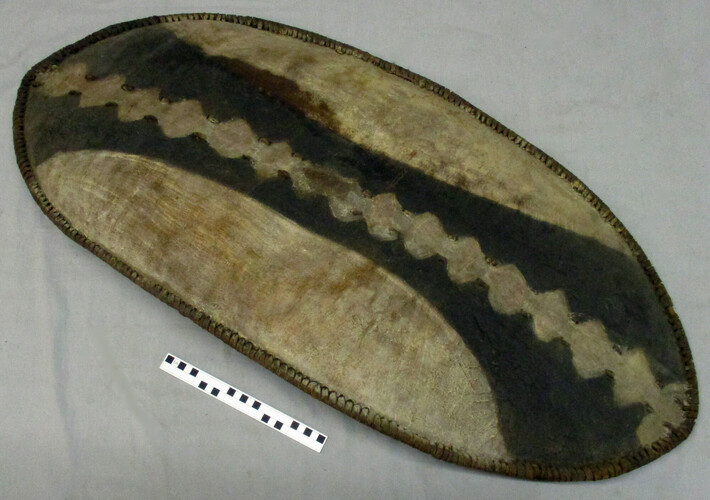 1949.5.13Oval shaped hide shield with pointed ends and domed central boss. The front of the shield is decorated with two curved sections and a central band of triangular designs in black and white pigments. The rim is perforated along the entirety of the rim through which strips of hide are woven. On the reverse in the centre there is a disc of hide with notches cut away from the edge. There is a carved handle which also serves as a central supporting rib which is bound to the shield with strips of hide threaded through perforations in the surface. There is a twisted plant fibre loop tied to the handle. [CW [OPS move] 17/8/2016]1949.5.13
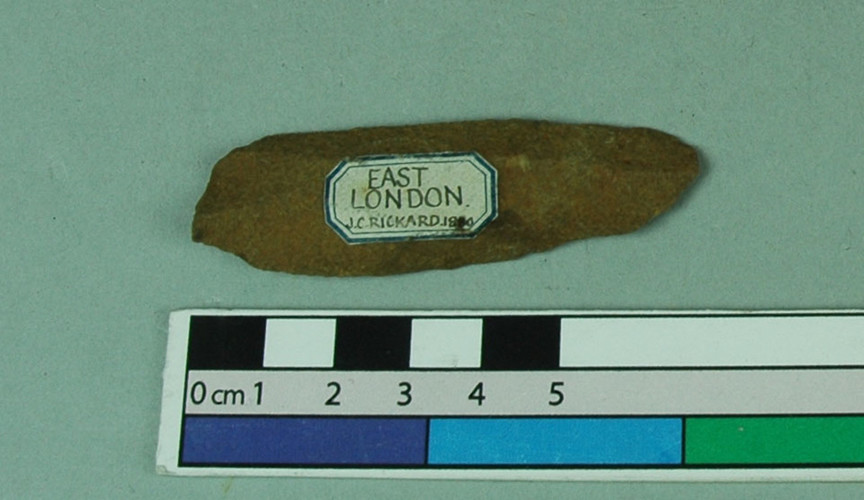 1928.68.403Flake implement made from a piece of orange brown stone, long and narrow and tapered to a point at the distal edge. [LKG 26/04/2010]1928.68.403
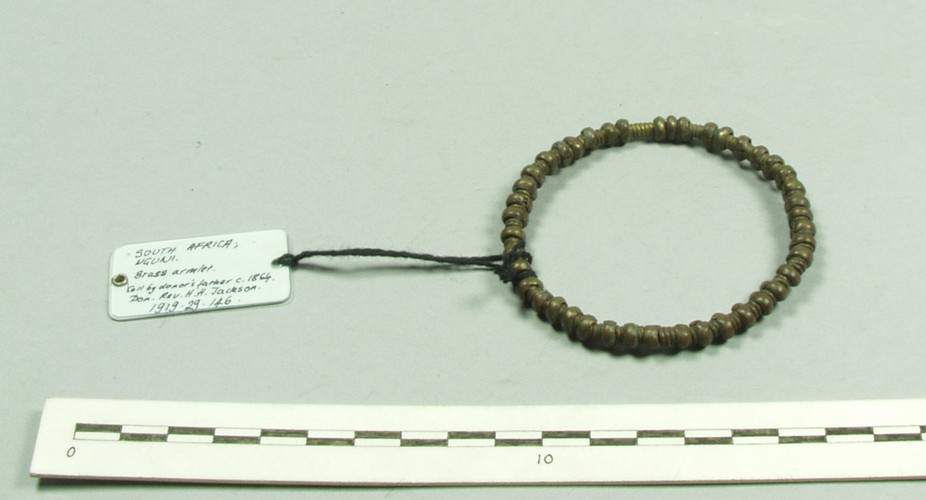 1919.29.146Arm ornament; flexible circlet of coiled brass wire with thicker brass (or copper?) wire ribbons clamped into 'beads' over the top [EC 'DCF 2004-2006 What's Upstairs?' 13/10/2005]1919.29.146
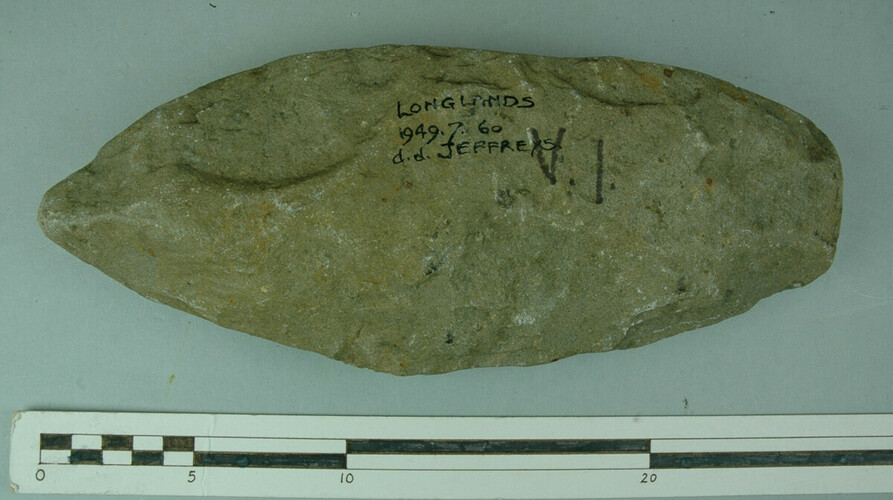 1949.7.60Stone tool, elongated oval shaped with one straight edge and one pointed edge. [MJD 19/07/2010]1949.7.60
 1935.13.106.412Narrow stone flake of yellow ochre-grey colour, with a strong dorsal crest. [LKG 07/06/2010]1935.13.106.412