
- Collection type
- Object
- Description
- Woman's skirt of dark blue cotton with blue stripes and supplementary weft designs in dark blue yarn and red-dyed dog's hair.
- Long description
- Woman's skirt of dark blue cotton with blue stripes and supplementary weft designs in dark blue yarn and red-dyed dog's hair. The cloth is constructed of two panels of plain woven cotton textile, stitched together with dark blue yarn. There are two lighter blue warp stripes, with another very thin blue line (3 warp threads thick) in the middle. The two thicker blue stripes are decorated with motifs woven with supplementary weft inlays: one stripe contains twenty diamond and opposing triangle (jabili) motifs and a short zigzag line, while the other stripe contains nine opposing triangle motifs. Each of these motifs is half dark blue yarn, half red-dyed dog's hair, with the ends of the threads extending at right angles into the dark blue cloth. There are twenty further rectangular motifs in red-dyed dog's hair, based along the narrow blue line. At one end of the cloth there are four red weft stripes alternating with three blue stripes, while at the other end are five red weft stripes alternating with four blue stripes. The warp ends of the cloth have been twisted and knotted into a fringe at each end.
- Cultural groups
- Ao Naga
- Date / Period
- Date made: Before 1921
- Date collected
- 7 March 1921
- Acquisition information
- Loaned: 06/1921 Donated: 1928
- Materials and processes
- Material Cotton Seed Fibre Textile Plant, Material Cotton Seed Fibre Yarn Plant, Process Woven, Process Dyed, Material Dog Hair Yarn Animal, Process Supplementary Weft Woven, Process Stitched
- Dimensions
- Length x Width 1300 x 725 mm
- Object numbers
- Accession number: 1928.69.177
- Research and responses
This skirt fits into Wettstein's typology of Ao women's clan skirt as T2/T3. These are skirts with blue longitudinal stripes with red symbols and red squares or oblongs on longitudinal lines. Wettstein notes that the opposing triangle design is called 'chapili', and represents the old Ao iron currency.
Reference: Wettstein, M., 2014. Naga Textiles: design, technique, meaning and effect of a local craft tradition in Northeast India. Stuttgart: Arnoldsche Art publishers, p.175.
In a Talking Threads meeting with members of the Ao Naga women's apex organisation, Watsü Mungdang, in September 2021, the group confirmed the current spelling for this design is 'jabilee' and that it symbolises wealth.
- Associated publications
- This textile has been hand drawn as a colour pencil drawing reproduced as fig.83 on page 247 of 'Naga Textiles: design, technique, meaning and effect of a local craft tradition in Northeast India' by Marion Wettstein, published 2014 Vienna , Arnoldsche Art publishers, Stuttgart. The drawing is accompanied with the caption: 'A variation of an Ao woman's clan skirt of design type 2 and 3 combined, worn by Pongener clan of Sangratsu village (PRM Acc. No. 128.69.177, 1920s)' [FB 22/10/2014] This textile has been hand drawn as a diagram, with details of the motifs, by Marion Wettstein on page 28 of 'Naga Textiles: design, technique, meaning and effect of a local craft tradition in Northeast India' by Marion Wettstein, published 2014 Vienna , Arnoldsche Art publishers, Stuttgart. [FB 22/10/2014]
Further items to explore
 1948.2.3Square piece of Kente cloth composed of five handwoven strips with a tassel at each corner.1948.2.3
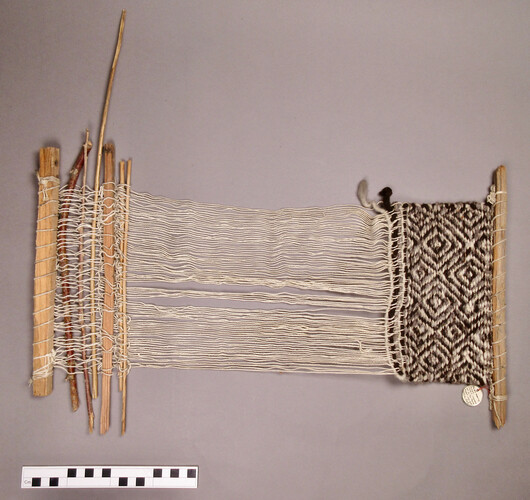 1947.4.21.1BOne of 3 child's weaving samples. The sample is partly made, with heddles and laze-rods in place.1947.4.21.1B
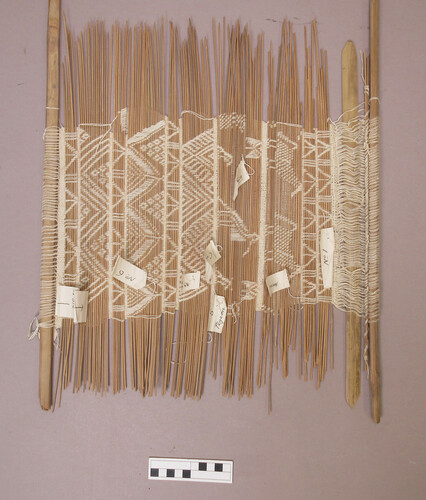 1955.11.39Woven sample with 7 patterns.1955.11.39
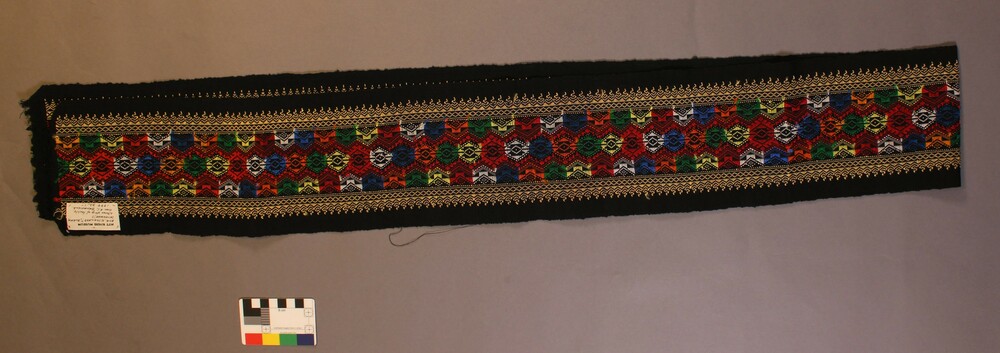 1999.32.1Long rectangular strip of woven textile.1999.32.1
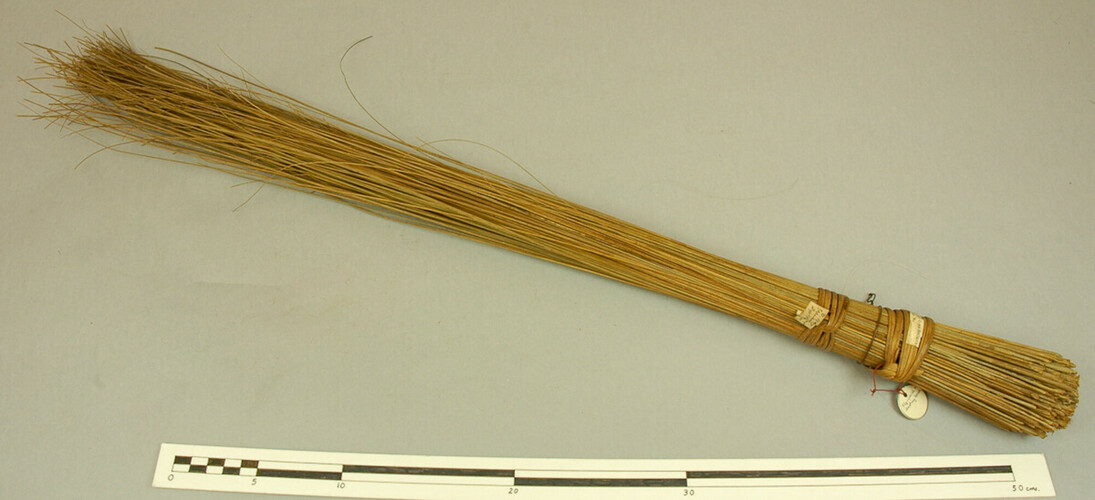 1965.3.88Fly whisk, also used as dusting brush, of bundle palm leaf ribs bound with two pieces of cane. [MJD 13/08/2009]1965.3.88
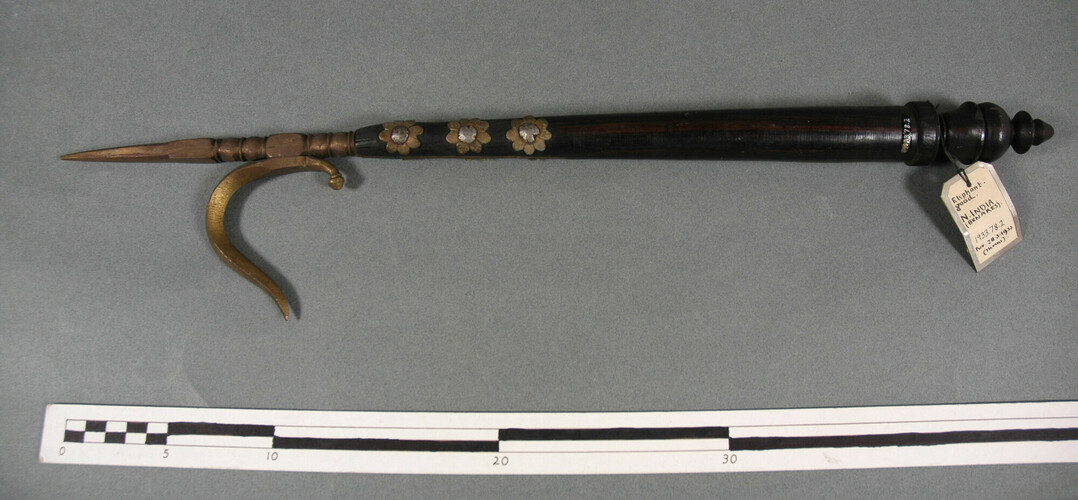 1933.78.2Elephant goad, dark wooden handle with brass hook and spike. [MJD 21/11/2012]1933.78.2
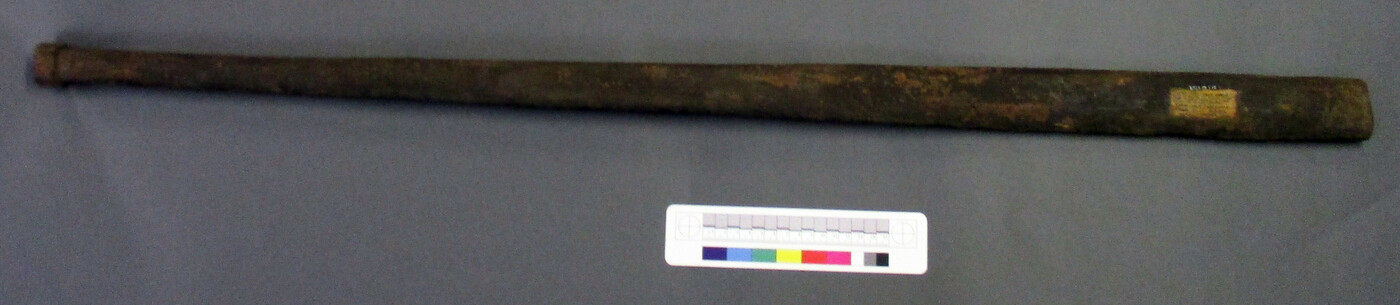 1923.84.539Wooden club, oval in section, widening and flattening slightly towards the distal end, which is squared off. There is a rectangular knob at the butt. [JC [OPS Move] 25/10/2016]1923.84.539
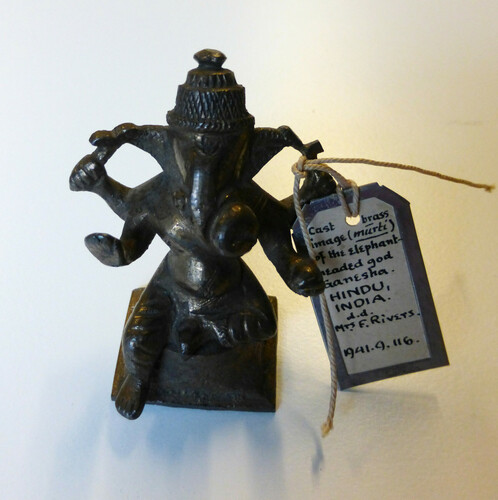 1941.9.116Cast brass figure of the elephant-headed god, Ganesha. [DCF Court Team 16/12/2002]1941.9.116