
- Collection type
- Object
- Description
- Adire cloth patterned using fold and stitch resist dye method.
- Long description
- Adire cloth, made from ten rectangular pieces of plain weave, machine woven cotton that have been machine stitched together with white and black straight stitch. There is a machine stitched hem of 7-8cm down each side. The textile is a half-cloth, typically paired with another half to form a complete iro (wrapped skirt). It has been patterned with alternating bands of different widths running the length of the cloth. The wider dark bands have fine lines within them. There is one full and one partial company logo printed on the back of the textile which reads ' C. Cottschalck & Co (West Africa) Ltd ‘. The textile is an example of adire cloth which has been dyed using a resist dye technique. The word adire literally means "that which is tied and dyed," but it is commonly used to refer to all indigo-dyed cloth in Nigeria. Each individual strip has been folded, tied and sewn lengthwise before being dyed using indigo. The cloth name was recorded by Jane Barbour as Elelo or 'coiled'. This name refers to the method of manufacture which creates the pattern of alternating warp stripes. The name for the stitch dye technique is adire alabare which means “the owner of the needle (abere)”. Raffia was used to overstitch the folds in the fabric before immersing it in a dye bath. After the dyeing process, the stitches are removed and these areas remain white, while the rest of the cloth turned a deep indigo blue. The pattern is created on both sides. Cloth preparation and dyeing were primarily done by women. Part of the collection made by Jane Barbour of 23 Adire, indigo resist-dyed cloths, made by the Yoruba in Nigeria (see 1971.28.1-23).
- Geographical reference
- Cultural groups
- Yoruba
- Person
- Maker C. Cottschalck & Co (West Africa) Ltd
- Field collector Jane Morris Barbour
- PRM source Jane Morris Barbour
- Date / Period
- Date made: Before 1970
- Date collected
- December 1970
- Acquisition information
- Purchased: 1971
- Materials and processes
- Material Cotton Seed Fibre Yarn Plant, Process Stitched, Process Woven, Material Cotton Seed Fibre Textile Plant, Material Pigment, Process Indigo Dyed, Process Resist Dyed
- Dimensions
- Length 1890 mm, Width 730 mm
- Object numbers
- Accession number: 1971.28.20
- Research and responses
This textile was viewed by Dr. Louisa Onuoha, Assistant Director in the Museum Educational Services and Training for the National Commission for Museums and Monuments (NCMM), Nigeria on Tuesday 17 June, organised as part of the Clothworkers’ Textile Project.
Please see a summary of Louisa’s comments below;
Adire cloth is culturally significant in Yoruba culture and was traditionally worn at special events such as naming ceremonies and weddings. Nowadays the fabric is available in all garments such as jeans, T-shirts etc – it has evolved greatly. Adire is still made and is a symbol of Yoruba identity, but there are changes such as men now being more involved, rather than just female dyers, and replacement materials such as wax, instead of cassava paste, being used.
At the time the pieces in the collection were made [pre 1970s] there very little mass production and the cloths were made by hand. The cloth was 100% cotton meaning the dye can be taken well (synthetic fabrics do not absorb the dye) and the richness of the colour shows it is of a high quality. Adire like this is really expensive today. We now have very few handmade textiles, and we mainly do not have this quality because there is a lot of imitation, a lot of mass production and makers wanting to make as many in as little time as possible to make money. So, there’s no longer the beauty and the creativity. In reference to the hand painted ones – this is a lot of work, and it’s a lot of hard work for little money. But I prefer these ones, they are the originals.
The designs depict everyday life on the fabric, a closeness to nature, the environment and a connection to spirituality. All the designs have meaning. “Koko” is seen on many cloths and means communication in Yoruba, passing on the message and making a connection. Geometric shapes such as the large V shapes, represent strength, stability, protection, energy, movement and dynamism. Cowries represent wealth and status and are worn as a status symbol. Floral designs represent growth, beauty and fertility. Leaves represent abundance, prosperity and good fortune. Many animals feature and all have individual meanings, the tortoise for example symbolises resilience, longevity and wisdom
Cassava is a staple of Yoruba culture, they eat it, they use it for a lot of things, so it’s normal that it would be depicted in fabric because it’s something they see every day as well as being used in the resist dye process.
The Ikin Ifa or Ifa divinity tree is seen often and represents a connection to traditional Yoruba religion. We see the use of characters like Adam and Eve come into later designs showing the change that came with colonisation and the spread of Christianity.
The design and symbolism of the textiles all have their meaning and combine to communicate a message. For example, cloth with cowries, geometric designs and floral motifs will convey wealth, strength, resilience, beauty.
Regarding the overprinting of adire on fabric with existing decoration or supplementary weft designs, this is seen occasionally when cotton fabric was reused, and the pattern was layered as part of the artwork.
Patches of discoloration seen on a couple of the textiles are due to faults in the batches of dye mix, but no art is invalid and adds to creativity.
Several pieces have the raffia from the adire oniko dying process still in place. This is often left in to show that it is a newly made cloth and that the buyer if the first person to own it. The threads fall out and are lost during use. In a similar way a few cloths have seeds remaining tied in situ.
The main people to mention when talking about contemporary adire are Nike Davies-Okundaye and Susanne Wenger.
Nike Davies-Okundaye is a batik artist and champion of adire as a symbol of Yoruba heritage, empowerment and emancipation by giving people a livelihood. Nike has worked to preserve traditional culture and teach is to new generations.
Nike Davies-Okundaye praises Susanne Wenger in helping people respect and revive the tradition of adire. Wenger was born in Austria and moved to Nigeria in 1950. She became initiated in traditional Yoruba religion and learnt the art of adire eleko. Thorugh the revival of sacred artworks and redevelopment she helped to get the Osun-Osogbo Sacred Grove designated as a national monument in 1965 and as a UNESCO World Heritage site in 2005.
Indigo dyers pay tribute and pray to Iya Mapo, goddess associated with women's crafts, and to the Osun the Yoruba water goddess. There is an annual festival in August which is dedicated to Osun, also the goddess of fertility, love, beauty which is held at the Osun-Osogbo Sacred Grove.
Louisa demonstrated how the cloths would be worn by women and explained that adire cloths are worn as an iro (skirt), iborun (shawl) and gele (headscarf) with a buba (blouse). There are many different creative ways of tying them, see YouTube! A key factor to always consider when tying a cloth was to have your feet are shoulder width apart to ensure it is not too tight to walk! Adire is now also worn by men as a buba (loose round necked shirt), sokoto (trousers) and agbada (robe.)
- Associated publications
- Adire Cloth in Nigeria, Editor: Jane Barbour; Editor: Doig Simmonds; University of Ibadan, Nigeria, 1971 Adire coth in Nigeria 1971 - 2016, Editor: Doig Simmonds; Editor: Pat Oyelola; Editor: Segun Oke; Additional author: Dele Layiwola; Additional author: Bisi Akpata; Additional author: Nancy Stanfield; Additional author: Segun Oke; Additional author: Jane Barbour; Additional author: George Jackson; Additional author: Nike Okundaye; Additional author: Pat Oyelola; Additional author: Margaret Areo; Additional author: John Picton; Additional author: Doig Simmonds; UK on behalf of the Institute of African Studies, University of Ibadan, Nigeria, 2016
Search terms: Textile, Clothing, Body Cloth
Further items to explore
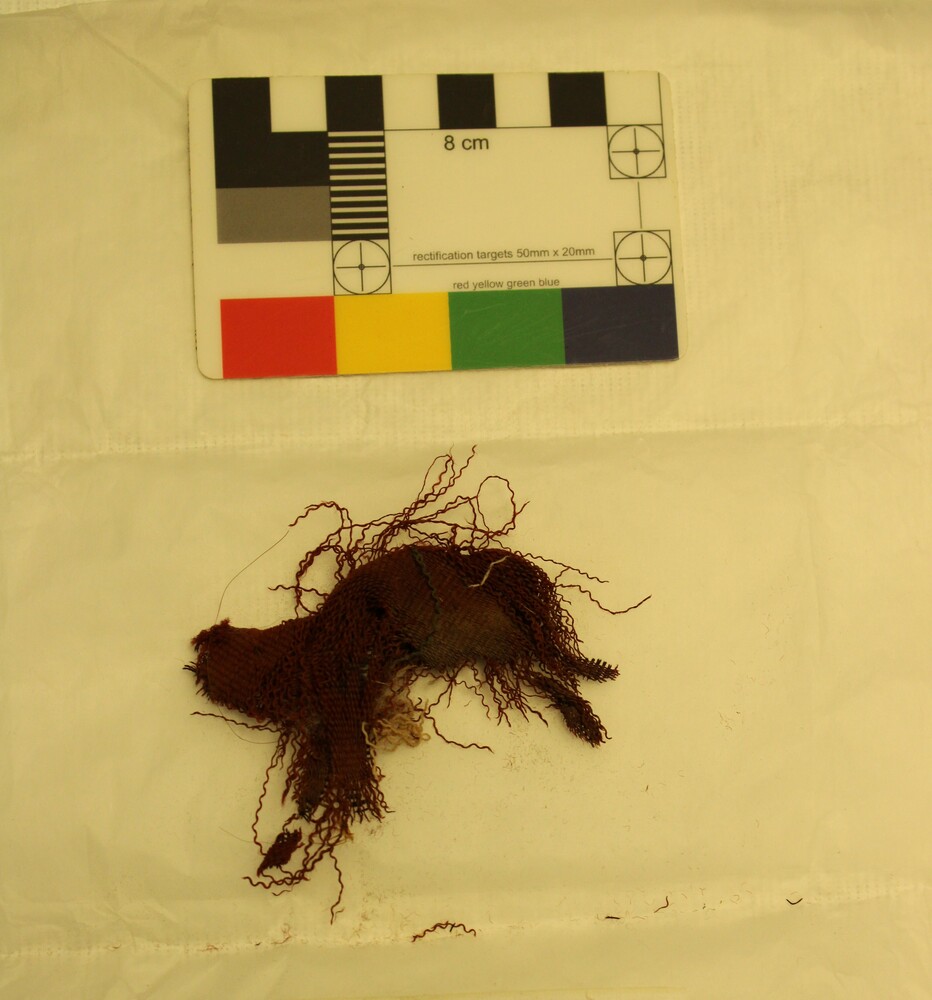 1990.21.7Textile fragment; from a grave1990.21.7
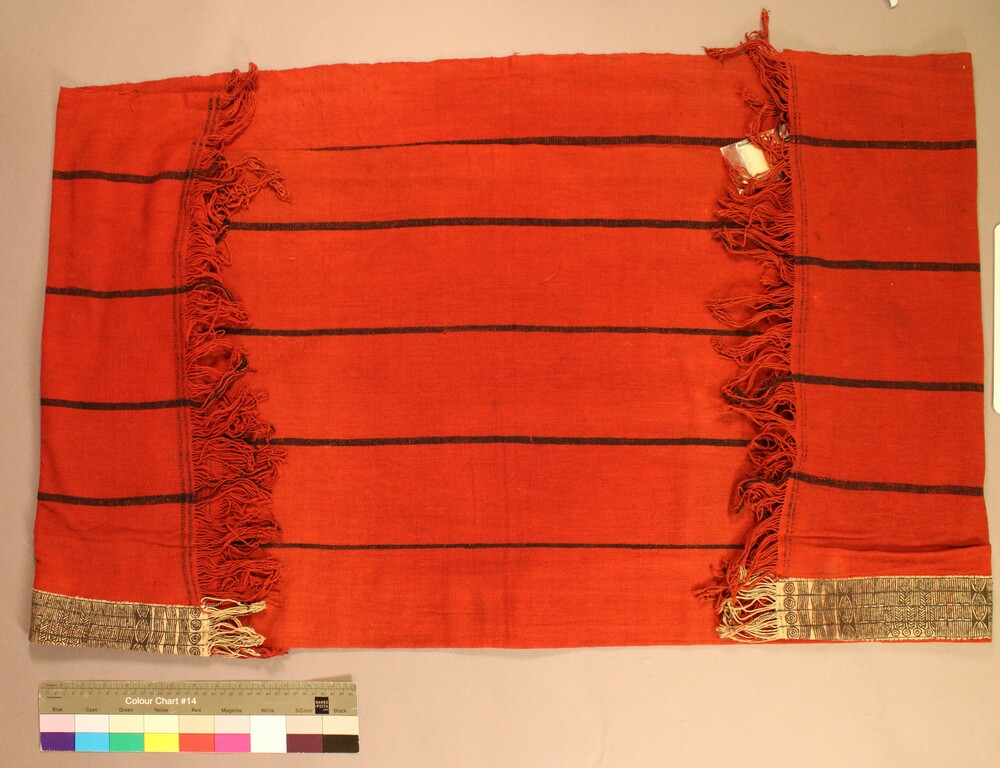 1928.69.712Red cloth with narrow black lines and a white band decorated with designs in black wax of conventionalised human figures. [ZM 13/5/2005]1928.69.712
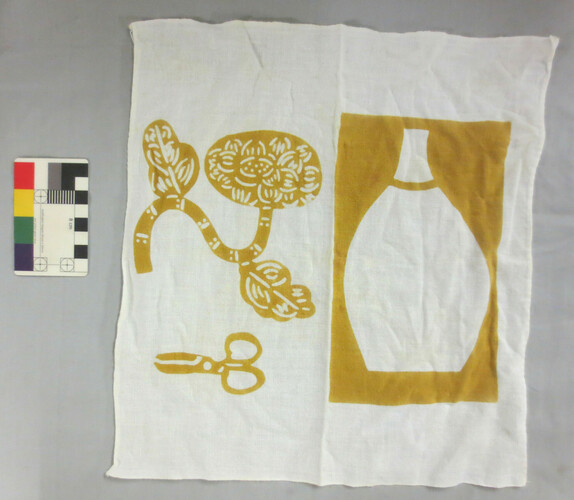 1996.17.175.8Cotton presentation textile for a sake bottle. Part of boxed set 1996.17.175 .1 - .8. [ASh [OPS move] 03/03/2016]1996.17.175.8
 2009.135.103.2Gaiter [one of a pair, see 2009.135.103 .1 for the other one]. [FB 08/06/2012]2009.135.103.2
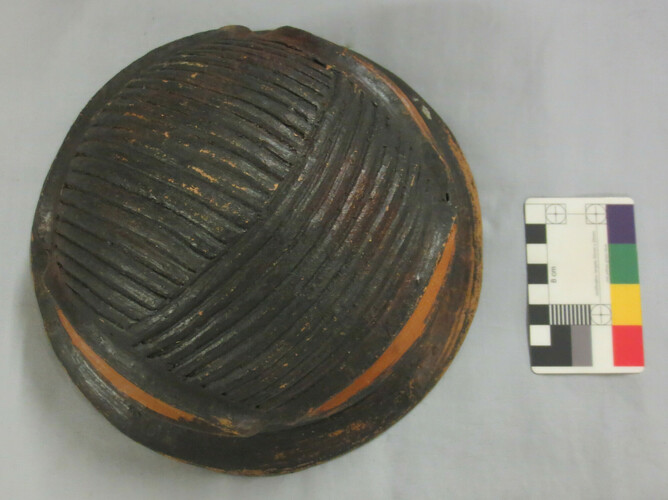 1942.13.454Round pottery bowl, with expanding rim, the outer surface decorated with mouldings, four elongated mouth-shaped projections and groove patterns,1942.13.454
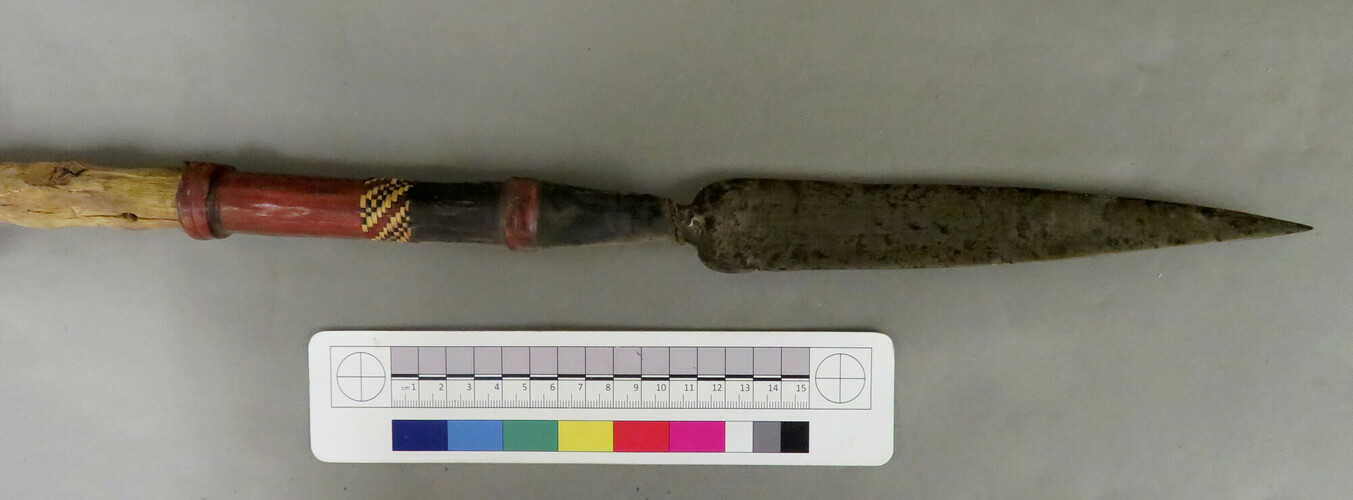 1950.9.2Spear with wooden shaft and socketed metal head, with leaf shaped blade, and butt spike. Three leather bands with areas of woven leather and plant fibre. [DV [OPS move] 6/7/2018]1950.9.2
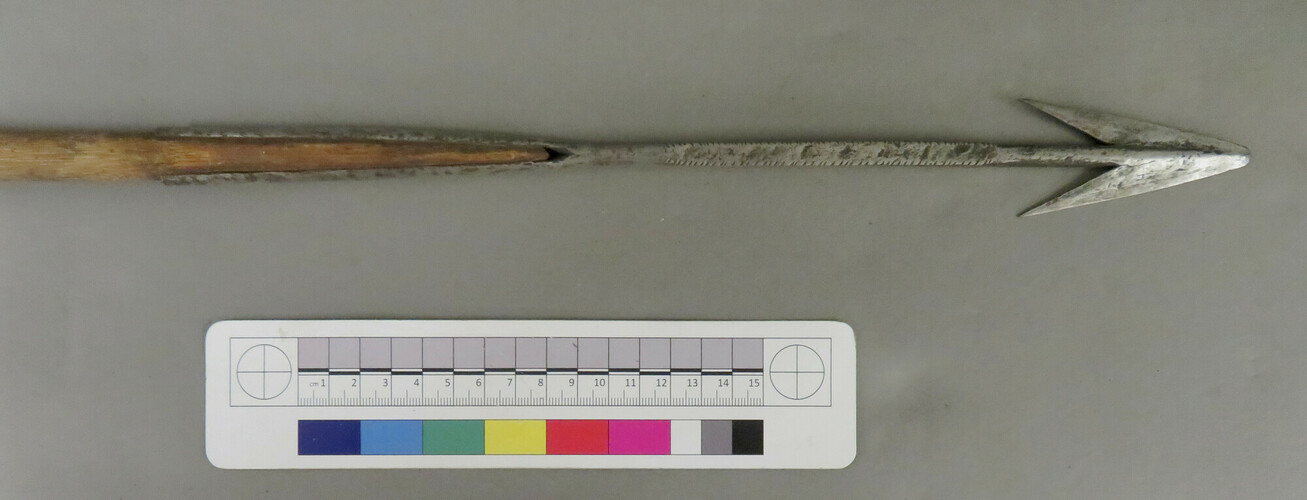 1887.1.152Spear with bamboo shaft and socketed metal head. The is a coil of metal at the butt. The head has an arrow blade. [DV [OPS move] 6/7/2018]1887.1.152
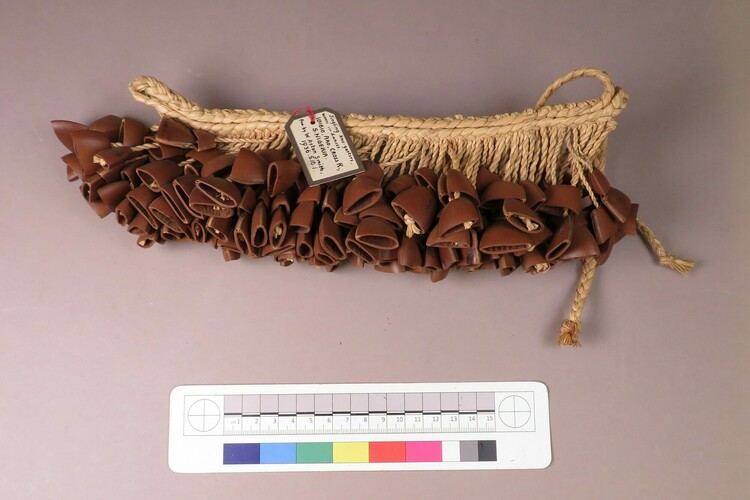 1936.5.10.1One of a pair of jinging knee garters. Made from nut shells cut in half and pierced at top. Threaded in pairs onto fibre twisted cord which is knotted at the end to secure shells. This cord is plaited into the main pait of fibre which ties around the leg, the plait is bent back double so that at one end of the nuts there is a loop at the other end the two ends. The ends are threaded through the loop to attach the rattle to the leg. [HLR]1936.5.10.1