
- Collection type
- Object
- Description
- Iron hoe-blade. The cutting edge is rounded, each end is pointed at the shoulder. In the centre of the shoulders there is an extending tang. The tang tapers slightly and has a rectangular section. [AB [OPS Move] 13/1/2017]
- Date / Period
- Date made: Before 1967
- Date collected
- By 1967
- Acquisition information
- Donated: 1967
- Materials and processes
- Material Iron Metal, Process Forged (Metal)
- Dimensions
- Length: max 413 mm, Width: max 238 mm, Depth: max 21 mm
- Object numbers
- Accession number: 1967.18.23
- Research and responses
According to the Encyclopedia Britannica Online, Khasia (or Ka) is the name given to the higher caste of the Pahari (also known as Parbate, Khasa or Chetri), a people of mixed descent who live in Nepal and Himalayan India. This may be the group referred to here. Alternatively, Khasia is the name of a language, of the Mon-Khmer family, and is is spoken bypeople living in the region surrounding the Khasi Hills and Jaintia Hills of Meghalaya state, India. This is perhaps more likely what is referred to in this instance. [CW 25/10/2000]
Search terms: Tool, Agriculture and Horticulture, Hoe, Agricultural Tool
Further items to explore
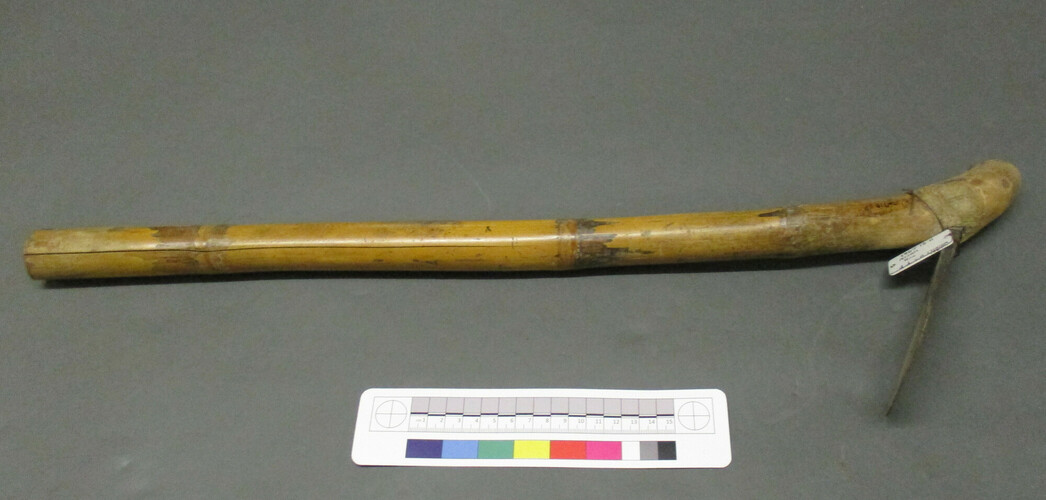 1967.18.11Hoe. With an iron blade set into a bamboo handle. The blade flares from the tang and has a rounded cutting edge, it is set into the root-end of the bamboo handle at an acute angle. The handle is mostly straight, it curves slightly at the head where it becomes the root. [AB [OPS Move] 12/1/2017]1967.18.11
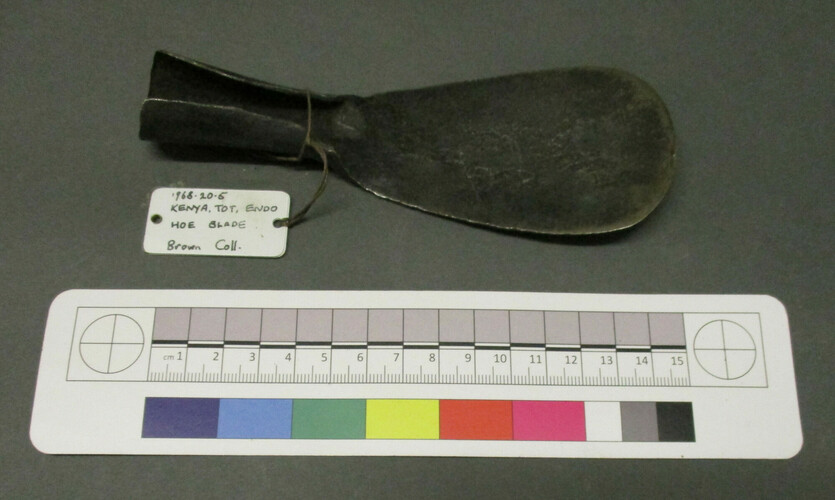 1968.20.5Small iron hoe blade. The blade itself is flat with a rounded end and has a rectangular tang, the sides of which are folded up to form an open socket. [JC [OPS Move] 9/1/2017]1968.20.5
 1914.50.3.2Iron blade from a hoe. [MJD (Verve) 3/1/2017]1914.50.3.2
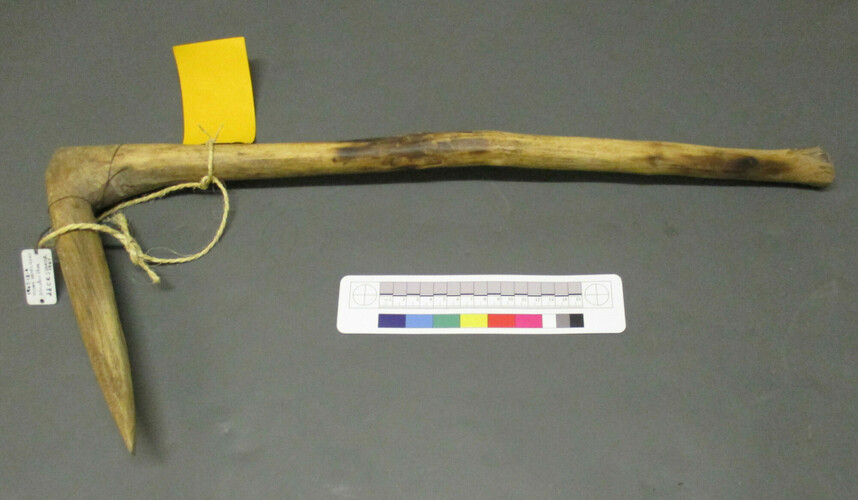 1967.18.6Hoe. Made from a single piece of wood. The wood is naturally bent in places, the pointed 'pick-end' is carved from a natural junction in the wood. [AB [OPS Move] 12/1/2017]1967.18.6