
- Collection type
- Object
- Description
- Stone flake, mid grey colour. [MJD 03/03/2014]
- Long description
- Stone flake, mid grey colour. Cortex remains on the dorsal surface right side distal edge. [MJD 03/03/2014]
- Geographical reference
- Schleswig-Holstein Hamburg Stormarn Ahrensburg Meiendorf OR Stellmoor
- Date / Period
- Archaeological period: Palaeolithic
- Date collected
- 1934
- Acquisition information
- Donated: 1959
- Materials and processes
- Material Flint Stone, Process Flaked
- Dimensions
- Length: max 77 mm, Width: max 26 mm, Depth: max 13 mm
- Object numbers
- Accession number: 1959.4.30
- Research and responses
Alfred Rust [1900 - 1983], a pupil of Prof. G. Schwantes, excavated the Meiendorf and Stellmoor hunting camps in the Ahrensburg tunnel valley between 1932 - 1936. It is not currently known from which of these two sites this object was excavated. Rust published both sites in two volumes; the first [1937] on Meiendorf titled Das altsteinzeitliche Rentierjägerlager Meiendorf, the second [1943] on Stellmoor titled Die air- and mittelsteinzeitlichen Funde yon Stellmoor. Both volumes were published by Karl Wachholtz [Neumünster]. [MN 28/07/2009]
In a 1996 paper Bodil Bratlund [DOI: 10.1007/BF02226070] states that excavation at Meiendorf apparently started in 1932 and Stellmoor in 1934. The locations of both sites are described on page 9; Meiendorf "is situated on the northern side of the Ahrensburgian tunnel" whilst Stellmoor is "on the southeastern side of the valley about 800 m northeast of Meiendorf. Here the excavations were limited to the meadows below the hill of Stellmoor (Stellmoor Hügel)". Full reference: Bratlund, B. 2005. Hunting strategies in the Late Glacial of northern Europe: A survey of the faunal evidence. Journal of World Prehistory Volume 10, Number 1: pp 1-48. [MN 28/07/2009]
Text provided by Alison Roberts for the Characterising World Archaeology project:
"The PRM holds a small collection of 32 unmarked flint artefacts ‘of the Ahrensburg culture’ from Germany, that are recorded as being collected by ‘Alfred Rust of Hamburg in 1934’ (1959.4.11–36). Before the present assessment, these were mis-identified in PRM records as being of Mesolithic age (‘Mesolithic Period I, Pre-Boreal Culture’), but were recognised during a review of the stores for the characterization project. The Ahrensburgian is a Final Palaeolithic industry of Northern Europe that is mainly associated with the Younger Dryas climatic phase of the Lateglacial, and is characterised by the presence of small tanged points. It is often seen as a precursor of the early Mesolithic, and it is presumably in this context that the PRM material was acquired. The material was donated by Armand Donald Lacaille of the Wellcome Historical Medical Museum in London, who seems to have become interested in Final Palaeolithic tanged point industries in relation to his work on the Mesolithic in the 1930s–1950s. Lacaille mentions the Ahrensburgian in his discussion of the origins of the ‘Magelmosean Forest Culture’ in his book on the Stone Age of Scotland (Lacaille 1954: 110–11). He also identified an Ahrensburgian point in the assemblage from Daylight Rock Fissure, Caldey Island, in his work on the Mesolithic of Wales (Lacaille and Grimes 1955). How Lacaille obtained the Ahrensburgian artefacts is unknown at present, but it is possible that he received them from Rust for comparative purposes. Alfred Rust (1900–1983) was a German archaeologist best known for his 1930s excavations of the classic Late Upper Palaeolithic sites of Meiendorf (1932–1934, Hamburgian) and Stellmoor (1934–1936, Ahrensburgian and Hamburgian) near Hamburg in northern Germany (Rust 1937, 1943). The assemblages from these excavations are held in the Archäologisches Landesmuseum in Schleswig, and have been the subject of recent research (Grønnow 1985; Bokelmann 1991; Bratlund 1996). As such, it is unlikely that the material now in the PRM comes from either of the two classic excavations. However, the Stellmoor site was first identified from surface finds, and it is possible that the collection date of 1934 might suggest that artefacts now in the PRM material were part of this material. The Wellcome Collection archive holds Lacaille's correspondence from 1932–1959 (WA/HMM/CO/Lac: http://archives.wellcome.ac.uk), and might contain some documentation about the acquisition of the material. Without a clear provenance the material is useful for teaching and comparative purposes only." [Dan Hicks 04/10/2012]
Further items to explore
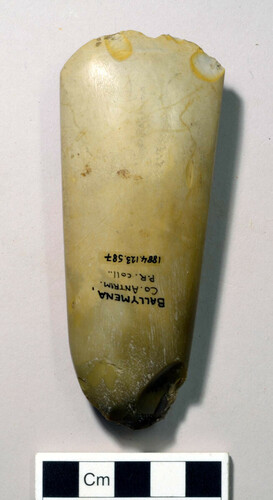 1884.123.587Stone axe1884.123.587
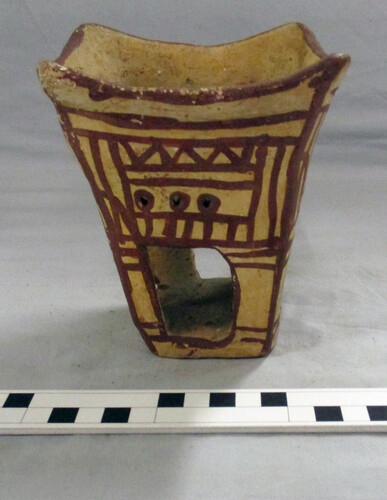 1905.45.5Pottery stove. Buff ware with red painted geometric decorations and a cross on the base. Three holes perforating through the bowl to the sides on each side of the stove. The upper section of the stove is concave in shape with pulled corners. [Bethany Skuce [OPS Move] 30/06/2016]1905.45.5
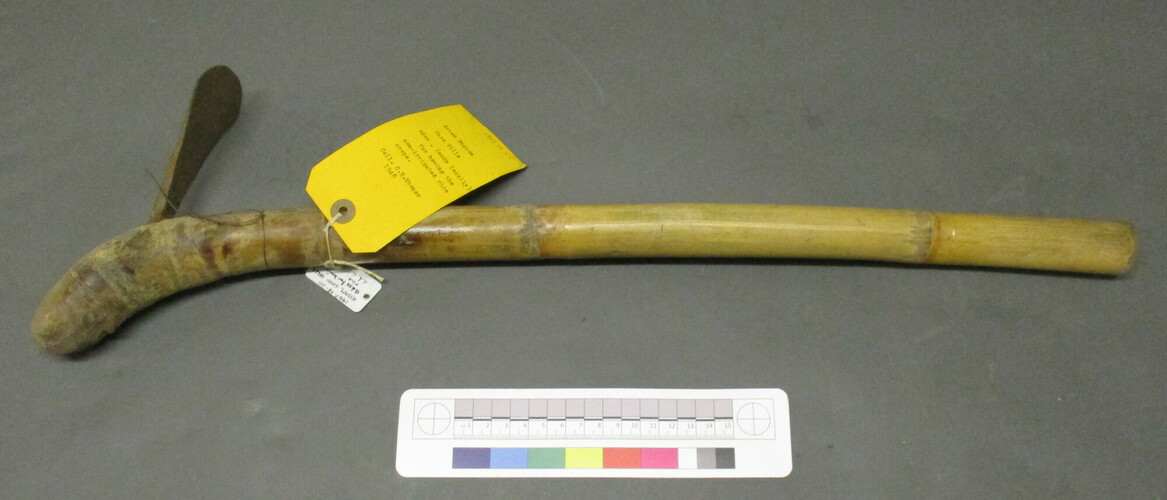 1967.18.20Hoe. With flared iron blade set into a bamboo handle. The blade flares from the tang and has a rounded cutting edge. The handle is mostly straight but curves slightly at the head, this is the root. The tang is set into the root at an acute angle. [AB [OPS Move] 13/1/2017]1967.18.20
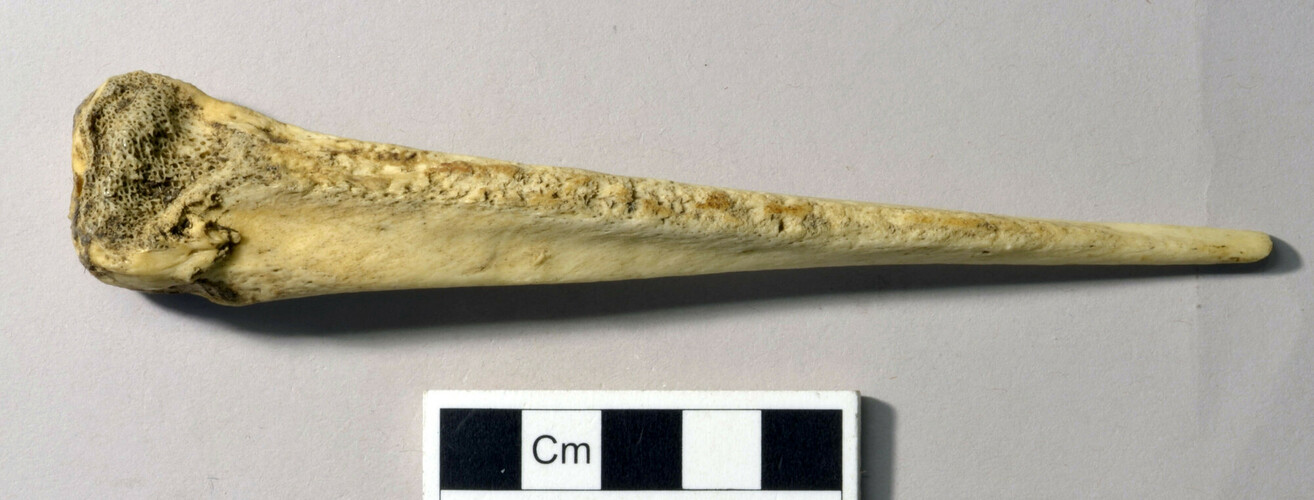 1884.118.186Cream white bone point; long and tapering to a point; one side smooth, porous bone visible on the other side. [CC [Excav. PR] 13/12/2013].1884.118.186
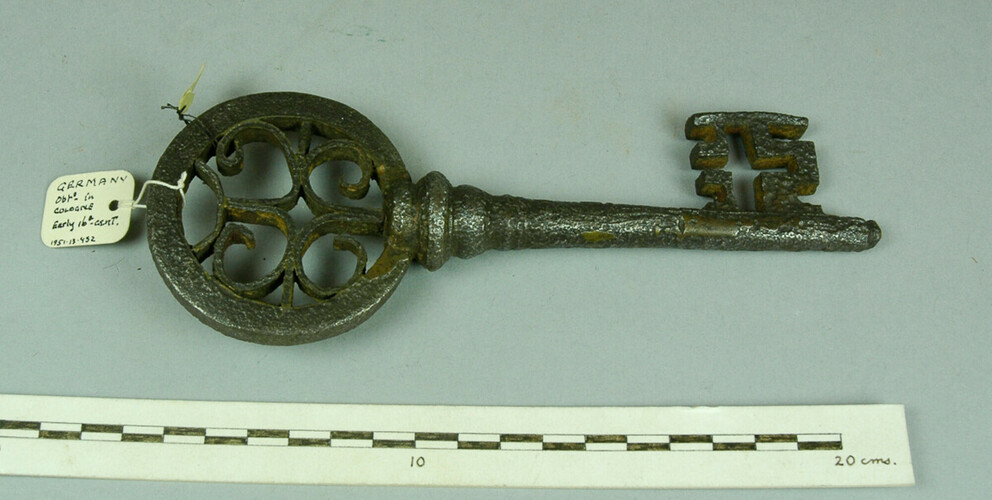 1951.13.452Iron key, circular bow with scroll design, solid stem and bit with cross-shape cut out and flange at the bottom. [El.B 20/03/2009]1951.13.452
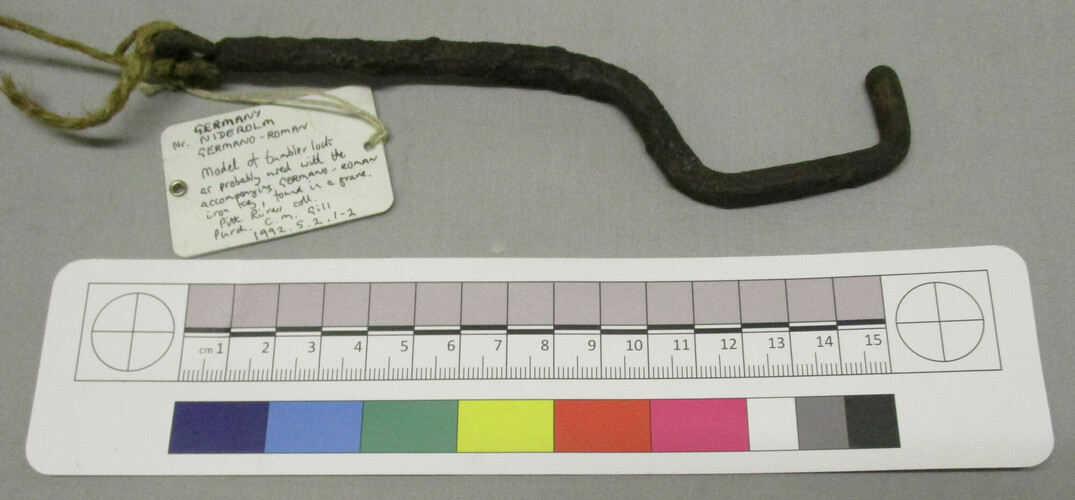 1992.5.2.2Key, made from iron. The key has a long handle with a ring at the end and a metal protrusion pointing upwards that acts as a single tooth. This key was found in a Germano-Roman grave near Nieder-Olm [Niederolm]. This type of key was used with the lock 1992.5.2 .1 [ASh [OPS move] 07/09/2016]1992.5.2.2
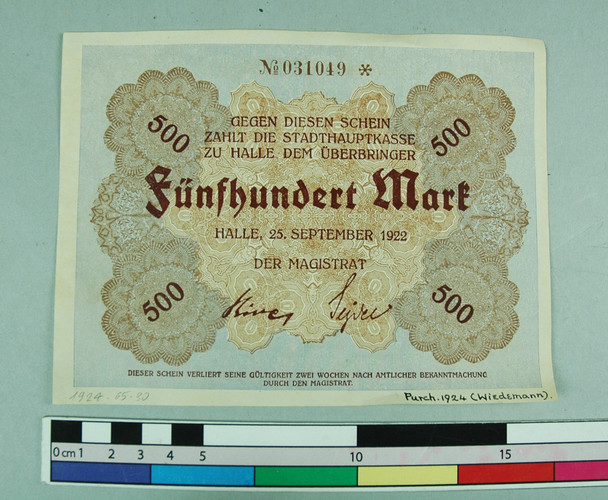 1924.65.30Currency banknote for 'Funfhundert Mark'. Printed on paper. [LKG 03/02/2010]1924.65.30
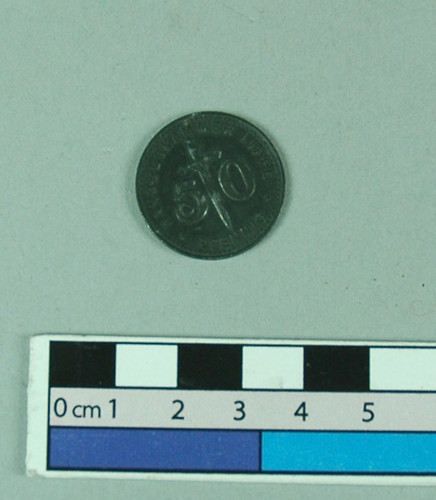 1922.26.650 pfennig circular nickel coin. [LKG 19/01/2010]1922.26.6