
- Collection type
- Object
- Description
- Scenery for shadow-puppet theatre, showing a landscape with trees, houses and various animals.
- Geographical reference
- [Manchuria Manzhou] Liaoning Shenyang or Mukden
- Cultural groups
- Manchu
- Date / Period
- Date made: Before 1905
- Date collected
- By 1905
- Acquisition information
- Loaned: 04/1905 Donated: 1913
- Materials and processes
- Material Animal Skin, Material Pigment, Process Painted
- Dimensions
- Width: max 1260 mm
- Object numbers
- Accession number: 1905.83.20
- Research and responses
This object was viewed as part of a participatory research visit with the local Chinese community on 21st June 2022 as part of the Play! project. The meeting was led in Mandarin by Jenny Wang with interpretation help from Tianqi Wang. The discussion was transcribed and translated by Lunchen Song [MC 1/07/2022].
Introduction by Jenny Wang:
There are two parts in the collection, the traditional Chinese shadow puppets on the right, and the Indonesian traditional shadow puppets on the left for your comparison. Shadow puppets are related to the theme of play and entertainment. As a traditional art, shadow puppetry is on the verge of extinction. That’s why we are here to discuss its future.
Shadow puppet art is believed to have originated in the 1st millennium BC during the rule of Emperor Wu of the Han Dynasty. According to historical records, to commemorate Emperor Wu’s favourite deceased concubine Lady Li, the Emperor’s ministers proposed to commemorate to avoid him stepping down from his position in a state of grief, and so her presence was brought back to life in the form of a shadow show, which the emperor could watch at any time.
There are various forms of shadow puppet art in China, India, and Central Asia. Shadow puppetry flourished in the Tang and Song Dynasties and reached its peak in the Ming and early Qing Dynasties. However, it gradually declined in the late Qing era.
In contemporary China, shadow puppet artists are generally over 70 years old, and the art of shadow puppetry is on the verge of disappearing. In 2011, Chinese shadow puppetry was inscribed on UNESCO’s Representative List of the Intangible Cultural Heritage of Humanity. In Beijing, Shanghai, and Zhejiang, there are special museums, online libraries, and "Digital Shadow Play Museums" to record shadow puppet art.
One important artistic feature of shadow puppet shows was that only five people were needed to make a play. It is said that making shadow puppets consists of 24 stages and requires more than 3,000 incisions to create a single figure. The main difference between Chinese and Western shadow puppets is that Chinese shadow puppets are generally pigmented and incised. Western shadow puppets, by comparison, are generally in the form of black silhouettes. The German Leather Museum and the Puppet Museum in Munich have relatively well-preserved Chinese shadow puppets and some scholars argue that Chinese shadow puppets are the predecessor of film.
Chinese shadow puppets are primarily made of animal skin, and their purpose is to tell entertaining, and sometimes mythological stories as a form of entertainment. The Indonesian shadow puppets we have here today are made of cardboard, but they were traditionally made of painted leather as well and were often used to tell stories from the Hindu religion. Indonesian shadow puppets still play an important role in society and are therefore better preserved compared to the Chinese ones.
Audience’s Reaction:
-I've lived in Oxford for over ten years, and this is the first time I've seen shadow puppets up close. It feels like being taken back to my childhood. When I was a child, my dad bought me a shadow puppet as a reward. The objects over there seemed like clay figures to me (1997.14.22.1-25). I'm wondering which country in Asia they are from. Certainly not from India- the face shape of the clay figures is very much Chinese.
-I come from Chengdu, China, and my daughter is studying here. Two or three months ago, a foundation in Germany contacted me, hoping to use metaverse technology to present shadow puppet art in a new way in the new era. Unfortunately, I do not have the time and the energy to work on their project.
Jenny: It seems that the German government is very supportive of projects on the shadow puppets.
-I lived in Oxford for two years. When I was a child, I used to go to temple fairs in Beijing and watch craftsmen perform shadow puppet art. I think shadow puppetry and puppet animation are similar in purpose. I feel that traditional culture is the most valuable. We could hold a traditional Chinese festival garden party in Oxford, set up a small stage and perform shows. I also brought a framed shadow puppet bought from Shaanxi.
-I came to the UK in 1992 and have lived for five years in Oxford. Shadow puppets are part of Shaanxi culture. In 1999, my mother came to the UK to promote shadow puppets as a member of the Shaanxi Federation of Literary and Art Circles. I was very uninterested at the time, and now I regret it a little bit. I remember that the movie "Alive" had shadow puppets and references to the Qin Opera. When I saw these shadow puppets in Oxford, I felt that I knew too little. I want to learn more about shadow puppets. I keep some shadow puppet bookmarks, which are gifts from friends but I have given most of them away.
-I came to the UK 20 years ago and this is my first time seeing Chinese shadow puppets up close. I work in education and run a Chinese cultural interest class in Oxfordshire, and I find that shadow puppets are one of the most popular themes for children. The children's sheets can be used as curtains, and shadow puppets can be made from cardboard to form images. I think technology can save shadow puppets from dying out, by recreating shadow puppets with anatomy, animation, etc.
-I work in the Confucius Institute. I didn't watch shadow puppets when I was a child, but I watched the Tangshan shadow puppet dance in 2006, and I was amazed by "Pretty Sunset". I think shadow puppet art should be inherited in various forms in contemporary society.
-I am from Gansu. When I saw these objects, I felt amazed. I felt that the Chinese shadow puppets were exquisitely made, while the Indonesian paper shadow puppets have a rougher texture.
-I was interested in shadow puppets but am amazed by today’s workshop. Shadow puppets came from Weinan, Shaanxi Province. Friends in Shaanxi have given me shadow puppets, and I have given them to others. I was very moved to see them today, I think shadow puppets contain a kind of Chinese feeling.
-Shadow puppets combine artistic creation and cultural appreciation.Maybe this is a true luxury. I think we need to hold shadow puppet activities for children. I think that that object (1997.14.22.1-25) is not a flour sculpture, but is made of clay, because the face of clay sculptures would crack over time (unless it is improved technology).
-I agree with everyone's statement. I am also a handicraft lover, and my grandfather is a craftsman. In the summer when I was a child, my grandfather cut paper in the kitchen, installed curtains on the windows, lit candles, and performed shows. As a teacher, I tried making cardboard shadow puppets with my pupils and realised that the craftsmanship required to make the joints, cords, and shafts is very complicated. We carved characters on cardboard to re-enact small stories like "Journey to the West". I think this is the inheritance of ancient traditional culture and art, and I want to go home and talk to my children about the shadow puppets I see today.
-I am an archaeology student at Oxford University and an anthropologist. Your discussions today reminded me of many academic concepts: identity, belonging, and social memory. Shadow puppet art may be a dying art form. How exactly should the live performance of shadow puppets be combined with modern technology? I think this is an important question to answer in order to preserve the craft.
-I saw shadow puppets in Shanghe Garden at the Qingming Festival when I was a child. Shadow puppets are high and low, far and near, and have the power to inject new artistic vitality into modern artistic reflections. There are also shadow puppet productions in Yunnan, and I have also seen shadow puppets in Henan. The development and prosperity of shadow puppets reflect the courage and ingenuity of the Chinese people.
- I work at the Oxford Confucius Institute and have hosted workshops on Chinese traditional culture. I love shadow puppets. Seeing this shadow play wall (1905.83.20), I feel that shadow play is not a simple craft. We need to use good artwork to tell stories. Traditional shadow puppet art is expensive and not suitable for low-cost reproduction, but we could simplify shadow puppets and reduce production costs.
Jenny: Many old artists hope that their skills will be passed down to their children, who have been surrounded by shadow puppetry since childhood. If you haven't been exposed to shadow puppets during your youth in this way, your memories towards Chinese shadow puppetry can become fragmented when you grow up.
- I have learned a lot from seeing these objects, I haven't seen a shadow puppet show before. This workshop on shadow puppets at Oxford University is of great significance. Human society has become a big global village, and cultural exchanges can promote mutual understanding, respect for other nations, and reduce conflicts. We should also pay attention to the mode of transmission to tell a touching story about the collection of cultural relics. The British are worth learning from on this point. They collected a lot of precious things and treated them well.
Jenny: Indeed, today's international situation is very complicated. Cultural and artistic exchanges can avoid conflicts, and museums should focus on communication and sharing.
-I went to Xi'an shadow puppet show more than ten years ago. The performers behind the shadow puppets attracted me. I would like to mention two things: Firstly, technological progress and computer technology will make the potential reproduction of shadow puppet shows more likely. Secondly, people who are engaged in handicrafts are very important. It takes more than ten years to master this craftsmanship, which is very difficult.
-I have been in the UK for more than ten years and have seen shadow puppets in movies. I'm from Chongqing, and I don't know much about Northwest China. I was pleasantly surprised to see these exquisite shadow puppets. We should hold more events to promote shadow puppets in Oxford. For example, the shadow puppets of the Dragon Boat Festival on the Dragon Boat Festival, and the creative workshop with the theme of Journey to the West.
-I have been in the UK for more than ten years, and my primary school was in Tangshan. Shadow puppets are a speciality of Tangshan. When I was in primary school, I organised the shadow play "Pretty Sunset" which left me with positive memories and made a lasting impression on me. I do feel that shadow puppets are very delicate and difficult to preserve for a long time.
-I am from Northwest China, from Shaanxi and Weinan. For the first time today, I have learned that shadow puppets are a speciality of Weinan. I feel overwhelmed by all this history, and I must work hard to inherit this history and gain cultural confidence. As an architect, inheriting traditional culture is an eternal task for me. Protection is one aspect, and creative thinking is another aspect of reproducing Chinese culture. The dissemination of Chinese culture in a Western context relies on architectural design and landscape art. There are also a lot of shadow puppet elements in the movie "Alive". I think that children must learn about shadow play somehow, which is engraved in our minds. There is also a mention of Chinese shadow puppet culture at the end of Kung Fu Panda 3 which I watched with my family- my children didn’t understand why my husband and I were so excited to see it. National culture and identity is worth celebrating, and shadow puppets are treasures of the Chinese nations, and the world. The next generation must understand national art. Popularising ethnic art for children is a mission for the existing Chinese community.
-I came to the UK 15 years ago, and before today, I only knew about shadow puppets through reading. I like to paint, and I pay attention to colour. The details of shadow puppets remind me of traditional Chinese paintings. Shadow puppets bring people's understanding of colour together. The skin is so thin, translucent, and bright, that it feels beautiful when they’re moving. The artist's craftsmanship is superb. I will show my children the pictures of these shadow puppets and share my feelings with them.
Jenny: Shadow puppet genres are divided into north, west, and southeast. Northeast China, Tangshan, Guangdong, and Sichuan all have shadow puppet art. These shadow puppets are colourful and have the same effect, and they are worth further study.
The exact origin of Chinese shadow puppetry is not known, but both ‘Records of the Grand Historian’ by Sima Qian written in 91BC and ‘History of the Former Han’ by Ban Gu in 82 AD are cited as, potentially, some of the first written records of Chinese shadow play.
In ‘History of the Former Han’, it was written that when the emperor’s favourite concubine Lady Li passed away tragically young from illness, the emperor felt unable to rule. In an attempt to console the emperor his ministers hired a magician, who used shadow play to bring her presence back to life, as Burton Watson’s translation describes:
“The emperor continued to think longingly of Madam Li and could not forget her. A magician from Ch’i named Shao-weng, announcing that he had the power to summon spirits, one night lit torches, placed curtains around them, and laid out offerings of wine and meat. He then had the emperor take his place behind another curtain to observe the proceedings from a distance. The emperor could see a beautiful lady who resembled Madam Li circling within the curtains, sitting down and then rising to walk again. But he could not move closer to get a good look and, stirred more than ever to thoughts of sadness, he composed this poem:
Is it She?
is it not?
I stand gazing from afar:
timid steps , soft and slow,
how long she is in coming!”
A similar event is described in ‘Records of the Grand Historian’, which chronicles the same magician, Shaoweng, bringing another of Emperor Wu’s favourite concubines, Lady Wang, back to life through shadow play:
“The emperor had formerly had a favourite concubine named Madam Wang who had died. It is said that Shaoweng by his magical arts succeeded in summoning forth at night the apparitions of Madam Wang and the god of the fireplace, while the emperor stood within a curtained enclosure and gazed at them from afar.”
Sources:
Watson, B. (1974), Courtier and Commoner in Ancient China, Selections from the History of the Former Han by Pan Ku, Columbia University Press, New York, p. 249.
Watson, B. (1961), RECORDS OF THE GRAND HISTORIAN, HAN DYNASTY II, REVISED EDITION, By Sima Qian, Translated by Burton Watson, Columbia University Press, Hong Kong and New York, p. 29.
Search terms: Theatre and Drama, Figure, Shadow Puppet
Further items to explore
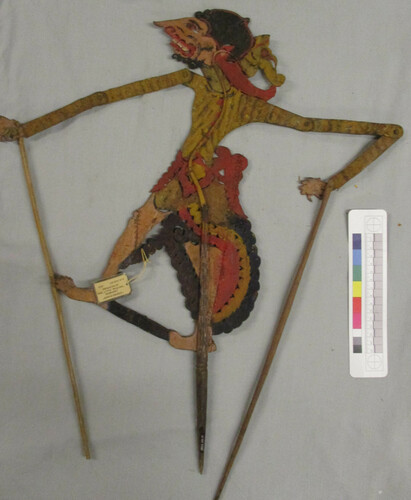 1899.58.10Shadow puppet representing Sarang Kunee/ Pathi Sangkuni. On one side this figure has black hair, with a yellow and green striped body and a skirt of blue, green, red, and yellow skirt. The reverse of this puppet is possibly faded, but is much darker in colouring. The paint is quite fragile.1899.58.10
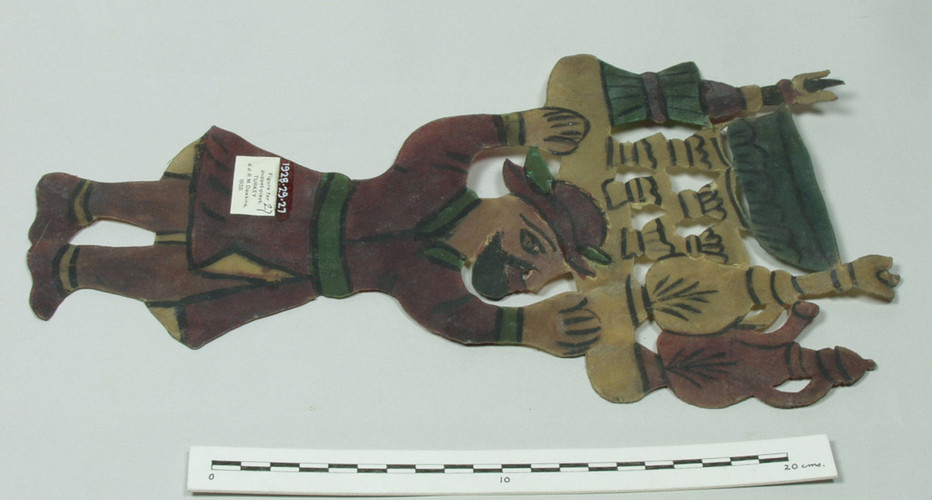 1928.29.27Shadow puppet of a man carrying a tray loaded with jugs etc on his head [L.Ph 'DCF 2004-2006 What's Upstairs?' 11/3/2005]1928.29.27
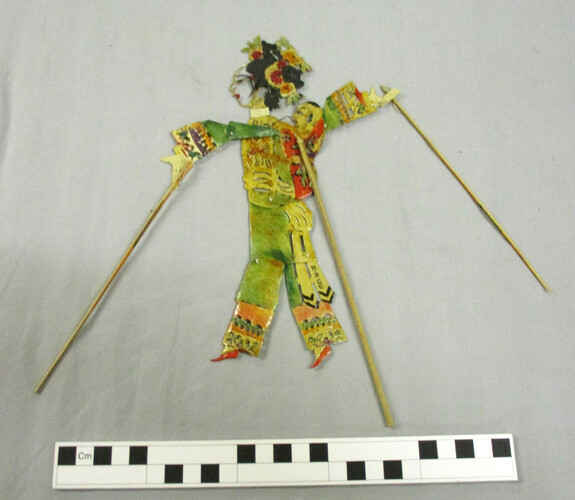 1985.36.128Female shadow puppet carring a small baby on her back. Very elaborate costume. Hinged limbs with string, canes attached to body, and moveable limbs. [ASh [OPS move] 31/05/2016]1985.36.128
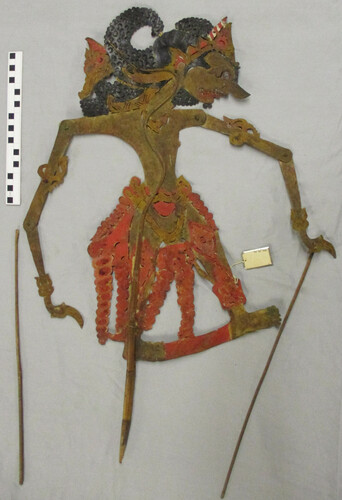 1899.58.34Shadow puppet representing Anthawan/ Antareja/ Antasena. This puppet has a brown face and body with black hair and it has very long arms. It is wearing a red costume. One stick has become detached, but is stored with the object along with the detached knot which had connected it to the puppet. [MOBB [OPS move] 16/05/2016]1899.58.34