
- Collection type
- Object
- Description
- Curved sword [.1], shamshir, with enamelled hilt and leather bound sheath [.2] with enamelled chape, locket and middle mount. [SM 30/04/2007]
- Long description
- Curved sword [.1], shamshir, with enamelled hilt and leather bound sheath [.2] with enamelled chape, locket and middle mount. The sword has a single edcged blade. The hilt is made from ?ivory. The quillons and ecusson are decorated with enamelled flowers. The enamelling is green, blue and gold. The ends of the quillons and the pommel are shaped like ram's heads and are green. Between the hilt and the quillons is bound with plaited yarn and a loop of woven textiles. The sheath is made of dark leather which has been painted gold, with a tooled scrolling design in relief. The locket, middle mount and the chape are decorated with the same enamelled patterns as the quillons and ecusson. A portion of the chape is also bound with plaited metallic yarn which has been painted with gold paint. [SM 30/04/2007]
- Geographical reference
- Date / Period
- Date made: 1650-1750
- Date collected
- By 1902
- Acquisition information
- Loaned: 1902
- Materials and processes
- Material Steel Metal, Material Animal Leather Skin, Material Wood Plant, Material Enamel, Material Textile, Material Yarn Metallic, Material Animal Ivory Tooth, Process Forged (Metal), Process Bound, Process Enamelled, Process Gilded, Process Stitched, Process Tooled
- Dimensions
- Length: max 935 mm sword, Width: max 113 mm sword, Length: max 825 mm sheath, Width: max 74 mm sheath
- Object numbers
- Accession number: 1902.87.10.1 Accession number: 1902.87.10.2
- Research and responses
The following notes are drawn from research compiled by Andy Mills as part of the DCF Cutting Edge Project 2006-2007. This is a very fine example of the shamshir – the quintessential single-edged curved longsword of Persia, Mughal India and Arabia, which developed and rose to prominence during the mid-16th century. Its name means ‘tiger’s claw’, alluding to the pronounced curve (Wikipedia). This curve is a direct functional development, intended to widen the centre of percussion, and permit deeper wounds when used in a ‘draw cut’ – as I discussed above in relation to the European cavalry sabres which mimic the shamshir form. Shamshirs are highly adapted to the form of combat employed by the Arabs, Persians and Mughal Indians in the 16th-18th centuries – hand-to-hand combat on horseback. Attacks were frequently made in passing, or upon infantry from above, for which the shamshir is an ideal weapon (see The Book of the Sword, by R. F. Burton, published by Chatto & Windus in 1884).
As with our example here, the blades of the best shamshirs are manufactured using wootz or True Damascus steel. This generates a very particular grain to the blade, which in our example has unfortunately been almost entirely obliterated by over-zealous polishing at some point in the past. This hidden beauty could be restored by etching with a mild acidic substance (the original process of highlighting the grain was generally done with tamarind or citrus juice), although this is not PRM conservation policy.
True Damascus blades were manufactured in Persia, originally in Syrian Damascus, and then later in Khorassan and Isfahan, using steels of Indian origin. The process of creating Damascus steel is essentially one of the extremely slow cooling of the iron bloom, which encourages the formation of crystals of extremely hard Martensite, and soft Cementite. The veins of these crystalline inclusions consequently create the distinctive ‘watered steel’ pattern on these blades, as well as creating a steel of admirably balanced hardness and flexibility. 16th century Persian ‘watered steel’ was famous across Eurasia, and high quality Persian shamshirs like this one were capable of splitting contemporary European helmets with a single stroke, and halving a silk handkerchief drawn lightly across their blades ((see Indian & Oriental Armour. by Lord Egerton of Tatton, published in 1896 by Arms and Armour Press. p.57).
This shamshir is of characteristically Persian form – the diagnostic characteristics being the downturned zoomorphic pommel, delicate langets (longitudinal spurs from the cruciform hilt), and the absence of a ricasso (khajana) which would indicate an Indian origin. Zoomorphic pommel terminals as in our ram-headed example are seen as indicative of a high-status and luxurious weapon (Shamshir Website, www.vikingsword.com/ethsword/shamshir/index.html
). Similarly, the raised gilt scrollwork of the wooden scabbard is a characteristically Persian trait (Egerton, 1896: 48-9).
The Islamic sultan Firuz Shah Tughluq of the Delhi Sultanate (r. 1351-1388) (Wikipedia) forbade the employment of precious materials in arms during his reign, which laid down a precedent for the use of bone in hilts. This led to later luxurious examples possessing ivory hilt cheeks, as on our shamshir (Egerton, 1896: 51n2). Here, then, we have something of a juxtaposition of traditionally inherited Islamic artistic austerity, mingled with later luxury, and the gorgeousness of fine Persian cloisonné enamel. Egerton (ibid.: 51-2) characterises four principal periods of Persian arms manufacturing, and illustrates a sword very much like ours (Egerton, 1896. Plate III, No.2), which he attributes to the third period, 1650-1750 AD.
The acquisition of this Persian shamshir in India is not surprising, as almost all high-status Indians owned swords of Persian manufacture (Egerton, 1896: 59). [SM 17/06/2008]
- Associated publications
- This object features in the Museum's audio guide produced during the DCF-funded 'Cutting Edge’ project, 2007-2009. [HH 20/06/2010] Illustrated in colour on pages 138-9 (centre) of Battle: A Visual Journey Through 5000 Years of Combat by R. G. Grant (Dorling Kindersley 2005), with the captions 'SHAMSHIR AND SCABBARD', and 'CURVED SWORDS The shamshir is a type of sabre originating in Persia...', and annotations 'Carved ivory grip', 'Short straight qiullions', 'Watered steel blade', 'Wooden scabbard bound in leather' and 'Coloured enamel decoration'. [JMC 1/8/2019]
Search terms: Weapon, Figure, Sword, Sheath, Animal Figure
Further items to explore
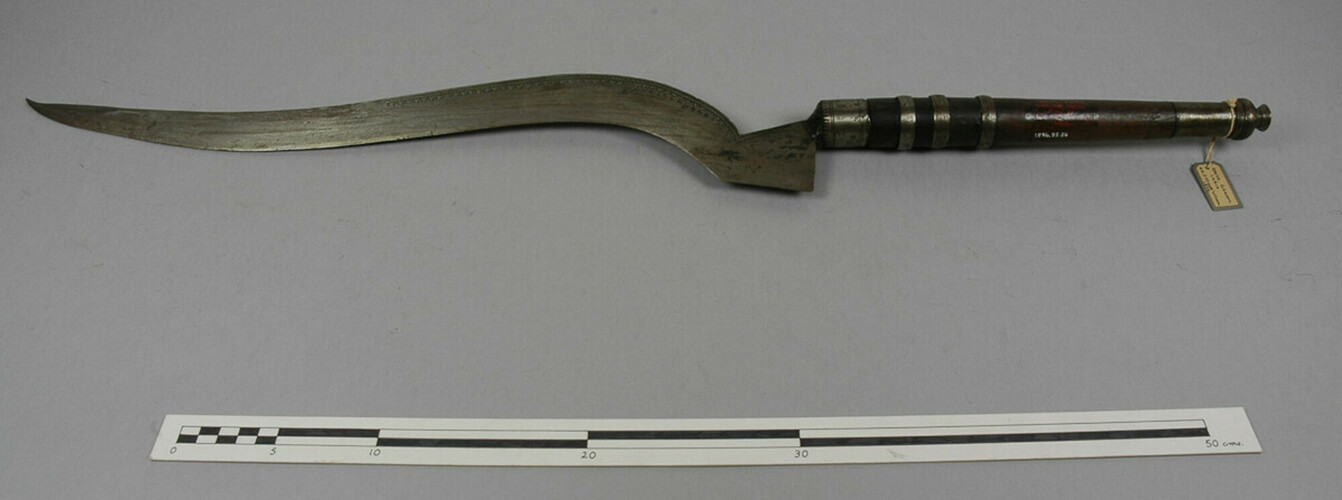 1894.32.54Chopping sword: heavy, one-edged, stepped, S-shaped pointed blade with incised decoration on the back; wooden hilt with iron collars and pommel. [LM 03/10/2007]1894.32.54
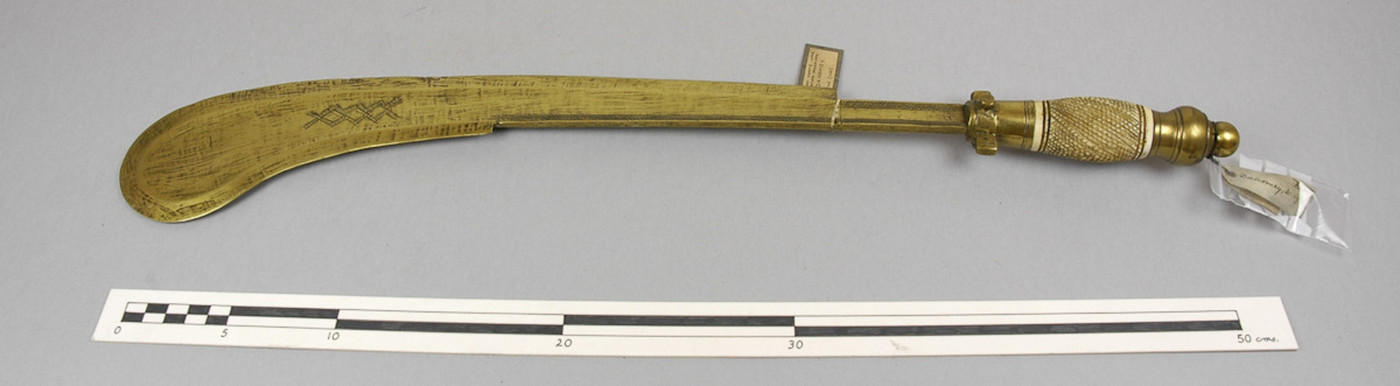 1884.24.15Ceremonial brass sword.1884.24.15
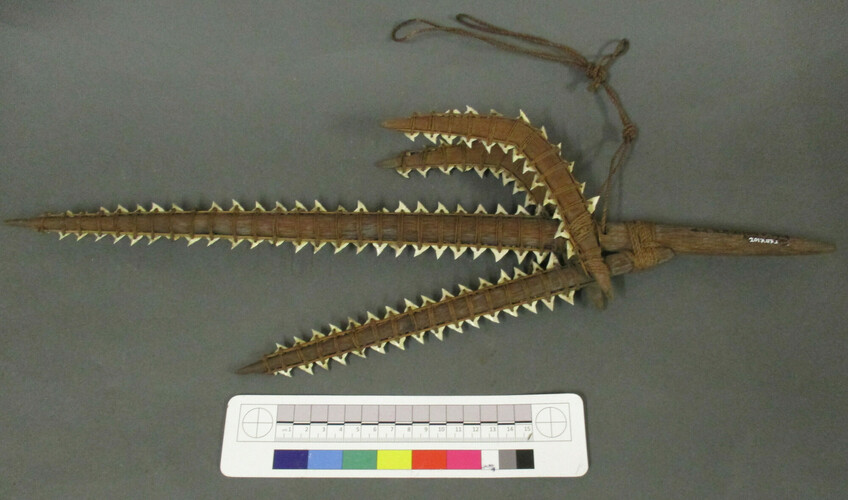 2017.117.1Sword or glaive with short handle and four prongs edged with shark teeth. [AB [OPS Move] 24/5/2017]2017.117.1
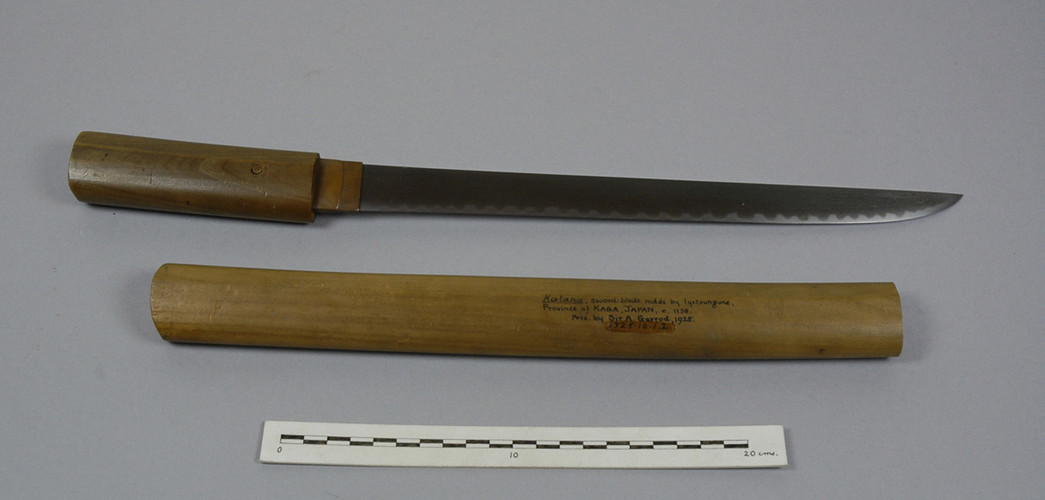 1925.10.1.1Short sword or dagger with plain wooden hilt, with a scabbard sleeve of copper alloy. [with sheath .2] [El.B 27/4/2007]1925.10.1.1
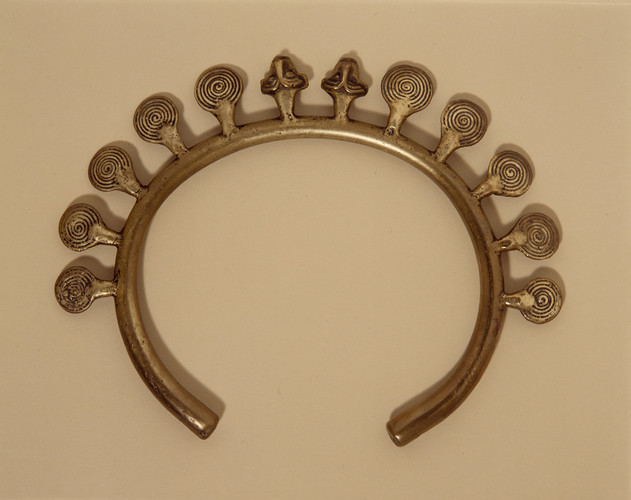 1945.10.94Brass necklet with circular plaques and two faces. [El.B 'DCF 2004-2006 What's Upstairs?' 19/4/2005]1945.10.94
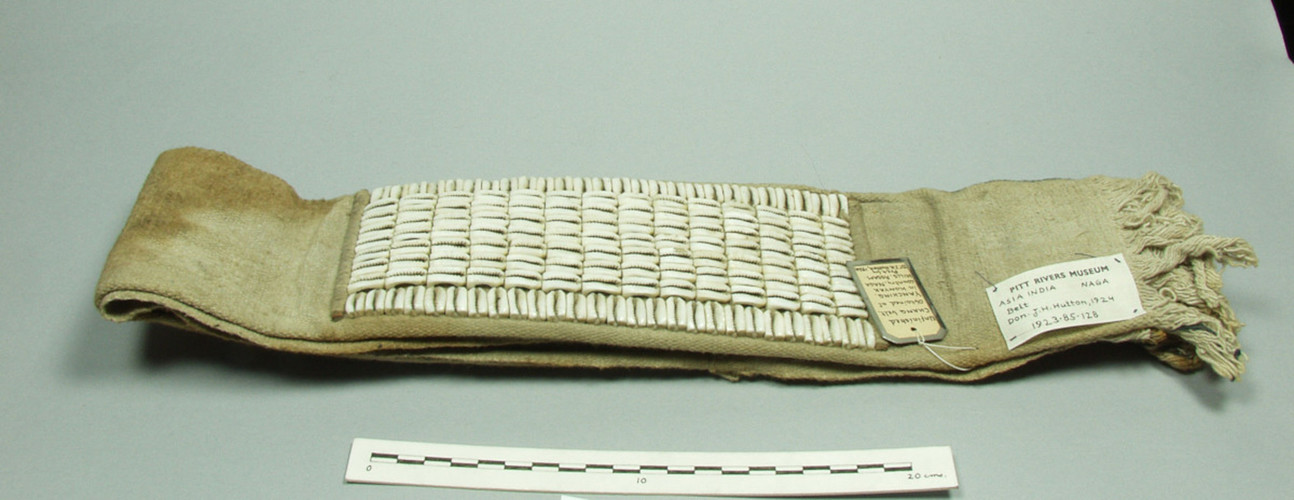 1923.85.128Belt of folded white textile with plaited split cane inside, decorated with cowrie shells. [El.B 'DCF 2004-2006 What's Upstairs?' 28/4/2005]1923.85.128
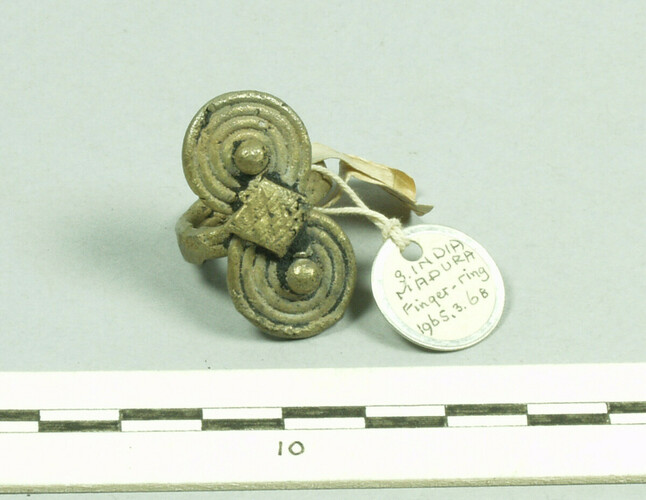 1965.3.68Brass finger ring with a design of two sets of concentric circles. [N.B. 'DCF 2004-2006 What's Upstairs?' 25/5/2005]1965.3.68
 1892.41.545Coin-like token with Queen Victoria head, apparently whist markers that have been reused both as currency and apparently adapted as ornaments. [CM 8.7.1998]1892.41.545