
- Collection type
- Object
- Description
- White and dark brown glass marble. [N.B. 'DCF 2004-2006 What's Upstairs?' 17/3/2005]
- Geographical reference
- England
- Cultural groups
- English
- Date / Period
- Date made: Circa 1801-1900
- Date collected
- By 1956
- Acquisition information
- Donated: 1956
- Materials and processes
- Material Glass
- Dimensions
- Diameter: max 13 mm
- Object numbers
- Accession number: 1956.11.29.12
- Research and responses
http://en.wikipedia.org/wiki/Marbles: Marbles is a class of children's games played with glass, clay, or agate balls usually about ½ inch (1¼ cm) across. However, they may range from less than ¼ inch (1.25 cm) to over 3 inches (7.75 cm), while some art glass marbles for display purposes are over 12 inches (30 cm) wide. Marbles are often collected, both for nostalgia and for their aesthetic appeal. Marbles were originally made from clay or marble, hence their name.
Marbles are often mentioned in Roman literature, and there are many examples of marbles from ancient Egypt. They were commonly made of stone, metal, or glass until the 18th century, when ceramic marbles become more common.
Ceramic marbles entered mass production in the 1870s, starting inexpensive mass-production.
Glass marbles entered mass production in the early 20th century, when WWI cut off their importation from Europe, causing American innovation to be applied to the task, producing a mechanized method of glass marble production which became the most common system in the world. Glass marbles, too, became the most popular variety, and have remained so to this day.
One version of the game involves drawing a circle in sand, and players will take turns knocking other players' marbles out of the circle with their own. This game is called ringer. Other versions involve shooting marbles at target marbles or into holes in the ground. A larger-scale game of marbles might involve taking turns trying to hit an opponent's marble to win. A useful strategy is to throw a marble so that it lands in a protected or difficult location should it miss the target. As with many children's games, new rules are devised all the time, and each group is likely to have its own version, often customised to the environment. [AP 27/09/2006]
http://www.1911encyclopedia.org/Marbles: [A long article about marbles] ... A writer in Notes and Queries (IX. ii. 314) thus describes the marbles used by English boys in the middle of the 19th century: " In ring-taw the player put only commoneys in the ring, and shot with the taws, which included stoneys, alleys and bloodalleys. Commoneys were unglazed; potteys glazed in the kiln. Stoneys were made from common pebbles such as were used for road-mending; alleys and blood-alleys out of marble. The bloodalleys were highly prized, and were called by this name because of the spots or streaks of red in them. In Derbyshire, where large numbers were made, they had relative values. The stoney was worth three commoneys or two potteys. An alley was worth six commoneys or four potteys. Blood-alleys were worth more, according to the depth and arrangement of colour - from twelve to fifty commoneys and stoneys in proportion."... [AP 27/09/2006]
Search terms: Toy and Game, Children and Childcare, Toy, Gaming Piece
Further items to explore
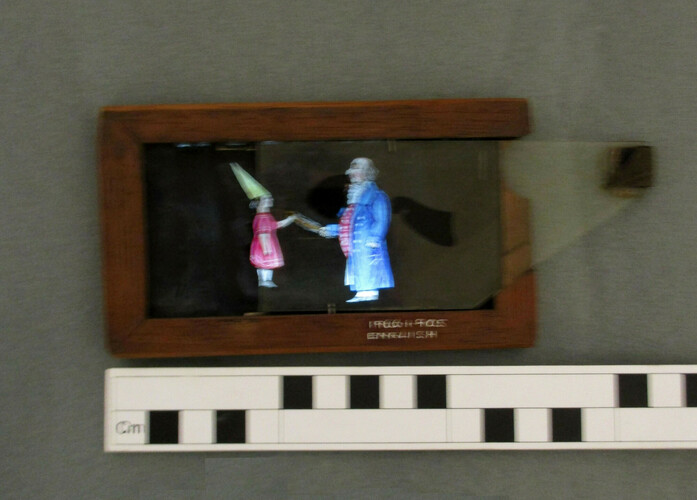 1966.1.905Optical toy with a plain wooden frame and painted glass depicting a small girl in a red dress and dunce's cap being hit on the hand by an older man. A second piece of glass is painted with black areas, which, when slid sideways, obscure the man's lowered hand. There is a pin at the top and bottom of the frame. [RH [OPS Move] 28/6/2017]1966.1.905
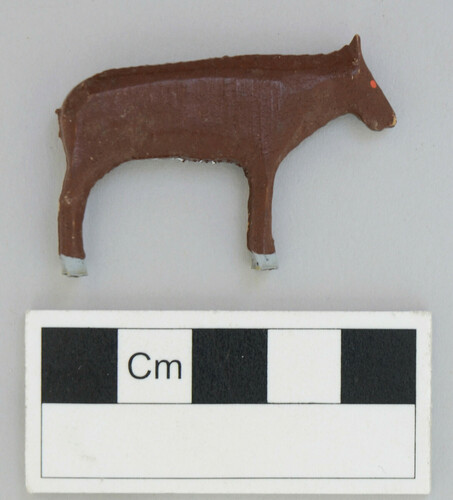 1956.9.70.97Small brown ?cow figure with grey feet and red eyes. Part of a Noah’s Ark set. One of a pair. [See 1956.98.70.96 for other figure] [SM (Verve) 15/04/2015]1956.9.70.97
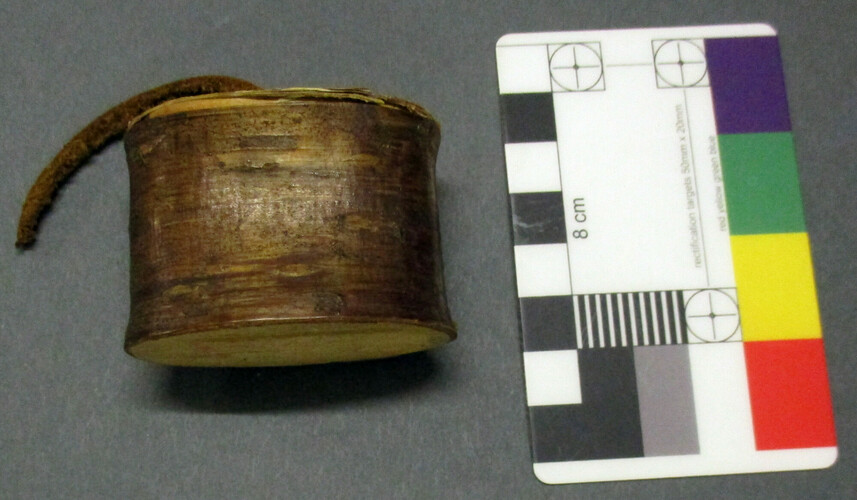 1985.36.222.7A miniature 'toy' wooden box 1985.36.222 .7 .1 with lid 1985.36.222 .7 .2, the side of the box is made from bark. There is a leather handle through the lid. [EH [OPS Move] 18/4/2017]1985.36.222.7
 1938.36.1881.3Miniature wooden peg top. [E.S-R 'DCF 2004-2006 What's Upstairs?' 13/1/2005]1938.36.1881.3
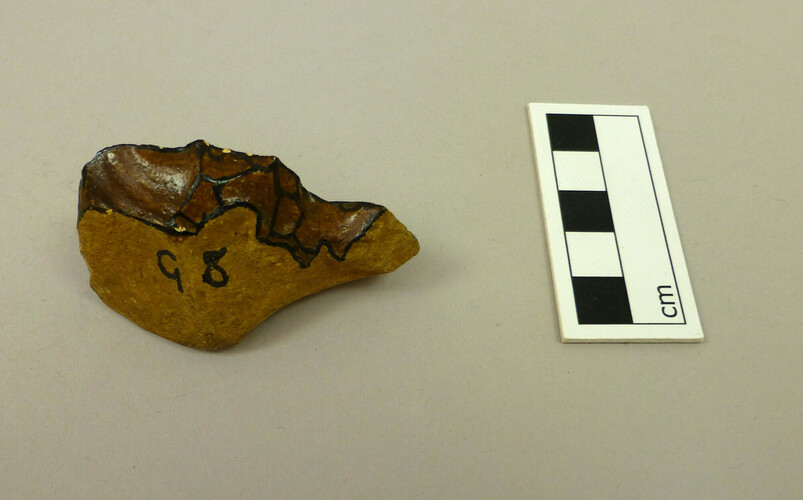 1940.12.162.8Cast of geological specimen, with markings drawn in black.1940.12.162.8
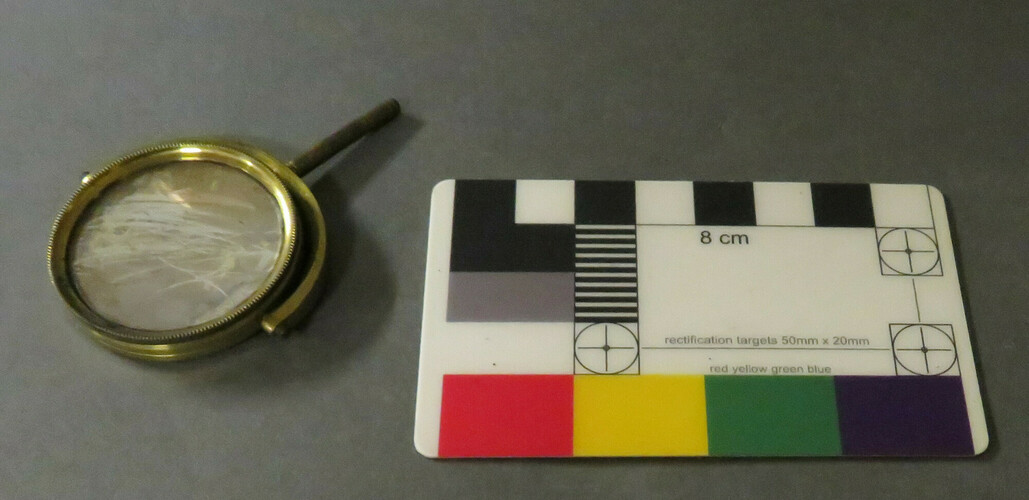 1971.30.7.4Microscope Mirror. For the related records see 1971.30.7 .1 - 18 [MOBB [OPS move] 13/6/2018]1971.30.7.4
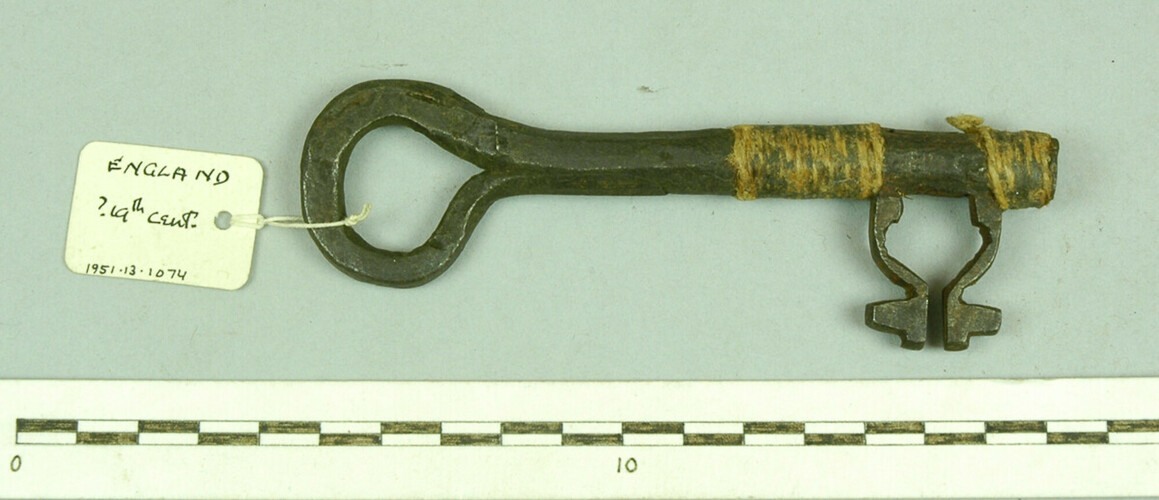 1951.13.1074Iron key with almost circular bow, solid stem and twin bit. The stem is bound with string on both sides of the bit. [El.B 05/05/2009]1951.13.1074
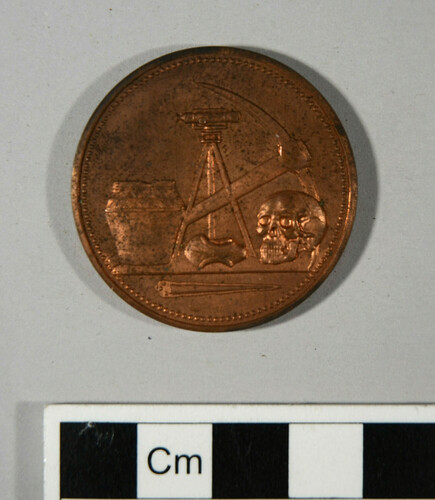 1971.30.5.15One of 23 copper alloy medallions (for excavations) [.3 - .25]. [FB 10/04/2014]1971.30.5.15