
- Collection type
- Object
- Description
- Large tobacco pipe, with zoomorphic pipe bowl in the shape of a hyena [.1], wooden stem and gourd and hide mouthpiece [.2] [RTS 17/12/2004].
- Long description
- Composite tobacco pipe consisting of a gourd and hide mouthpiece on a wooden shaft [.2] and a pottery pipe bowl with hide sheath at tip [.1]; at the moment, these parts are firmly wedged together and can not be easily separated. The mouthpiece consists of 2 parts fitted closely together. The inner section is made from a small pale yellow gourd (Pantone 7401C-7402C) with narrow mouth on a narrow cylindrical neck that flares out at its base into an ovoid body with sloping shoulder. This has been fitted into an outer casing made from a section of animal tail, stretched to cover the lower half of the gourd and then folded and shrunken into a narrower cylinder that fits as a socket over the top of the wooden stem. The hide is currently dark brown in colour (Pantone 438C) with some lengths of buff coloured hair still attached to the outer surface. There is a faint smell of tobacco around the top of the mouthpiece. The body has been carved from a length of yellowish brown wood (Pantone 729C) with the bark removed; this is round in section, and the interior has presumably been hollowed out. 2 pairs of crude holes have been bored through the top and bottom part of this shaft, although their function is not clear. 2 loops of European cotton yarn string have been tied around the shaft; this could be part of a modern mounting rather than original. The lower end of the shaft has been fitted with a short sheath of animal hide, covered with buff to reddish brown hair (Pantone 7505C); this is made from a rectangular strip that has been folded around the shaft and stitched down the joining sides using a flat length of yellow plant fibre or bast (Pantone 7508C); these stitches cross one another and make a thick plaited band that runs down this seam. This sheath covers the junction of pipe bowl and shaft. The base of the pipe consists of a separate pottery pipe bowl, the stem of which fits inside the hide sheath to rest up against the base of the wooden body. This has been hand made from a soft, moderately well levigated clay with tiny mica inclusions, fired darkish gray at core and reddish brown at surfaces. The exterior has been covered in a reddish brown slip (Pantone 476C). This has a cylindrical stem that swells out then continues into a splaying solid pipe rest at the base, with a slightly convex underside. The body of the bowl extends out from one side of this at right angles to the top of the stem, and has been shaped in the form of an animal figure, probably a hyena. This has a broad oval head with 2 semicircular ears with concave interiors applied to the top, two neatly bored circular cut-out eyes, and a ridge that runs from the base of the neck up and over the head to just above the mouth, where it ends in 2 small depressions marking the nostrils. The mouth below is wide and lentoid-shaped; this is where the tobacco would be put. This head sits on a short neck, which swells out to the body below; no limbs or other details are shown. The surface has been decorated with a series of incised and impressed lines, filled with a white chalky pigment and arranged in bands, leaving plain, highly burnished areas between for contrast. Only the underside of the pipe rest is not finished in this way. These consist of a band of crosses, or crosshatching around the top of the pipe stem, partially obscured by the hide sheath; a band filled with 3 horizontal rows of impressed and inlaid crescents around the pipe rest base, and a series of 5 vertical columns filled with crescentic impressions and framed by vertical lines on either side, covering most of the animal's body. Similar bands, made of double rows of crescents, run down the front flanks of the animal, and the head and area under the throat are filled with multiple rows of this motif, with lines that frame its edges meeting in a v-shape at the base of the throat. These crescents also run along the crest, down the nose, and in a circle around each eye. The object is probably complete, although lacking the usual carrying loop; however the pipe bowl has been broken and repaired at some stage, with damage to the pipe stem and face, where a few surface chips are missing. Some of the decoration appears to be without inlaid pigment. It has a total weight of 531 grams, and is 735 mm long. The mouthpiece is 174 mm long, has a maximum diameter of 70 mm and a neck diameter of 26.4 mm, while its top opening is 7 mm wide. The pipe shaft has a diameter of 26 mm. The hide sheath at its base is 80 mm long, and the pipe bowl is 200 mm long (including the section covered by the sheath), with a stem diameter of 31.4 mm and a base diameter of 45 mm; the head is 62.1 mm wide and the body has a maximum width of 53 mm, while the mouth measures 49 by 19 mm across [RTS 17/12/2004].
- Geographical reference
- [White Nile]
- Cultural groups
- Shilluk
- Date / Period
- Date made: Before 1923
- Date collected
- 1923
- Acquisition information
- Donated: 12/1965
- Materials and processes
- Material Gourd Plant, Material Animal Hide Skin, Material Animal Tail, Material Wood Plant, Material Plant Fibre, Material Pottery, Material Bast Fibre Bark Plant, Process Carved, Process Hollowed, Process Perforated, Process Socketed, Process Stitched, Process Handbuilt, Process Impressed
- Dimensions
- Diameter: max 70 mm, Length 200 mm bowl, Length 174 mm mouthpiece, Length 80 mm hide sheath, Length: max 735 mm, Width: max 62.1 mm head, Diameter 26 mm shaft, Weight 531 g
- Object numbers
- Accession number: 1965.12.118.1 Accession number: 1965.12.118.2
- Research and responses
Throughout the twentieth century the term ‘White Nile’ has been used to denote an administrative district immediately south of Khartoum. However at the time this object was collected, the term was also used more losely to refer to the Bahr el Abiad and Bahr el Jebel rivers, or the areas immediately around them. It is not clear in which sense it is being used here, although association with the Shilluk might indicate the river is being referred to rather than the administrative district.
Shilluk commoners call the tobacco pipe dak, while its royal name is labo, meaning earth or mud. Tobacco is called athabo, or omaro by royalty, signifying its colour. The Shilluk use 2 types of dak – the dangduong and the dangthen. The former is kept within the family enclosure; the latter is more commonly used in public. The two types are not structurally different. They are made up of a pipe bowl (the base is known as tyel dak), attached to a hollow stem (obec dak – usually made from a plant known as obec) with a skin sheath (apyeth dak), and at the top, the mouthpiece is made of skin, usually cow's tail (apyeth agwayo), fitted around a gourd plant (agwayo). A filtering material (anywön) is put into the latter through a hole in its base; this is made from a plant known as thitho, treated in a special way that makes the fibres very soft. This is changed when it becomes thick and bitter with nicotine. A wire instrument called a godi is used to remove bad anywön. When a new filter has been put into a pipe, it is often smoked by a number of people in an event known as Käki 'dak, where the beauty of a pipe can be shown off. The pipe in question is often decorated with beads and cuttings from the tails of newly born sheep for the occasion. Many pipes decorated with lion or human heads and other designs were produced by a Shilluk school teacher and sculptor called Mariano Gwado Ayoker during the early 1930's; he sold many of these and his wooden sculptures to the the Verona Fathers, and later the Mill Hill Fathers in Tonga and Malakal; he died in 1975. One of his lion pipes is currently in the British Museum (Kunijwok Gwado Ayoker of Wolfson College, Oxford, circa 1980's, from an unpublished paper titled "Reflections on Cultural Artifacts and History: the Case of a Shilluk Pipe", pp 2-5, 11-13, figs 1, 3; a copy of this is kept in Jeremy Coote's office) [RTS 16/12/2004].
The Acquisition field above states that the object was donated in December 1965, but the circular sticker on the object and a letter in the RDF suggest that it was actually handed over on June 21st 1965 [RTS 17/12/2004].
Search terms: Narcotic, Pottery, Figure, Pipe, Tobacco Accessory, Animal Figure
Further items to explore
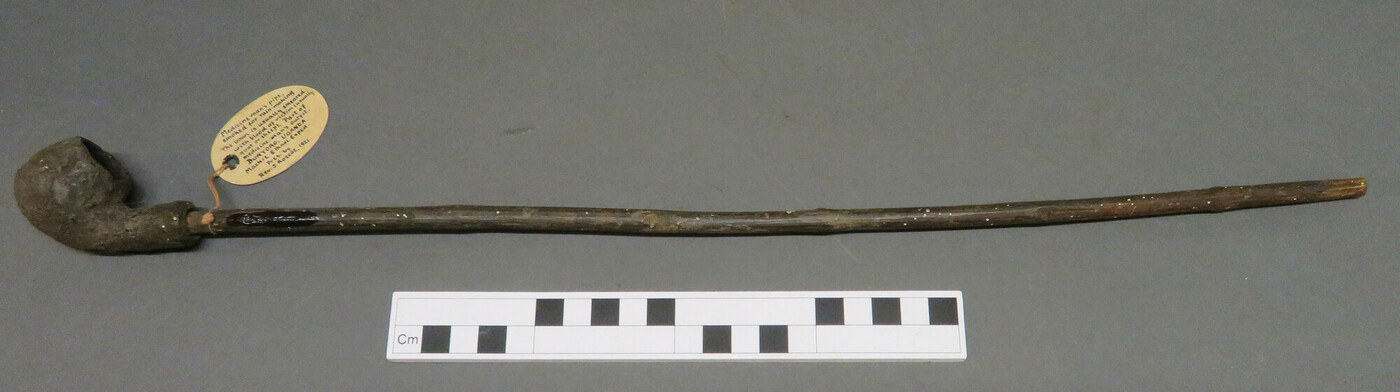 1921.9.167Medicine man's wooden pipe. [ASh [OPS move] 12/5/2017]1921.9.167
 1987.4.1Cylindrical wooden pipe stem, stained, slightly curved. [MOBB [OPS move] 21/10/2016]1987.4.1
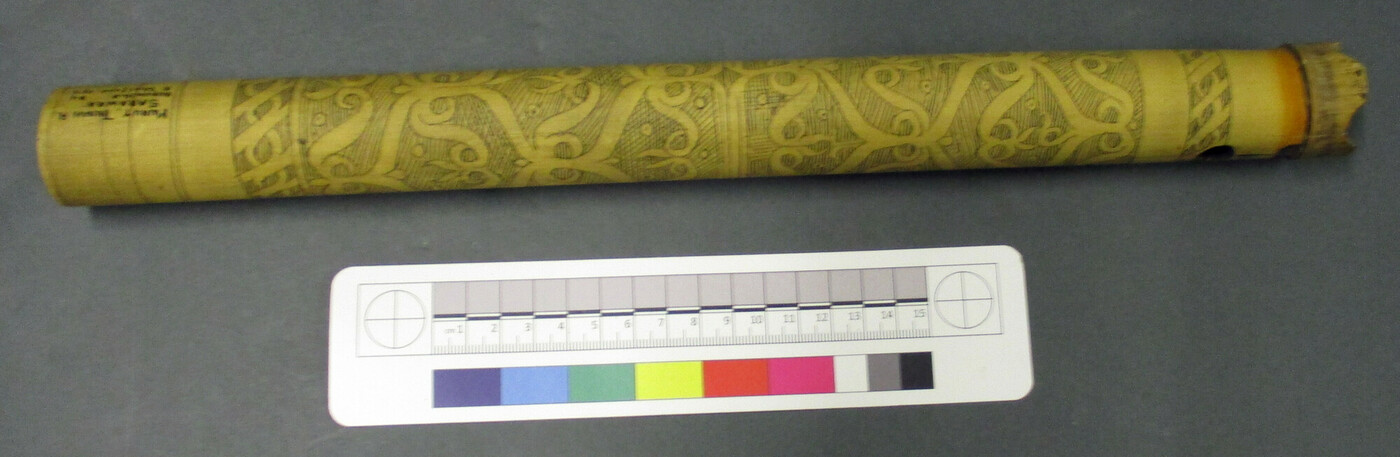 1912.31.44.2Bamboo pipe stem and body. Section of bamboo, decorated with incised scroll-like patterns. The bowl for this pipe is 1912.31.44 .1. [MOBB [OPS move] 24/10/2016]1912.31.44.2
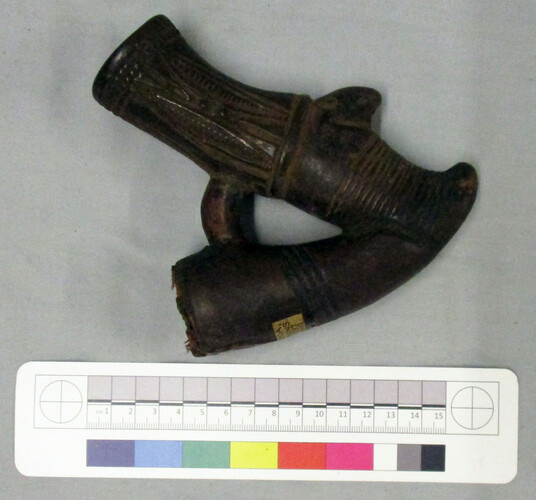 1942.13.287.1Red pottery bowl. For the carved cylindrical wooden pipe stem with tubular metal mouthpiece see 1942.13.287 .2. [CW [OPS Move] 5/10/2016]1942.13.287.1
 1954.5.114Iron shoe horn.1954.5.114
 1998.9.14.2Circular crocheted doily with star and shell design in cream coloured wool, used on tables or over the backs of chairs [RTS 17/2/2005].1998.9.14.2
 1979.20.101.1Wooden tobacco container with dark brown biconical body [.1] and disc shaped stopper cut from a gourd [.2].1979.20.101.1
 1917.25.76Lyre with wooden frame, bowl-shaped tortoiseshell resonator and 5 strings [RTS 21/9/2005].1917.25.76