
- Collection type
- Object
- Description
- A large flat, thick and well-fired ceramic sherd. The decoration on the outside of the pot consists of rolled cord marks all over. [EH [OPS move] 12/12/2017]
- Long description
- A large flat, thick and well-fired ceramic sherd. The decoration on the outside of the pot consists of rolled cord marks all over and the decoration inside is overlapping radius marks (which is called, sei kai ha mon, meaning blue sea wave pattern). [Fumiko Ohinata, Japanese Archaeology Project 1996-2000]
- Geographical reference
- Cultural groups
- Japanese
- Date / Period
- Archaeological period: Kofun 古墳時代
- Date collected
- Before 1884
- Acquisition information
- Donated: 1896
- Dimensions
- Length: max 173 mm, Depth: max 19 mm, Width: max 171 mm, Weight 407.5 g
- Object numbers
- Accession number: 1896.9.10 Other numbers: 10 JAC 444
- Research and responses
See 1896.9.1 for a letter and memorandum from Aston which, possibly, but not definitely might match these objects [AP 23/11/2012]
Listed and described as JAC444 on page 126 of the unpublished draft typescript 'The Japanese Archaeology Collections at the Pitt Rivers Museum, University of Oxford', by Fumiko Ohinata and Jeremy Coote (dated 2002): ‘Pottery ... Sue-ware from the Kofun period ... Pottery from the Kofun period is either Sue ware or Haji ware. Haji ware developed from Yayoi pottery and they are not always easy to distinguish from one another. On the other hand the technique of making Sue-ware was introduced to Japan in the middle of the Kofun period from the Korean peninsula. ... Sue-ware is grey in colour and unglazed. All pottery before the appearance of Sue-ware, such as Jomon pottery, Yayoi pottery and Haji ware from the Kofun period, was fired at about 700-800 C° and is called earth ware, while Sue-ware was fired at temperatures of around 1100C°, at which point partial fusion occurs and partial vitrification takes place and thus Sue-ware is classified as stone-ware. When the temperature exceeds 1200C°, feldspar in the clay melts and the resultant pottery becomes a ceramic, while with the temperature over 1350C°, the quartz in the clay melts and the resultant pottery is called porcelain. Sue-ware is hence an intermediary stage in the development of pottery from earth-ware to porcelain ... The production of Sue-ware which required a higher temperature than that of the Jomon period means that there was a change from oxidation based kilns to reduction based kilns. ... The other big change which occurred together with the introduction of Sue ware is the use of the potter’s wheel. Until the Yayoi period, a simple turning table was used to change the direction of turning pottery ... JAC 444; Plate 62.1 / Bluish grey / 17.3×17.1×1.9 cm; 407.5 g / A large flat, thick and well-fired ceramic sherd. The decoration on the outside of the pot consists of rolled cord marks all over and the decoration inside is overlapping radius marks (which is called, sei kai ha mon, meaning blue sea wave pattern). An attached label reads, “Gyogi ware, 7th-10th century Japan”. / Deposited by Consul Aston, Nagasaki; PRM 1896.9.10.' Also illustrated in Plate 62.1. (Copy of typescript in RDF: Researchers: Ohinata and Coote). [MN 23/10/2010]
- Associated publications
- Referred to on pages 507-8 of 'Japan', by Alice Stevenson, Fumiko Ohinta and Simon Kaner, in World Archaeology at the Pitt Rivers Museum: A Characterization, edited by Dan Hicks and Alice Stevenson (Oxford: Archaeopress, 2013), pp. 504-10. Stevenson, Ohinta and Kaner write: ‘Chamberlain had been in regular correspondence with Tylor since his initial letter of 1883 and through Chamberlain Tylor also secured for the PRM 16 intact, Kofun period pottery vessels (1896.9.1–11, 1896.78.1–4) from the consul in Nagasaki, William Aston, a ‘chief authority on matters connected with early Japanese tombs and dolmens’ and another prominent British Japanalogist of the 19th century. It seems that Tylor had originally requested ancient terracotta figures, but was informed by Chamberlain that they were ‘so rare that there are only three or four genuine whole ones in existence above ground’ and to ‘procure one would therefore be almost an impossibility’, thus the ceramics were offered as ‘other things which he [Aston] thinks might be acceptable’. These ‘other things’ are all Sue-ware pieces, a specific type of unglazed, grey pottery fired at much higher temperatures (around 1100–1200°C) than other pottery of the period or preceding periods. When they were offered to Tylor, however, they were described as giogi-yaki, ‘an ancient kind of pottery called after Giogi, the alleged inventor or introducer into Japan of the potter’s wheel’.’
Further items to explore
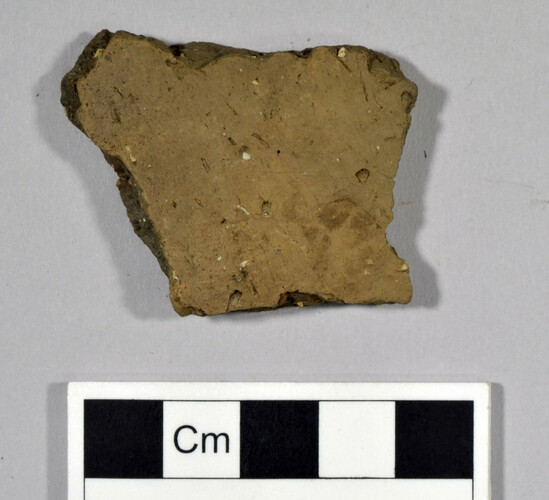 1884.35.60.2Ceramic sherd1884.35.60.2
 1884.138.7.20Ceramic sherd1884.138.7.20
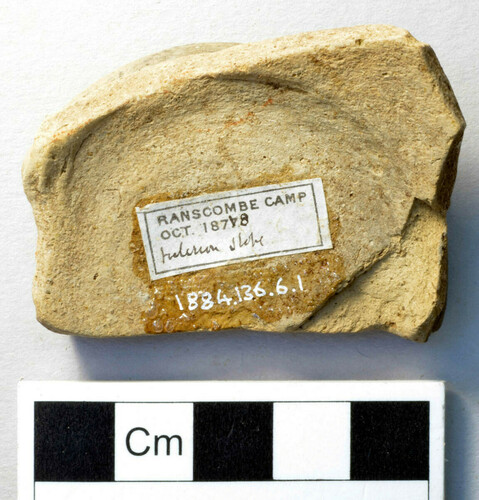 1884.136.6.1Ceramic base sherd1884.136.6.1
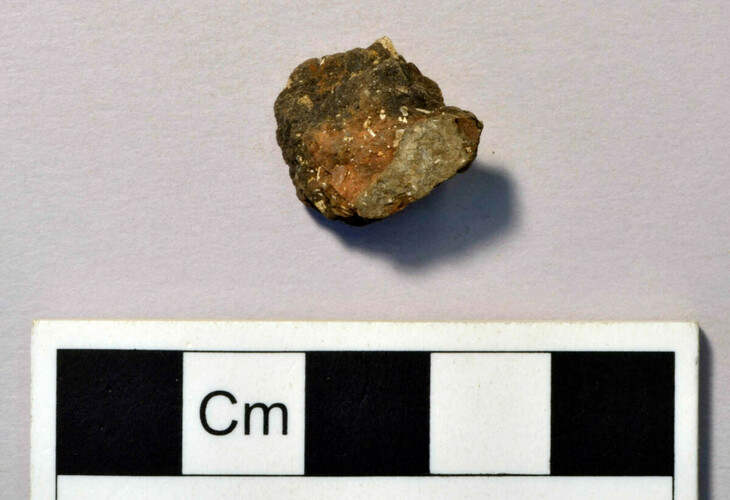 1884.137.52.44Ceramic sherd1884.137.52.44
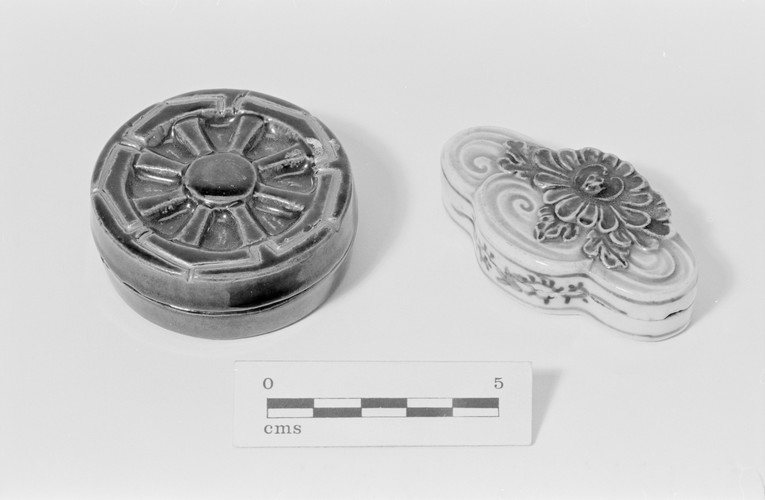 1996.17.63Incense box with lid, circular and dark green glazed. The interior is also glazed green. There is a maker's mark stamped in the base.1996.17.63
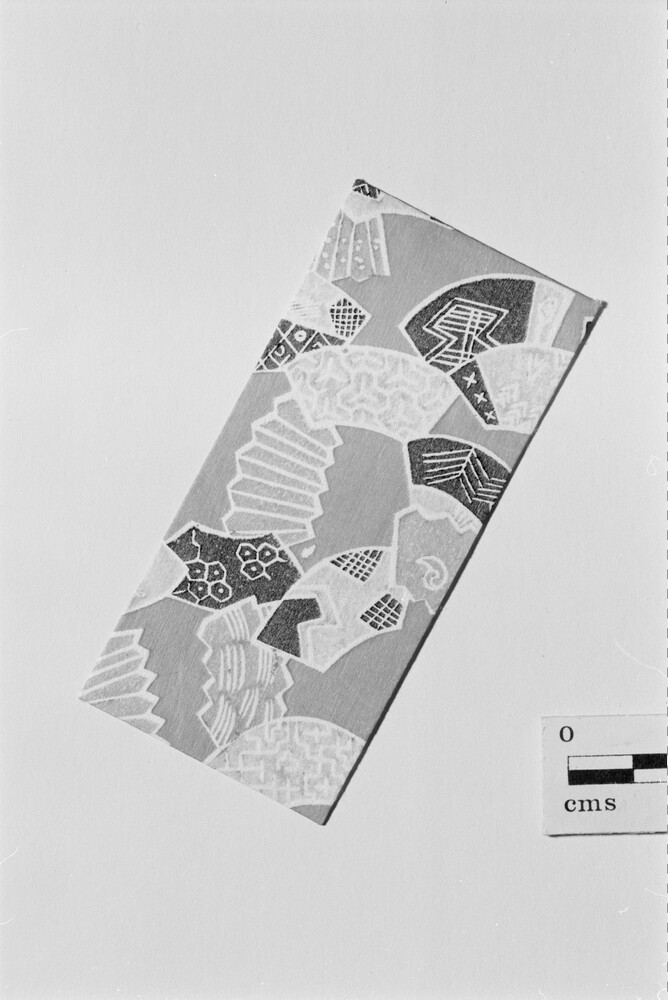 1997.24.66Rectangular printed envelope.1997.24.66
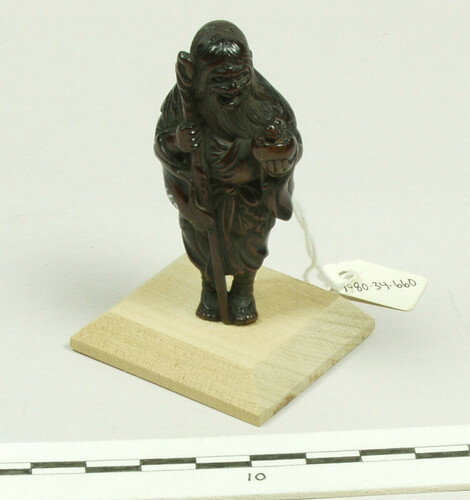 1980.34.660Netsuke toggle of wood, in form of a figure holding a bowl in his left hand out of which emerges the head of a dragon.1980.34.660
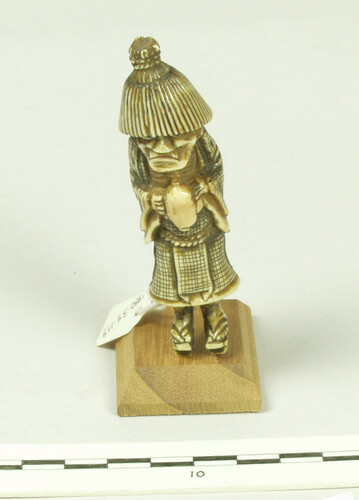 1980.34.119Netsuke toggle of an oil thief: man with hat, holding jug [L.Ph 'DCF 2004-2006 What's Upstairs?' 1/4/2005]1980.34.119