
- Collection type
- Object
- Description
- Bronze uraei [sacred snake] with disc.
- Geographical reference
- Dunqulah [Dongola or Dunkula] Kawa
- Date / Period
- Archaeological period: Ancient Egyptian, uncertain
- Date collected
- By 1932
- Acquisition information
- Purchased: 1932
- Materials and processes
- Material Copper Alloy Metal, Material Bronze Metal, Process Cast
- Dimensions
- Length: max 83 mm
- Object numbers
- Accession number: 1932.80.22 Other numbers: 44 45
- Research and responses
Kawa - ancient Egyptian colony in Cush (Kush; modern Sudan) on the east bank of the Nile River, 4 to 5 miles (6 to 8 km) north of Dunqulah. It was excavated (1930-36) by Francis L. Griffith and Laurence Kirwan for the University of Oxford. It was founded by the Karmah culture (identified as Cush by the Middle Kingdom Egyptians) The city was sacked by the Roman Petronius Arbiter in 23 BC, and though it was occupied for two centuries thereafter, it did not regain its former wealth and importance. [Encyclopaedia Britannica on line] [AP 4/8/2000]
This Encyclopedia Britannica entry confuses two people with the same name, Gaius Petronius. The person they mean was called Gaius Petronius (no Arbiter), he was a governor of Egypt during the time of Augustus (emperor from 27 B.C. to 14 A.D.). While holding that position he was engaged in a war against Meroe in the south of the Kushite Kingdom. Gaius Petronius Arbiter (from arbiter elegantiarum, i.e. 'judge of what is elegant or fashionable'), on the other hand, lived from ca. 27 A.D. to 66 A.D., was a courtier of the emperor Nero and had neither the power nor the inclination to sack any cities. [El.B 12/02/2009]
This Encyclopaedia Britannica entry quoted above is out of date with recent archaeological research. Kawa is believed to have been founded by the Egyptian Pharaoh Akhenaton [1352-1336 BC] during the New Kingdom when Egypt held sway over the Kingdom of Kush. There is a strong possibility however that the settlement at Kawa predated Akhenaton as an extensive Kerma period [2500 - 1500 BC] Kushite cemetery is located near the city [Welsby 2004: 148]. Egyptian control over the area ceased in 1070 BC.
The excavations of Francis Llewellyn Griffith focussed on only a small area of the city around a complex of four temples. The most well known [and largest] of the temples, devoted to Amon-Re, was built by Taharqa/Taharqo [a shrine from the temple dedicated to Taharqa is on display in the Ashmolean Museum]. Taharqa ruled the Kingdom of Kush during the Napatan phase [9th - 4th centuries BC, capital located at Napata near Jebel Barkal] and was a member of the 25th Dynasty of Kushite Pharaohs who also ruled Egypt [747 - 656 BC]. The city is believed to have reached its peak during the Napatan period before beginning a slow decline and being finally abandoned/destroyed during the later Meroitic phase [4th century BC - 4th Century AD, during this period the capital of Kush moved to Meroe, 200 km NE of modern day Khartoum] [Morkot 2000: 136]. It is not believed that the Romans ever occupied the city. As the Griffith excavations had a relatively narrow focus, further investigations by the Sudan Archaeological Research Society were started in the early 1990s and are currently ongoing [Welsby 2008]. Full references: Morkot, R. 2000. The Black Pharaohs. London: Rubicon Press. Welsby, D. A. 1998. Survey and excavations at Kawa, the 1997/8 season. Sudan and Nubia 2: 15-20. Welsby, D. A. and Anderson, J. R. (eds.). 2004. Sudan: Ancient treasures. London: British Museum Press.
Welsby, D. A. 2008. The Northern Dongola Reach Survey. Excavations at Kawa, 2007-8. Sudan and Nubia 12:
34-39. [MN 17/02/2009]
Contemporary photographs from the Francis Llewellyn Griffith/University of Oxford excavations at Kawa are visible online at:
http://www.griffith.ox.ac.uk/gri/heathcote/images.php?q=kawa .[MN 19/02/2009]
- Associated publications
- The University of Oxford excavations at Kawa in the 1920s and early 1930s [from which this object was recovered] were not finally published until the mid 20th century. The report was authored by Miles Frederick Laming Macadam. Full reference: Macadam, M F L .1955. The temples of Kawa : Oxford University excavations in Nubia. London: Oxford University Press (Published on behalf of the Griffith Institute, Ashmolean Museum, Oxford). [MN 19/02/2009]
Search terms: Figure, Insignia, Animal Figure
Further items to explore
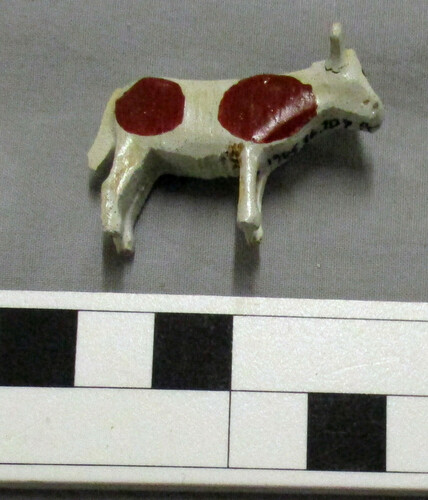 1985.36.209.4Carved wooden cow figure. The body has been painted white with brown spots on the sides. Ears, tail and facial features are all carved in detail. Part of a toy farm see 1985.36.209 .1 - .10 [ASh [OPS move] 14/06/2016]1985.36.209.4
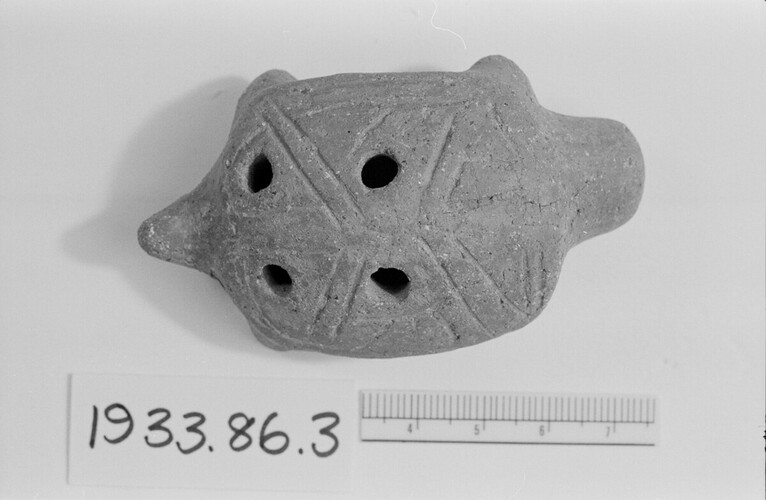 1933.86.3Whistle shaped as a tortoise, with 4 finger holes on the carapace. Hole for suspension in the tail.1933.86.3
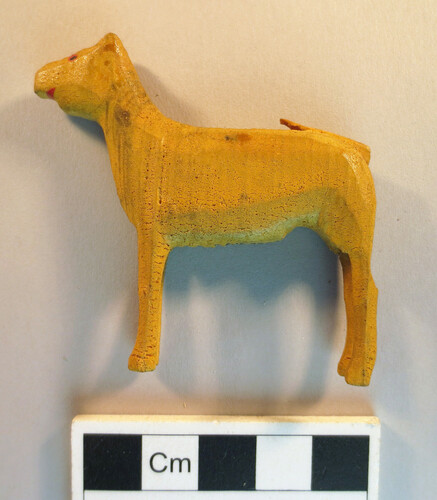 1956.9.70.63Yellow/orange animal figure with partially missing tail. Part of a Noah’s Ark set. One of a pair. [See 1956.9.70.62 for other figure] [SM (Verve) 15/04/2015]1956.9.70.63
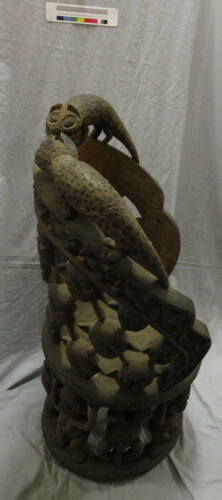 1942.13.1664A chair carved out of a single piece of wood. It has a circular seat with a high curved back and a pedestal base, and the whole is carved with human and animal figures. [RH [OPS Move] 25/5/2017]1942.13.1664
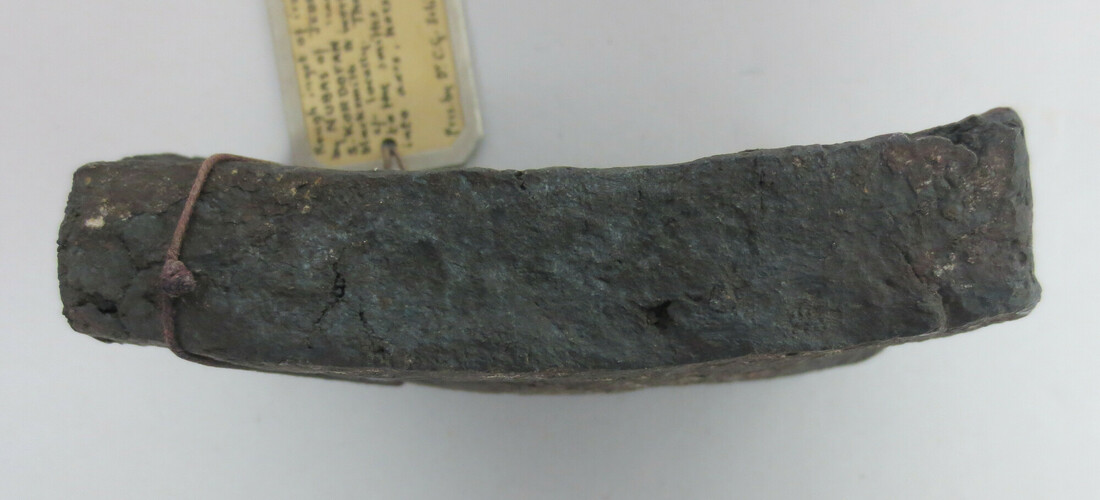 1911.2.2Iron Ingot. [SM (Verve) 17/09/2014]1911.2.2
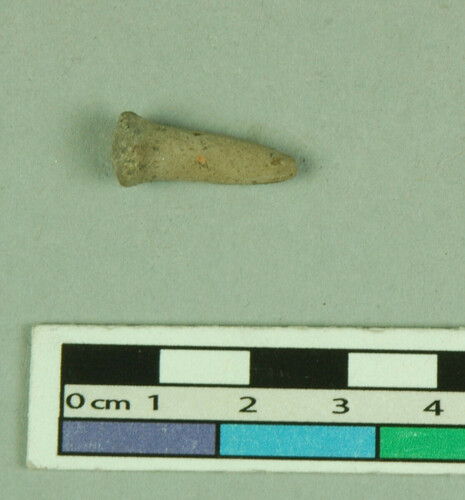 1949.12.137.10Pottery lip stud. [El.B DDF Body Arts Project 2010/2011 11/10/2010]1949.12.137.10
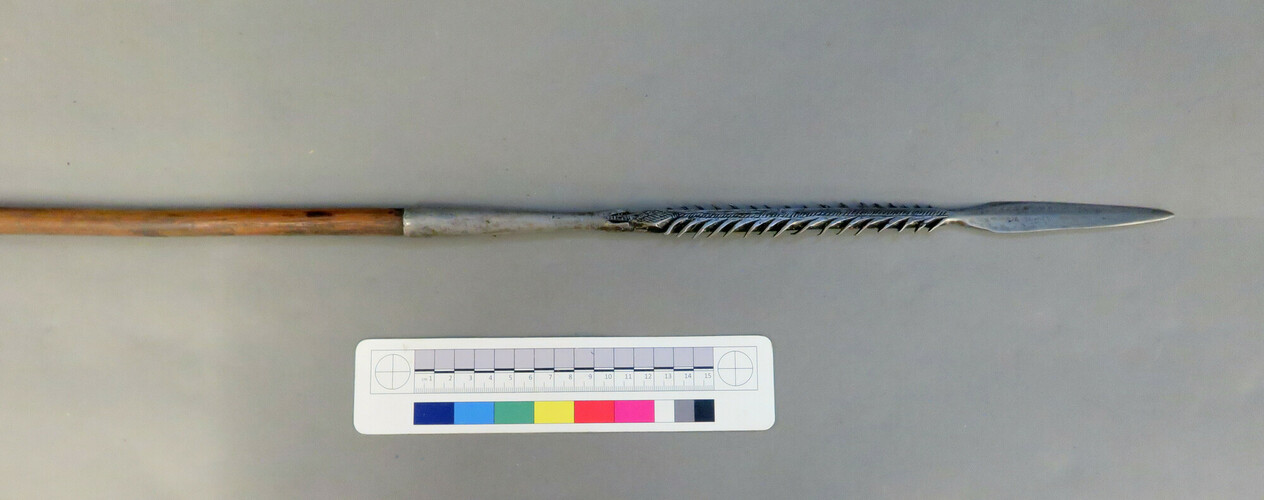 1917.25.22.3Spear with wooden shaft with socketed metal head and bound metal butt. The head has a barbed and incised foreshaft and a leaf shaped blade. [DV [OPS move] 5/7/2018]1917.25.22.3
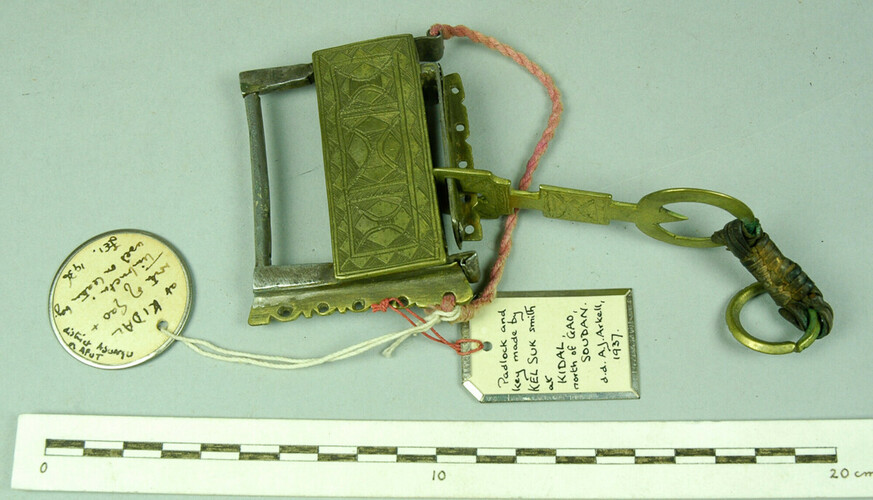 1937.35.47.1Padlock [.1], rectangluar box with bar across the top, with key [.2] sliding along the bottom. [El.B 27/05/2009]1937.35.47.1