
- Collection type
- Object
- Description
- Large, orangey brown barkcloth sheet made from 3 rectangular panels stitched together with plant fibre [RTS 19/7/2005].
- Long description
- Large rectangular sheet of beaten barkcloth made from orangey brown bark fibre (Pantone 154C). The inside face is covered with a lattice of impressed squares, made by the crosshatched head of the beater; these appear as small bumps on the opposite side. The sheet has been made from 3 rectangular pieces, sewn together along their long edges with a double row of simple oblique or vertical running stitches, using a pale yellow grass fibre as the thread (Pantone 7506C). This is reinforced at the ends of each seam by a short double row of stitches, using a different technique that produces a crossed over stitch on one side, and 2 rows of stitches on the other. The piece is complete, but has a few small holes, and one surface is badly worn with patches where the fabric is breaking up into its component layers. There is also a local repair near one corner, where a small rectangular barkcloth patch has been sewn in place using the crossover style of stitching at each end and oblique running stitches down the sides, and several fold creases across the surface, and has been folded into a rectangle at some stage. There is also some surface discolouration, particularly around the edges. The barkcloth has a weight in excess of 1000 grams, and a maximum length of 1840 mm, width of 1580 mm and thickness of 1.5 mm [RTS 19/7/2005].
- Geographical reference
- Cultural groups
- Zande
- Date / Period
- Date made: Before 1930
- Date collected
- 1927 - 1930
- Acquisition information
- Purchased: 31/12/1930
- Materials and processes
- Material Bark Cloth Textile Plant, Material Plant Fibre, Material Grass Fibre Plant, Process Beaten, Process Stitched, Process Repaired (local)
- Dimensions
- Width: max 1580 mm, Length: max 1840 mm, Depth: max 1.5 mm, Weight 1000 g
- Object numbers
- Accession number: 1930.86.48
- Research and responses
Evans-Pritchard reviews the history of use of barkcloth amonst the Zande, using reports of early travellers such as Schweinfurth, Junker and Casati. These suggest that the Zande used skins as their primary clothing, with barkcloth being something of a luxury, introduced through contacts with groups to the south; by the time Evans-Pritchard did his fieldwork amongst the Zande in 1926-1930, the use of barkcloth had become ‘universal’. It was supposedly made from the fig tree, or roko (Evans-Pritchard 1971, The Azande, pp 79-85). According to Larken, barkcloth manufacture was not a specialised profession, but something 'practised by all' (P.M. Larken, 1926, "An Account of the Zande", Sudan Notes and Records IX no. 1, p. 10). He describes the process as follows: "During the rains, about July, two horizontal cuts are made round the stem four or five feet apart, a perpendicular one joining them. The bark is loosened and removed in a single piece. The outer skin is scraped away with a knife, and the dark brown fibrous remainder beaten on a log with a wata. This is usually the point of a small tusk about a foot long. The pointed end is used as a handle, the other, of which the face has been scored with a series of closely-crossing lines to a depth of about the tenth of an inch, as a stamp, the bark, lying on the log, being punched all over with it. The process is gradual, and not too much force may be employed. The fibres become spread out and the thickness of the substance reduced, though somewhat unevenly so. The resulting cloth when dry is of a light reddish brown colour, harsh in texture, and bearing throughout its not very long life the marks of the corrugations on the face of the wata. If the tree is so small that the strip of cloth is not big enough for its destined purpose, other strips are sewn on to the first with fibre. The cloth may be dyed black by immersion in the mud of a stream, where chips and pieces of the wood of a banga tree have been placed. Parti-coloured garments of black and brown are often noticed" (Larken op.cit. pp 34-35). Brock also describes barkcloth manufacture, adding that the bark is "prepared with oil" and "... either left in its natural yellowish brown colour or dyed red or black according to the fashion of the moment. Great care is taken in the correct wearing of the rokko with respect to its folds and which side overlaps the other. It is held round the body by a belt and drawn up between the legs, the ends either being carried right up to the arm pits or turned down over the thighs. The fig tree from which the bark is taken is found in most mens' villages and they always plant cuttings from the trees when starting a new village' (R.G.C. Brock, "Some Notes on the Zande Tribe as Found in the Meridi District", Sudan Notes and News 1, 1918, 254).
Note that the double stitching seen on this piece of barkcloth is also seen on 1940.86.47 and 1940.12.018. For Zande beaters, of the type used to produce barkcloth, see 1934.8.125-6, 1931.66.15 and possibly 1927.54.61 [RTS 7/5/2004].
Search terms: Barkcloth
Further items to explore
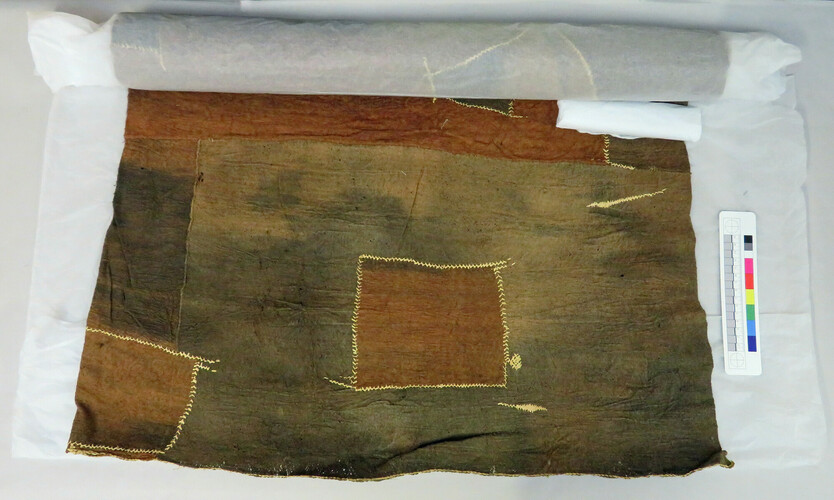 1964.9.13Barkcloth with stitched patterns, resembling patchwork. [AF [OPS move] 21/8/2017]1964.9.13
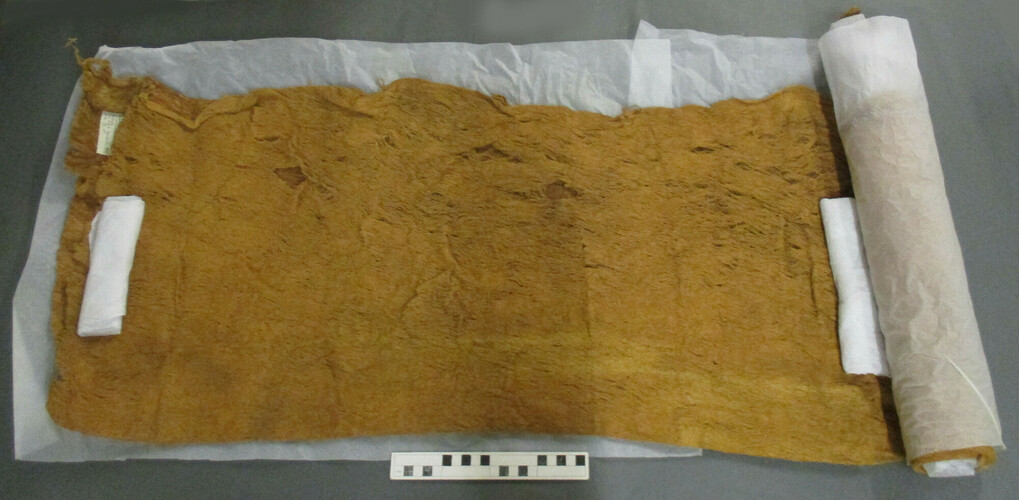 1895.22.117Barkcloth. It is brown in colour. There are areas where the fibres are thin and there are some holes. It has been folded once along the length. [AB [OPS Move] 17/7/2017]1895.22.117
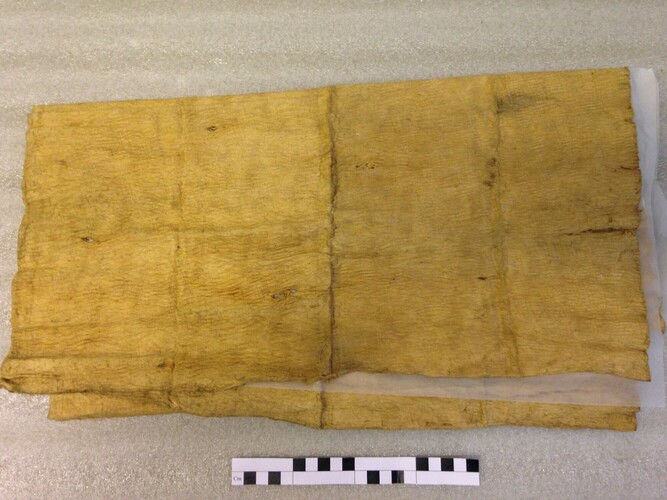 1938.36.584Barkcloth back cloth. It is light brown in colour. It is rectangular and undecorated. [AB [OPS move] 20/7/2017]1938.36.584
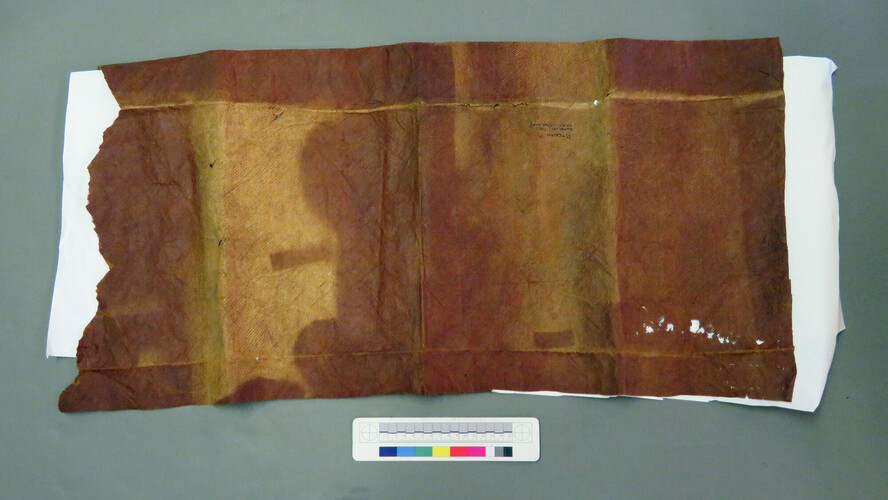 1884.87.96Specimen of barkcloth. It is brown in colour with a dense texture, square on two sides, uneven on the other two sides. [AF [OPS move] 25/8/2017]1884.87.96
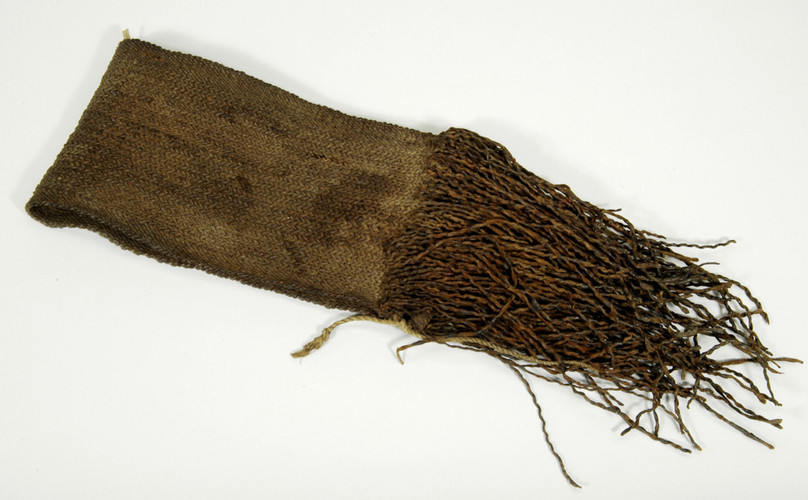 1934.8.13Hide strips woven into a broad rectangular collar with long fringed ends, and a fibre cord to tie it around the neck of a bull [RTS 17/11/2004].1934.8.13
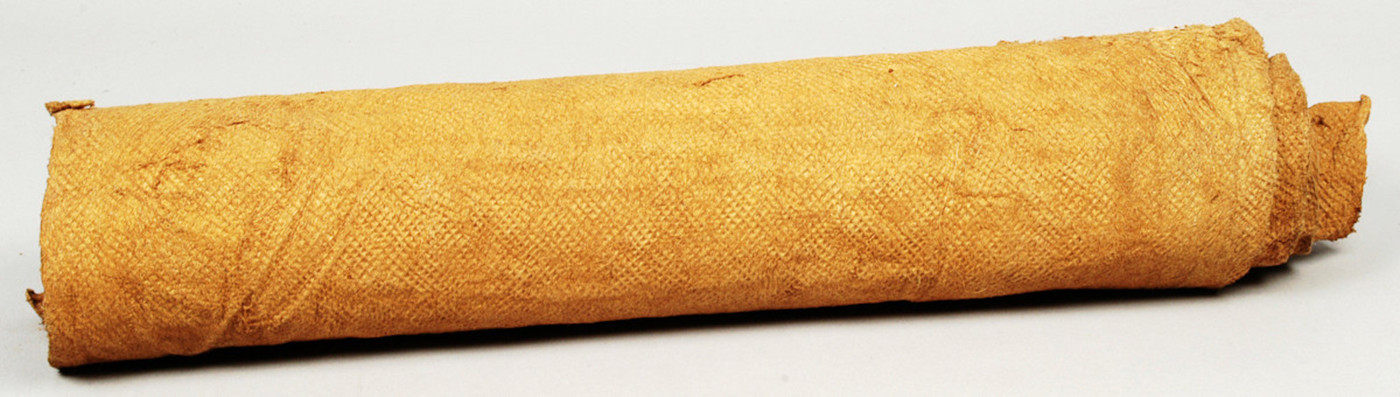 1930.86.46Narrow rectangular strip of orangey brown barkcloth [RTS 19/7/2005].1930.86.46
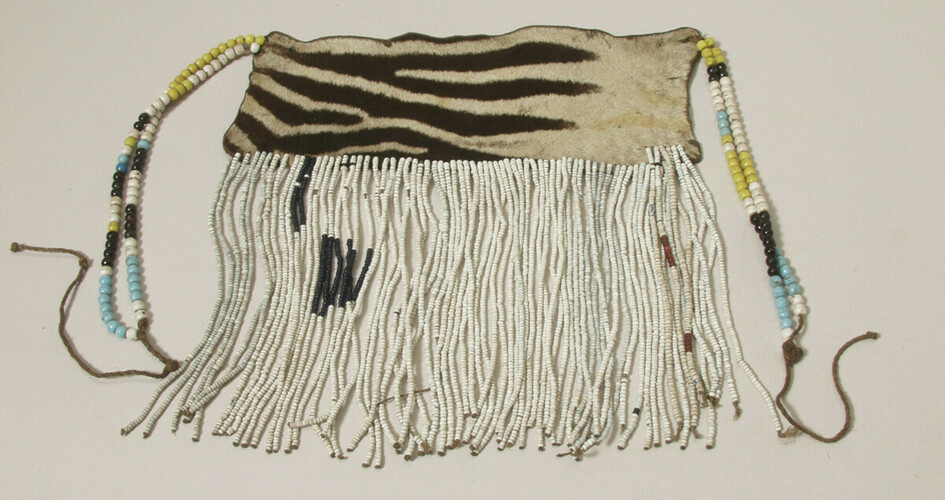 1934.8.62Zebra skin back apron with a fringe of coloured glass beads and with beaded ties [RTS 2/8/2004].1934.8.62
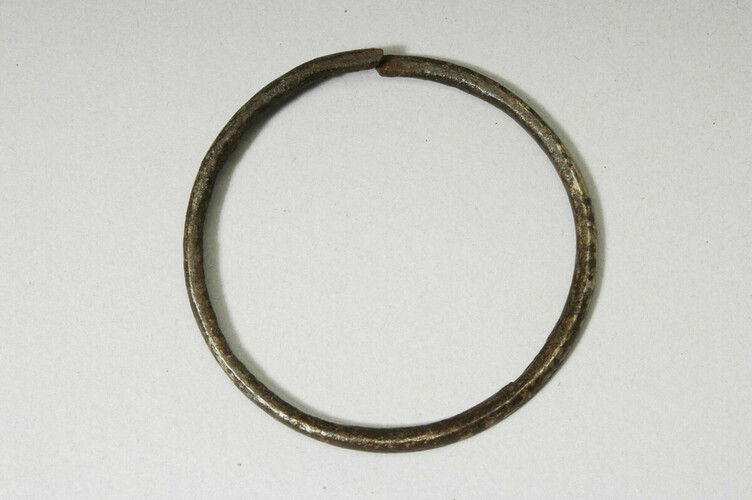 1966.1.517.2Penannular iron arm or leg ornament with square section and overlapping ends [RTS 21/7/2005].1966.1.517.2