
- Collection type
- Object
- Description
- Throwing knife with fibre and string bound handle [JP 18/7/2003].
- Long description
- Iron throwing knife consisting of a rectangular plate tang with rectangular section, covered with plant fibre to provide padding, then bound over the top with twisted strands of plant fibre string to form a comfortable hand grip. The binding goes horizontally around the handle, with the string knotted in at least three places; the metal tang is just visible at the end. This binding extends up to the point where the lower angled blade joins the body; it is a light yellowish brown in colour (Pantone 465C). The central stem, which is a silver gray colour (Pantone 420C), continues as a single narrow piece from the tang with parallel sides that widen slightly at its upper end. Neither edge is particularly sharp; the section continues to be rectangular. It is decorated at the top of the stem, on its upper surface, with two parallel rows formed of short oblique lines running in opposing directions, creating two rows of a broken zigzag pattern. Three additional blades are angled away from the central stem, and were probably separate pieces that have been forged into place. The lower of these projects at an acute angle from the body just above the handle. The edges of the balde have been hammered on both sides to form a bevelled sloping surface down to the cutting edge on all sides. The blade has straight sides that taper in towards the rounded tip; there is a rounded, projecting spur at the base of the outer edge, with a smaller convex spur below that has not been sharpened (unlike that seen on 1934.8.120). A second blade projects from the end of the central stem at right angles; this is curved and tapers to a point at the end; the outer edge is concave and the inside edge convex. A third, broader blade extends up from the end of the stem, with a triangular spur on the inner edge, then a curved blade above with concave inner edge and strongly curved convex outer edge. The surfaces of these blades are also bevelled down to their cutting edges, which run around all sides. The underside of the knife is flat, except where it has been hammered thinner at the edges. Complete and intact; there are some minor nicks in the cutting edges of all blades that may be the result of use wear. Length 436 mm, width of handle 26.3 mm, thickness of handle 17.7 mm; width of central blade 22.6 mm, thickness of central blade 1.8 mm; length of lower angled blade 205 mm, width of lower angled blade 41 mm; length across second and third blades 250 mm, width of second blade 40 mm, width of third blade, including spur, 81.4 mm, and thickness at cutting edges 0.1 mm [RTS 20/2/2004].
- Geographical reference
- Cultural groups
- Zande
- Date / Period
- Date made: Before 1930
- Date collected
- 1927 - 1930
- Acquisition information
- Purchased: 31/12/1930
- Materials and processes
- Material Iron Metal, Material Plant Fibre, Process Hammered, Process Forged (Metal), Process Incised, Process Bound, Process Twisted, Process Decorated
- Dimensions
- Depth 17.7 mm handle, Length 436 mm, Width 26.3 mm handle
- Object numbers
- Accession number: 1930.86.10
- Research and responses
This object represents the southern type of throwing knife, which is found in northern Gabon, and from eastern Cameroon almost to the White Nile; it was used by the Zande and by groups who fell under their influence, including the Adio, Bongo and Kreish. This specific variety, which corresponds to Westerdijk's type SP VIII.1A, is found in the region inhabited by the Zande and neighbouring groups in the Central African Republic and Democratic Republic of Congo. This is supposedly the form which is known to the Zande as kpinga, although Petherick called it a gangoo, and Powell-Cotton’s informants gave it the name sapa (J. Petherick 1861, Egypt, the Sudan and Central Africa, p. 481; P. Westerdijk 1988, The African Throwing Knife, p. 207-8).
Petherick describes the Zande carrying two or three throwing knives at a time, hung from a disc on the back of the shield (J. Petherick 1861, Egypt, the Sudan and Central Africa, pp 469; C. Spring, 1990, African Arms and Armour, pp 69-70; 79-80). They were used as projectile weapons: “The iron weapon, when employed, is thrown with great force, and in such a manner as to revolve upon its centre when spinning through the air” (J. Petherick, 1861, 'On the arms of the Arab and Negro Tribes of Central Africa bordering on the White Nile', Journal of the Royal United Services Institution IV no. 13, p. 176).
RDF 1930.86 contains a letter from Evans-Pritchard to Mr. Malcolm dated 12 December 1930, offering him some 81 Zande and Nuer objects. As Malcolm was curator of the Wellcome Historical Medical Museum, it seems unlikely that these objects were ever sent to the Pitt Rivers Museum and this letter is only useful as background for Evans-Pritchard's attitudes to the intended future use of his material, and as evidence for the temporary storage of these objects in Professor Seligman's office in the London School of Economics at the time. The file also contains an undated list of 48 objects, which does not seem to match accessioned material and could be the list of rejected items that Balfour mentions in his letter [RTS 17/5/2004].
Search terms: Weapon, Cordage, Throwing Knife
Further items to explore
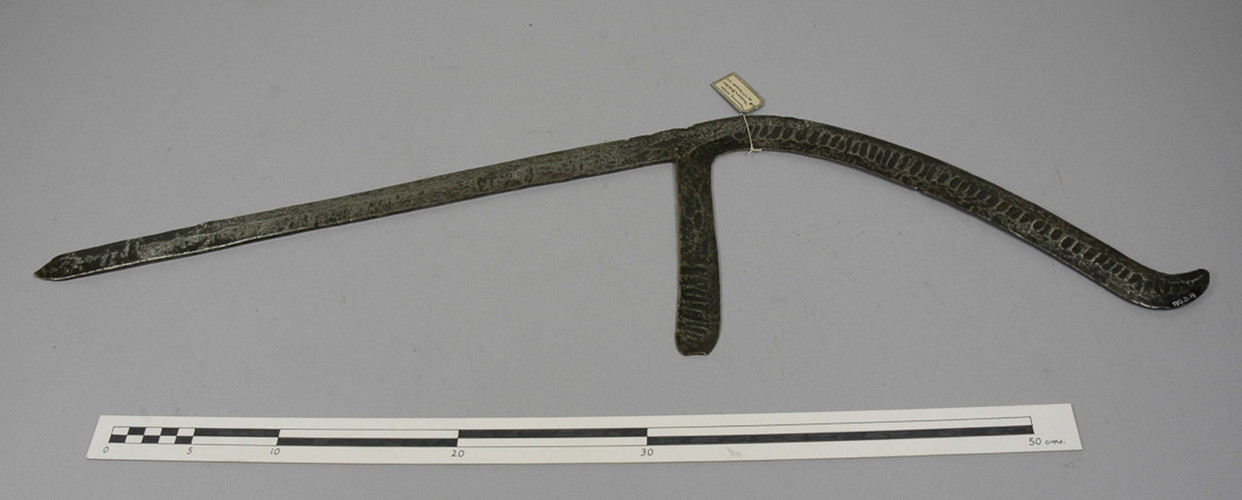 1913.31.19Iron throwing-knife - 'F' shaped, with three other knives [1913.31.17 .1, 1913.31.18, 1913.31.20] and a sheath [1913.31.17 .2] [SM 05/06/2007]1913.31.19
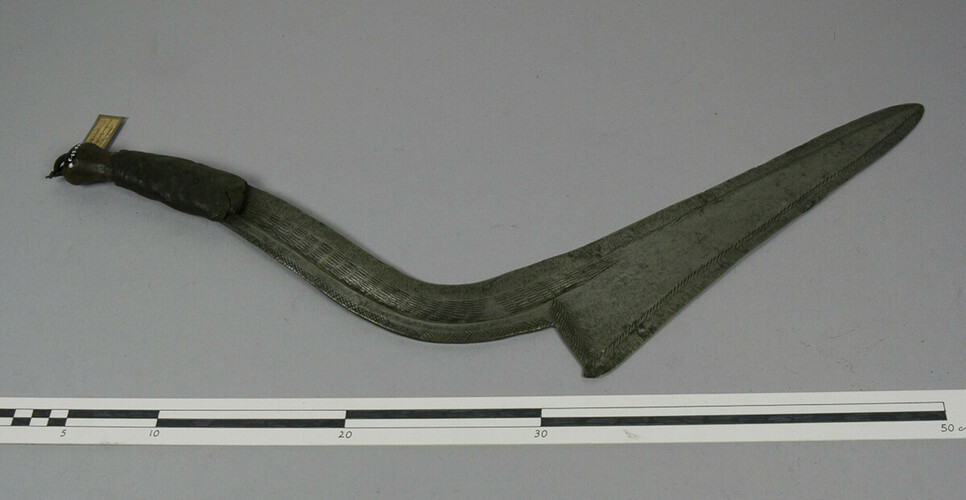 1906.65.3Throwing knife with angled blade, long broad triangular tip, incised with lines and crosshatched lines. With wooden handle covered with leather except for the very end. [El.B 4/6/2007]1906.65.3
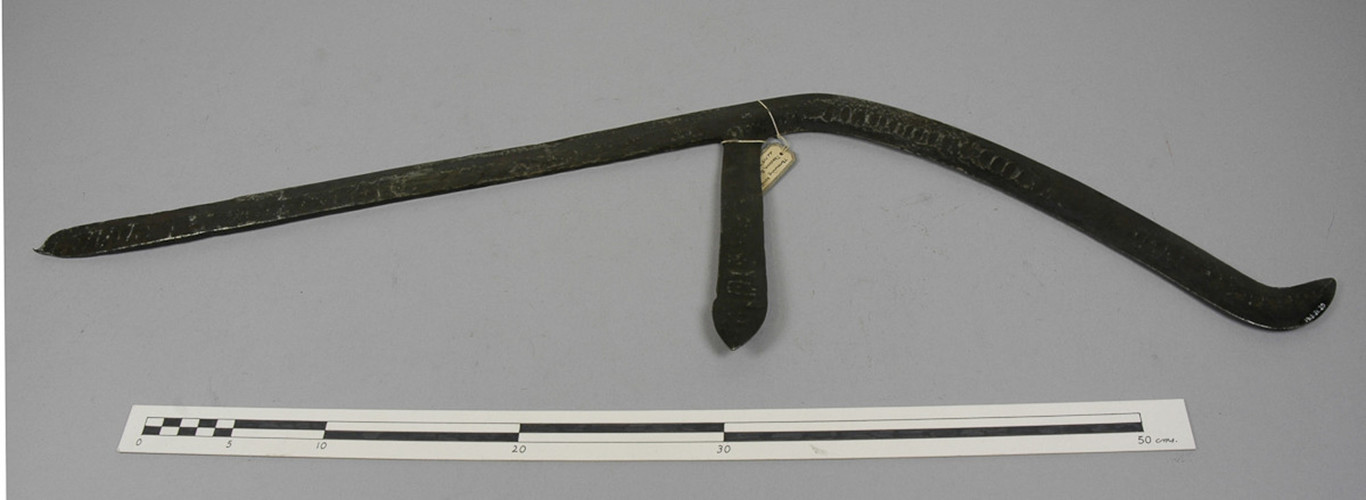 1913.31.20Iron throwing-knife - 'F' shaped, with three other knives [1913.31.17 .1, 1913.31.18, 1913.31.29] and a sheath [1913.31.17 .2] [SM 05/06/2007]1913.31.20
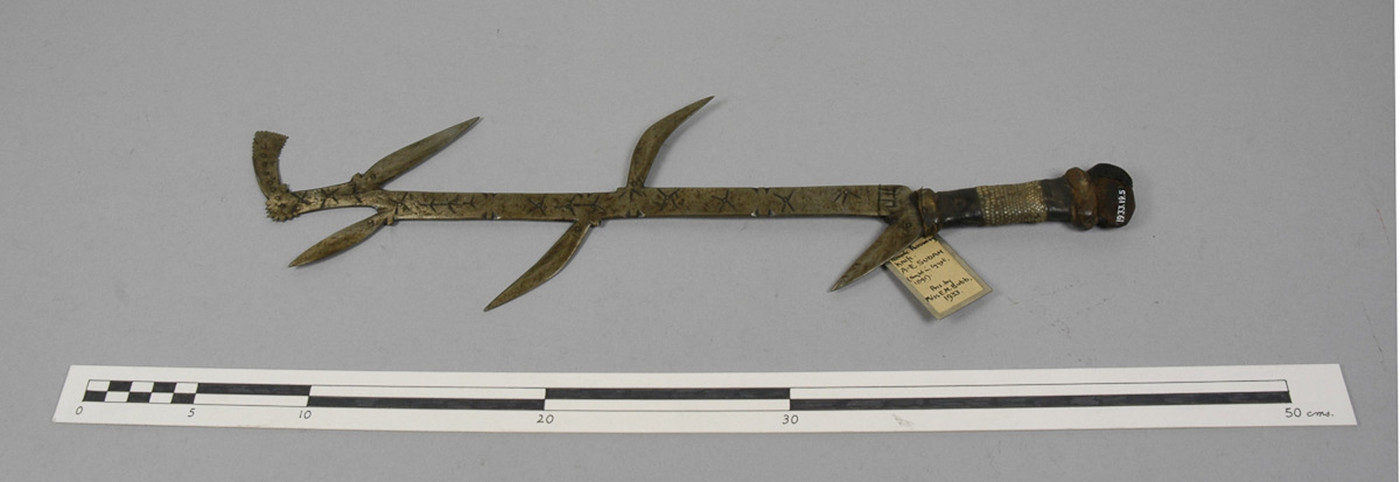 1933.19.5Throwing-knife with five pointed spur-like blades and an angled serrated tip. With a leather and reptile skin bound handle. [SM 05/06/2007]1933.19.5
 1884.140.828Arrow with iron leaf-shaped blade with ogee-shaped section and barbed shank on a cane shaft with bound and nocked end [RTS 6/7/2005].1884.140.828
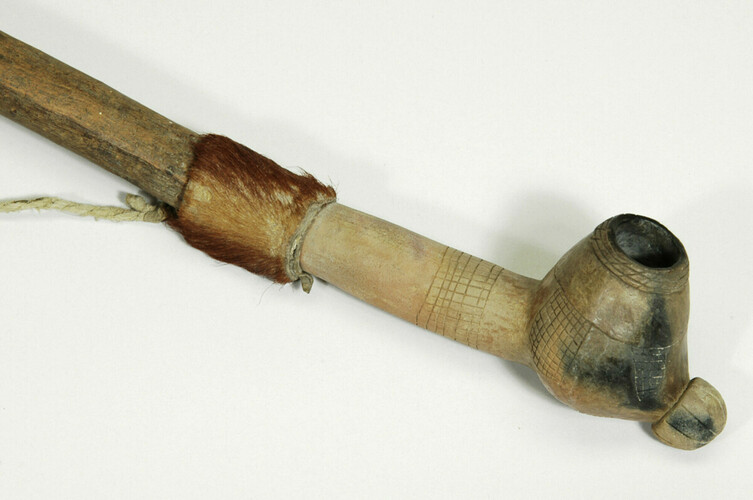 1937.34.66.1Pipe for smoking tobacco, with wooden stem, ceramic bowl [.1] and gourd mouthpiece [.2], and carrying strap attached with hide bands [RTS 1/10/2004].1937.34.66.1
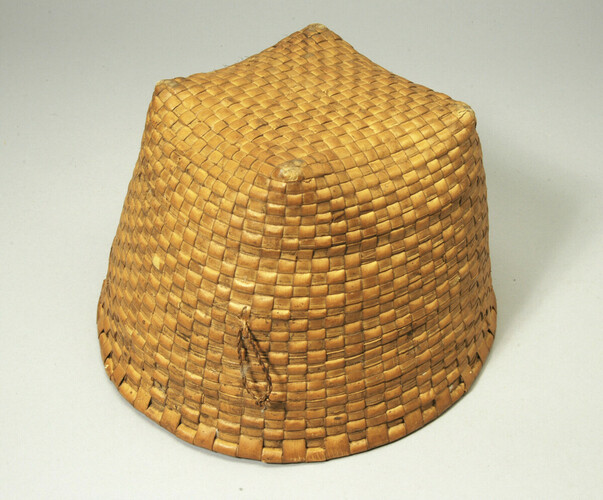 1979.20.4Checkweave basket with round mouth and square base, made of palm strips and used for carrying sorghum [RTS 20/9/2005].1979.20.4
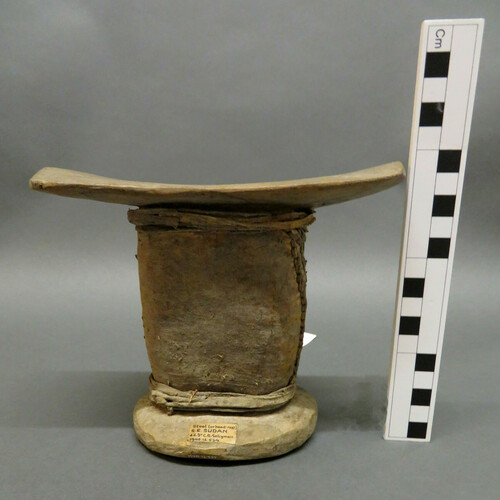 1940.12.534Wooden headrest or stool with rectangular seat on a hide covered pedestal foot with hide carrying loop [RTS 11/4/2005].1940.12.534