
- Collection type
- Object
- Description
- Paddle club, culacula, with inlaid bone pieces on broad blade. [FB 21/02/2012]
- Long description
- Paddle club, culacula, with inlaid bone pieces on broad blade. The club is made from a dark wood. The blade is broad with vertical strengthening bar across the bottom of the blade extending ti the tips of the 'wings'. There is a less pronounced raised rib running the length of the blade. The handle is plain with flanged flat butt end. The blade has serrated edges at the wings and is inlaid with rectangular pieces of whale bone? in four sets of pairs, six pieces are missing. 'FIJI ISLANDS' has been painted across the centre of the blade on one side in white paint. The surface of the club has a polished/varnished look. [FB 21/02/2012]
- Date / Period
- Date made: Before 1939
- Date collected
- By 1939
- Acquisition information
- Donated: 1955
- Materials and processes
- Material Wood Plant, Material Pigment, Material Whale Bone Animal, Process Carved, Process Inlaid, Process Painted, Process Polished
- Dimensions
- Width: max 258 mm, Length: max 1098 mm
- Object numbers
- Accession number: 1955.10.12 Other numbers: Beasley no. 2119
- Research and responses
Paddle club. See F Clunie 'Fijian Weapons and Warfare' 1977 Fiji Museum, Suva, Bulletin of the Fiji Museum no.2 and R. Ewins, Fijian Artefacts: Tasmanian Museum and Art Gallery collection' Australia 1982: p.44 "Paddle Clubs - Culacula and Kinikini. These broad-bladed clubs were of two types, war clubs and ceremonial. They are said to be possibly Tongan or Samoan in origin but some of the oldest surviving Fijian clubs are of the Culacula type. The war-clubs were used like broadswords, the sharp edges on the very hard wood being sufficient to snap, if not cut through bone. The ornately decorated ceremonial clubs were often excessively broad, almost fan-like, and were exclusive to chiefs and priests. They were handed down as heirlooms, and long use has often worn the carved designs almost away from the handle., even the blades in some cases. They were probably seldom used to strike with, being so thin in the blade that they would break easily - though not, it must be admitted, before doing very considerable damage..." [FB 14/02/2012]
See Mills, Andy, 2009, 'Akau Tau: Contextualising Tongan war-clubs' in Journal of the Polynesian Society, 118 (1), pp. 7-45 for a discussion of this type of club. The culacula and kinikini can be very similar in appearance, a key difference that can help in the correct identification being the shape of the ridge across the blade, which Mills describes on page 30 as follows: 'The straight-ridged culacula' and 'the curve-ridged or ridge-less kinikini.' [ZM 10/8/2016]
Search terms: Weapon, Ritual and Ceremonial, Status, Club, Status Object
Further items to explore
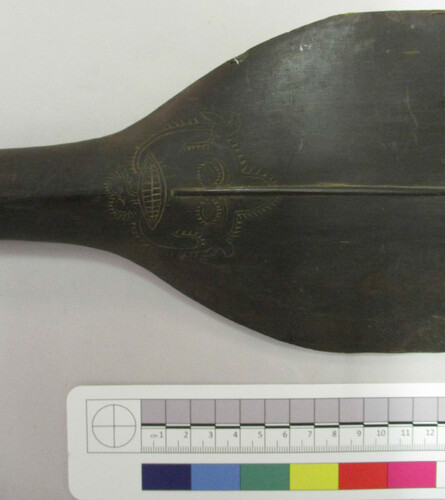 1884.12.247Paddle-shaped club. The cylindrical shaft expands into the flat, leaf-shaped blade, pointed at the distal end. There is an incised face design, coloured white, and central raised longitudinal rib on both surfaces of the blade. Towards the proximal end the shaft is bound with strips of plaited plant fibre, coloured red. Below this is a conical butt terminating in a point. [JC [OPS Move] 15/08/2016]1884.12.247
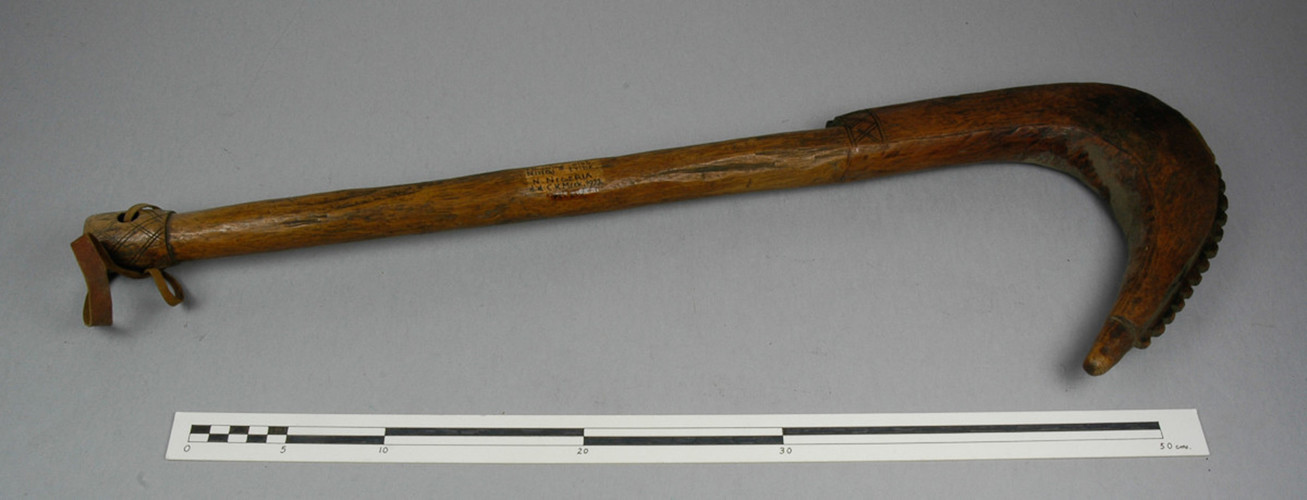 1922.23.3Throwing-club with one end carved into a ridged, pointed hook, the other end incised with lines and with a loop of leather. [El.B 16/08/2007]1922.23.3
 1884.12.295Wooden club of purple wood. [ASh [OPS move] 25/5/2016]1884.12.295
 1940.5.10Leaf-shape headed club. The shaft is rhombus in section and there is a central ridge along the blade head. The butt expands to a conical point. [BS [OPS Move] 09/08/2016]1940.5.10
 1921.93.513Perforated whale's tooth. [El.B 'DCF 2004-2006 What's Upstairs?' 9/12/2005]1921.93.513
 1994.16.1Rectangular barkcloth with handpainted design in brown and black comprising eighteen bordered rectangles, each containing a repeated motif of concentric circles with radial petals.1994.16.1
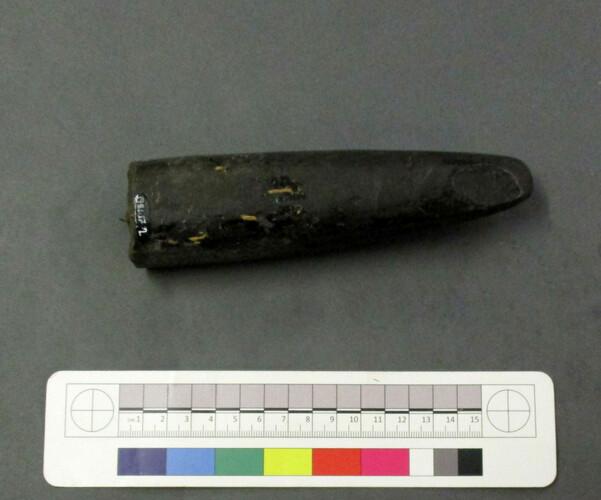 1981.17.1.2Stone adze head, broadly cylindrical tapering towards one end. The lower half of the head appears to have been polished, the upper half left rough. For the wooden haft see 1981.17.1 1, and for the broken plaited plant fibre bindings see 1981.17.1 .3. [CW [OPS Move] 17/1/2017]1981.17.1.2
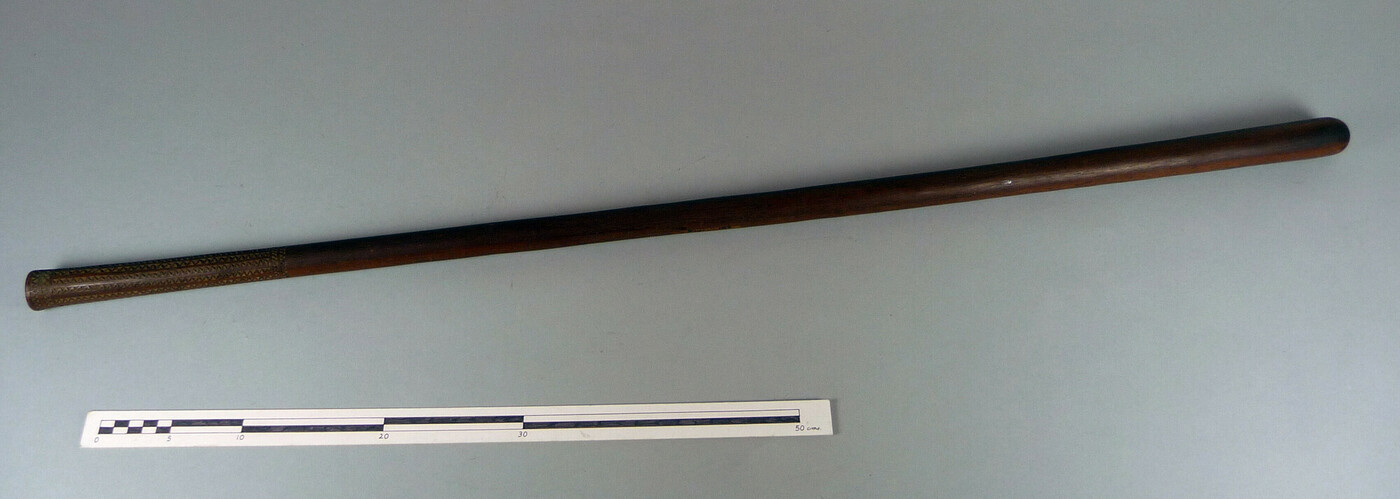 1918.2.16Cylindrical wooden club. [FB 10/10/2011]1918.2.16