
- Collection type
- Object
- Description
- Throwing knife with engraved blade and leather bound handle [SM 24/04/2007]
- Long description
- Throwing knife with engraved blade and leather bound handle. The blade curves towards the end and has a projecting spike approximately two thirds down the blade. The blade is decorated with incised crosshatching, lines, and dots on both sides. The handle is bound with leather and has two plaited bands of leather and a grip of woven or twisted leather. [SM 24/04/2007]
- Date / Period
- Date made: Before 1936
- Date collected
- 1934 - 1936
- Acquisition information
- Donated: 1954
- Materials and processes
- Material Iron Metal, Material Animal Leather Skin, Process Forged (Metal), Process Bound, Process Twisted, Process Incised, Process Decorated, Process Plaited
- Dimensions
- Length: max 725 mm, Width: max 170 mm
- Object numbers
- Accession number: 1954.5.74 Other numbers: 37D.44C
- Research and responses
The following notes are drawn from research compiled by Andy Mills as part of the DCF Cutting Edge Project 2006-2007. This is a zungan dowi or ‘cock’s tail’ form of throwing knife (see Throwing Sticks & Throwing Knives in Darfur. by A. J. Arkell, in ‘Sudan Notes & Records’ Vol. 22. Published in 1939. p.257), which was made in Dar Masalit. Throwing knives are generally known as somboro in Masalit. It is of the Northern or ‘F-Shaped’ type, used more often for ceremonial purposes than the Southern types. The blunt underside of the inner spur was used to carry the knife, over the shoulder. Arkell (ibid: 252n6) remarked on the functional use of such weapons to cut the legs of horses and infantrymen alike, and speculated on the weapon’s historical development, out of the throwing stick of much the same form, to counter the armed cavalry of Arabic invaders during the period 1000-1500 AD. It should be remarked that Spring (see African Arms & Armour by C. Spring, published 1988 by British Museum Press) has questioned this origin for the Western Sudanese throwing knives due to the absence of cavalry in that region, although it may well still hold for the Eastern Sudan.
Darfur throwing knives appeared in a number of social and cultural contexts other than warfare, which Arkell (1939) discusses well. He remarks they were carried by slaves of the Sultan (Samballang- ‘throwing-knife men’) as regalia of state in the processions of the Darfur Sultanate, and before the Sultan when he went to hunt, up until the 1870s (p.256); they were carried by young men at dances to impress their martial qualities on unmarried women – much as kaskara swords and rifles were subsequently used well into the 20th century; they were carried by Koranic scholars (fiki) as a badge of status, and so on. [SM 16/06/2008]
Search terms: Weapon, Tool, Throwing Knife
Further items to explore
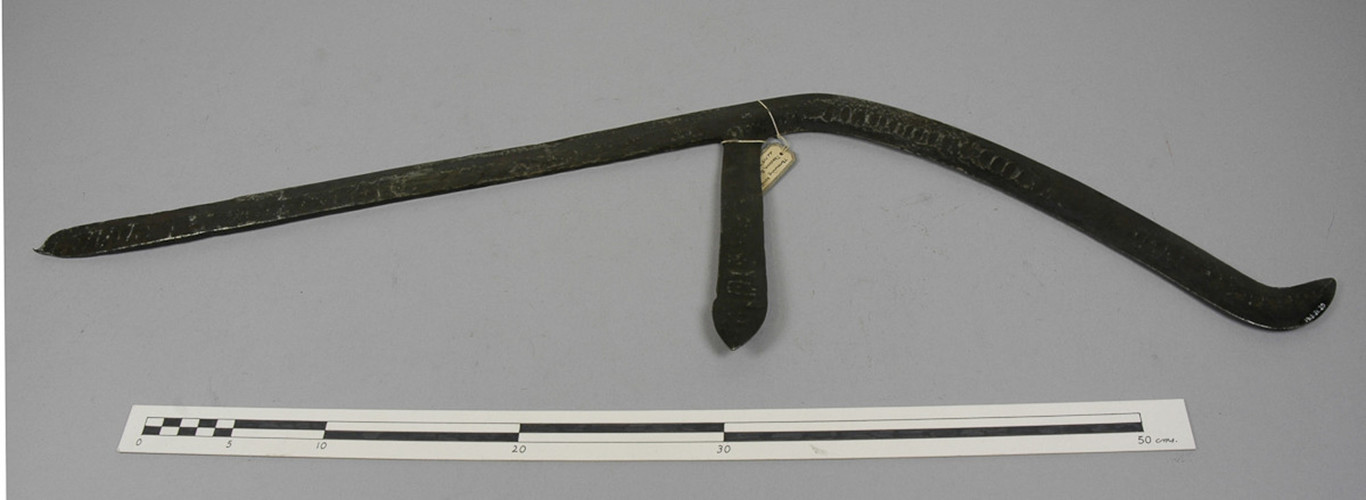 1913.31.20Iron throwing-knife - 'F' shaped, with three other knives [1913.31.17 .1, 1913.31.18, 1913.31.29] and a sheath [1913.31.17 .2] [SM 05/06/2007]1913.31.20
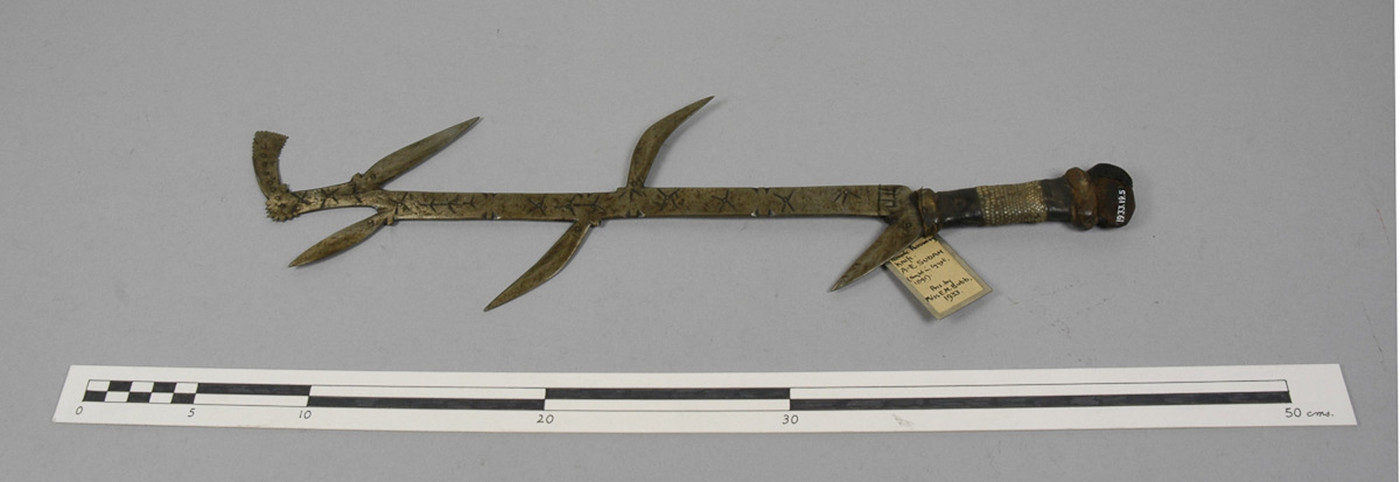 1933.19.5Throwing-knife with five pointed spur-like blades and an angled serrated tip. With a leather and reptile skin bound handle. [SM 05/06/2007]1933.19.5
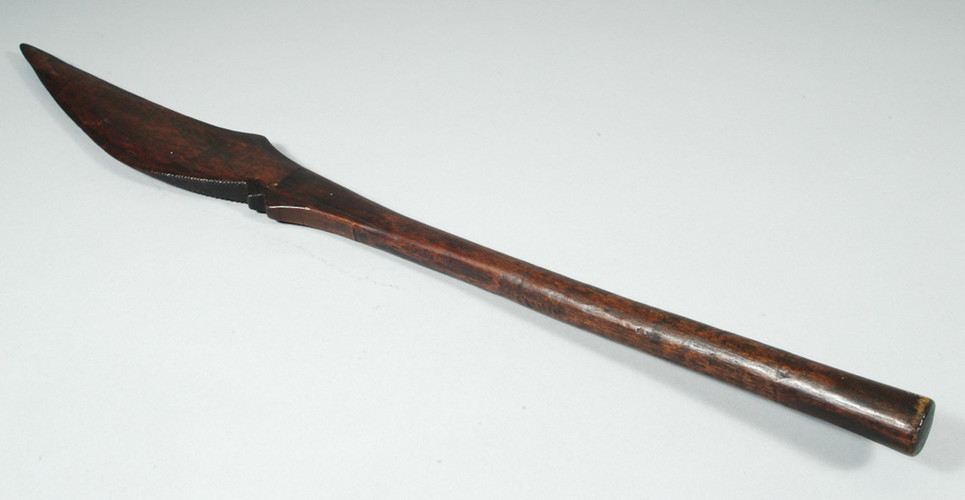 1884.12.8Wooden throwing and cutting weapon with curved, flat-sectioned blade on a straight round sectioned handle [RTS 11/5/2005].1884.12.8
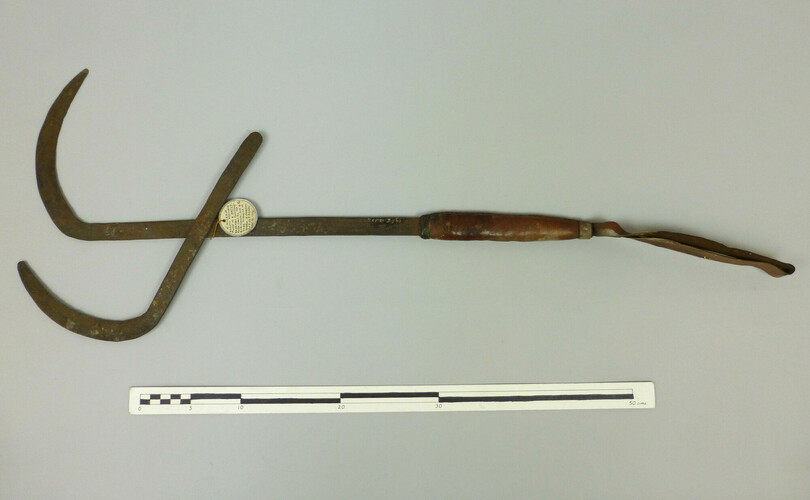 1965.12.124Model of a throwing knife, made of iron with leather handle. [MJD (Verve) 12/05/2015]1965.12.124
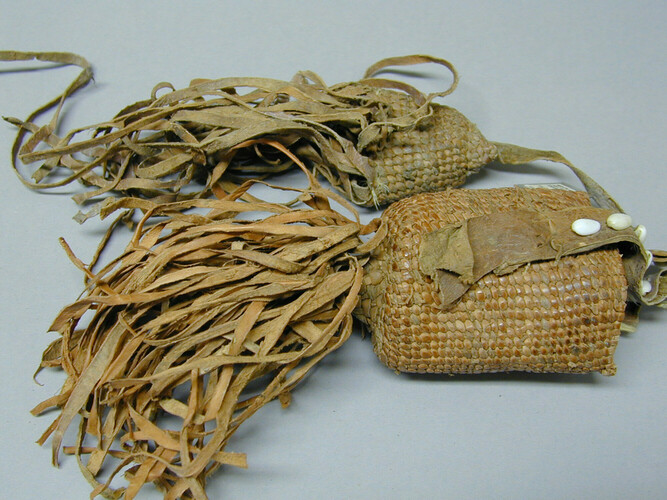 1935.20.19.1Case [.1] and lid [.2] made from woven leather strips, with long leather tassels & cowrie shells, used to hold a scent-flask. [EC 'DCF 2004-2006 What's Upstairs?' 21/2/2006]1935.20.19.1
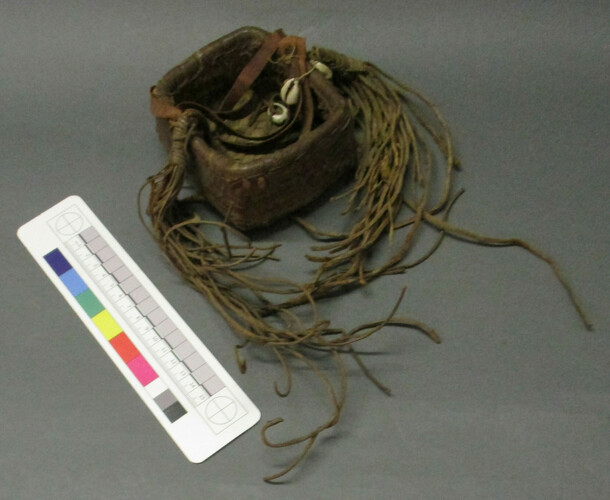 1966.1.926Small rectangular cane basket, covered on the outside with leather. [MJD 10/6/2010]1966.1.926
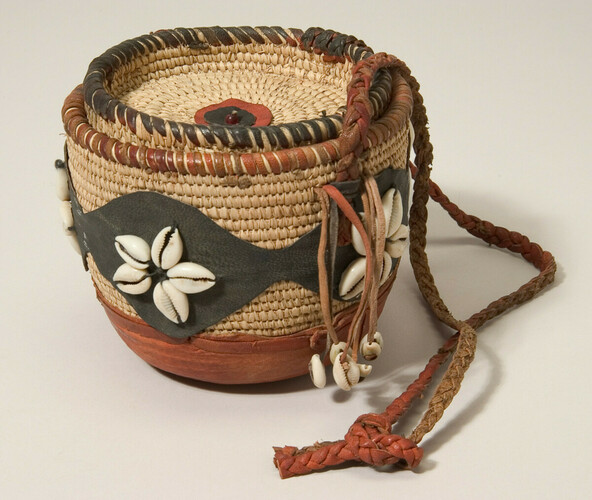 2001.77.2'Wedding basket'. A round basket with flat base and lid attached, with long plaited leather strap for carrying, and decorated with red or black tanned goat skin and cowrie shells.2001.77.2
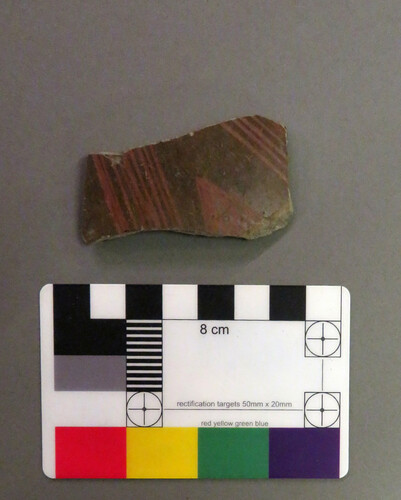 1949.12.28.5Sherd of brown pottery decorated with red painted lines and gridlines on one side. The other side is grey in colour. It is a body-sherd. [BA [OPS move] 28/11/2017]1949.12.28.5