
- Collection type
- Object
- Description
- Box of tubular (cylindrical) faience beads
- Geographical reference
- Northern Sudan Dunqulah [Dongola Dunkula]
- Date
- Date collected
- 1913-14
- Acquisition information
- Acquired: 1921 Acquired: 07/1945
- Materials and processes
- Material Faience Pottery, Material Bead
- Dimensions
- Length: max 11 mm one cylinder
- Object numbers
- Accession number: 1945.7.10 Other numbers: 1/ 179
- Research and responses
Napata: the capital in about 750-590 BC of the ancient kingdom of Cush (Kush), situated downstream from the Fourth Cataract of the Nile, near Kuraymah in the northern part of what is now The Sudan. The Egyptian custom of royal burial under pyramids was introduced into Cush, as may be seen at Kurru and at Nuri, where the largest pyramid, that of the king Taharqa (reigned 690-664 BC), is situated. Taharqa, who also built several Egyptian-style temples at Napata and elsewhere, was defeated by the Assyrians and expelled from Egypt in 671 BC. Dunqulah: also spelled DONGOLA, OR DUNKULA, town, northern Sudan. It lies on the west bank of the Nile River, about 278 miles (448 km) northwest of Khartoum. Source: Encyclopaedia Britannica Online. [MR 10/8/2000]
Further items to explore
 1919.59.226.10Unquantified assemblage of ?50 stone beads1919.59.226.10
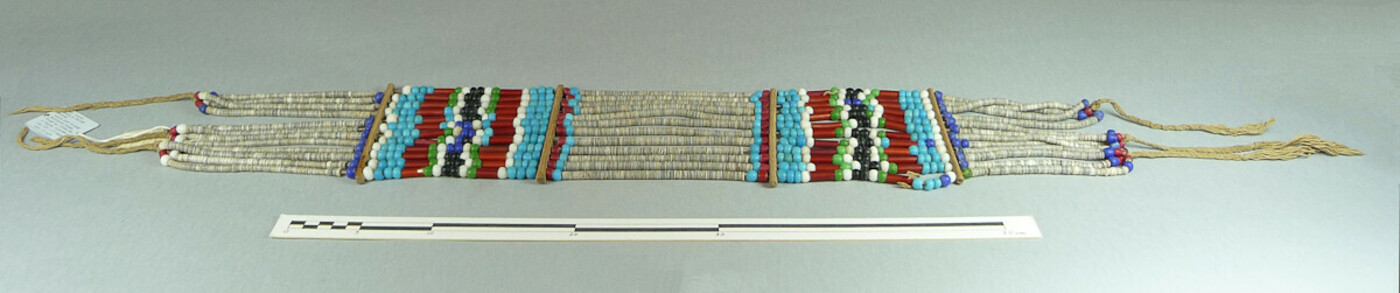 1971.15.1319Waist belt made of twelve horizontal strings with shell discs at each end and two sections of coloured glass and short barrel beads with wooden spacers and shell beads in middle.1971.15.1319
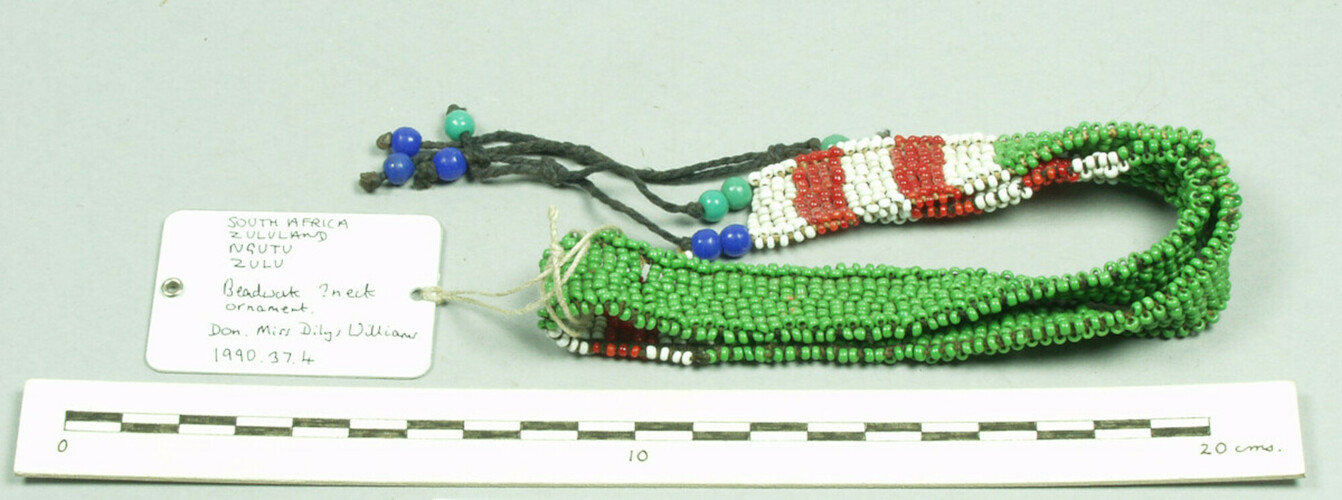 1990.37.4Flat band of green beadwork with red and white vertical stripes at intervals, and tie strings at each end with larger green and blue plastic beads. [N.B. 'DCF 2004-2006 What's Upstairs?' 12/7/2005]1990.37.4
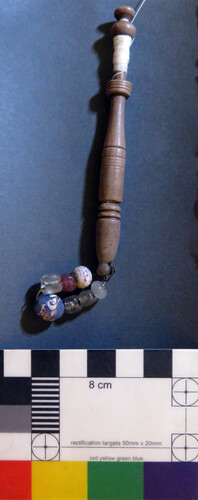 1947.5.5.54Wooden spangled bobbin for lace-making of the larger 'gimp' type. Part of a set of wooden and bone bobbins still attached to a partially completed sample of lace, for the other bobbins in this set see [1947.5.5 .43 - .72, .75 - .78 & .91 - .102]. [BS [OPS Move] 31/5/2017]1947.5.5.54