
- Collection type
- Object
- Description
- Ceremonial mace, nephrite blade, wooden handle wrapped in barkcloth attached with plaited sennit and bound with flying fox wool at both ends.
- Geographical reference
- Person
- Field collector Emma Hadfield
- Field collector London Missionary Society
- PRM source Emma Hadfield
- Date / Period
- Date made: Before 1920
- Date collected
- 1886 to 1920
- Acquisition information
- Purchased: 1923
- Materials and processes
- Material Nephrite Stone, Material Wood Plant, Material Bark Cloth Textile Plant, Material Pteropus Hair Animal, Material Sennit Coconut Seed Fibre Yarn Plant, Process Carved, Process Bound, Process Beaten, Process Wound, Process Plaited
- Dimensions
- Width: max 180 mm blade, Length: max 625 mm
- Object numbers
- Accession number: 1923.74.5
- Research and responses
This object must be very old because of the bark-cloth covered handle. In later pieces the handle would have been covered with textile. Nephrite is not found in the Loyalty Islands but it was obtained by trade. Pteropus hair string is often associated with an exchange of gifts, so this object might have been involved in an exchange of gifts between chiefs. It was certainly the property of an important person. The bulge at the end of the handle is produced by half a coconut. Magic items can be placed in the handle, e.g. fingernails or hair, which will give the owner power. Pumice stones have also been found in the handles, they would have made a rattling noise when the club is moved. The plant fibre string used on this object is made from hibiscus fibre. Information given by Francois Wadra, visiting researcher from Mare, Loyalty Islands, and Julie Adams, British Museum, September 2009. [El.B 24/09/2009]
A sample of the hair string was given to Caroline Cartwright of the Department of Conservation and Scientific Research at the British Museum for identification. [JU 13/12/2012] It was identified as flying fox fur (Pteropus sp.), both underfur and guard hairs. See RDF for her report [JU 16/12/2013]
This is very similar to the ceremonial staff from New Caledonia in the collections of the University Museum, Philadelphia (museum number P 2126) that is identified as a gi okono and described on page 214 of Gathercole, Kaeppler and Newton, 1979, The Art of the Pacific Islands (Washington: National Gallery of Art) as follows: 'These well-known ceremonial batons were important possessions of chieftains. They were held during oratorical sessions and also used as instruments during the procedures of rain-making magic.' [ZM 06/02/2015]
In May 2015 during email correspondence with myself, Dr Joshua Bell, Curator in the Anthropology Department of the Smithsonian Museum, USA, noted this type of New Caledonia 'axe' with a serpentine stone disk head covered in flying fox fur and often shell money are known as gai o kono. They are items of prestige that are traded and wielded by orators to denote their status. [ZM 13/05/2015]
For more information about the collector and donor see 'Emma Hadfield Among the natives of the Loyalty Group', by Hannah Ivory, pages 313 to 317 in Melanesia Art and encounter, edited by Lissant Bolton, Nicholas Thomas, Elizabeth Bonshek, Julie Adams, and Ben Burt (London: British Museum Press, 2013). On page 313 Ivory notes Emma, along with James Hadfield were London Missionary Society evangelists 'who resided on the islands of Ouvea and Lifou for nearly forty years, from 1886-1920...Recent research into the Hadfields' time in the Loyalties and their collecting activity indicates that it was principally Emma who collected the objects while in 'the field''. [ZM 4/5/2016]
For the donor's own description of this type of object see pages 170 to 172 of Emma Hadfield, 1920, Among the Natives of the Loyalty Group (MacMillan: London), she writes that after a battle: 'the conquering chief seized the standard of the enemy. This was called a "sio". It was a splendid disc of jade stone mounted on a long wooden handle, and ornamented with native valuables such as cloth (wathe) and wool from the flying fox (dela). This stone was rare and was accounted one of their most treasured possessions. It was never found in the Loyalty Group, but was imported from New Caledonia. In times of peace these royal standards or maces - each of which had its own name - were passed about as a complimentary mark of honour among friendly chiefs.' [ZM 4/5/2016]
Search terms: Weapon, Ritual and Ceremonial, Status, Club, Ceremonial Object, Status Object, Adze
Further items to explore
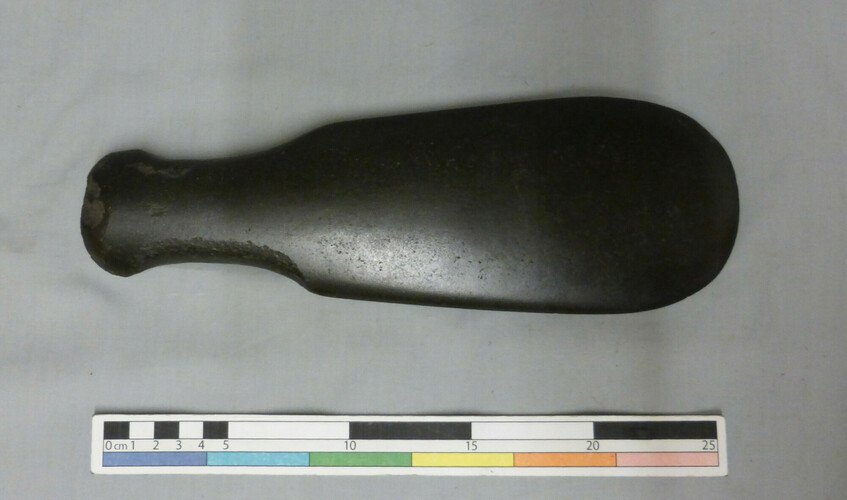 1955.10.8Spatulate stone club with convex blade tip and restricted handle and slightly convex butt. [BS [OPS Move] 14/09/2016]1955.10.8
 1886.1.1447Wooden club. Leaf-stalk shaped. Undecorated.1886.1.1447
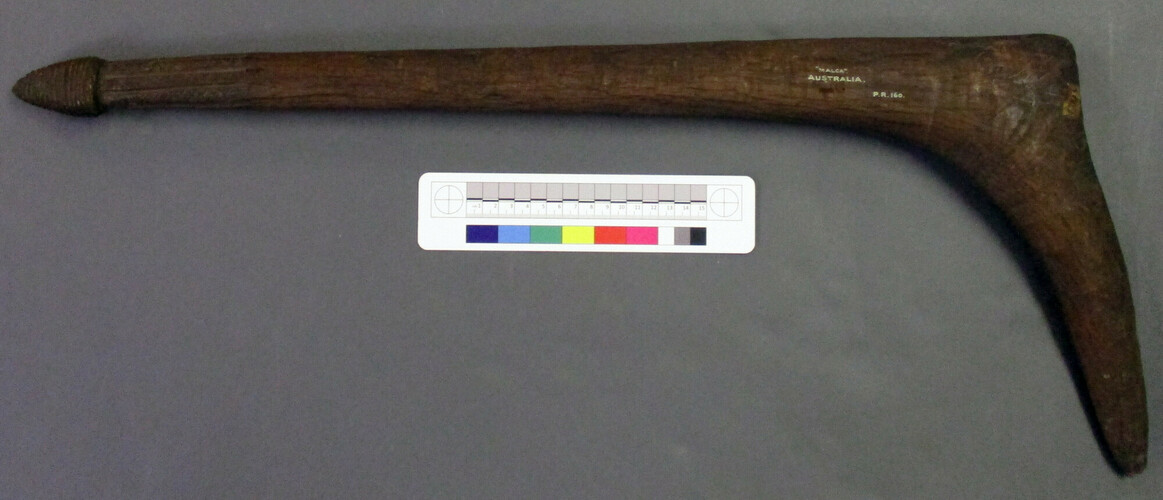 1884.12.59Wood club with curved and pointed blade. [JC [OPS Move] 17/10/2016]1884.12.59
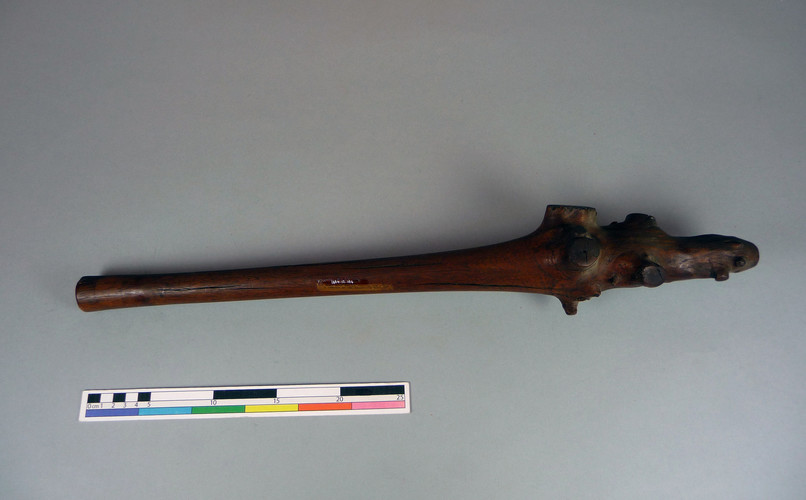 1884.12.106Rootstock club (vunikau) with chip carved handle grip in zigzag and linear design. [BS [OPS Move] 14/09/2016]1884.12.106
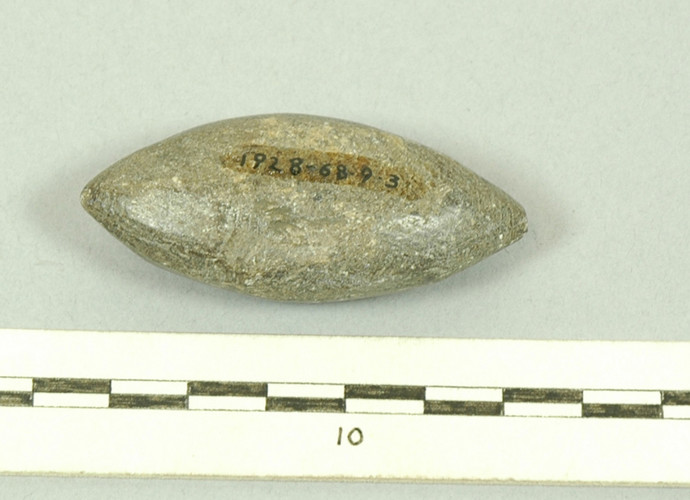 1928.68.9.3Steatite sling-stone with pointed ends. [El.B 12/2/2007]1928.68.9.3
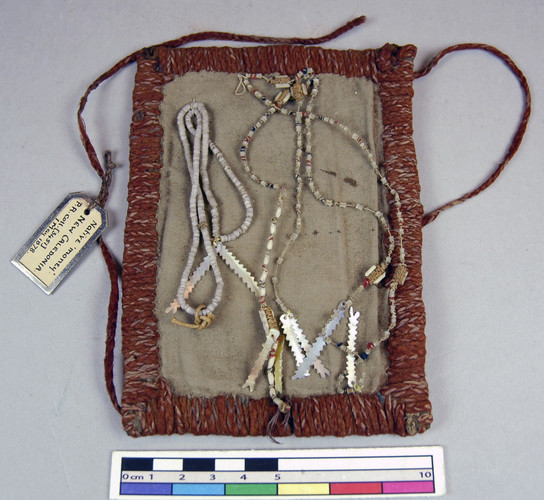 1884.99.16Strings of shell beads, fish vertebrae and pearl shell pendants on a textile, edged with pteropus hair, used as currency. [MJD 21/12/2009]1884.99.16
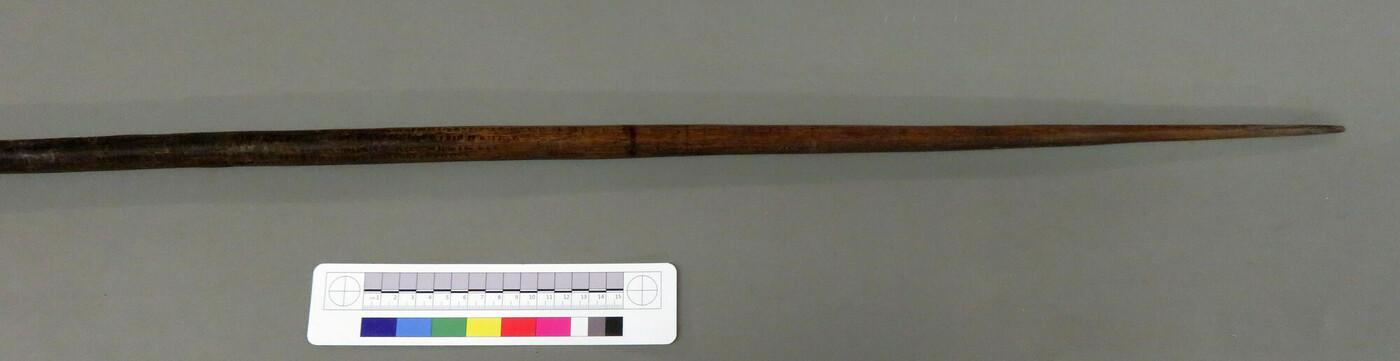 1886.1.1506Spear. Carved from a single piece of wood. The ends taper to points, the surface is notched and stained black. [AB [OPS move] 18/6/2018]1886.1.1506
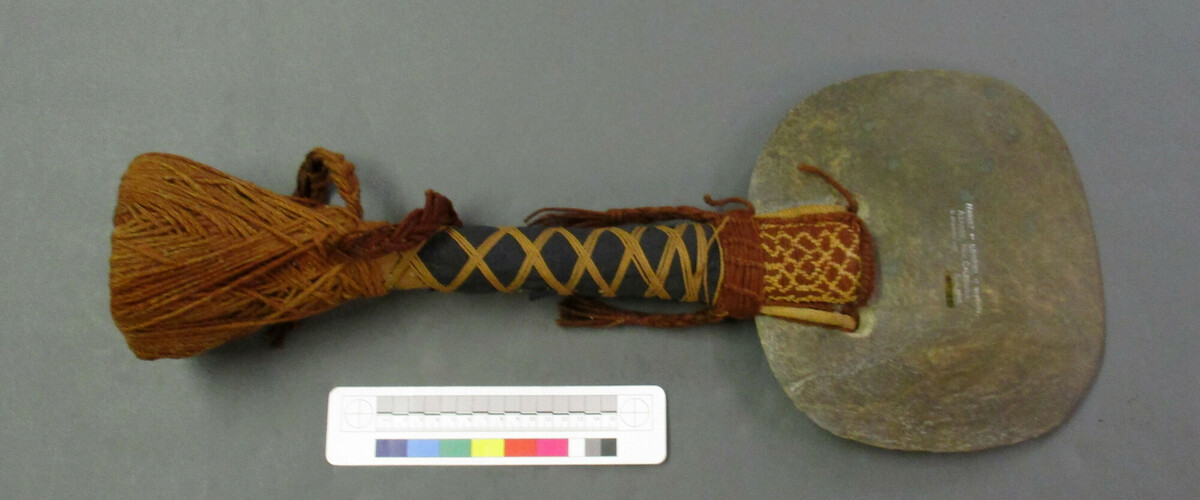 1903.54.1Knife with a nephrite blade. The stone head is a flat circular disk, light brown in colour. [Dan Hicks 13/06/2012]1903.54.1