
- Collection type
- Object
- Description
- Iron throwing knife with plate tang and incised decoration on blade [RTS 14/4/2004].
- Long description
- Iron throwing knife with a narrow rectangular plate tang, splaying out at the end which has been cut flat and has a small projecting tab that has been hammered at the end and slightly bent. A series of short barbs run down the length of this handle area, formed by hitting the metal along the edges with a tool such as a chisel in a series of short, oblique blows. These barbs are on the upper surface on one side of the tang, and on the lower surface of the opposite edge, and were probably designed to keep a handle binding in place, although there is no binding currently present. These barbs run up the tang as far as the junction of body and the lower, angled blade. The central stem continues above this, and has a triangular section with thick, blunt back, opposite a sharpened cutting edge. The surface of this edge has been bevelled on either side. The back edge of this stem is slightly convex. There are three blades extending from this central stem. The lowest of these projects at an acute angle from the body, just above the handle. This has an almost leaf-shaped body coming to a point at the end, with a small rounded spur projecting from near its base, and a second, smaller and broader spur just below; the lower edge of this is almost flat. The rest of this blade has a sharpened cutting edge; the broader spur remains blunt. A second angled blade extends away to one side from the top of the central shaft, with a shallow, angular spur at its base. This blade has a slightly concave lower edge, with the body tapering to a pointed tip then the opposite edge curving convexely round to join with a third triangular blade continuing from the top of the central stem. Both blades have sharpened edges. Apart from the cutting edges, which have been hammered to form a broad bevelled area on both upper and lower surfaces, the underside of the knife is flat. The upper surface has been decorated with a series of punched motifs that outline the shape of the two upper blades and part of the central stem. This consists of three sets of two lines each, made up of short lentoid depressions, that run parallel along the edges of the curved upper blade, creating a semicircular space in the centre of the blade which is framed by a row of short arcs around the edge. Four double lines cut this design off near the junction with the triangular blade, where the centre has similar framing of pairs of dotted lines around a central four leaf rosette. The lower part of this frame has a scalloped edge. The central stem is decorated from the back to mid body with four rows along the length; the two outer rows being made up of running arcs, the central rows of running lozenge shapes. Three vertical lines with two sets of two horizontal lines between add as a terminal motif to the base of this design. The object is complete and intact, with several small nicks along the edges of the upper blades. The iron is currently a metallic gray colour along the edges (Pantone 422C), and a duller matt gray elsewhere. The throwing knife has a total length of 443 mm, with the lower blade being 145 mm long and 33 mm wide, the second blade being 213 mm long and 57 mm wide, and the third, triangular blade being 109 mm long and 70 mm wide. The handle is 27 mm wide and 1.7 mm thick, the central stem is 32.2 mm wide and 0.5 mm thick at the cutting edge, and the object as a whole weighs 529.8 grams [RTS 2/6/2004].
- Geographical reference
- Nubia
- Cultural groups
- Nubian
- Date / Period
- Date made: Before 1915
- Date collected
- By 1915
- Acquisition information
- Purchased: 10/1915
- Materials and processes
- Material Iron Metal, Process Forged (Metal), Process Hammered, Process Incised, Process Punched
- Dimensions
- Length 443 mm, Width 27 mm handle, Width 32.2 mm central blade, Depth 1.7 mm handle, Weight 529.8 g
- Object numbers
- Accession number: 1915.45.1 Other numbers: 1915.ß.24
- Research and responses
This object represents the southern type of throwing knife, which is found in northern Gabon, and from eastern Cameroon almost to the White Nile; it was used by the Zande and by groups who fell under their influence, including the Adio, Bongo and Kreish. This specific variety, which corresponds to Westerdijk's type SP VII.1, is found in the regions inhabited by the latter three groups (P. Westerdijk 1988, The African Throwing Knife, p. 191). [RTS 19/3/2004].
The following notes are drawn from research compiled by Andy Mills as part of the DCF Cutting Edge Project in 2006-2007. Kpinga are one of the few undisputed functional throwing knives, with considerable documentary evidence of their use in battle. They are of the ‘Southern’ or ‘Winged’ type (infinitely more aerodynamic than the ‘Northern’ or ‘F-Shaped’ types), and are found predominantly south of 9º North. This said, they still possessed strong cultural significance for the Azande, and their distribution was monopolised by the ruling Avongara clan (see African Arms & Armour’ by C. Spring. 1993. p. 68). Kpinga were considered to be mara ngbanga or ‘Court Metal’, i.e. weaponry produced under the patronage of the ruling elite, and then distributed to the regiments of professional warriors in wartime. During large-scale warfare, termed sungusungu vura, these full-time regiments were swelled by all able and willing adult males, and in this situation, the kpinga served as a clear visual signifier differentiating the professional soldier from the land army (Evans-Pritchard et al, 1971).
Kpinga were carried into battle in a very specific way; at the centre of the inside of complete examples of the large, oblong Zande shields, there is an iron disc (imgasi) attached. Traditionally, four kpinga were hung over the imgasi, for rapid access. When the Azande went into battle, they would close with the enemy to a distance of ten meters or so. Two to four spears would be thrown by each warrior, and then he would throw his kpinga. Kpinga were always thrown following a call to alert all to the fact, ostensibly to show that the warrior was not simply throwing his valuable kpinga away in the bush (Evans-Pritchard et al, 1971). This said, given that Zande warfare appears rarely to have progressed to hand-to-hand engagement, we might speculate that it possessed a certain restrained and ceremonial quality, and the call constituted a ‘fair play’ warning of the unpredictable missile’s imminent release.
The kpinga was first bent slightly under the foot, and then either thrown overarm, almost vertical (when it flew at head height in a curving arc), or underarm, almost horizontal, when it flew at the knees. It seems the skill in avoiding the former was crouching behind the tall, three-quarter length shield, while the skill in avoiding the latter involved a more acrobatic and minutely-timed leap. Even if it was caught on the shield, the shield did not always offer complete protection. [SM 09/04/2008]
Search terms: Weapon, Throwing Knife
Further items to explore
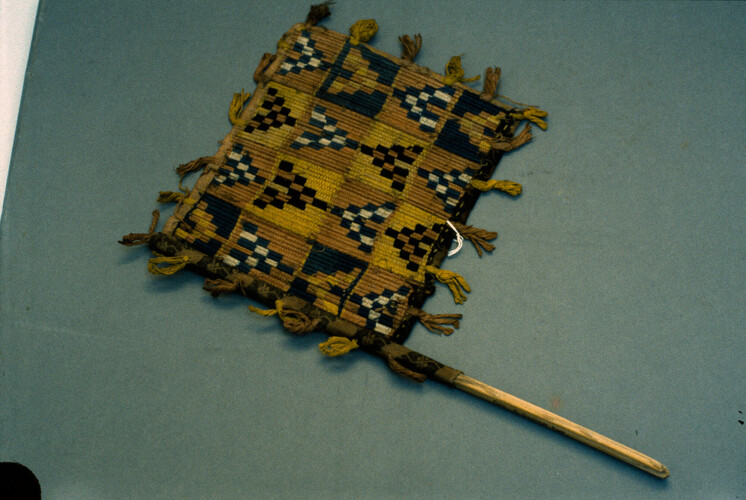 1921.53.10Flag-shaped fan of wool-work in yellow, black, blue, white and peach woven into designs of triangles in rows. [LKG 24/09/2009]1921.53.10
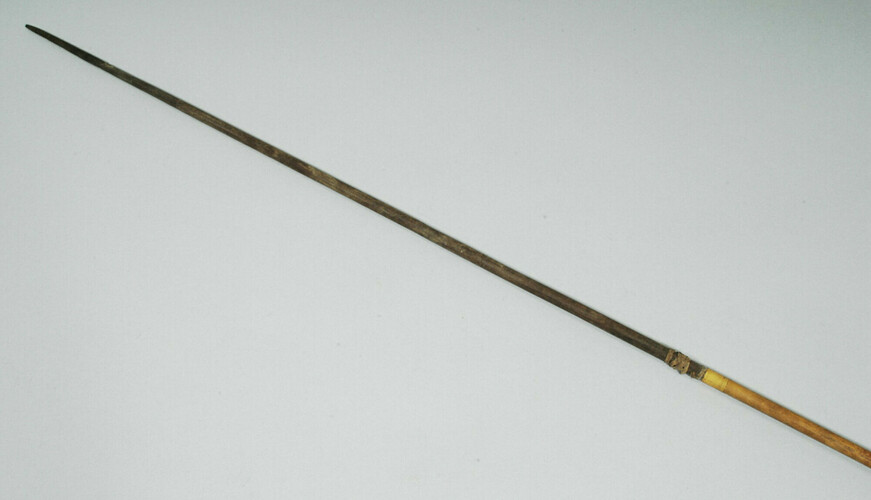 1944.10.64Carved arrow with notched ebony point on a cane shaft with bound and nocked end [RTS 26/5/2005].1944.10.64
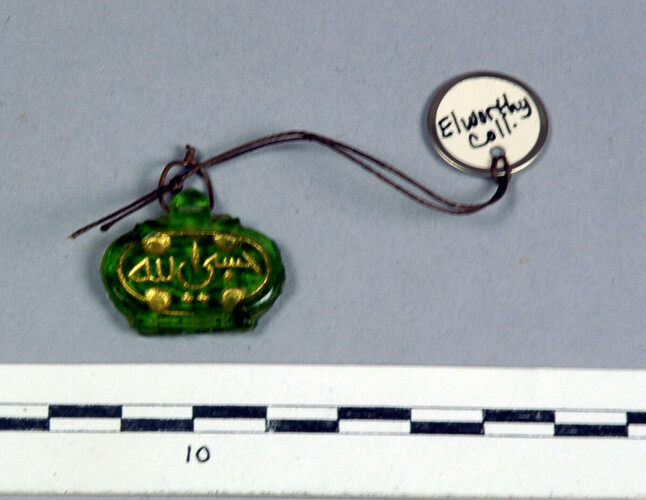 1968.13.317Green glass pendant impressed with Arabic letters in gold. [El.B 03/11/2008]1968.13.317
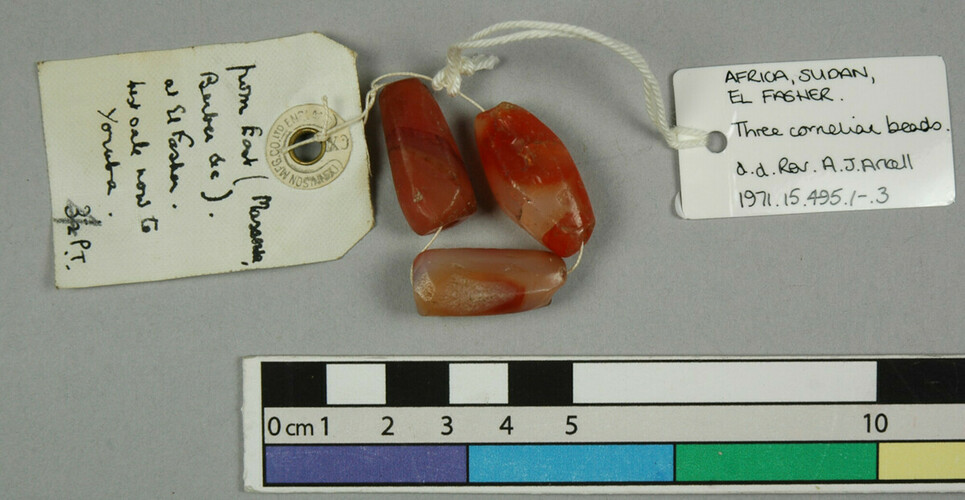 1971.15.495.1Three cornelian beads: one tapered at both ends [.1] and two slightly expanded at one end [.2-.3] Strung together by the collector. [SM 17/11/2010]1971.15.495.1