
- Collection type
- Object
- Description
- War charm.
- Long description
- War charm. Carved, incised, and painted wooden head atop a body made of long red-black feathers. Worn by warriors at the back of the neck. [JC 11 1 2002]
- Geographical reference
- Admiralty Islands Bismarck Archipelago
- Date / Period
- Date made: Before 1914
- Date collected
- By 1914
- Acquisition information
- Purchased: 1914
- Materials and processes
- Material Bird Feather, Material Wood Plant, Process Carved, Process Incised, Process Painted
- Dimensions
- Length: max 530 mm
- Object numbers
- Accession number: 1914.69.1 Other numbers: 1914.ß.269
- Research and responses
On Tuesday 1 September 1914 while in Brisbane, Australia as part of the British Association for the Advancement of Science trip, Henry Balfour records in his diary: 'Found a shop with some interesting native curios (Samuel Sheppard, 201 Albert Str.) + bought several things.' [CRFW 27/1/2003, JC 24 5 2013]
This object was shown at a meeting of the Oxford University Anthropology Society on 26.11.1914 when Balfour showed a series of objects [AP 27/02/2006]
For very similar objects see plate 52 on page 65 of Anna Edmundson and Chris Boylan, Adorned: Traditional Jewellery and Body Decoration from Australia and the Pacific (University of Sydney: Macleay Museum, 1999), which are described on page 107 as follows: 'War charms, Admiralty Islands, Manus Province, Papua New Guinea, 19th century, wood, pigments, frigate bird feathers, resin, plant fibre...War charms were used throughout the Admiralty Islands until the end of the nineteenth century. They were talismans carried into battle to protect the wearer from both the enemy and evil spirits. The war charm projected out from the back of the neck, secured by a string around the neck. An ancestor's bone was sometimes incorporated into the charm to increase its potency.' [ZM 08/07/2015]
Search terms: Ritual and Ceremonial, Status, Figure, Ornament, Religion, Ceremonial Object, Status Object, Amulet, Neck Ornament
Further items to explore
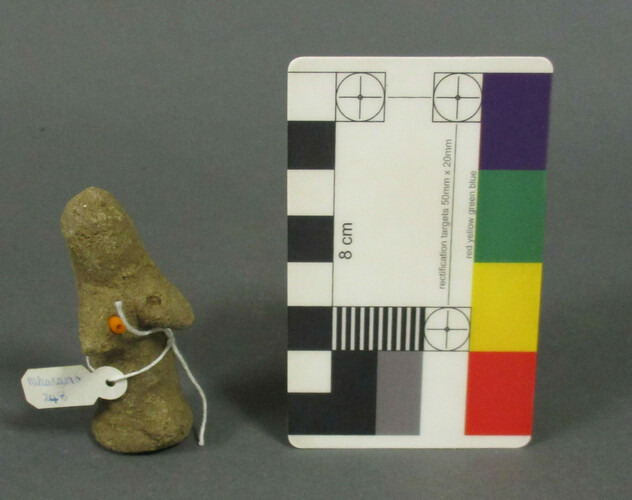 1958.11.2.248Clay Mkaramo figure. Cylindrical body, with a flared base. Two extended protrusions, possibly either arms are breasts. A small orange bead placed in between them. A domed shaped protrusion near the base, possibly representing a navel or pregnancy. No distinction between the body and the head, with no facial features. [BH [OPS Move] 10/5/2017]1958.11.2.248
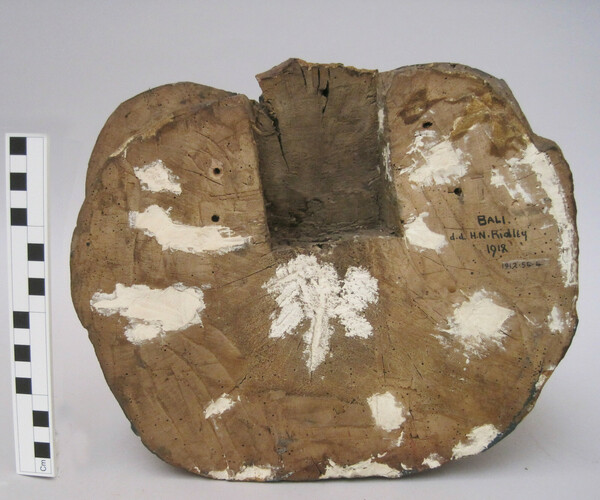 1912.54.4Carved and painted face of demon or mythical animal with four tusks, four teeth and protruding eyes. [SM (Verve) 14/05/2013]1912.54.4
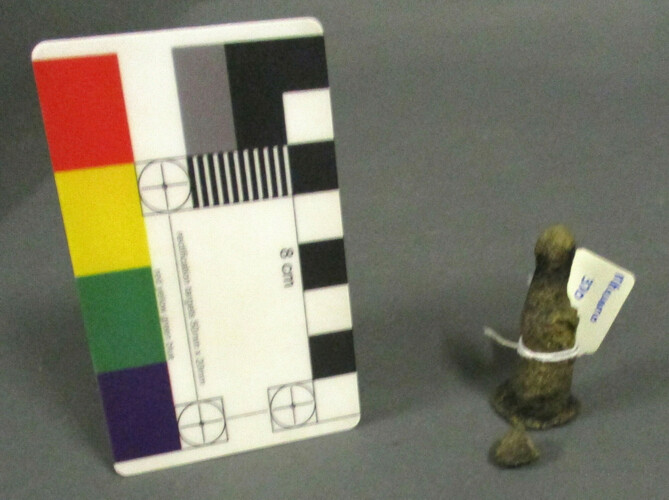 1958.11.2.296Clay Mkaramo figure. Cylindrical body, with a flared, circular base and rounded head. One extended protrusion, representing a breast or arm. Painted black band around the bottom half of the head, and possibly at the base. [IL [OPS Move] 12/5/2017]1958.11.2.296
 2010.67.1.2Lid for a rectangular wooden box 2010.67.1 .1 [RM [OPS move] 17/10/2016]2010.67.1.2
 1933.18.51.14Fish hook with plain, unbarbed point, which is bound to a shank attached to a twisted piece of cord. This hook [.14] is tied together with seven others [.10 to .13 and .15 to .17]. [ZM 20/7/2004]1933.18.51.14
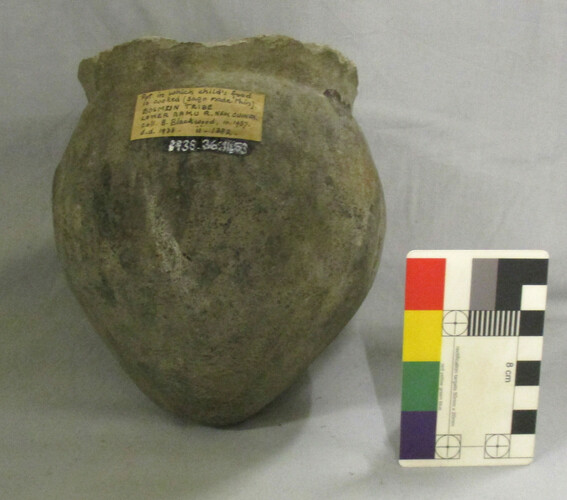 1938.36.1453Small blackened pot with pointed bottom and slightly curved sides with short narrowing neck and flared rim, which has many chips. [MOBB [OPS move] 07/04/2016]1938.36.1453
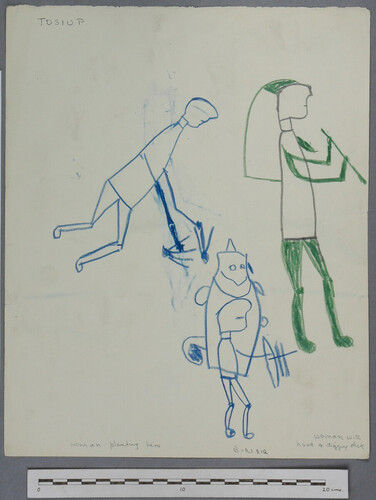 1994.15.1270Drawing in coloured pencil of three figures and an ?animal figure [SM 07/05/2008]1994.15.1270
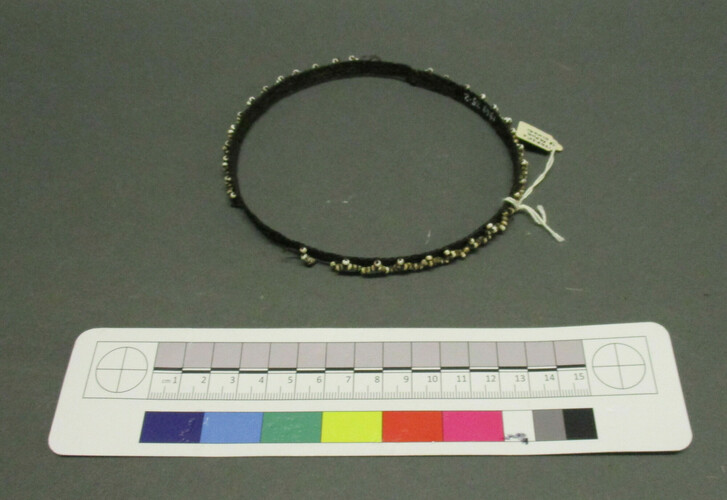 1969.35.2Very narrow leg ornament, consisting of woven plant fibre with a zig-zag decoration of white beads [N.B. 'DCF 2004-2006 What's Upstairs?' 21/2/2005]1969.35.2