
- Collection type
- Object
- Description
- Dance shield. [FC 04/08/2010]
- Long description
- Dance shield. The shield is made from wood and is carved with curvilinear design painted white, orange and black. There is a central handle. [FC 04/08/2010]
- Date / Period
- Date made: Before 1900
- Date collected
- By 1900
- Acquisition information
- Donated: 1900 Found unentered: 06/1946
- Materials and processes
- Material Wood Plant, Material Pigment, Process Carved, Process Inlaid, Process Painted
- Dimensions
- Length: max 620 mm, Width: max 240 mm, Depth: max 100 mm
- Object numbers
- Accession number: 1946.6.69.4
- Research and responses
If Trobriand Islands: The kaydiba is a dance shield used in the energetic male dances of the same name. There was traditionally a three-month dancing season in Trobriands culture – the milamila – of which the kaydiba formed a major attraction. In this dance, young men wore loincloths and elaborate and beautiful cockatoo feather headdresses, and held these dance shields in their right hands. They danced in an anti-clockwise circular formation, around the singers and drummers. The kaydiba has been anthropologically interpreted as a forum for men to display their beauty to the watching women, who themselves used the kaydiba as an opportunity to spot a potential partner. The form of the kaydiba is symmetrical across the handle. The principal whorl represents – in a highly schematic form – the beak of a hornbill bird. The more substantial mass at the base of each panel near the handle bears some resemblance to the head of a snake, which was associated metaphorically with the penis in Trobriands mythology. The carving of the elaborate fretwork required very high levels of skill, and the reputation of individual specialists - who carved both dance shields, canoe prow-boards, and other fine works – made their work much sought after. Some scholars have argued that the similar curvilinear fretwork designs which appear on Trobriand Islands canoe prows are intended to bewilder and mesmerise the viewer, and make social relations between trade partners flow as the designs do. If this is the case, it seems possible that a young Trobriands man might implement such powerful carvings to aid him in the course of love. Relevant Reading: Malinowski, B. (1932) The Sexual Life of Savages in Northwest Melanesia. London: Routledge. Guiart, J. (1963) The Arts of the South Pacific. London: Thames & Hudson. Newton, D. (1975) Massim: Art of the Massim Area. New York: Museum of Primitive Art. Gell, A. (1992) The Enchantment of Technology & the Technology of Enchantment. In: Coote, J. & Shelton, A. (eds.) Anthropology, Art & Aesthetics. Oxford: Clarendon Press. Research Conducted for DCF Cutting Edge 2006/2007 [AM].
Search terms: Dance, Weapon, Figure, Ritual and Ceremonial, Dance Accessory, Shield, Bird Figure, Ceremonial Object
Further items to explore
 1914.26.13.3Wooden horn carved in a spiral until the mid section, this then curves and tapers to a blunt point. The opposite end features a dowel for securing into the mask head figure. For the head figure see [1914.26.13 .1] and the matching horn see [1914.26.13 .3] [BS [OPS Move] 5/9/2016]1914.26.13.3
 1950.4.88.2Ankle (or wrist) dance-rattle. Attached to 1950.4.88 .1 and 1950.4.88 .3 [LC 5/2/2020]1950.4.88.2
 1949.5.3BDance costume.1949.5.3B
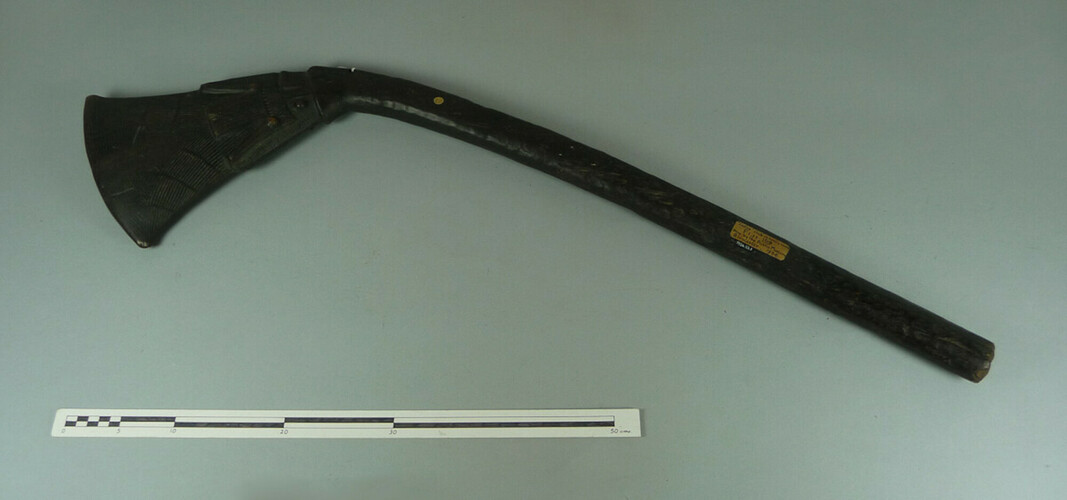 1936.23.1Wooden dance club of heavy dark wood (Gugu) with broad carved blade. [FC 09/08/2011]1936.23.1
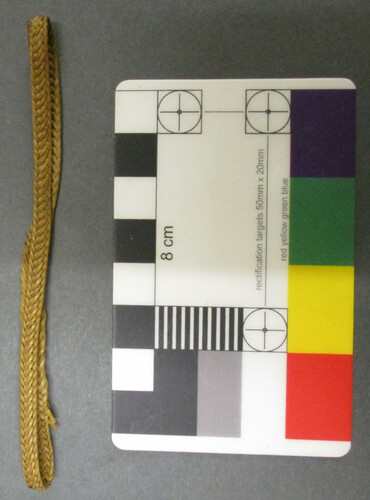 1938.36.658Armlet, made from pandanus plant fibre plaited into a band. Roughly oval in shape. [ASh [OPS move] 14/11/2016]1938.36.658
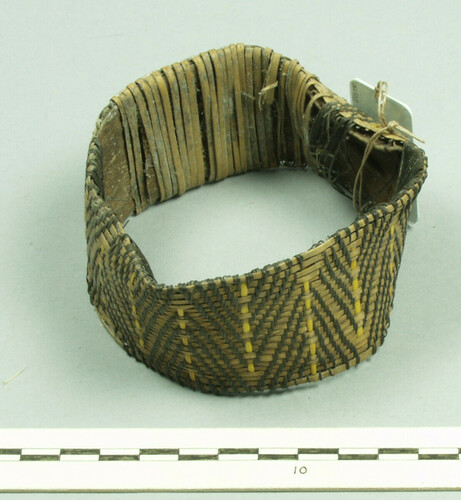 1979.21.47Huli style bracelet: a strip of bark wrapped with narrow black cane and broader undyed cane, into which strips of undyed cane are plaited on the outer surface, forming twill patterns with inserts of yellow orchid stem. [LM 'DCF 2004-2006 What's Upstairs?' 29/11/2005]1979.21.47
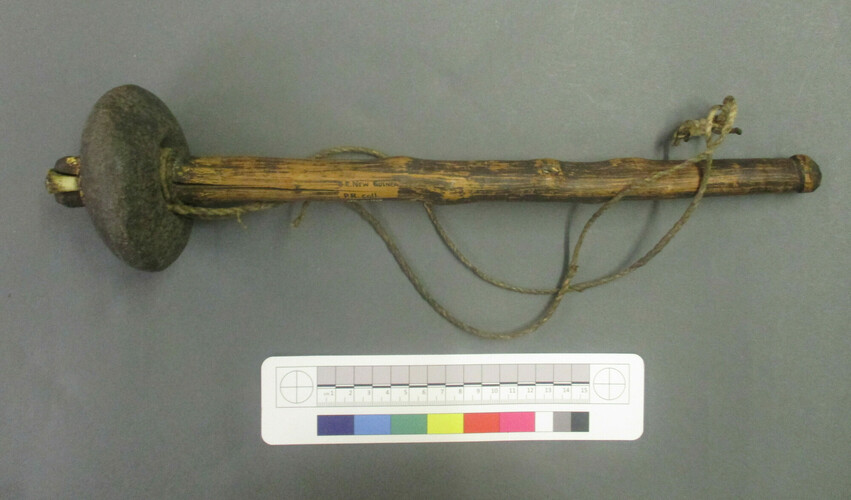 1884.140.1767Wood club with perforated, ovoid stone head. [JC [OPS Move] 20/09/2016]1884.140.1767
 1938.36.1159Obsidian flake.1938.36.1159