
- Collection type
- Object
- Description
- Sling-stone. [JC 28 2 2014]
- Long description
- Sling-stone of steatite in the shape of a prolate spheroid. [JFK 23/2/2009; JC 28 2 2014]
- Geographical reference
- Grande Terre North Province Poéubo commune Balad district
- Person
- Field collector Johann Reinhold Forster
- Field collector Georg Forster
- PRM source Ashmolean Museum, University of Oxford
- Date / Period
- Date made: Before 13/09/1774
- Date collected
- Between 4 and 13 September 1774
- Acquisition information
- Transferred: 19/04/1886
- Materials and processes
- Material Steatite Stone
- Dimensions
- Length: max 55 mm, Width: max 27 mm
- Object numbers
- Accession number: 1886.1.1535.3 Other numbers: Forster 164
- Research and responses
The sling given by the Forsters (Forster 163) is 1886.1.1535.1, the bag (Fiorster 164) is 1886.1.876, and the six surviving stones (also part of Forster 164) are 1886.1.1535.2-.6. [JC 4 20 1012]
In his Journal entry for 5 September 1774, Reinhold Forster notes: 'Their slings are singular, with oblong heavy Stones, pointed on both sides, made I believe on purpose.' See page 644 in Volume 4 of The Resolution Journal of Johann Reinhold Forster, 1772-1775 (edited by Michael Hoare), (London: The Hakluyt Society (Second Series, No. 154), 1982). [JC 24 10 2012]
On pages 385-386 of Volume 2 of his A Voyage Round the World in His Britannic Majesty’s Sloop, Resolution, Commanded by Capt. James Cook, During the Years 1772, 3, 4, and 5 (London (2 vols), 1778), George Forster discusses New Caledonian slings and related objects: 'Their last weapons were slings.... These slings consisted of a slender round cord, no thicker than a packthread, which had a tassel at one end, and a loop at the other end and in the middle. The stones which they used were oblong, and pointed at each end, being made of a soft and unctuous soap-rock (smectites), which could easily be rubbed into that shape. These exactly fitted the loop in the middle of the sling, and were kept in a wallet or pocket of coarse cloth, strongly woven, of a kind of grass, which was tied on about the middle. Their shape gives them a striking resemblance to the glandes plumbeae of the Romans.' (See pages 568-570 of the edition of A Voyage round the World edited by Nicholas Thomas and Oliver Berghof (Honolulu: University of Hawaii Press, 2000.) [JC 24 10 2012]
On page 00 of his Observations Made during a Voyage round the World on Physical Geography, Natural History, and Ethic Philosophy... (London, 1778), Johann Reinhold Forster discusses New Caledonian slings and related objects: 'The natives carry stones for their slings in small bags. These stones are of an oblong roundish figure, and pointed at both ends, consisting of a kind of soap-rock or smectites.' (See page 34 of the edition of Observations edited by Nicholas Thomas, Harriet Guest, and Michael Dettelbach (Honolulu: University of Hawai'i Press, 1996).[JC 25 10 2012]
- Associated publications
- Listed according to the 'Forster list' numbering system in 'From the Islands of the South Seas 1773-4: An Exhibition of a Collection Made on Capn. Cook's Second Voyage of Discovery by J.R. Forster - A Short Guide (Oxford: Pitt Rivers Museum, no date [1970]): '164. A bag filled with stones for slinging. Six egg-shaped stones of steatite have survived. Lengths: from 5cm. to 6cm.' NB The bag itself was not exhibited as it had not yet been identified. It has now been identified as 1886.1.176. [NMM; JC 6 6 2000, 4 10 2012] Listed under numbers 1-6 under ‘New Caledonia...Sling Stones’ on page 244 of 'Artificial Curiosities': Being an Exposition of Native Manufactures Collected on the Three Pacific Voyages of Captain James Cook, R.N. at the Bernice Pauahi Bishop Museum, January 18, 1978 - August 31, 1978 on the Occasion of the Bicentennial of the European Discovery of the Hawaiian Islands by Captain Cook - January 18, 1778 (Bernice P. Bishop Museum Special Publication 65), by Adrienne L. Kaeppler (Honolulu: Bishop Museum Press, 1978): '1-6. Six sling stones, Oxford (164). Lengths 5 to 6 cm. Evidence: Forster collection. Second voyage. Literature: Gathercole, n.d. (1970) [see above]'. [JP 24/7/2002] Published as part of the Forster Collection on a dedicated website at www.prm.ox.ac.uk/forster (from February 2001). [JC 7 7 2005] For an account of the history of the collection of which this is part, see 'The Cook-Voyage Collections at Oxford, 1772–1775', by Jeremy Coote, in Jeremy Coote (ed.), Cook-Voyage Collections of 'Artificial Curiosities' in Britain and Ireland, 1771–2015 (MEG Occasional Paper No. 5), Oxford: Museum Ethnographers Group (2015), pp. 74–122. (Copy in RDF: Researchers: Jeremy Coote (Cook-Voyage Collections).) [JC 9 6 2016]
Search terms: Weapon, Sling-stone
Further items to explore
 1884.29.5.5One of seven sling-stones that go with a rectangular stringwork bag [see 1884.29.5 .1 - .8 for bag and other sling stones]. [El.B 12/2/2007]1884.29.5.5
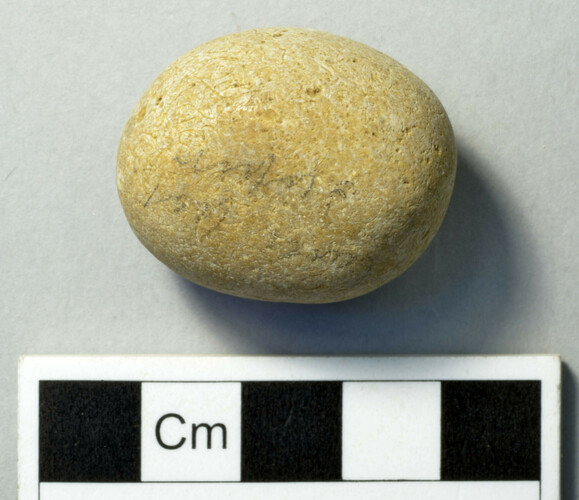 1884.140.1459.10Stone; possibly a sling-stone1884.140.1459.10
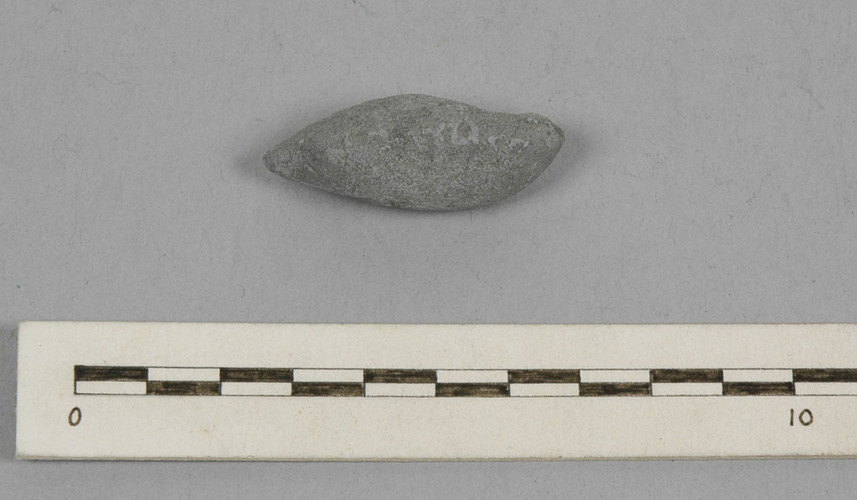 1898.55.13Lead slingstone, pointed oval shape, with raised inscription: '... O ...'. [LM 11/07/2007]1898.55.13
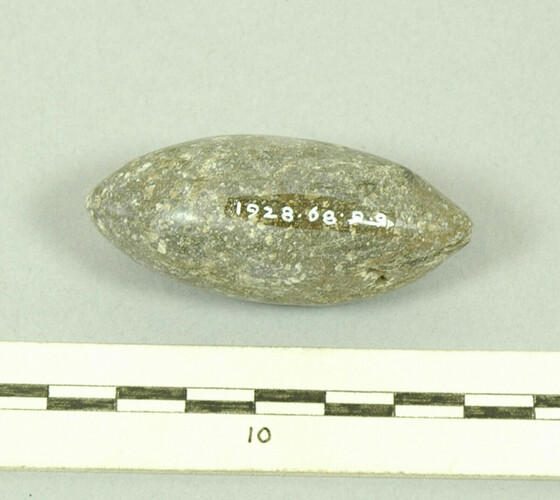 1928.68.9.9Steatite sling-stone with pointed ends. [El.B 12/2/2007]1928.68.9.9
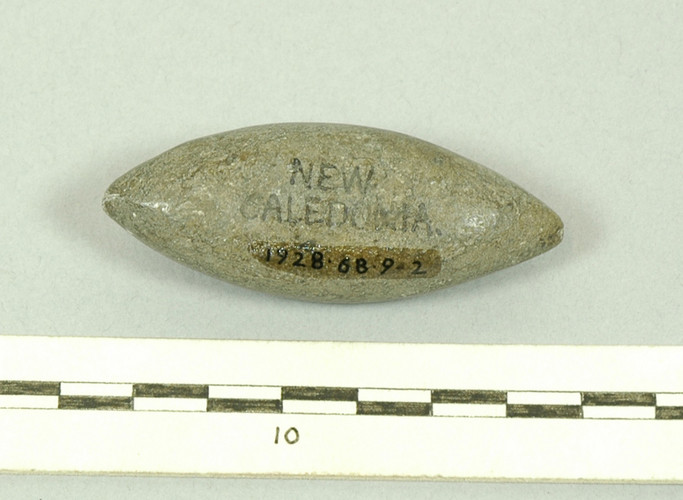 1928.68.9.2Steatite sling-stone with pointed ends. [El.B 12/2/2007]1928.68.9.2
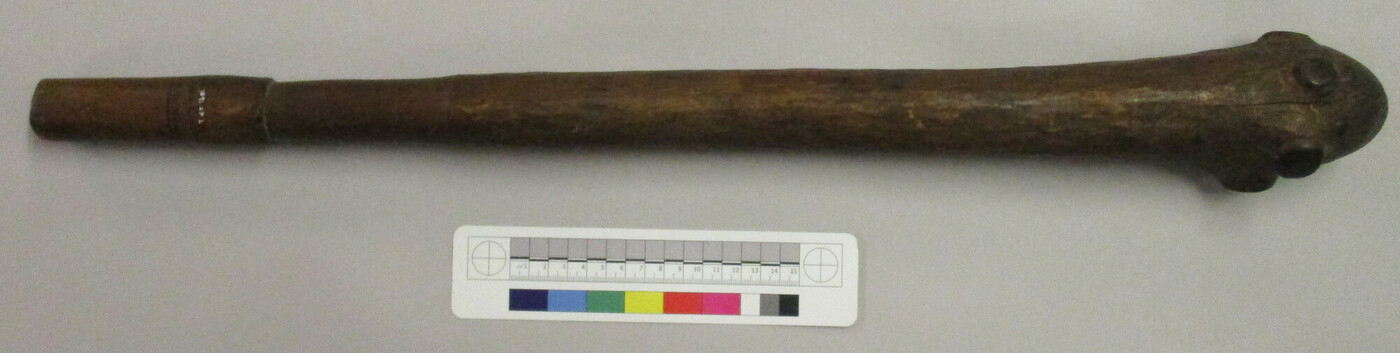 1891.27.2Wooden club. Rounded head and primarily cylindrical in shape. [MOBB [OPS move] 25/07/2016]1891.27.2
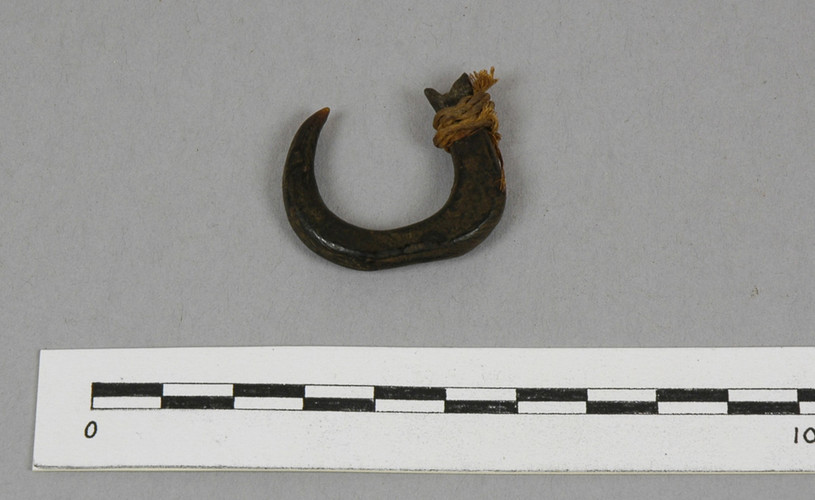 1923.74.2Turtleshell fish hook, bound with plant fibre twine.1923.74.2
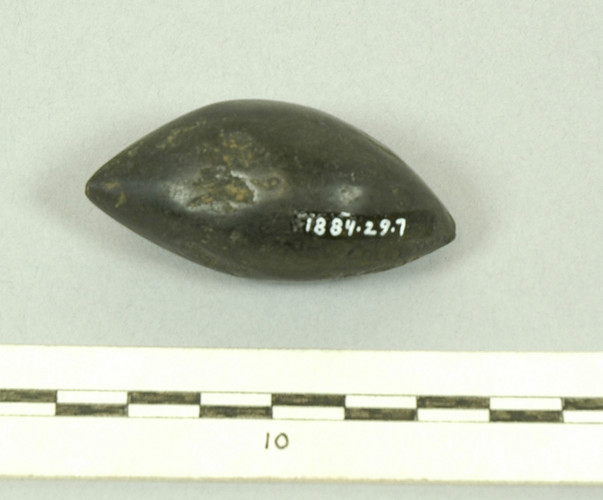 1884.29.7Ground stone ball in the shape of a prolate spheroid, recorded as a sling-stone. [Dan Hicks 13/06/2012]1884.29.7