
- Collection type
- Object
- Description
- Multistranded necklet or chest ornament made from hide strips and plant fibre cord and strung with numerous ostrich eggshell and blue faceted glass beads [RTS 25/8/2004].
- Long description
- Neck or chest ornament consisting of one or more cords of twisted plant fibre, possibly bast, bent into 14 loops and secured at either end weaving them in and out of a horizontal band of hide plaiting, with two short lengths continuing beyond this on the inside edges where they probably served as ties to fasten the ornament in place around the neck. These appear to be made of 4 strands twisted together. The plaited hide bands are formed from two narrow hide strips with a series of slots cut into the body, through which the other strip is passed. Their ends extend beyond the edges of the necklet, where their lower parts are bound around with a length of white metal wire, possibly aluminium. Above this, each band has been woven around a single cowrie shell bead with its back removed, with the two strips slotted through one another to secure them on the other side. In addition, on either side two narrow lengths of hide strip project from the plaited band area, and may also have acted as fastening ties. The top 13 strings of the ornament have been decorated with a series of disc shaped beads chipped from a cream coloured ostrich eggshell; these gradually increase in diameter from a minimum of 6 mm at the top, to 14 mm on the lowest string. The strings also change, with the top 4 strings being virtually horizontal and straight, and subsequent strings becoming gradually more curved. They also become gradually longer, with the top shell string having 163 beads in place, and the lowest one carrying 305 beads. The edges of these beads appear to have been polished. The lowest and final string has been decorated with 88 octagonal faceted beads with flat sides and ends, a typical example of which is 7 mm long and 8.7 mm wide. These are made of a opaque cobalt blue glass (Pantone 534C). The necklet is essentially complete, but the edges of some of the egghsell and glass beads are chipped and one of the eggshell beads is only half complete. The necklet has a length of 353 mm as strung and a width of 280 mm across the top; the wire bound tabs have a diameter of 6 mm and the plaited hide band is 6 mm wide. It weighs around 850 grams [RTS 25/8/2004].
- Geographical reference
- North western Uganda [Upper Nile]
- Person
- Field collector Henry Balfour
- Field collector Armine Charles Almroth Wright
- PRM source Henry Balfour
- PRM source Armine Charles Almroth Wright
- Date / Period
- Date made: Before 1939?, uncertain
- Date collected
- ?By 1939
- Acquisition information
- Donated: 1942, uncertain
- Materials and processes
- Material Ostrich Eggshell Bird, Material Glass, Material Cowrie Shell, Material Animal Hide Skin, Material Plant Fibre, Material Bast Fibre Bark Plant, Material Aluminium Metal, Process Twisted, Process Knotted, Process Chip Carved, Process Perforated, Process Strung, Process Polished, Process Plaited
- Dimensions
- Width 280 mm top, Length 353 mm, Weight 850 g
- Object numbers
- Accession number: 1942.1.450
- Research and responses
Carey suggests that ostrich eggshell beads were made by chipping the material to the correct size then boring a hole through it, after soaking the eggshell in water to prevent the material splitting. Several partially worked beads could then be strung together and the edges ground to finish them off. It was possible to make around one hundred beads of this kind per day (M. Carey, Beads and Beadwork of East and South Africa, 1986, p. 9).
This neck ornament has similarities to 1934.8.69, a single string necklet strung with ostrich eggshell disc beads and two blue faceted beads of the types seen here, and of similar dimensions. This was collected by Powell-Cotton in 1933 from the Lotuko, and it is possible that 1942.1.450 has a similar cultural origin. These blue beads also appear on a Dinka neck ornament in the British Museum (exhibited in the British Museum reading room in 2004 as part of exhibition 'Sudan Past and Present') [RTS 30/9/2004].
It is possible that this object actually came in as part of the Seligman collection (see 1940.12) [JC 30/9/2004].
- Associated publications
- Illustrated in colour as figure d on page 26 of A Shared Struggle: The People & Cultures of South Sudan, edited by Tim McKulka (no place [Juba]: Ministry of Culture, Youth and Sports, Government of the Republic of South Sudan and the United Nations Mission in South Sudan, 2013). Caption (same page): 'Lotuka beaded necklace'. [JC 28 2 2014]
Search terms: Ornament, Bead, Neck Ornament
Further items to explore
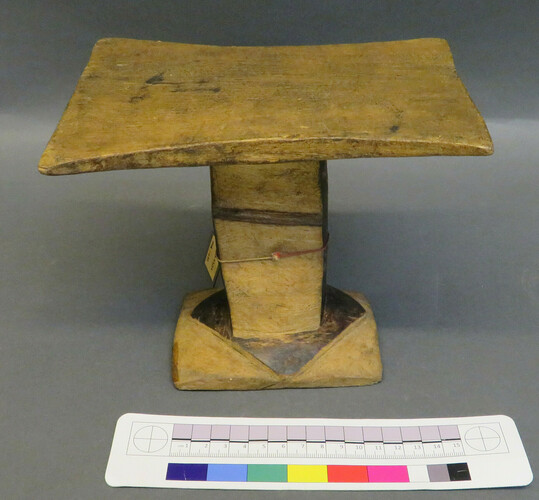 1942.1.433Wooden stool, consisting of a flat rectangular seat, with concave long edges, supported by a rectangular-sectioned pillar on a rectangular base. There is a lozenge-shaped expansion on the base where it meets the pillar. This expansion, the edges of the pillar and a strip on the underside of the seat have been blackened. [JC [OPS Move] 3/5/2017]1942.1.433
 1992.19.55Wooden bow of round section which has a natural curve and is pointed at each tip. [SB [OPS Move] 11/7/2017]1992.19.55
 1920.101.65Arm ornament of black ?giraffe tail hair with two crescentic brass beads. [El.B 'DCF 2004-2006 What's Upstairs?' 19/10/2005]1920.101.65
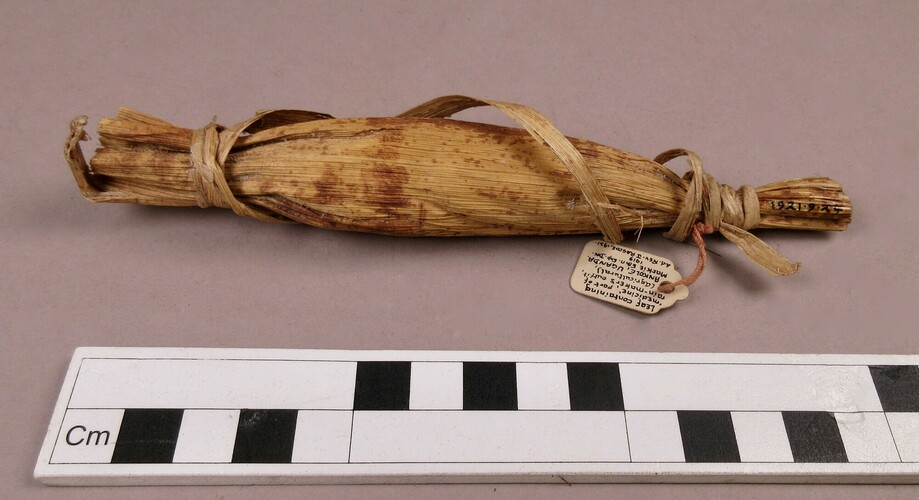 1921.9.24Leaf bundle of medicine, belonging to rain-maker.1921.9.24