
- Collection type
- Object
- Description
- Headrest carved from a tree branch, with narrow seat and 3 angled legs [RTS 3/6/2005].
- Long description
- Headrest carved from a single piece of orangey brown wood, stained a darker reddish brown (Pantone 469C). This is an example of 'found form', with a naturally grown branch specifically chosen because its shape, with subsidiary branches coming off the main stem to form the three feet, was suitable for making a headrest. It consists of a narrow horizontal seat across the top with a flat upper surface that is concave along its length, and which tapers in to the front, possibly suggestive of the neck or head or an animal. Here, the underside of the seat has an sharp ridge that runs down from the front, flattened tip of the seat end to between the front legs, where it continues along the underside to the back leg, but becomes less well defined. The seat also narrows slightly to its back end, which is also cut flat on the outer face. This has a narrow flat underside where the wood has been shaved, that extends as far as the back leg of the headrest. Three narrower branches extend from the underside to form the legs, with 2 legs at the front end, splaying out in opposite directions, and the third leg extending down from the back; all three legs are comparatively straight. The feet have been shaved to have slightly pointed undersides. The headrest is complete and intact. It has a weight of 512.6 grams and is 196 mm high; the seat is 342 mm long, 33 mm wide and 37 mm thick, while the legs have a diameter of from 23.7 to 27.2 mm [RTS 3/6/2005].
- Geographical reference
- Cultural groups
- Anywaa (Anuak)
- Date / Period
- Date made: Before 1936
- Date collected
- March - May 1935
- Acquisition information
- Donated: 1936
- Materials and processes
- Material Wood Plant, Process Carved, Process Stained, Process Polished
- Dimensions
- Width: max 33 mm seat, Length: max 342 mm, Height 37 mm seat, Height: max 196 mm, Weight 512.6 g
- Object numbers
- Accession number: 1936.10.56
- Research and responses
Presumably collected by Edward Evan Evans-Pritchard during his period of fieldwork amongst the Anuak between early March and May 1935 (see E.E. Evans-Pritchard, 1940, The Political System of the Anuak of the Anglo-Egyptian Sudan, p. 3).
Evans-Pritchard states that the local name for this type of headrest is köm, a term which elsewhere he also applies to Nuer headrests such as 1937.34.49. This type of lightweight headrest, made from a tree branch, is produced by a number of Nilotic groups; for another Anuak example, see 1936.10.55; for Nuer examples, see 1917.25.40, 1931.66.17-18, 1932.30.1, 1936.10.56, 1937.34.49 and 1948.2.128, and for Dinka examples, see 1934.8.17.
Objects like these were used by men to protect their elaborate hairstyles. Willis described the Nuer practice of covering their hair with a paste made of clay, cow dung and urine, and then shaping it into the desired style, such as a cock's comb, or a peak at front or back. This treatment gradually wears off, staining the hair a reddish colour, and then the hair needs to be redone. Domville-Fife describes a similar process for the Shilluk in some detail, although amongst that group hair is dressed by a specialist barber, and is a costly process (C.W. Domville Fife, 1927, Savage Life in the Black Sudan, pp 71-76) [RTS 22/08/2005].
Search terms: Furniture Dwelling, Headrest, Furniture
Further items to explore
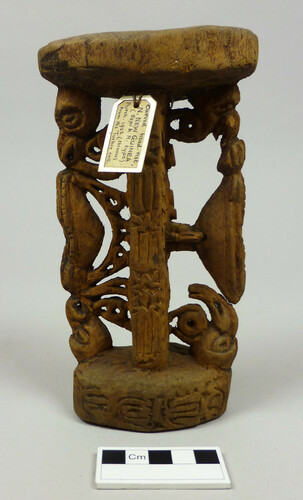 1922.60.1Carved wooden headrest with bird figures carved on either side. [SM (Verve) 09/01/2014]1922.60.1
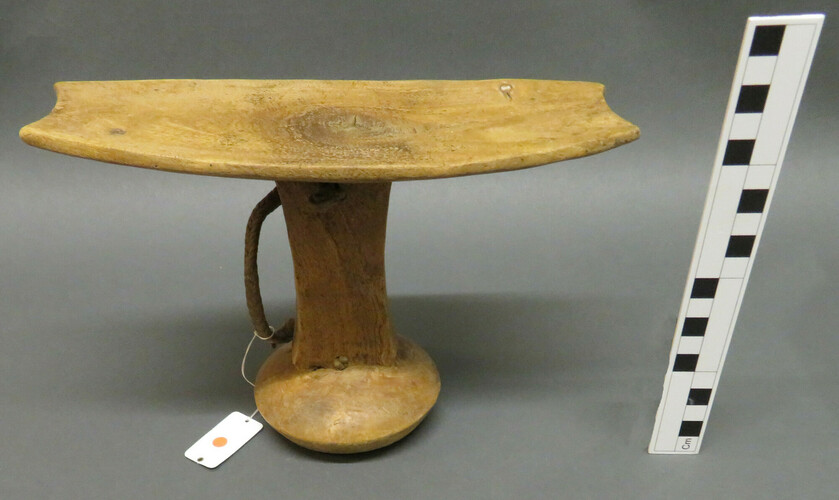 1999.20.17Wooden headrest carved from a single piece of wood. Oblong, slightly curved seat with concavely carved ends. Flat rectangular pillar with circular foot which is slightly hollowed on the under side. Plaited hide carrying strap is attached to one side. [MOBB [OPS move] 21/3/2017]1999.20.17
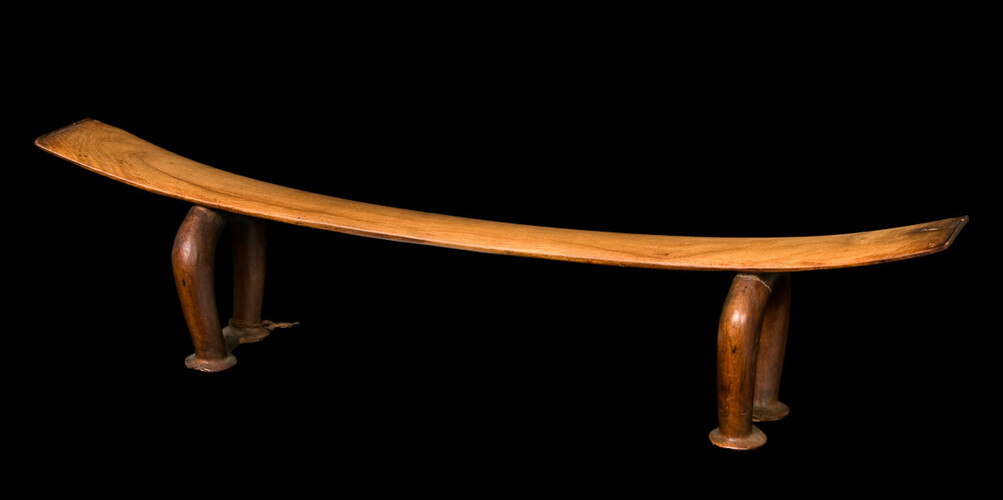 1886.1.1419Headrest. Carved from a single piece of wood. One leg has a plaited coconut cord tied around it. There were originally thin braces or cross-rails between the front two and back two legs. One of these wooden braces is broken. There is a hole on the top of the headrest at one end. 1886.1.1419
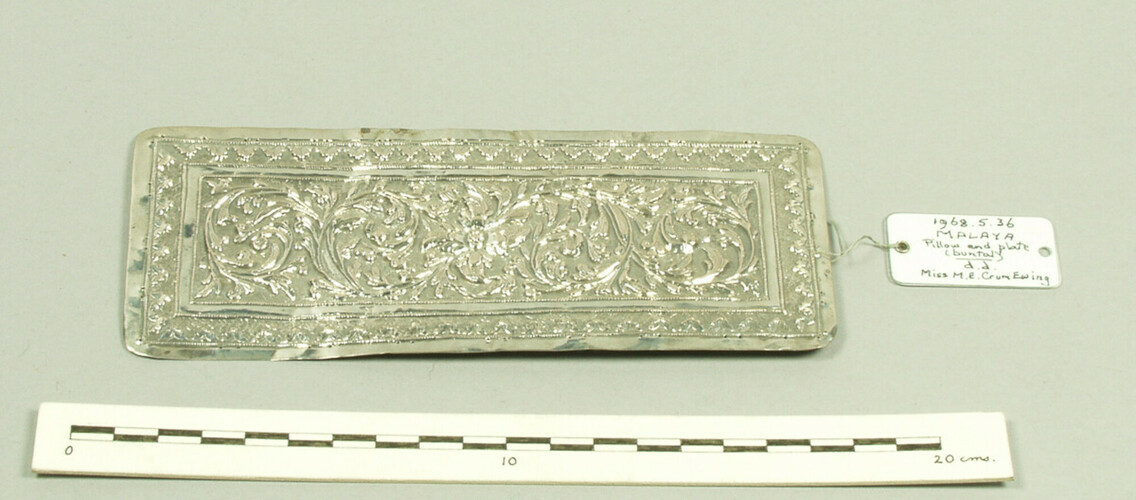 1968.5.36Rectangular silver pillow end-plate, with 4-petalled flower in centre flanked by foliated scrolls. [El.B 'DCF 2004-2006 What's Upstairs?' 25/5/2005]1968.5.36
 1939.7.120Small hide shield with wooden back support and ostrich feather decoration.1939.7.120
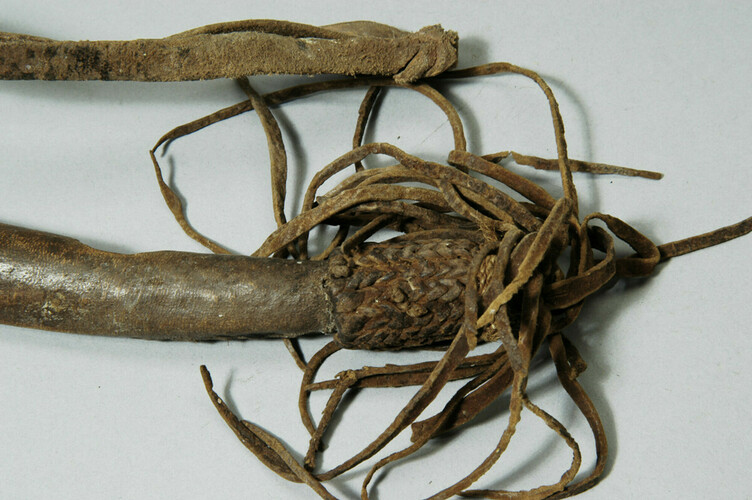 1940.7.093Ivory hide-covered side-blown trumpet with oval embouchure cut into concave side and a solid proximal end, with decorative tassel end and a hide carrying loop [RTS 7/12/2004].1940.7.093
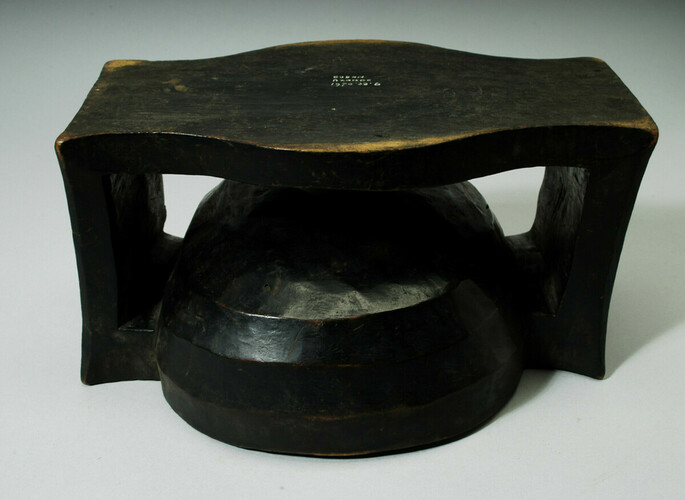 1970.38.6Wooden food bowl with faceted hemispherical body slung between 2 legs that join to a solid base plate [RTS 16/5/2005].1970.38.6
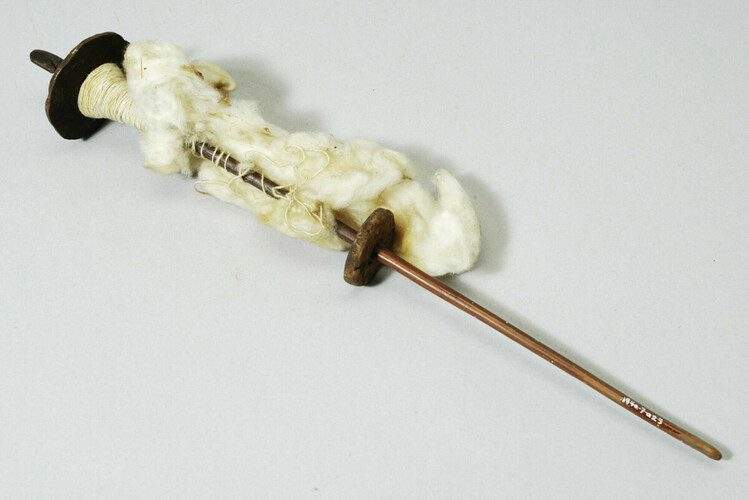 1940.7.023.1Wooden spindle with carved head, and 2 disc-shaped gourd spindle whorls in position at top and midway down the shaft [.1], with some raw cotton in the process of being spun into finished yarn and wound around the shaft [.2] [RTS 7/3/2005].1940.7.023.1