
- Collection type
- Object
- Description
- Narrow bag with tapering, tightly woven basketry body, used for straining beer.
- Long description
- Small tightly woven basketry beer strainer, consisting of a fairly narrow mouth whose rim has been formed by taking the ends of 64 narrow plant fibre strips, and bending each over at the top to form a loop; the loose ends hang down the inside of the mouth, where they are secured by similar strips woven in and out of the body in two horizontal rows. A third row runs beneath these, and is visible on the outside face; on the inside, this runs beneath the loose hanging ends. The ends of the horizontal strips have been knotted, then the separate strands plaited together and knotted a second time at the top, leaving a short plaited length projecting up from the rim. Below this horizontal band, the vertical strips continue to form the body of the strainer, tightly woven in a bias (e.g.: diagonal) twill, with each strand passing over two and then under two strands at right angles to it. The body expands slightly below the rim, and then tapers towards its base, with all the fibre strips gathered together at the bottom and secured with a reddish brown twisted plant fibre cord wrapped around the body a number of times (Pantone 477C). There is also a further strip that is wrapped vertically around the lower part of this, and used to secure a separate loop made of a piece of plaited plant fibre, with the loose ends tied together at the base. This has broken on one side. The strainer has been pressed flat and thus has a crease running down either side of the body. The mouth expands to make a diamond shape when opened. Essentially complete, there are numerous small breaks in the weave making up the body. The bag is a pale yellowish brown colour (Pantone 7508C), and is 332 mm long, 90 mm wide across the mouth, 122 mm wide across the upper body, and 14.5 by 13 mm wide at its base, with a weight of 26.4 grams. Each individual fibre strand making up the body weave has a width of 1 mm [RTS 7/7/2004].
- Geographical reference
- Cultural groups
- Anywaa (Anuak)
- Date / Period
- Date made: Before 1936
- Date collected
- March - May 1935
- Acquisition information
- Donated: 1936
- Materials and processes
- Material Plant Fibre, Process Tied, Process Basketry, Process Woven, Process Plaited, Process Twill
- Dimensions
- Width: max 122 mm upper body, Width: max 1 mm strand, Width: max 14.5 mm base, Length: max 332 mm, Width: max 90 mm mouth, Weight 26.4 g
- Object numbers
- Accession number: 1936.10.48
- Research and responses
Evans-Pritchard conducted his fieldwork amongst the Anuak between early March and May 1935 (E.E. Evans-Pritchard, 1940, The Political System of the Anuak of the Anglo-Egyptian Sudan, p. 3).
This object is known as adhinga. Similar types of woven bag are used by numerous other groups to strain beer, including the Acholi, the Lango and the Kakwa (M. Trowell & K.P. Wachsmann, 1953, Tribal Crafts of Uganda, pp 165-6, pl. 39o); see also 1979.20.83, from the Dinka Tuich [RTS 20/9/2005].
Search terms: Food and Drink, Basketry, Sieve, Food Accessory, Basket
Further items to explore
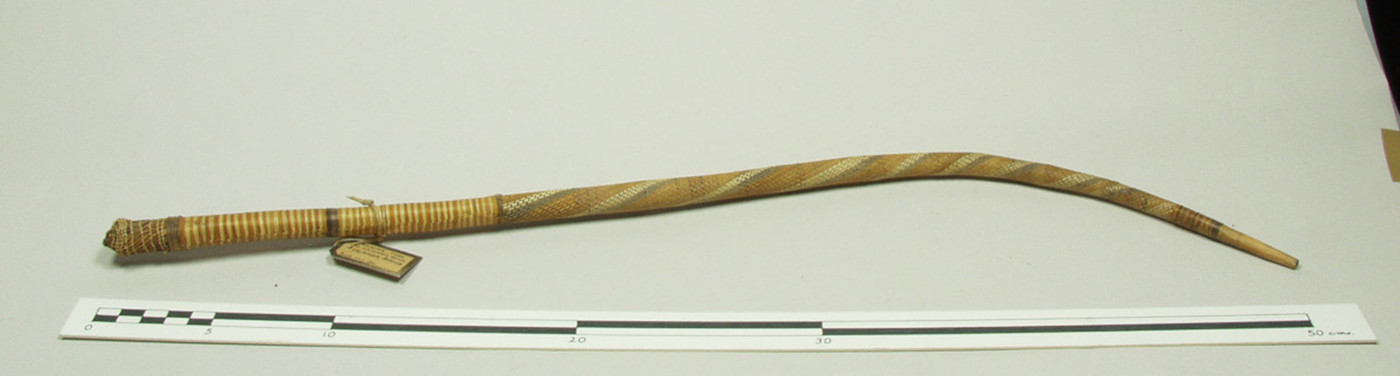 1901.63.1Beer-straining drinking tube, curved, with basketry top, bound with plant fibre in differently coloured stripes. [El.B 'DCF 2004-2006 What's Upstairs?' 7/4/2005]1901.63.1
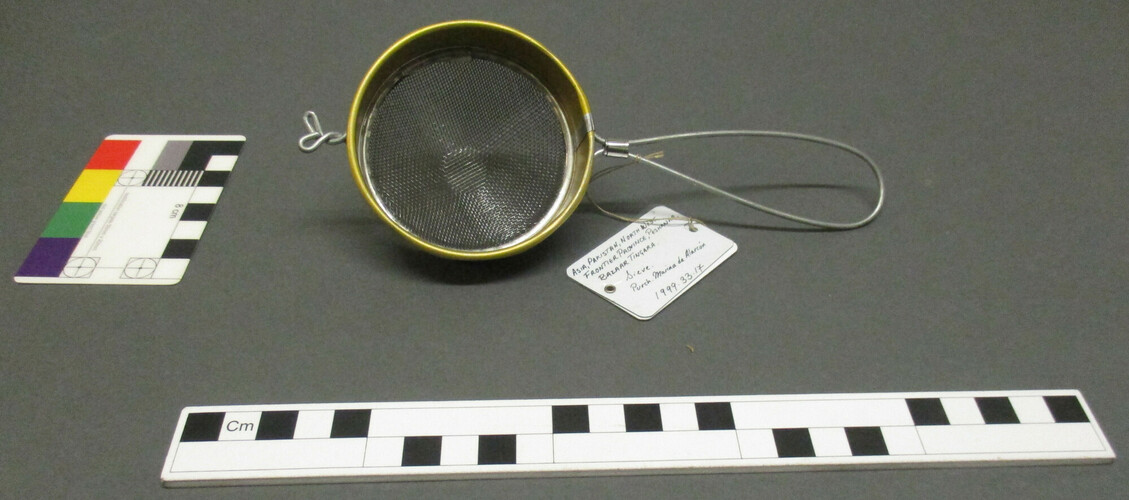 1999.33.17Sieve made partly from a sweet tin. The straining part of the sieve is made of a fine wire mesh. This is supported by a band of tin made from a sweet container. A wire handle has been fixed around the tin band. [MdeA 10/11/99]1999.33.17
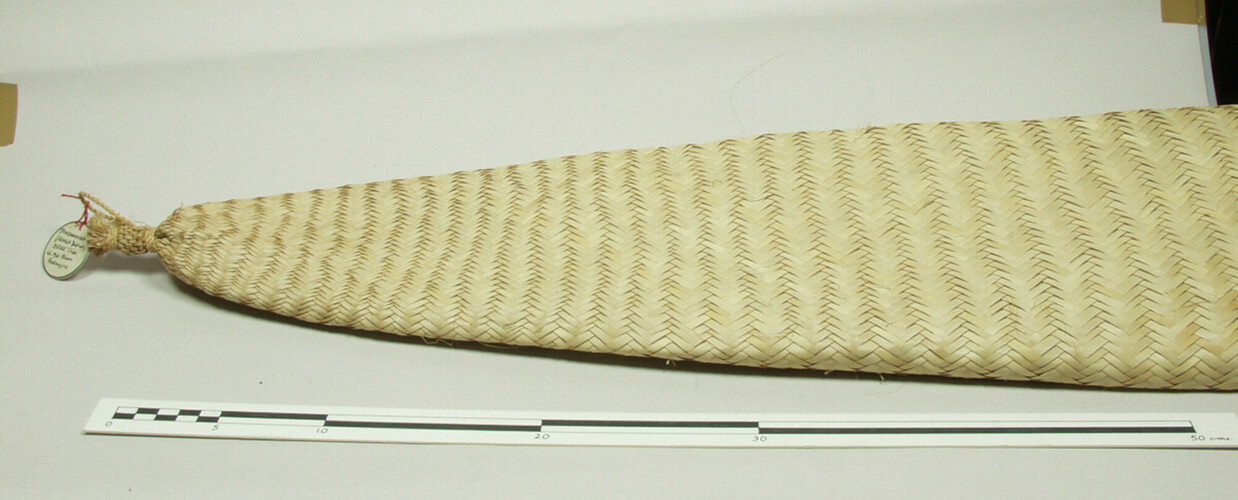 1963.11.50Beer or honey strainer made of woven basketry work, loop at one end and opening at the other. [N.B. 'DCF 2004-2006 What's Upstairs?' 7/4/2005]1963.11.50
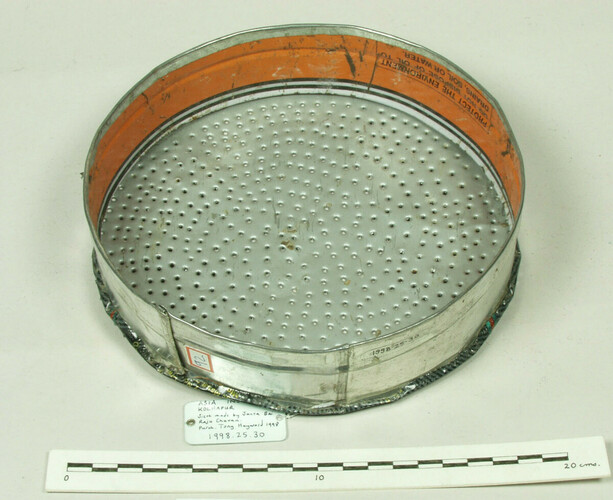 1998.25.30Sieve made from recycled misprinted tin, 'Park Ave. Talcum Powder'.1998.25.30
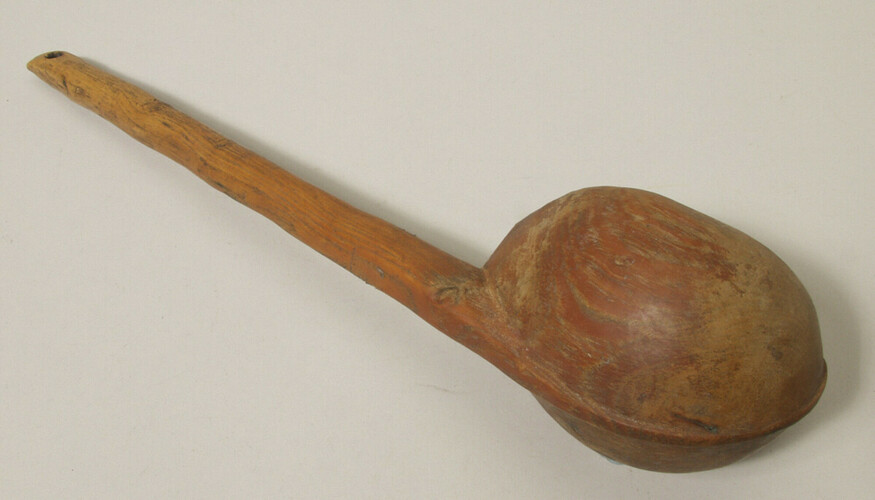 1979.20.198Light yellow to reddish brown wooden spoon with deep bowl [RTS 21/6/2004].1979.20.198
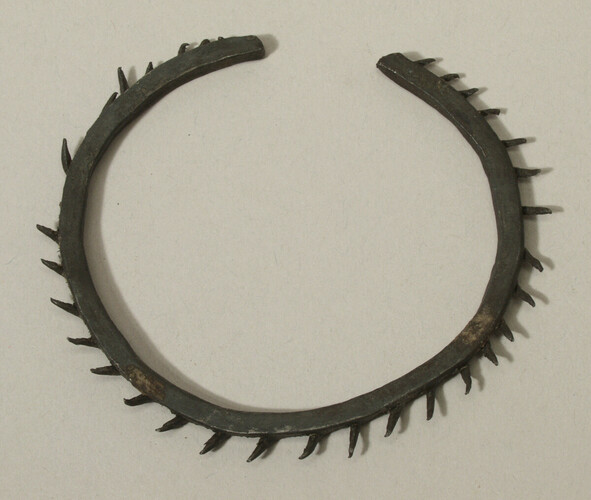 1936.10.18Iron armlet with sharp spikes around the edge, worn by boys during wrestling fights [RTS 4/3/2004].1936.10.18
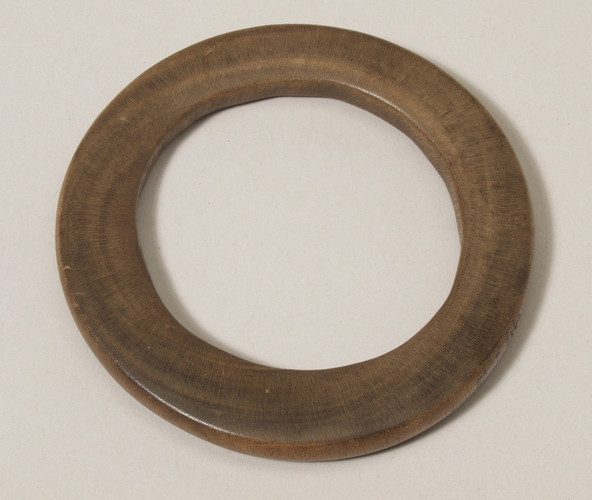 1917.25.85Annular wooden arm ornament [RTS 25/3/2004].1917.25.85
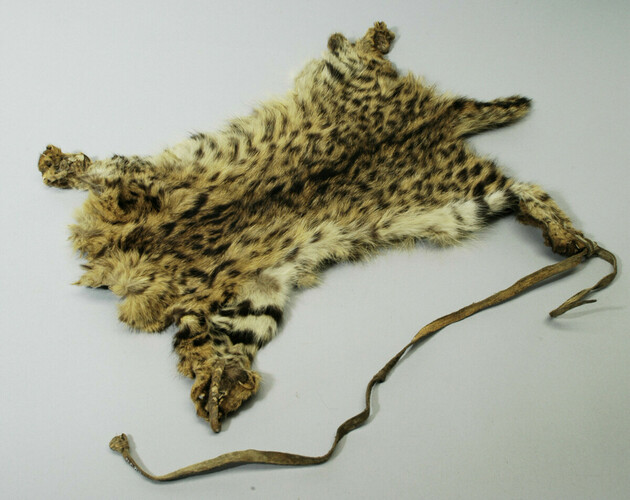 1936.10.65Wild cat skin, worn over left shoulder by men at dances [RTS 11/3/2005].1936.10.65