
- Collection type
- Object
- Description
- Iron armlet with sharp spikes around the edge, used for wrestling fights [RTS 23/3/2004].
- Long description
- Armlet made from a single bar of iron with square section, hammered and bent into an oval loop with ends touching at their tips. These have been cut at an angle. The upper surface has been worked with a chisel to form 25 long, sharp pointed spikes around its outer edge; each of these has been pulled away from the surface and angled downwards. The spikes are shorter on one side of the armlet. The inner surface, which rests against the skin, and the underside are both flat. The object is complete and intact, with no obvious signs of poison on the barbs. The length across the armlet is 86.3 mm with the spikes included, and 72 mm without, while the width across is 78.2 mm with spikes, and 66 mm without. The inside length of the armlet is 67 mm, and the width and thickness of the bar from which the armlet has been made is 3 mm. It weighs 19.8 grams. The metal is currently a dark gray colour (Pantone 425C). [RTS 23/3/2004].
- Geographical reference
- Cultural groups
- Nuer
- Date / Period
- Date made: Before 1936
- Date collected
- 1935 - 1936
- Acquisition information
- Donated: 1936
- Materials and processes
- Material Iron Metal, Process Forged (Metal), Process Hammered
- Dimensions
- Length x Width x Height 86.3 x 78.2 x 3 mm, Weight 19.8 g
- Object numbers
- Accession number: 1936.10.13
- Research and responses
Evans-Pritchard did his fieldwork amongst the Nuer in four expeditions, which took place in 1930, 1931, 1935 and 1936. This object was collected in 1935 or 1936, when he held a research fellowship from the Leverhulme Trust (see E.E. Evans-Pritchard, 1940, The Nuer) [RTS 2/3/2004].
Evans-Pritchard, writing in 1940, commented on the scarcity of iron amongst the Nuer and the high value consequently placed on objects made from it: 'Nuer have always been poor in iron objects ... Iron bells ... are rare and highly prized even at the present time, and in the old days iron rings and bracelets were important pieces of property' (E.E. Evans-Pritchard, 1940, The Nuer, p. 86).
Lindblom suggests that this type of fighting bracelet developed out of metal arm rings, and can be found among a number of African groups, including the Nuer, Dinka, Shilluk, Jibbeh, Bongo, Jur, Acholi, Madi, Latuka, Irenga, Jibbeh, Abukaya and Mittu. He illustrates an example similar to this one, said to come from the Mbum, in Cameroon (K.G. Lindblom, 1927, ‘Fighting-bracelets and Kindred Weapons in Africa’, Smärre Meddelanden, p. 7 and fig. 6). Although Evans-Pritchard associates this object with wrestling fights, and also with boys (see 1931.66.34-5, and The Nuer, p. 151), in other groups they could be associated with men (the Lotuko), or women, who used them for both fighting and dance (the Moru; C. Spring, 1993, African Arms and Armour, p. 116) [RTS 23/3/2004].
For the other armlets mentioned, see 1936.10.14-20.
Search terms: Weapon, Sport, Ornament, Arm Ornament
Further items to explore
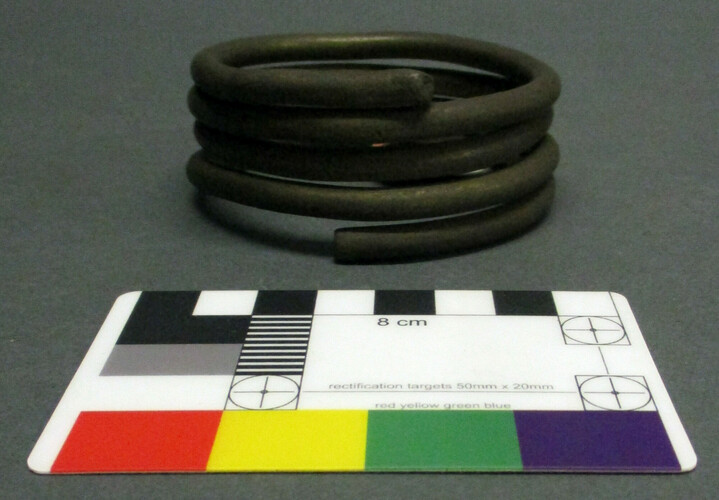 1942.13.725Arm ornament. Formed of a strong spiral of brass wire. [BS [OPS move] 12/12/2016]1942.13.725
 1942.1.132Arm ornament of twill plaited plant fibre with two-colour pattern. Tied by label in bundle of 105 (1942.1.69-173). [LM 'DCF 2004-2006 What's Upstairs?' 30/11/2005]1942.1.132
 1938.35.1571Arm ornament; circular band of braided black giraffe hair with a section of straight hairs with two sliders to adjust the size. [EC 'DCF 2004-2006 What's Upstairs?' 25/10/2005]1938.35.1571
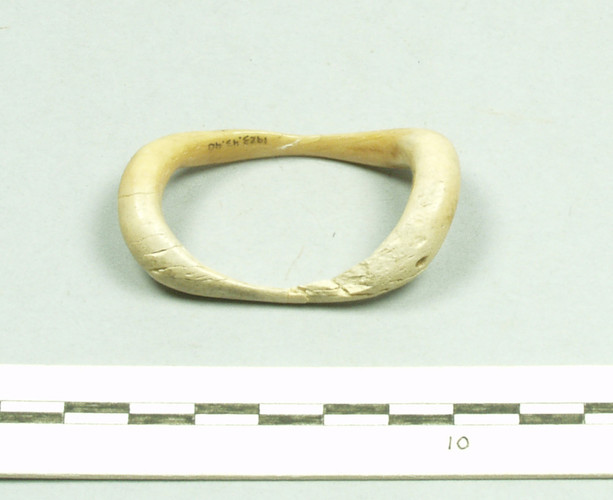 1923.43.40Elliptical ring (?bangle) of bone.1923.43.40