
- Collection type
- Object
- Description
- Ground stone axe.
- Long description
- Ground axe 'subquadrangular edge rounded but skew smooth pale grey veined stone faces almost flat ground from one side...with rounded top expanding to a curved edge'. [ZM 24/3/2004]
- Geographical reference
- Arunachal Pradesh Noa Dihing River Ningru Village
- Date / Period
- Date made: Before 1935
- Date collected
- By 1935
- Acquisition information
- Donated: 1935
- Dimensions
- Width: max 45 mm, Length: max 66 mm
- Object numbers
- Accession number: 1935.27.4
- Research and responses
See researchers file 'Milliken' for draft of A brief history of the stone tool collections from India in the Pitt Rivers Museum, Oxford by Sarah Milliken from the Institute of Archaeology, University of Oxford. [ZM 22/08/2008]
- Associated publications
- This is one of the stone tools described by A.A. Ashraf on page 5 of Prehistoric Arunachal as follows: 'There is an important collection of Stone tools from Arunachal Pradesh which have been preserved in the Pitt River [sic] Museum, Oxford. These were collected by J.P. Mills and J.H. Grace [sic note this should be Crace] during 1933-35. The first scientific report of this collection was made by A.H. Dani in 1960. In 1966, T.C. Sharma also studied the collection and pointed out that 10 specimens out of 16 are made on varieties of locally available rocks such as, sand stone, basalt, gneiss, schist and talcose. The rest of the implements are made on jadeite which is not locally available and thus these implements, according to him, reached Arunachal Pradesh either from north Burma or China.' [Itanagar, 1990] [ZM 21/11/2011] Illustrated (black and white drawing) as figure 22 on plate 8 in Prehistory and Protohistory of Eastern India by A.H. Dani (India: Firma K.L. Mukhopadhyay, 1960). Classified by Dani (page 60) as 'Curvilinear type' the caption (same page ) reads: 'Pl. 8, no. 22:- Collected by J.H. Crace. 1935. Bone. Similar to no. 20, except that the sides are rounded. It is very finely ground, but the butt is rough. The cutting edge is obliquely convex.' [ZM 22/11/2011]
Further items to explore
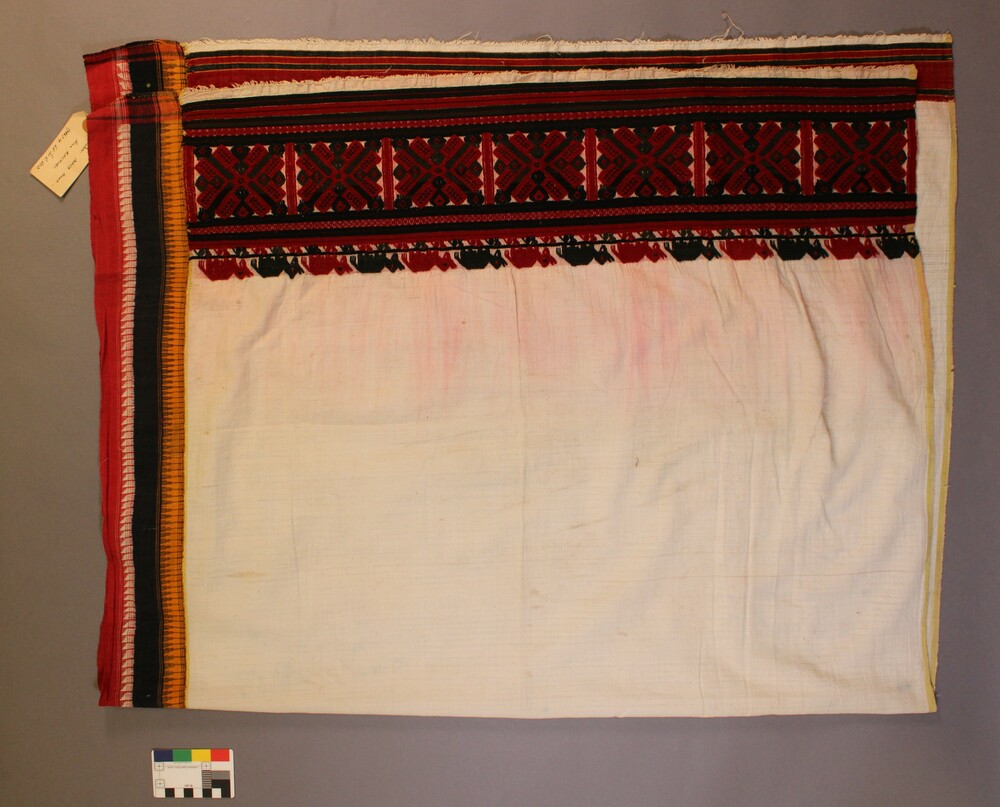 1946.7.19Woman's cloth1946.7.19
 1928.69.1450Dancing lengta of a man who has taken heads; a rectangular flap of cloth with ground cowries, rings of cowries shells,and a small brass disc or cymbal, with a fragment of carnelian bead on a string behind it to act as a striker1928.69.1450
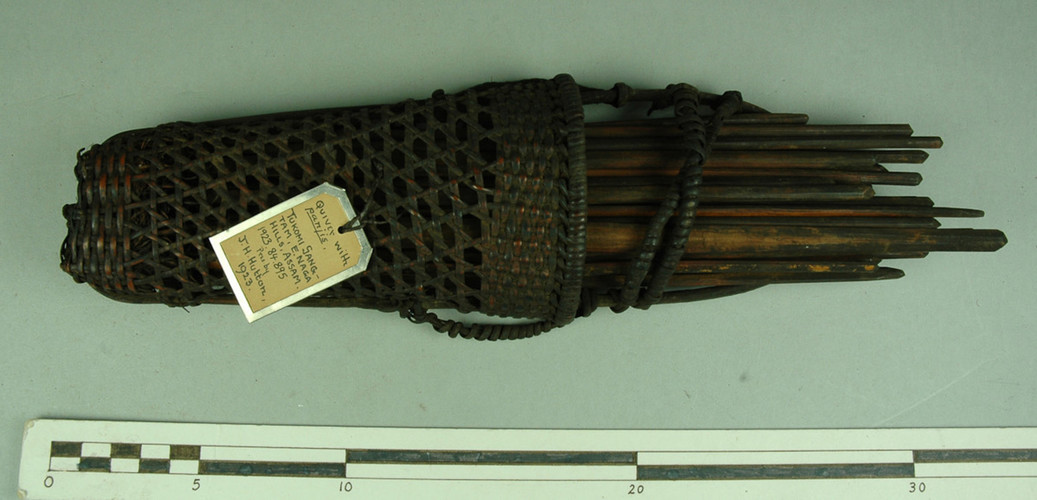 1923.84.895.1Basket container for calthrops or panjis. [MJD DDF Body Arts Project 2010/2011 29/09/2010]1923.84.895.1
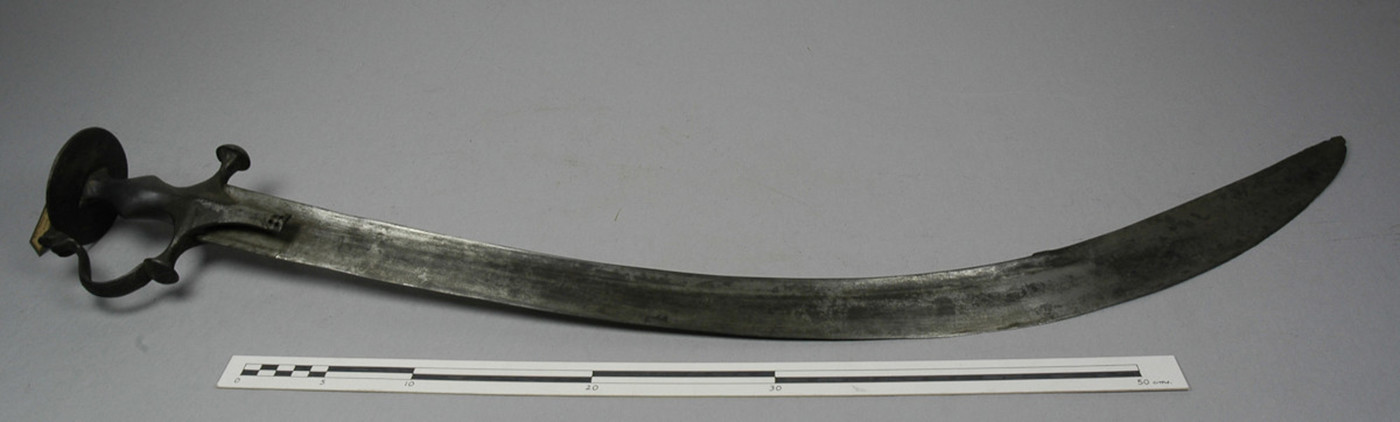 1918.19.4Sword with curved blade and hilt with long, perforated langets, flared quillons, a knucklebow and decorated disc shaped pommel. [SM 17/10/2007]1918.19.4