
- Collection type
- Object
- Description
- War charm to protect the wearer from the enemy and evil spirits, worn around the neck with the charm hanging down the back looking out [ZM 08/07/2015]
- Geographical reference
- Bismarck Archipelago Admiralty Islands
- Date / Period
- Date made: Before 1934
- Date collected
- By 1934
- Acquisition information
- Donated: 1941
- Materials and processes
- Material Wood Plant, Material Bird Feather, Process Carved, Process Incised
- Dimensions
- Length: max 460 mm
- Object numbers
- Accession number: 1941.2.3 Other numbers: 3518
- Research and responses
Although the initial accession entry refers to the object as a head, the added accession entry seems to refer to a head of a humerus. [CF 11/5/2000]
This object appears to be made entirely of wood and feathers and does not seem to be composed of or to contain a humerus. [EC 'DCF 2004-2006 What's Upstairs?' 3/10/2005]
For very similar objects see plate 52 on page 65 of Anna Edmundson and Chris Boylan, Adorned: Traditional Jewellery and Body Decoration from Australia and the Pacific (University of Sydney: Macleay Museum, 1999), which are described on page 107 as follows: 'War charms, Admiralty Islands, Manus Province, Papua New Guinea, 19th century, wood, pigments, frigate bird feathers, resin, plant fibre...War charms were used throughout the Admiralty Islands until the end of the nineteenth century. They were talismans carried into battle to protect the wearer from both the enemy and evil spirits. The war charm projected out from the back of the neck, secured by a string around the neck. An ancestor's bone was sometimes incorporated into the charm to increase its potency.' [ZM 08/07/2015]
Search terms: Ritual and Ceremonial, Status, Ornament, Figure, Ceremonial Object, Status Object, Amulet, Neck Ornament
Further items to explore
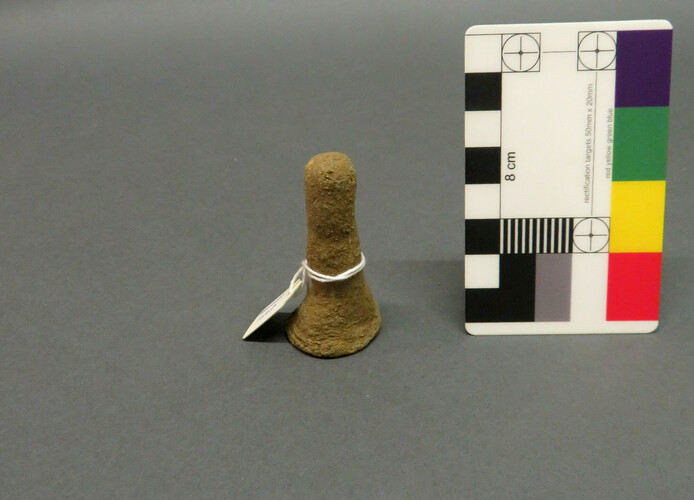 1958.11.3.93Clay Mkaramo figure. An off-centre, tapering cylinder with a rounded head and wide base. Probably phallic. [BA [OPS Move] 6/7/2017]1958.11.3.93
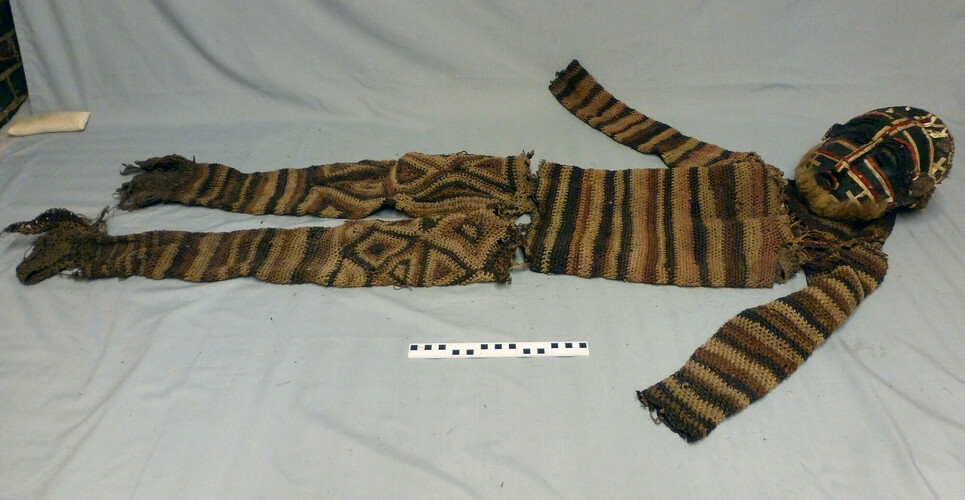 1949.5.4BDance mask and full body costume made of dyed and woven plant fibre string-work mask costume, and a carved wooden face mask. The plant fibre costume is dyed in horizontal bands and a geometric pattern at the midpoint. The mask section which is build onto a basketry framework is attached to the neck section of the costume. The face is painted and decorated with strips of red and white paper, and red textile. A plant fibre beard and eyebrows are adhered to the face.1949.5.4B
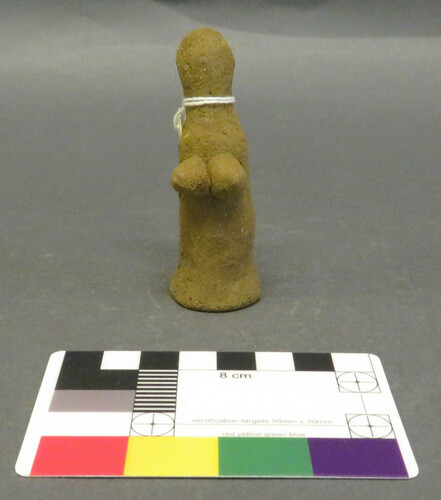 1958.11.2.133Mkaramo clay figure. Cylindrical figure. A slight tapering inwards, defining the difference between the head and body. The figure has no legs. The circular base is slightly flared. There are two prominent, triangular projections representing breasts or arms. No facial details. [BH [OPS Move] 27/4/2017]1958.11.2.133
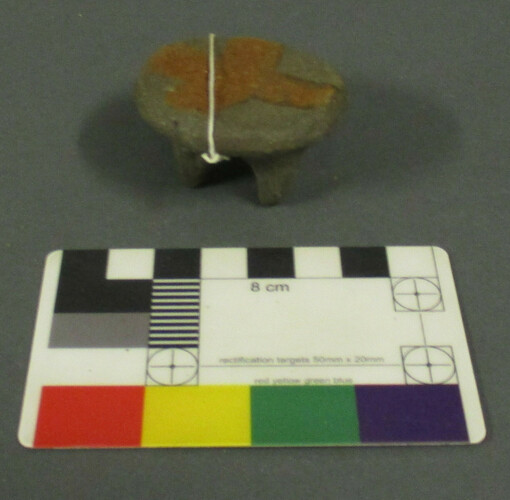 1958.11.2.225Clay Mkaramo figure. Circular disk with three cylindrical protrusions extending from the bottom, possibly representing some sort of tripod. Red pigment cross on the top surface. [BH [OPS Move] 8/5/2017] [BH [OPS Move] 8/5/2017]1958.11.2.225
 1931.86.188Armlet made of trochus shell, also used as currency. [El.B 18/08/2011]1931.86.188
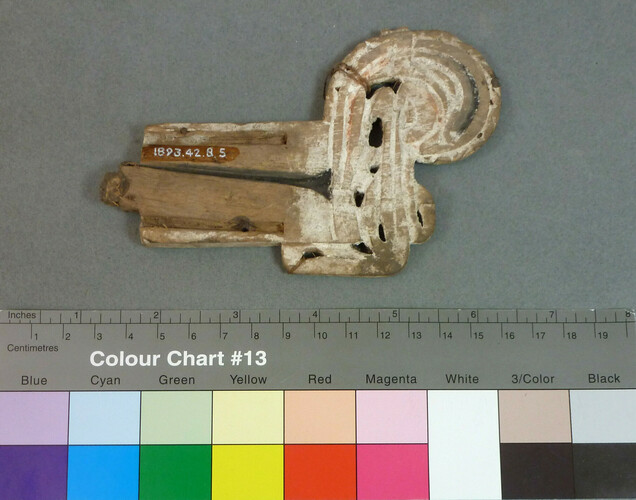 1893.42.8.5Prow ornament for the model canoe 1893.42.8 .1. Made from wood, with an elaborately and decoratively carved design. Coloured with white, black and red pigment. For the other associated records please see 1893.42.8 .1 - .21. [ASh [OPS move] 12/10/2016]1893.42.8.5
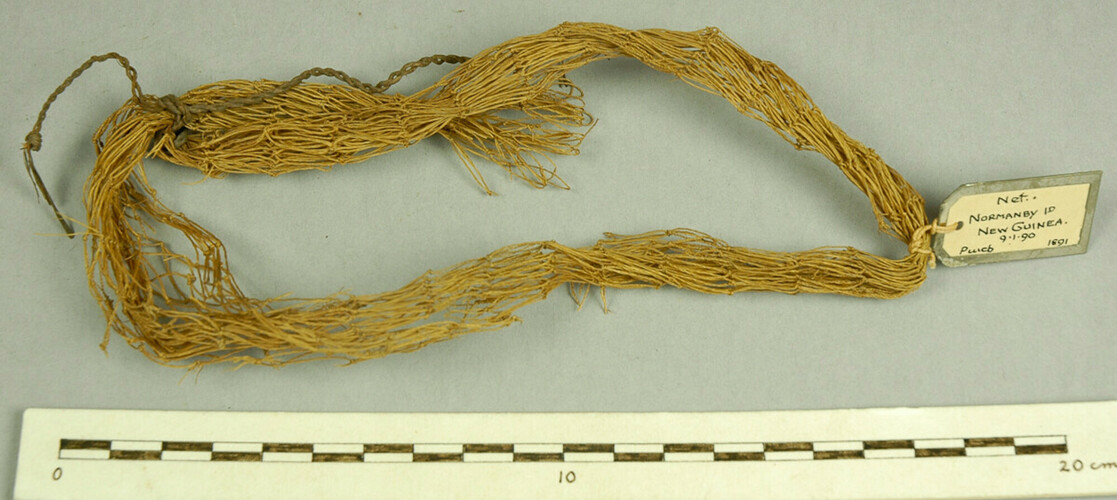 1891.58.10Small fine net. [MJD 15/06/2009]1891.58.10
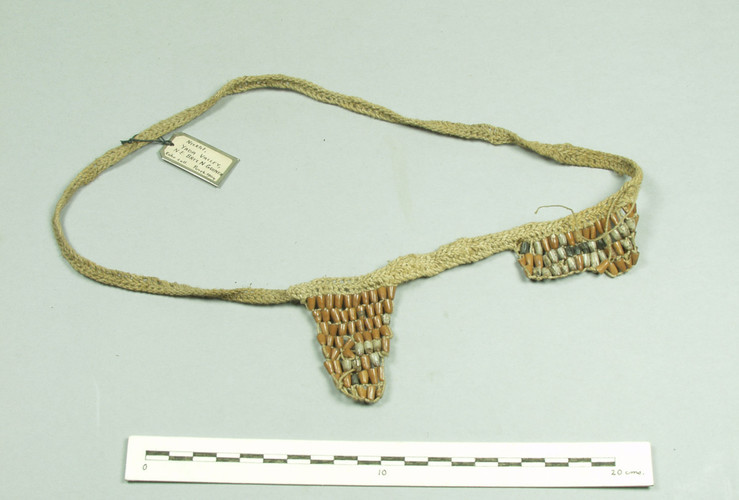 1904.60.207Necklet, unfinished. Stringwork with one and a half triangular pendant flaps of strung brown, white coix seeds and black seeds [EC 'DCF 2004-2006 What's Upstairs?' 26/7/2005]1904.60.207