
- Collection type
- Object
- Description
- Spear with ebony point set into a broken wooden shaft, with the junction covered by a double hide sheath [RTS 26/7/2005]
- Long description
- Spear consisting of a narrow, straight point made from polished dark brown ebony with an oval section (Pantone Black 4C). This joins at its base with a long narrow wooden shaft, slightly irregular in form and more circular in section, tapering in to a flat base and stained a orangey brown colour (Pantone 730C). The junction between these two parts is covered with a brown cylindrical sheath, cut from a section of animal tail with the hair removed (Pantone 7505C). This had been stretched over the body whilst wet and then shrunken in place, obscuring the exact manner by which the spearhead meets the shaft. There are faint lentoid-shaped impressions on the surface, where it has been tooled in rows, now barely visible. The spear is complete, but has been deliberately cut into two parts, mid-way along the shaft, with the two joining parts sheared off at an oblique angle so that they overlap when joined. This was probably done by the collector to facilitate transportation. The spear has a weight of 741.2 grams, and when the two parts are fitted together, a total length of 2210 mm. The visible part of the spearhead is 415 mm long, with a maximum diameter of 31.5 by 29 mm, while the sheath covers a length of 172 mm. The shaft has an upper diameter of 22.5 by 21 mm, and a diameter of 12.8 mm at its base. 1940.12.620.1 has an individual length, as cut, of 1125 mm, while the 1940.12.620.2 has a length of 1152 mm [RTS 26/7/2005].
- Geographical reference
- Person
- Field collector Charles Gabriel Seligman
- Field collector Brenda Zara Seligman
- PRM source Charles Gabriel Seligman
- PRM source Brenda Zara Seligman
- Date / Period
- Date made: Before 1940
- Date collected
- By 1940
- Acquisition information
- Donated: 1940
- Materials and processes
- Material Wood Plant, Material Ebony Wood Plant, Material Animal Hide Skin, Process Carved, Process Polished, Process Stained, Process Covered, Process Decorated, Process Impressed, Process Tooled
- Dimensions
- Length: max 415 mm spearhead, visible, Length: max 2120 mm total, Length: max 1125 mm, Diameter: max 32 mm, Weight 741.2 g
- Object numbers
- Accession number: 1940.12.620.1
- Research and responses
For an essay on the variety and cultural significance of spears in South Sudan, particularly among the Dinka and Nuer, see ‘“Spears” that are not Spears’, by Jok Madut Jok, in Pieces of a Nation: South Sudanese Heritage and Museum Collections, edited by Zoe Cormack and Cherry Leonardi (Leiden: Sidestone Press, 2021), pp. 110–114.
Evans-Pritchard, writing in 1940, said of the Nuer: 'Till recently they possessed very few iron spears, cherished as heirlooms, but used instead the straightened horns of antelope and buck, ebony wood, and the rib-bones of giraffe, all of which are still used to-day, though almost entirely in dances ...’ (E.E. Evans-Pritchard, 1940, The Nuer, p. 86). Howell gives the Nuer term for these spears as giit, while the iron headed spears were known as mur. He states that the giit were regarded 'with considerable amusement' by younger Nuer, but that a few were retained as they were 'considered particularly effective in war, and the Nuer hope they may one day be able to use them ... although it required greater skill and strength to inflict a wound with a giit, the wounds once inflicted are more severe'. He goes on to describe the method of hafting them: 'The giit ... is fixed at the joint with an unsewn leather collar made from the tail skin of an ox. This is soaked and stretched round the haft, where it shrinks as it dries' (P.P. Howell, 1947, "On the Value of Iron Among the Nuer", Man 47, p. 132-3). [RTS 3/3/2004].
Search terms: Weapon, Spear, Spear-head
Further items to explore
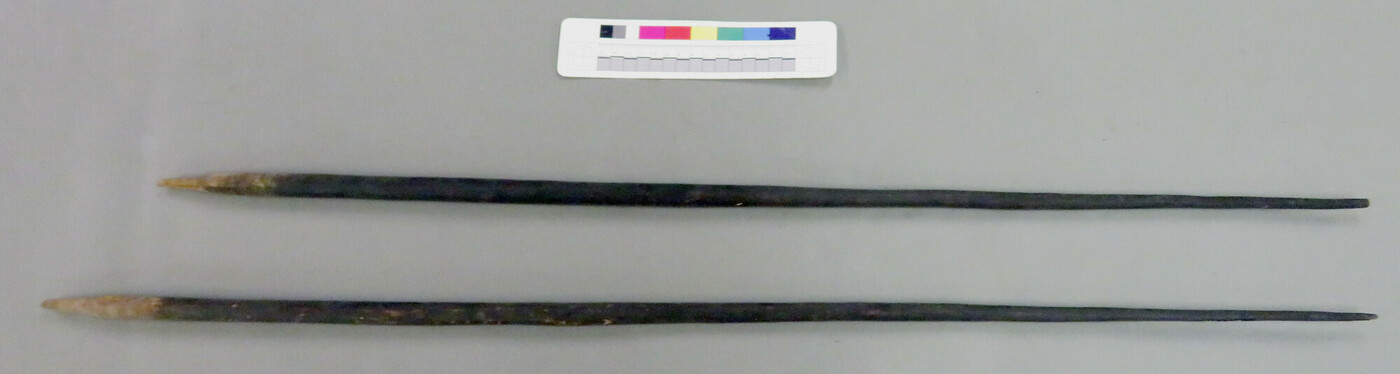 1886.1.1610Dark stained wooden spear with four wooden spear heads which would have been bound to the shaft with sennit. [DV [OPS move] 3/9/2018]1886.1.1610
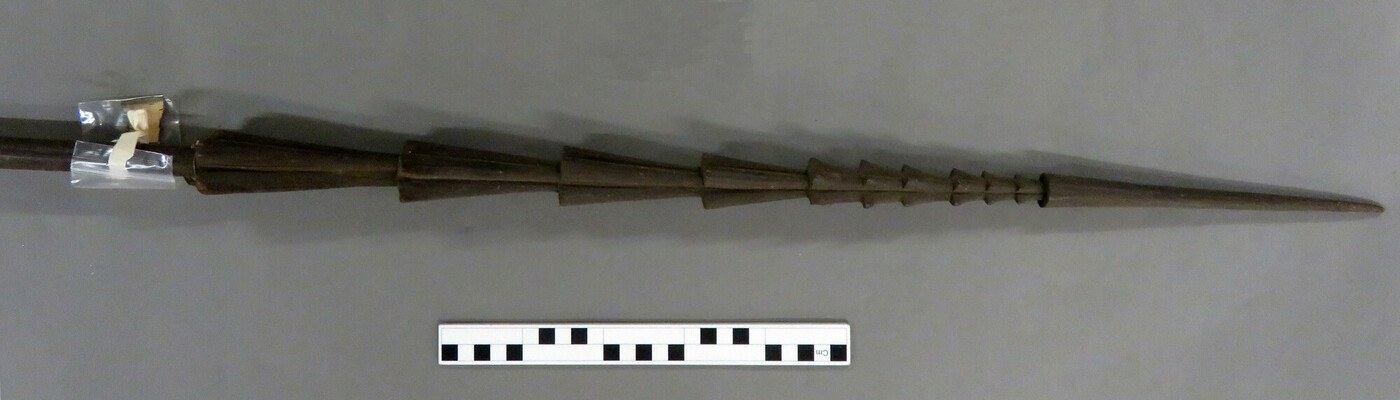 1899.62.664Spear made from wood with muliple carved barbed head the barbs increasing in size [FB 11/10/2018]1899.62.664
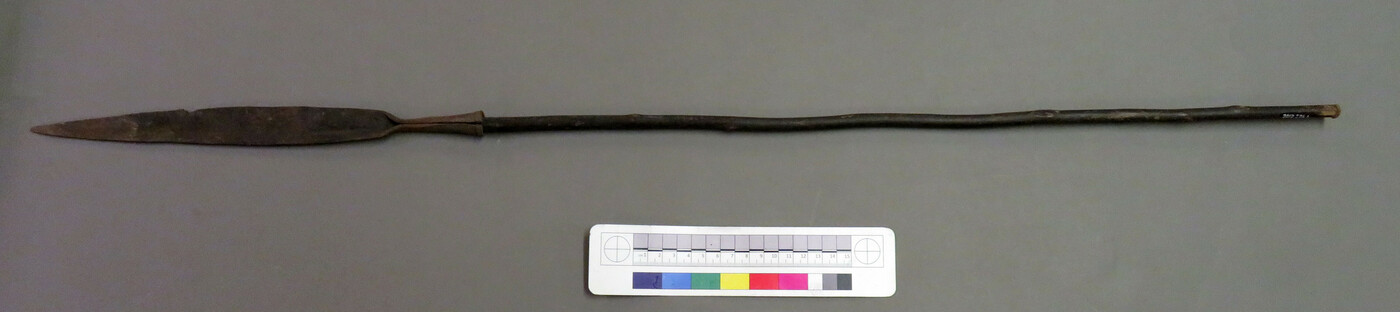 2017.276.1Spear with wooden handle and metal leaf shaped blade. [FB 2/11/2017]2017.276.1
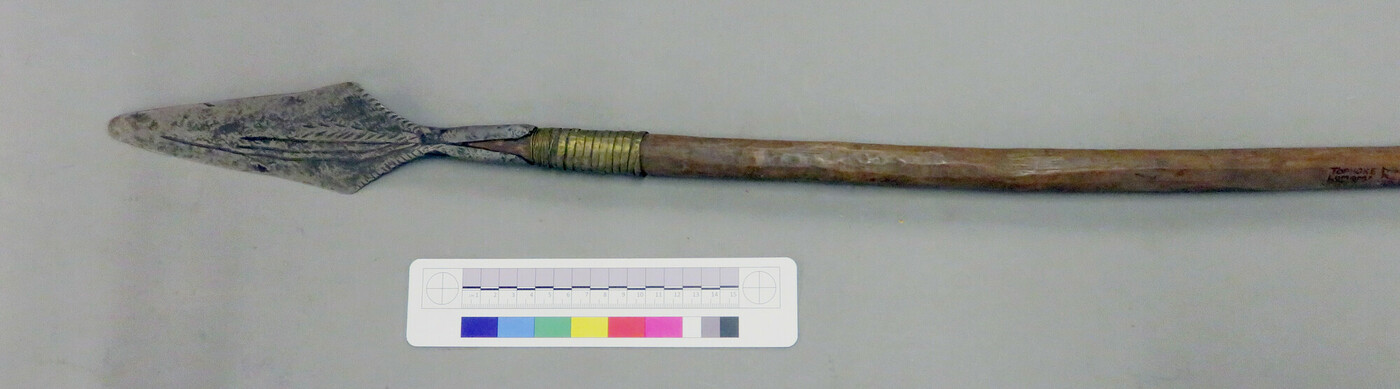 1910.51.1Wooden spear with iron lozenge-shaped blade socketed onto the shaft, with decorative copper wire and ribbon binding, and an iron pointed butt. [AFS [OPS move] 4/7/2018]1910.51.1
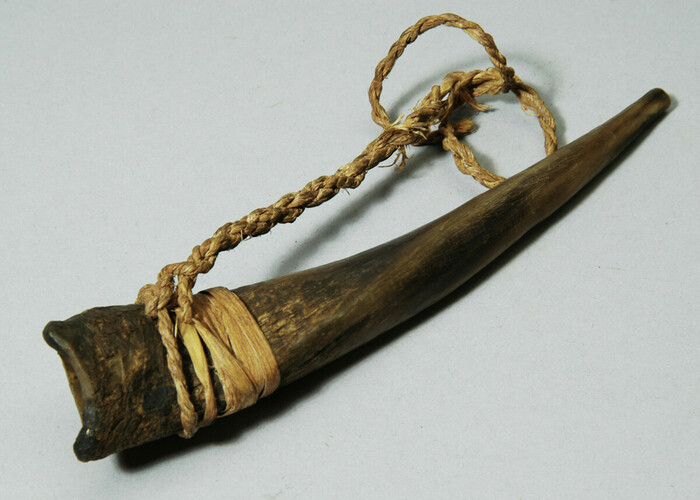 1934.8.96Notched end-blown flute carved from twisted antelope horn, with added resin narrowing the embouchure; wound round with fibre strips tied to a twisted grass cord [RTS 6/12/2004].1934.8.96
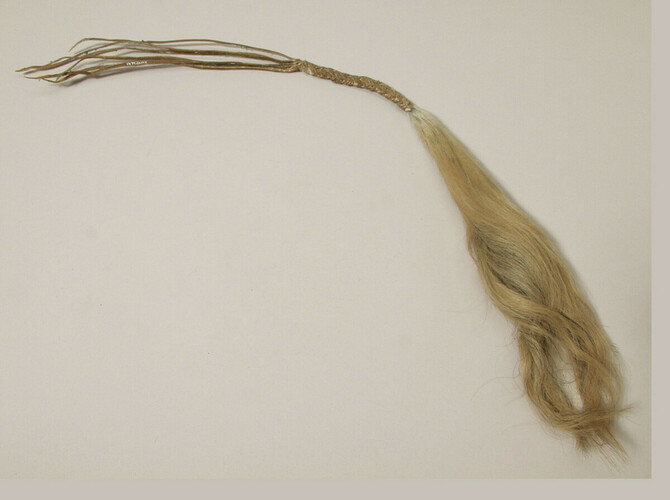 1979.20.145Unfinished upper arm ornament, with plaited hide arm band and tassel made from a cow's tail, worn by men [RTS 13/4/2004].1979.20.145
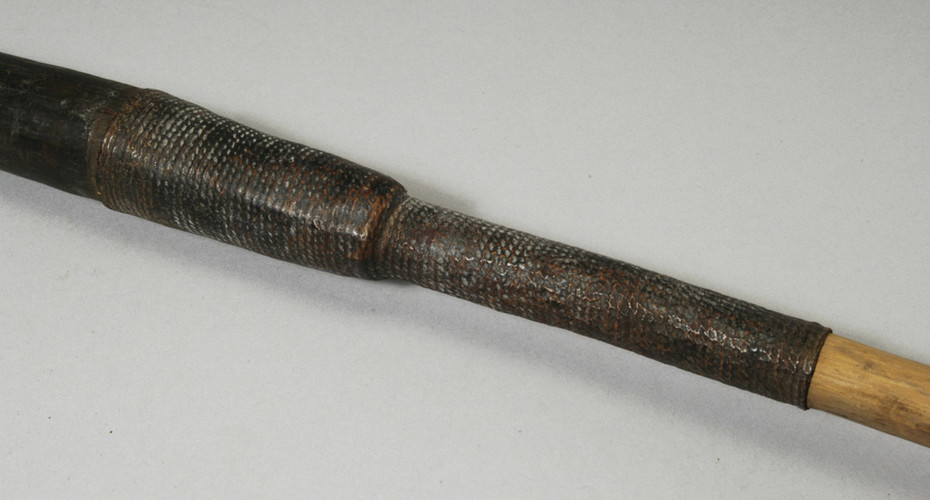 1919.13.18Spear with antelope horn point set into a long wooden shaft, with a tooled hide sheath covering the junction [RTS 5/8/2005].1919.13.18
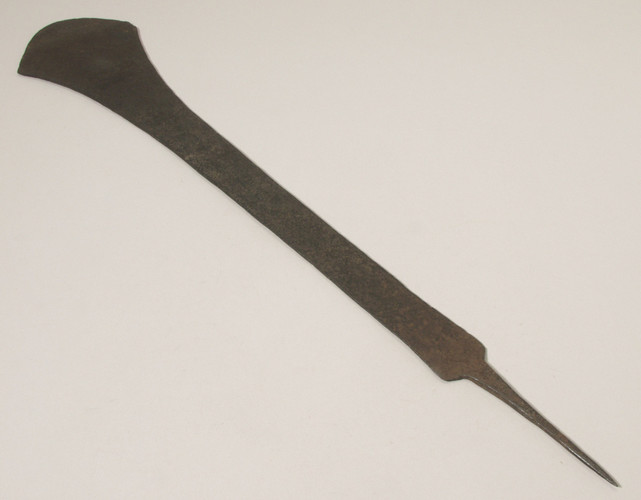 1934.8.131Long iron blade with splayed end and short tang, used as bride money [RTS 16/6/2004].1934.8.131