
- Collection type
- Object
- Description
- Iron throwing knife with iron bound handle and plaited hide carrying loop [RTS 19/2/2004].
- Long description
- Iron throwing knife consisting of a rectangular handle, tapering out slightly from the end, with rectangular section; this is covered with some kind of plant fibre as padding, then bound with four narrow iron bands, the ends of which are pushed down into the fibre or under the neighbouring strips. This forms the handle grip. The metal body or stem, which is an opaque silvery gray in colour, continues as a single piece from the handle tang, but widens slightly, with a slightly triangular section formed by blade sloping down from the flat back edge to the sharpened inner cutting edge. Three additional blades are angled away from this central stem, and were probably separate pieces that were forged into place. One of these projects at an acute angle from the body just above the handle; the outer edges of this blade are bevelled to slope down to a cutting edge on all sides. The join between this blade and the central one is visible on the flat underside. The inside edge is straight, curving around at the tip, then tapering out slightly, till it reaches a rounded projecting spur, with a second, smaller, convex sided spur just below. This second spur (unlike that seen on 1934.8.120) does not have a sharpened edge. A second blade projects at right angles from the end of the central blade; this also tapers to a rounded tip, with the outer edge being concave sided and the inner edge convex; a third, broader blade continues from the end of the central blade, with an angled spur and then a more strongly curved blade, with concave inner and convex outer edges. The upper surfaces of these additional blades are also bevelled down to their cutting edges, which run around all sides. The underside of the knife is flat, with only slight thinning around the edges of the angled blades. A carrying loop is attached to the iron tang just above the handle. This is made from a single cord formed from 8 narrow strips of reddish brown hide (Pantone 4705C), plaited around a central core of some light yellowish brown fibrous plant material; the cord is round in section. This has been doubled over to form a loop on one side, with a knot at its base; the two cord strands are then separated again, with one passing around either side of the tang, then fastened on the other side by thin fibrous strands; there is a similar binding 17 mm further down. The two cords then separate, with a knot at either end and the long strands hanging as a loose fringe below. Length of object 443 mm, length of bound handle area 68.8 mm, width of handle 26.5 mm, thickness of handle 9.9 mm; width of central blade 26.5 mm, thickness of central blade 1.8 mm, length of lower angled blade 213 mm, width of lower angled blade 49.3 mm, length across second and third blades 255 mm, width of second blade 47.5 mm, width of third blade, including spur, 95 mm, and thickness at cutting edges 0.01 mm. Complete and intact. There is damage to some blade edges, with several nicks in it and the ends curled over in some areas; this may indicate that the knife has been used as a weapon. The iron body is an opaque silver gray (Pantone 423C), and in good condition; the handle binding is a darker reddish brown colour, with some surface corrosion [RTS 19/2/2004].
- Geographical reference
- Kordofan Nuba Hills
- Cultural groups
- Zande
- Person
- Field collector Charles Gabriel Seligman
- Field collector Brenda Zara Seligman
- PRM source Charles Gabriel Seligman
- PRM source Brenda Zara Seligman
- Date / Period
- Date made: Before 1940
- Date collected
- By 1940
- Acquisition information
- Donated: 1940
- Materials and processes
- Material Iron Metal, Material Plant Fibre, Material Animal Hide Skin, Process Forged (Metal), Process Hammered, Process Bound, Process Plaited
- Dimensions
- Width 26.5 mm central blade, Width 9.9 mm handle, Length 443 mm
- Object numbers
- Accession number: 1940.12.610
- Research and responses
This object represents the southern type of throwing knife, which is found in northern Gabon, and from eastern Cameroon almost to the White Nile; it was used by the Zande and by groups who fell under their influence, including the Adio, Bongo and Kreish. This specific variety, which corresponds to Westerdijk's type SP VIII.1A, is found in the region inhabited by the Zande and neighbouring groups in the Central African Republic and Democratic Republic of Congo. This is supposedly the form which is known to the Zande as kpinga, although Powell-Cotton’s informants gave it the name sapa (P. Westerdijk 1988, The African Throwing Knife, p. 207-8). The knives could be hung from a disc on the back of the shield (C. Spring, African Arms and Armour, pp 69-70; 79-80). In Petherick's discussions of the Zande, whom he encountered in 1858, they were described as carrying two or three throwing knives at a time in this way (J. Petherick, 1861, Egypt, the Sudan and Central Africa, p. 469). He also describes their use: 'The iron weapon, when employed, is thrown with great force, and in such a manner as to revolve upon its centre when spinning through the air' (J. Petherick, 1861, 'On the arms of the Arab and Negro Tribes of Central Africa bordering on the White Nile', Journal of the Royal United Services Institution IV no. 13, p. 176).
The shape of this object is very close to that of 1934.8.120, from Yambio [RTS 19/2/2004].
Search terms: Weapon, Throwing Knife
Further items to explore
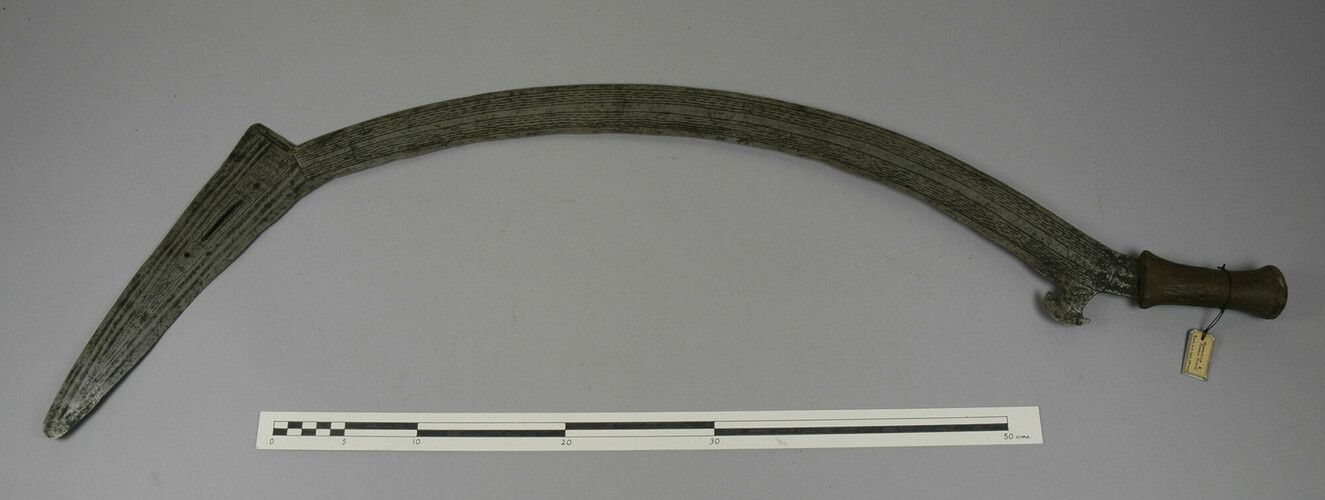 1909.65.7Long curved throwing knife/sword with wooden hilt. The blade has a concave edge, decorated near the tip with incised lines. [SM 04/06/2007]1909.65.7
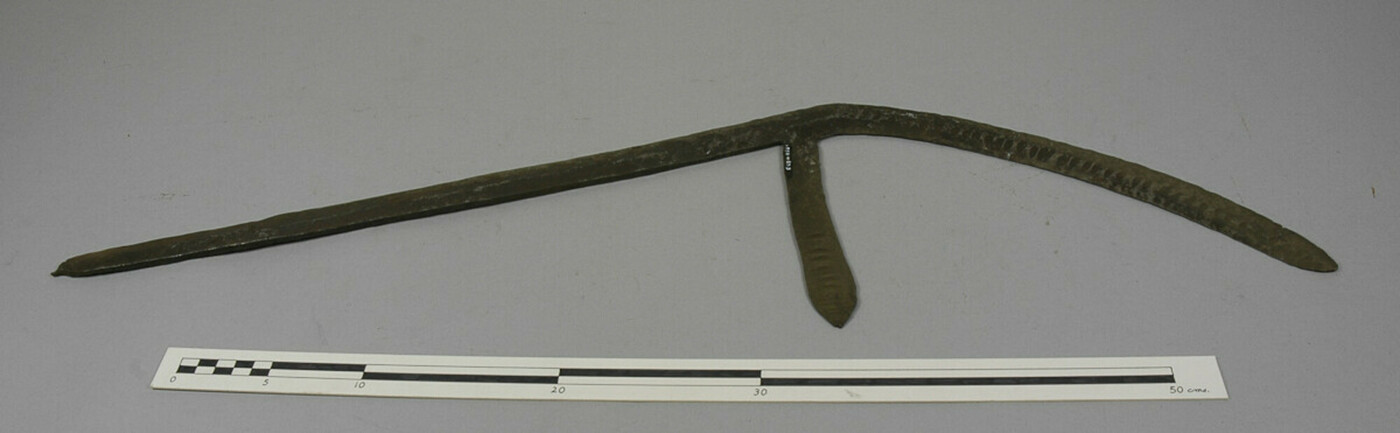 1950.4.87.3Iron throwing knife with long straight handle, curving blade and a spike projecting at right angles. [in sheath .4 with two other knives .1+.2] [El.B 6/6/2007]1950.4.87.3
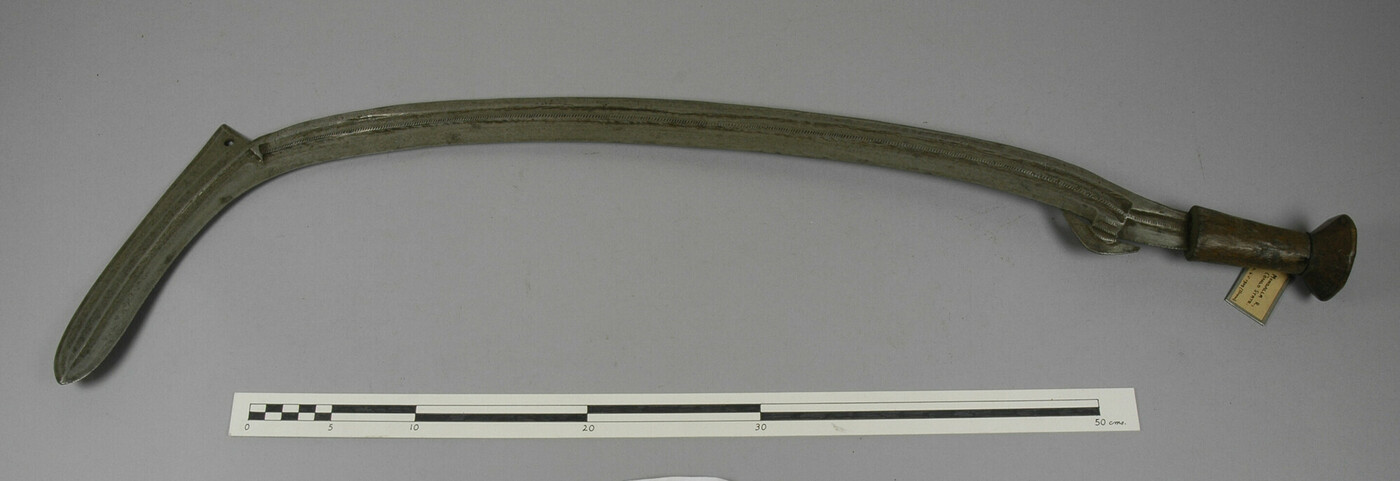 1909.65.8Long curved sword/throwing knife with wooden hilt and expanded butt. The blade has a concave edge. [SM 26/04/2007]1909.65.8
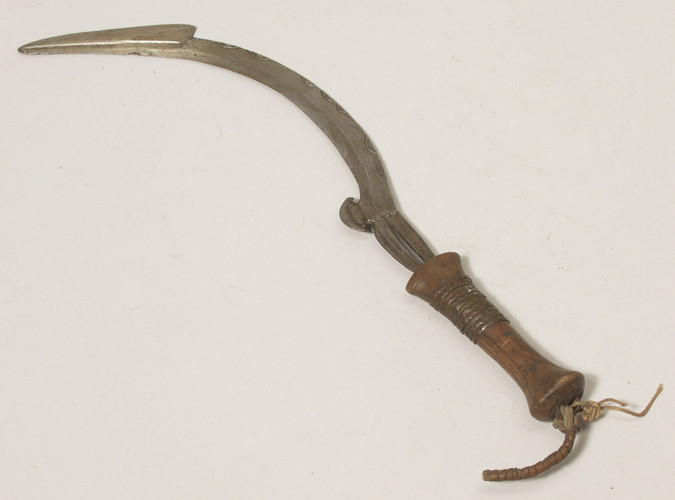 1899.85.1Model of a knife with curved iron blade and a projecting spur at its base, set in a wooden handle bound with copper strips [RTS 31/8/2004].1899.85.1
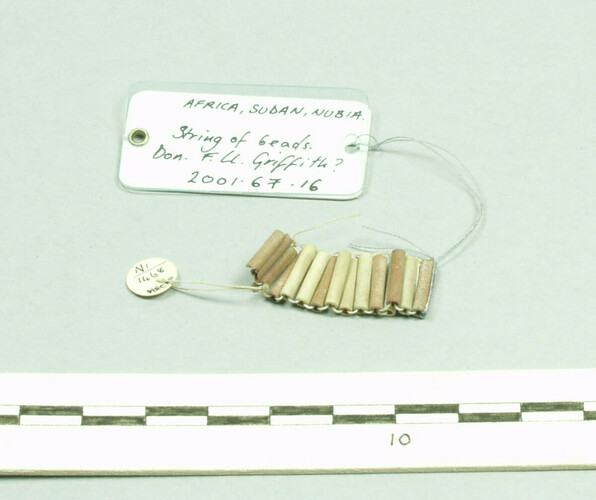 2001.67.16String of tubular faience beads. [El.B 'DCF 2004-2006 What's Upstairs?' 28/6/2005]2001.67.16
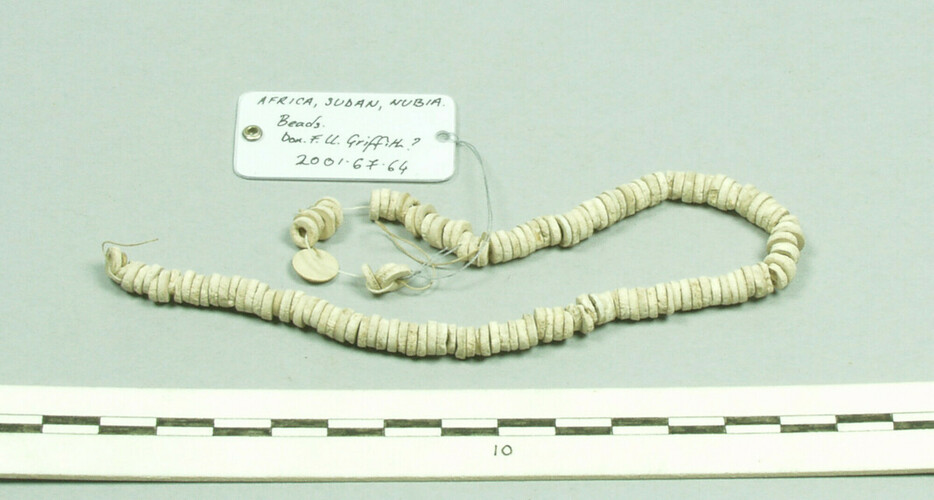 2001.67.64String of faience disc beads. [El.B 'DCF 2004-2006 What's Upstairs?' 1/7/2005]2001.67.64
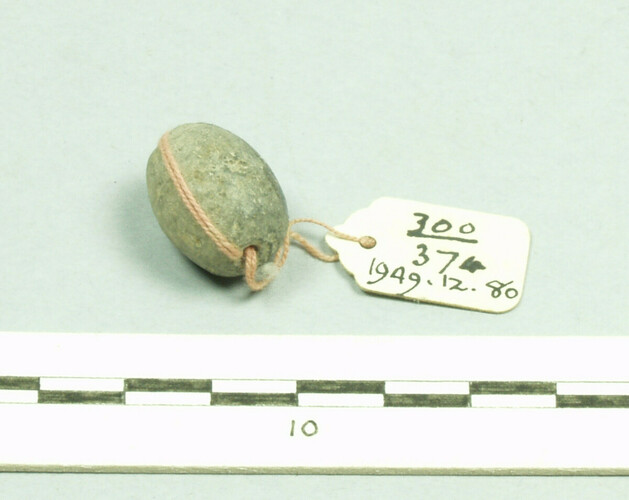 1949.12.80.6Large clay bead of globular to cylindrical shape. [N.B. 'DCF 2004-2006 What's Upstairs?' 1/7/2005]1949.12.80.6
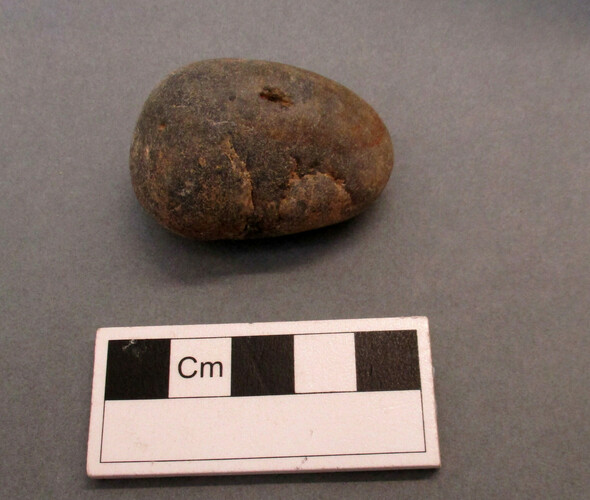 1985.54.809Amulet. Grey stone with orange stains, ovoid in shape. [PR [OPS] 09/03/2017]1985.54.809