
- Collection type
- Object
- Description
- Chain mail jacket comprising riveted links. [MOBB [OPS move] 1/8/2017]
- Long description
- Please note, this object was found with the connections under the arm disconnected, and so the hole normally found in this area is larger than average. [DCF Court Team 11/2/2004]
- Geographical reference
- Date / Period
- Date made: Before 1909
- Date collected
- By 1909
- Acquisition information
- Purchased: 1909
- Dimensions
- Length: max 605 mm, Depth: max 15 mm, Width: max 1400 mm
- Object numbers
- Accession number: 1909.78.20 Other numbers: 309
- Research and responses
There is a strong stylistic unity between the armours of Western and Southern Asia, arising as a result of historical events over the last 1,000 years. From the twelfth century onwards, the Persians and other Central Asian peoples had been supplying armour to the Indians, Turks and Saracens. Prior to the late eighteenth century, every major Persian city was a centre of arms production, but the cities of Khorasan and the Persian capital Isfahan were considered centres of the finest work. Conventionally, Persian armourers undertook their apprenticeship in one of these two great cities, and then travelled as far afield as Egypt, Syria, India or Russia – so sought after was Persian work. It was both the scale and quality of Persian armouries that led to this major influence on Asian armour generally. Consequently, we sometimes speak of Indo-Persian armour, rather than differentiating the two. The earliest documented form of Persian armour was the Joshan or Zirah Baktar, a long mail shirt, opening down the front (unlike the European hauberk, which was pulled on over the head like a tunic or dress), with the chest reinforced by plates of steel. This Zirah Baktar can be seen as the ultimate template for all of the Islamic suits of metallic armour. Simple Persian chainmail was known as Zirah, and was generally linked together using the same technique as that in Europe, known as ‘Four-in-One’, where each riveted ring passed through four others. Persian chainmail was sometimes heavily enhanced to become Zirah Korta Saktou – polychrome mail, incorporating patterns of rings made from gold, copper, or more commonly brass, interspersed with the conventional riveted steel rings. These patterns could make stripes, chevrons, zigzags, diamonds, even inscriptions in Arabic. In India, the same polychrome mail technique was known as Ganga-Jamni, in an allusion to the confluence of the milky Ganges and clear, dark Jamna rivers. Throughout most of the Early Modern period, Islam was ruled by three empires concurrently: In the west, the Ottomans, in Central Asia, the Safavid Persians, and in the east, the Moguls. One of the central early cultural achievements of the Safavid empire in the 16th century was the reconciliation of two major strands of Islamic religious culture: Sufism - the mystical branch of Islam - and Shi‘ia - the traditional veneration of ideal, heroic individuals, who exhibited the qualities of nobility, self-sacrifice, piety, purity of character and generosity to their enemies in victory or defeat. This is conventionally termed the Sufi-Shi‘i Complex, and underpinned the Safavid Persian concept of chivalrous warfare. This in turn influenced the Mogul attitude to war. The chivalrous warfare espoused by Sufism had informed Moorish warfare in North Africa long before, which had in turn passed through Spain into wider European culture during the Medieval period. Both the Persian and Mogul armies were organised on a decimal system; for every 100 horsemen, there was a centurion officer termed Sipah Salar, for every ten Sipah Salar, there was an Amir, commanding a thousand horses; for every ten Amir, there was a Malik, commanding ten thousand horses. The Malik answered directly to the emperor. Relevant Reading: Egerton of Tatton, Lord (1896) Indian & Oriental Armour. London: Arms & Armour Press. Robinson, H.R. (1967) Oriental Armour. London: Herbert & Jenkins. Wenner, M.W. (1980) The Arab/Muslim Presence in Medieval Central Europe. In: International Journal of Middle East Studies, Vol.12, No.1, pp.59-79. Alexander, D.G. (1983) Two Aspects of Islamic Arms & Armour. In: Metropolitan Museum Journal, Vol.18, pp.97-109. Grancsay, S.V. (1986) Arms & Armour. New York: The Metropolitan Museum of Art. Tirri, A.C. (2003) Islamic Weapons: Maghrib to Moghul. Fort Lauderdale, FL: Indigo Publishing. Schimmel, A. (2004) The Empire of the Great Mughals: History, Art & Culture. London: Reaktion Books Ltd. Research Conducted for DCF Cutting Edge Project 2006/2007 [AM]
Parker's full first name came from the 1901 census where he is listed as William H. Parker aged 37 born in Oxford and living in St Ebbes, a dealer in antiques [Alison Petch [as part of 'The Other Within' project 2006-9] 20/02/2007]
Search terms: Armour Weapon, Clothing, Armour, Jacket
Further items to explore
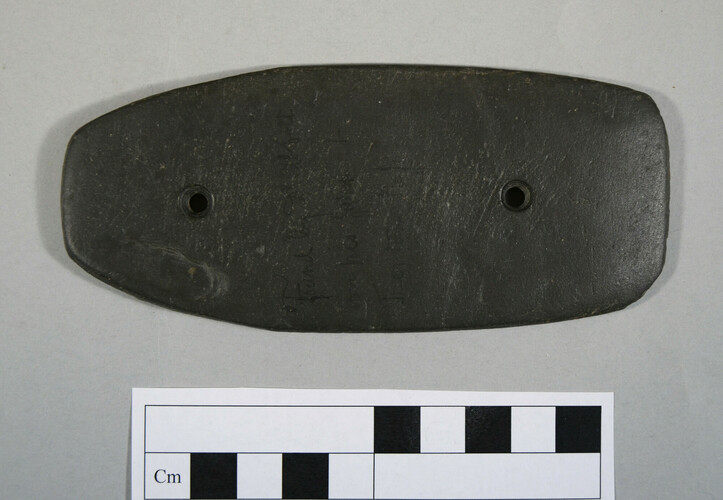 1917.53.149Flat oval piece of dark grey stone with two drilled holes, gorget or bracer. [MJD 14/03/2014]1917.53.149
 1892.4.2.2Sheath for knife [1892.4.2 .1], made of a shoulder-blade bone and a piece of wood, attached to a chest guard of lacquered leather [1892.4.2 .3] [SM 02/07/2007]1892.4.2.2
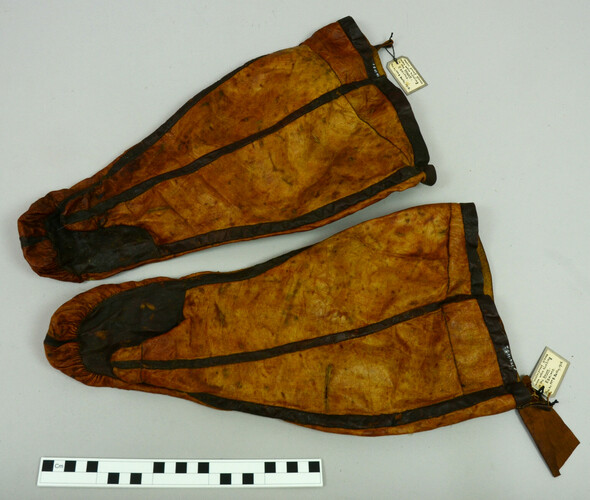 1916.35.5.1Pair of gauntlets, made of dark and light coloured seal-skin, right [.1] and left [.2]. [N.B. 'DCF 2004-2006 What's Upstairs?' 31/3/2005]1916.35.5.1
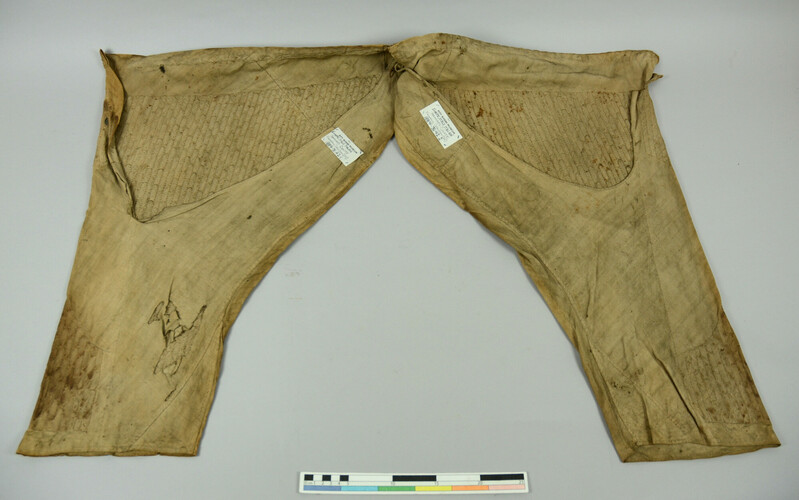 1884.31.42Armoured culottes, consisting of two pieces of grey canvas with small oblong pieces of iron quilted in lines between them. [MOBB [OPS move] 30/8/2017]1884.31.42
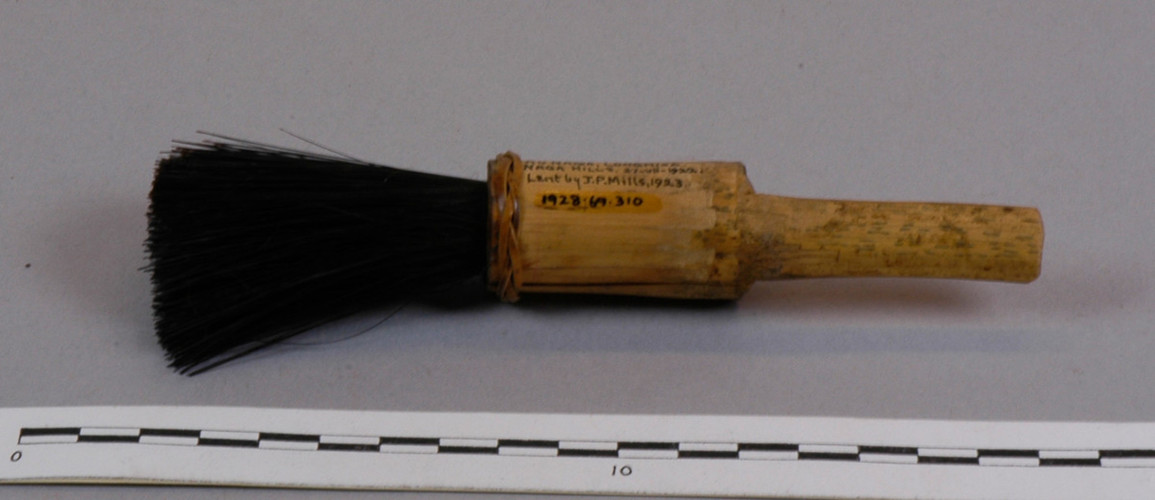 1928.69.310Brush made of pig's bristles set in bamboo handle with a long 'tongue'. Handle bound with plaited cane. [El.B 29/02/2008]1928.69.310
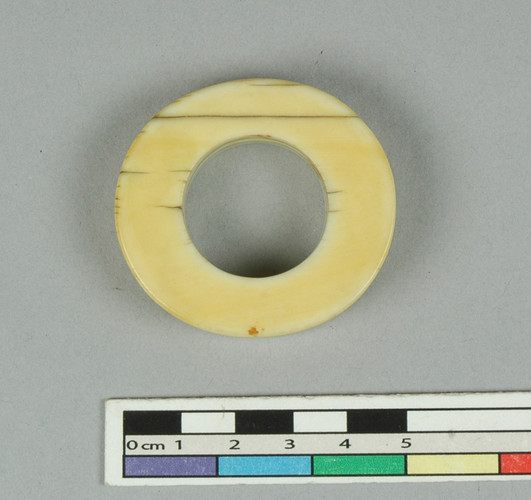 1922.20.7Ivory ring worn as ear ornament. [El.B DDF Body Arts Project 2010/2011 01/11/2010]1922.20.7
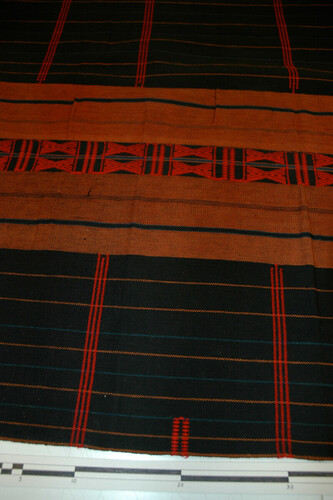 1946.7.65Black cloth, red and blue lines and central black band with design worked in red wool. [FC 4/2/2010]1946.7.65
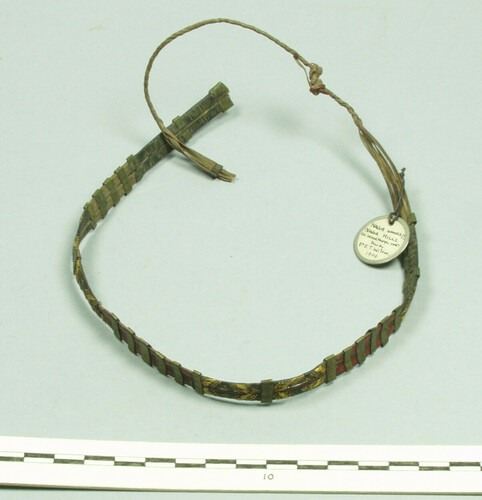 1909.21.96Ornament comprising three strips of red-dyed cane held together with bent strips of brass and bound at intervals with fine black cane into which a twill pattern is worked in yellow orchid stem. Plaited cane fastening. [LM 'DCF 2004-2006 What's Upstairs?' 14/11/2005]1909.21.96